
Behind 156 Million Patients, The Lancet Reveals the Realities of Chronic Kidney Disease Prevention and Treatment in China
When many people think of 'kidney disease,' they often imagine dialysis, uremia, or kidney transplants. However, the kidneys are vital organs responsible for filtering metabolic waste, regulating fluid and electrolyte balance, and maintaining internal stability, and their connection to health isn’t limited to the end-stage of disease. In fact, chronic kidney disease (CKD) represents a group of conditions characterized by ongoing damage to core kidney functions, rather than a single abnormal indicator. CKD tends to have long-term, systemic effects on the human body.
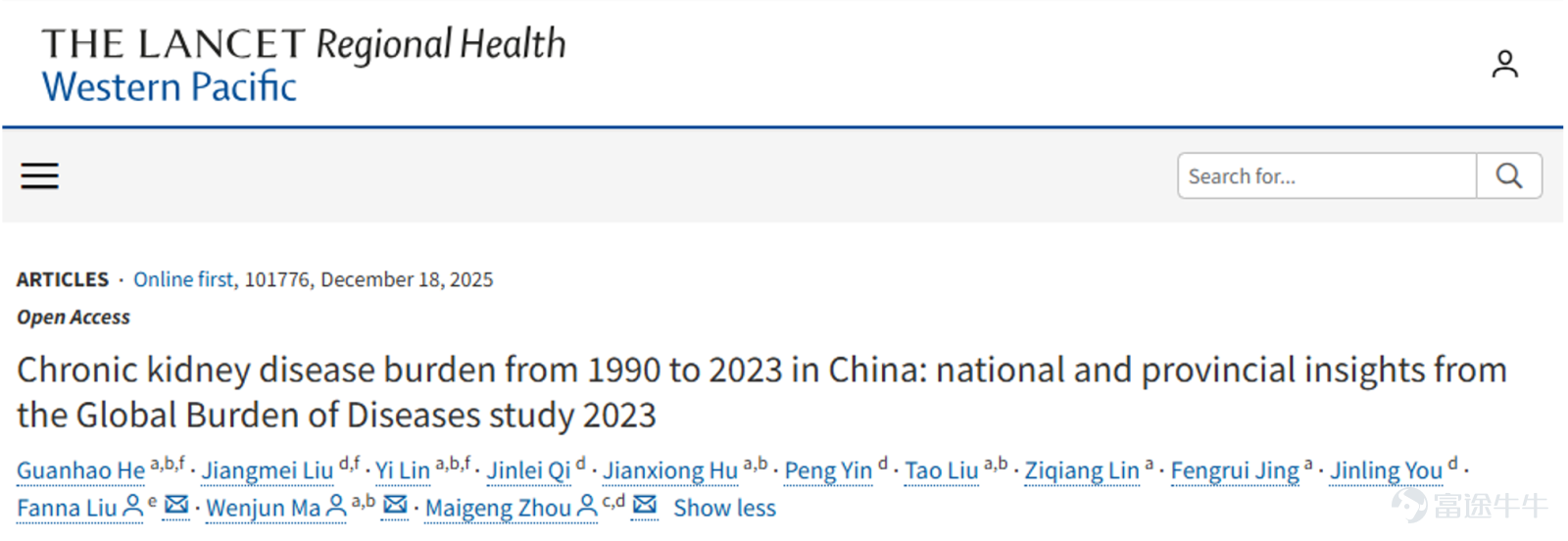
Recently, The Lancet Regional Health published a study titled 'Chronic Kidney Disease Burden from 1990 to 2023 in China: National and Provincial Insights from the Global Burden of Diseases Study 2023.' Based on GBD 2023 data, this research systematically evaluates the trends, mortality burden, and regional disparities of chronic kidney disease in China over the past three decades, providing an authoritative perspective on understanding the current state of CKD prevention and treatment in China.

The True Burden of Chronic Kidney Disease in China
This study, published in The Lancet, integrates demographic data, death registration records, and disease surveillance results from multiple sources in China between 1990 and 2023. It conducts long-term tracking and modeling analysis of CKD prevalence, mortality, and disability-adjusted life years (DALYs).
Unlike epidemiological surveys at a single point in time, this study focuses more on how the disease burden evolves over time and how it is distributed across different provinces, revealing the long-term health impact of CKD accumulation in China.
The study shows that as of 2023, the number of CKD patients in China has exceeded 156 million, ranking first among all countries globally. Even when considering only China's public health perspective, this represents a disease burden that must be addressed; and when assessed globally, the severity of this figure becomes even more impossible to ignore. According to the global epidemiological analysis published by The Lancet in 2025, the total number of CKD patients worldwide in 2023 was approximately 788 million, meaning nearly one-fifth of the world’s CKD patients live in China. Such a highly concentrated patient population places China under far greater health pressure in the CKD field than the global average.

TheLancet Regional Health | Epidemiology of CKD in China

Lancet | Global Epidemiology of CKD
In terms of temporal trends, since 1990, the number of CKD cases and the disease burden in China have continued to rise. Although some age-standardized indicators have stabilized in recent years, the absolute health loss caused by CKD continues to accumulate due to the large population base and accelerating aging. This trend also explains why chronic kidney disease has been included in the key prevention and control scope of the 'Healthy China 2030' plan, becoming an important issue in long-term public health management.
In terms of disease distribution patterns, the prevalence of CKD in China shows significant regional and demographic differences. The study points out that the disease burden is relatively heavier in the western and southern regions of the country, likely due to the prevalence of metabolic diseases, dietary habits, and uneven distribution of medical resources in these areas. At the same time, the intensification of population aging has made those aged 65 and above a "high-risk group" for CKD, with male patients statistically bearing a slightly higher disease burden than females. These multidimensional distribution characteristics further suggest that disease prevention and control strategies must move away from a "one-size-fits-all" model toward more precise regionalized management.
Overall, this GBD 2023-based study provides a comprehensive picture of China's chronic kidney disease spanning over thirty years: the patient population continues to expand, the disease burden keeps accumulating, regional disparities persist, and the underlying drivers are closely related to aging, diabetes, hypertension, and other chronic disease epidemics.
Beyond 'Kidney Protection': Chronic Kidney Disease Treatment Enters a New Phase
Faced with increasingly severe CKD prevention and treatment challenges in China, the medical community and industry have begun to focus on whether innovative therapies capable of intervening earlier and altering disease progression exist. As a chronic condition triggered by multi-dimensional pathological disorders, the onset and progression of CKD are not driven by a single molecular target or physiological pathway abnormality but rather by the combined effects of multiple mechanisms, which are interconnected and mutually causal, forming a complex pathological network. Therefore, in recent years, the development of multi-mechanism drugs has gained increasing attention to seek comprehensive intervention in renal function and systemic risks.
It is against this backdrop that HTD1801, developed based on a dual-mechanism approach, is being explored for its potential benefits in chronic metabolic-related diseases and kidney health. Results from completed Phase III clinical studies suggest that HTD1801 treatment may offer substantial improvement in kidney function for patients with kidney damage. This outcome presents a differentiated characteristic from previous treatment models primarily aimed at "slowing decline."
This kind of exploration suggests that drug development for CKD is attempting to shift from merely slowing progression to reshaping the trajectory of kidney function and even the disease process itself. For a condition with such a prolonged progression, what truly impacts long-term prognosis is often not the ability to intervene once the disease has reached its end stage, but whether it is possible to alter the course of the disease at an earlier stage. How to achieve this goal while ensuring safety and sufficient evidence-based support has become an important direction for ongoing exploration in the field of CKD treatment.
References:
1. He, Guanhao et al, Chronic kidney disease burden from 1990 to 2023 in China: national and provincial insights from the Global Burden of Diseases study 2023, The Lancet Regional Health-Western Pacific, Volume 0, Issue 0, 101776
2. GBD 2023 Chronic Kidney Disease Collaborators. Global, regional, and national burden of chronic kidney disease in adults, 1990-2023, and its attributable risk factors: a systematic analysis for the Global Burden of Disease Study 2023.Lancet. 2025;406(10518):2461-2482. doi:10.1016/S0140-6736(25)01853-7
Risk Disclaimer: The above content only represents the author's view. It does not represent any position or investment advice of Futu. Futu makes no representation or warranty.Read more
Comments
to post a comment
2