
Storage giants launch collective buybacks: Where does the supercycle stand?

[Opportunity Express] The top stock of the 2025 Top Ten Soaring Stocks! What’s behind SanDisk’s magic? How should we view its prospects?
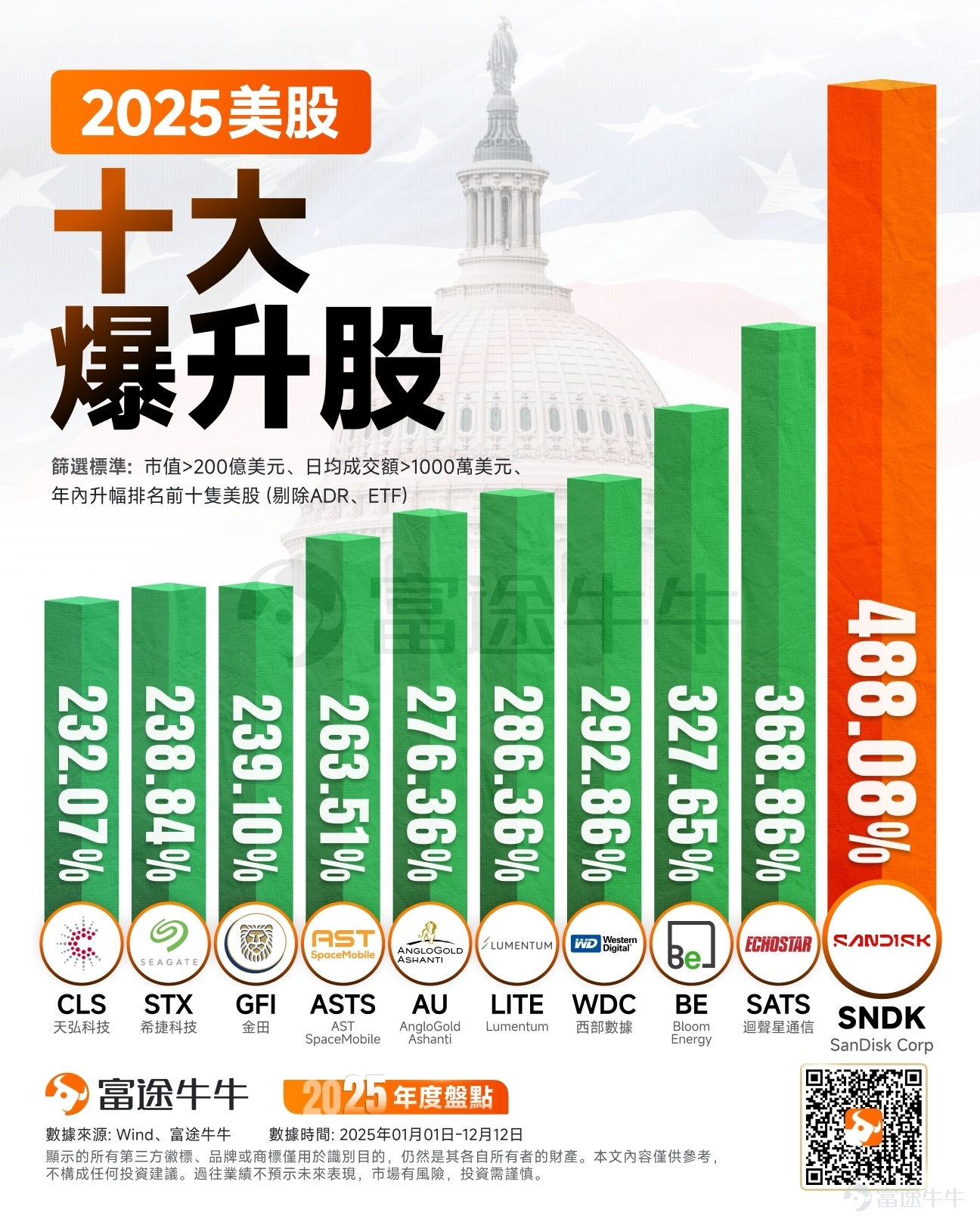
As 2025 comes to an end, NiuNiu has summarized the top ten best-performing U.S. stocks of the year for everyone. Companies from industries such as memory storage, satellite communications, and gold mining made the list, with the memory storage sector standing out in particular, $SanDisk (SNDK.US)$ with one company achieving an astonishing increase of 488.08%, taking the top spot.
What unique strengths does SanDisk have behind its strong stock performance? And how is the AI-driven supercycle in storage evolving? Let’s dive into this week's Opportunity Spotlight.

AI Ignites the Storage 'Supercycle,' From HBM to NAND
As AI expands from training to inference and edge-side applications, it generates unprecedented demand for memory storage. At different stages of AI development, varying segments of the memory industry experience distinct growth drivers.
In the early stages of the AI boom, HBM (High Bandwidth Memory) became the absolute focus, primarily because it met the requirements during the model training phase.Training large AI models requires massive amounts of data to be exchanged at high speed between GPUs and memory. However, the speed of data transmission significantly lags behind computational speeds, creating a 'memory wall' that constrains processing power and becomes a bottleneck in AI development.
The high bandwidth characteristics of HBM make it an essential requirement for training large AI models. The technological barriers for HBM are extremely high, with only a few companies globally—Samsung, SK Hynix ( $CSOP SK Hynix Daily Max (2x) Leveraged Product (07709.HK)$ )、 $Micron Technology (MU.US)$ among them. Particularly, Micron alone accounts for two-thirds of the market share.
However, when large models enter the large-scale inference deployment phase, there is increased sensitivity to cost and efficiency, at which point NAND takes center stage.
Inference in large models requires frequent, high-speed reading of massive model parameters and data, placing higher demands on storage capacity.As model capabilities continue to evolve, token consumption per AI query can reach 7-10 times the previous amount, with multimodal (image, video generation) data further exacerbating capacity requirements.
Simply put, HBM is akin to a computer’s RAM—its capacity may not be the largest, but it operates at extremely high speeds for temporary data storage and exchange during program execution; NAND, on the other hand, is like a computer’s hard drive, offering larger capacity but lacking speed advantages.As the wave of AI continues to evolve, their roles within the industry are also shifting.
From the supply side, to meet explosive demand, major storage manufacturers have allocated most of their new capital expenditures and advanced production capacity to HBM.NAND, due to its inherent characteristics, did not catch the early wave of development in the AI boom. After suffering severe losses in 2022-2023, major manufacturers have become extremely cautious about capital expenditure on NAND, prioritizing profitability over market share expansion.
Statements from several companies indicate that they all emphasize supply discipline and have no aggressive plans for capacity expansion.The shortage of NAND is expected to persist until the end of 2026 and will continue to intensify over the next few quarters.
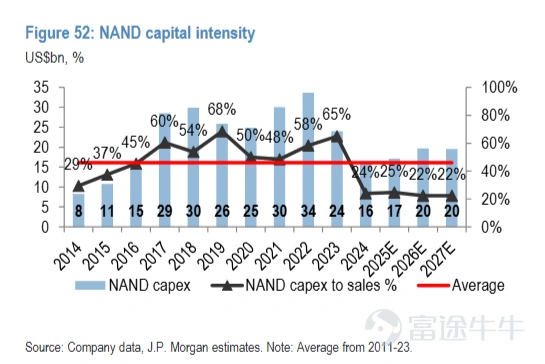
As AI-driven demand systematically advances, the supply side, constrained by resource allocation favoring HBM and disciplined manufacturer behavior, cannot respond quickly enough, pushing the NAND market into a new phase of structural shortages rather than cyclical fluctuations. $SanDisk (SNDK.US)$ In November, NAND contract prices surged significantly by as much as 50%, causing a major shakeup across the entire memory supply chain and prompting numerous module manufacturers to suspend shipments while reassessing their quotations.
SanDisk: Focused on NAND, HBF Strategy Challenges HBM
The company was founded in 1988 and launched its first NAND-based solid-state drive (SSD) in 1991. In 2016, it was acquired by $Western Digital (WDC.US)$ . Western Digital began spinning off SanDisk in 2023, with the formal completion expected by 2025, allowing SanDisk to relist on Nasdaq.
Although SanDisk’s market share in NAND is not particularly high, ranking fifth globally, it is more focused on this segment compared to other companies in the industry. This focus has positioned SanDisk to receive the most attention from investors when the storage industry's spotlight shifts.

Notably, SanDisk maintains a long-term and deep partnership with Kioxia (formerly Toshiba Memory).This collaboration dates back to 2000 when the two companies formed a joint venture. Over the past two decades, despite significant transformations within both companies, their alliance has remained robust.
Both parties jointly develop flash memory technologies, and the joint venture owns and leases wafer production equipment. SanDisk and Kioxia purchase wafers from the joint venture at cost plus a small premium and jointly fund the procurement of their equipment.
After years of turbulence, Kioxia went public on the Tokyo Stock Exchange at the end of 2024,with its US ADR $KIOXIA HOLDINGS CORPORATION UNSPON ADR EACH REP 0.1 COM (KXIAY.US)$Trading began in early October this year, and within a short period, it achieved remarkable gains. However, it is important to note that the current trading volume remains relatively low.

Data source: SanDisk
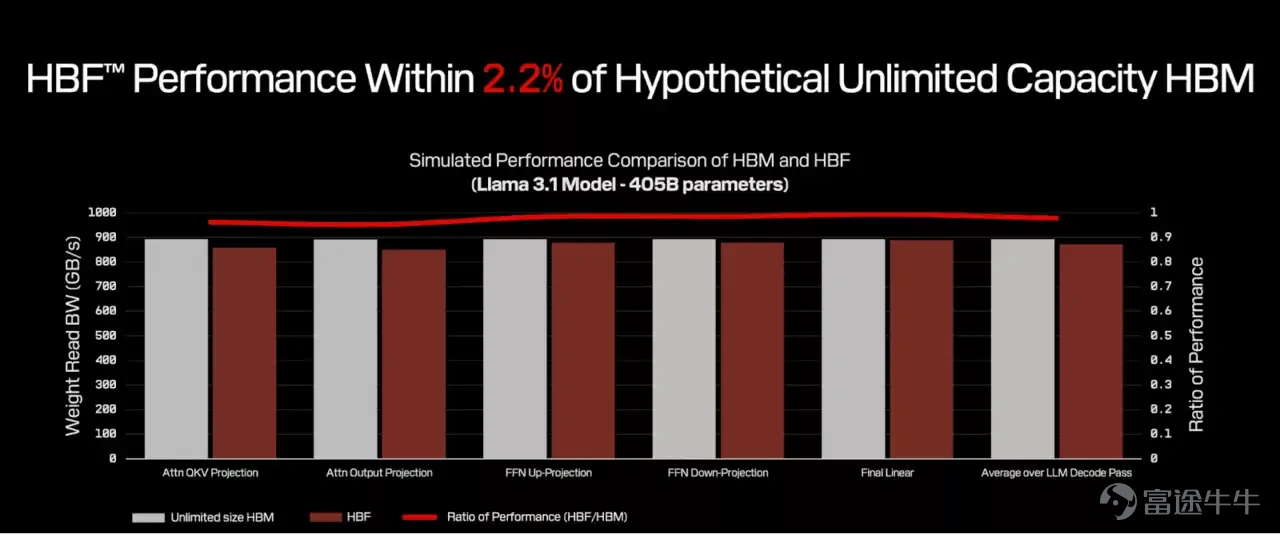
SanDisk announced significant progress this year in its HBF (High Bandwidth Flash) technology, which the company has been aggressively developing over the past two years. If successfully implemented, this technology could potentially challenge HBM's dominance in large-scale model training applications.
Data source: SanDisk
The core concept of this technology is to divide NAND flash memory chips into multiple arrays that can be accessed in parallel, combined with advanced packaging techniques,achieving bandwidth comparable to HBM while providing 8 to 16 times the storage capacity of HBM at a similar cost.
Although the technology has yet to be applied, it offers tremendous potential for SanDisk. According to plans, HBF module samples are expected to ship in the second half of 2026, and the first AI inference servers equipped with HBF are anticipated to launch in early 2027.
Profitability inflection point, optimistic guidance
Q1 of fiscal year 2026 (September quarter of 2025) $SanDisk (SNDK.US)$ Revenue reached USD 2.308 billion, representing a 21% increase quarter-over-quarter, driven by both higher volumes and prices of the company’s products. Non-GAAP net earnings per share amounted to USD 1.22, marking a substantial 321% increase from the previous quarter. Gross margin stood at 29.9%, an improvement of 3.5 percentage points quarter-over-quarter. The company achieved its goal of positive net cash approximately six months ahead of schedule, with a net cash position of USD 91 million at the end of the quarter.
Even more striking is the company's guidance, which directly raised the gross margin forecast for the December quarter to over 40% (an increase of more than 10 percentage points quarter-over-quarter), with operating margins set to enter the mid-20% range. The midpoint of the earnings per share guidance (USD 3.20) is approximately 75% higher than market consensus.This marks a transition in its profitability from past cyclical volatility to a new and higher earnings platform.
The company’s PE TTM remains negative, but this is mainly due to significant goodwill impairment charges (USD 1.83 billion) recorded during the early stages of its listing and restructuring and transition costs incurred during the spin-off from Western Digital.Current market estimates for SanDisk’s 2026 full-year earnings per share stand at around USD 20, implying a forward PE ratio for next year of just over 10 times.
SanDisk’s recent financial performance has been exceptional, marking a golden phase characterized by simultaneous increases in volume and price, rapid margin expansion, and strong confidence from management regarding sustained future growth. Its robust financial health provides a solid foundation for future investments and shareholder returns.The trends of revenue growth and margin improvement are also consistent with other memory manufacturers, confirming the industry’s extremely high level of prosperity.
It should be noted that, with the stock price having already risen significantly, market expectations are now very high, and any minor fluctuations could result in sensitive reactions in the stock price.
Furthermore, if the competitive landscape of the industry shifts, such as Micron or Samsung reallocating resources away from HBM and aggressively expanding production in the NAND sector, SanDisk’s high margins may not be sustainable.
Since September this year, the NiuNiu Classroom has been closely monitoring significant changes occurring within the memory sector. Fellow investors who are interested can visit to deepen their understanding of the overall industry.We also welcome everyone to follow the official account of the NiuNiu Classroom to stay updated with the latest investment knowledge~
Technical Analysis
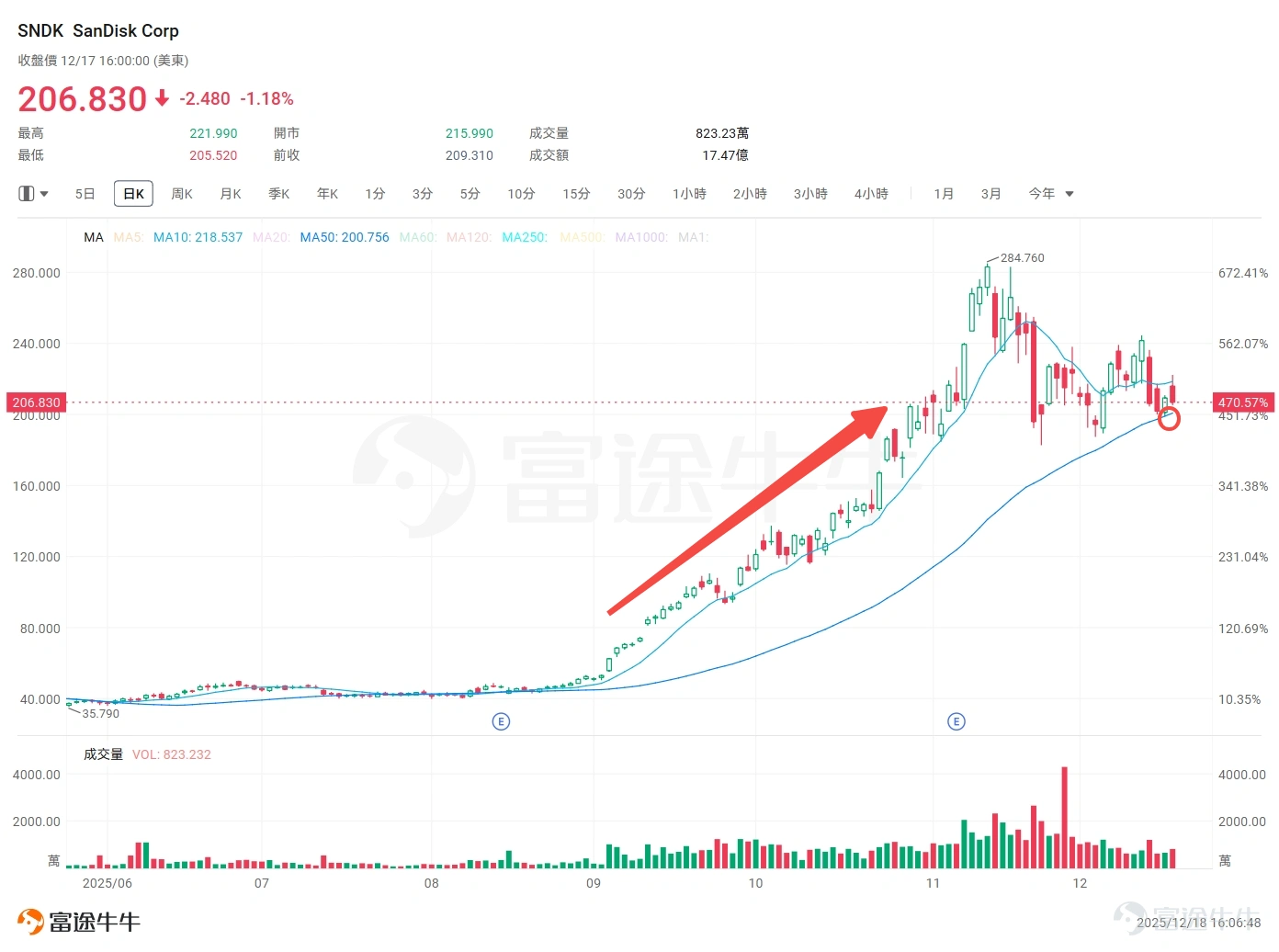
Since its listing in February 2025, SanDisk's stock initially performed modestly. However, it began a strong upward trend starting in early September, primarily supported by the MA10 line, with brief breakdowns typically recovering quickly.
Starting in November, influenced by the "AI bubble theory" and controversies over the Fed’s interest rate cuts, the company's stock experienced a round of corrections, finding support at the MA50 level.In after-hours trading on the U.S. stock market yesterday (December 17), Micron Technology reported better-than-expected earnings and guidance for the latest quarter, surging over 9% after hours and driving the overall storage sector higher.
As of press time, SanDisk's overnight session rose more than 5%. If the rebound continues, further attention should be paid to whether it can sustain above the MA10 level.
Risk Disclosure: This content does not constitute a research report and is for reference only. It is not intended as a basis for any investment decision. The information provided herein does not comprehensively describe the securities, markets, or developments mentioned. While the sources of information are considered reliable, no guarantee is made regarding the accuracy or completeness of the content above. Additionally, no assurance is given regarding the accuracy of any statements, opinions, or forecasts provided herein.
Risk Disclaimer: The above content only represents the author's view. It does not represent any position or investment advice of Futu. Futu makes no representation or warranty.Read more


Comments (256)
to post a comment
460
143