
Options Square: Storage stocks keep surging! Is UBS Group offering a double-up price?

Options Trading Strategy | A Year-End 'Volatility Feast' in U.S. Stocks Approaches! How to Navigate the Final Triple Witching Day of the Year?
This article comes from the 'Options Market Insights' column, which aims to position itself at the forefront of investment trends, providing readers with insights into market opportunities and teaching them how to seize these opportunities using options. If you are interested, feel free to subscribe.Click hereUpon joining the learning platform, you will receive notifications when subsequent columns are updated.
This Friday (December 19th), marks the final 'Triple Witching Day' of 2025, a day traditionally known for both volatility and opportunity.
Therefore, the following will delve into an explanation of 'Triple Witching Day,' covering everything from basic concepts to hot-topic analysis, as well as actionable strategies to help you understand how to seize the opportunities it presents.
What exactly is Triple Witching Day, and what patterns does it exhibit?
Triple Witching Day is essentially the quarterly derivatives expiration day in the U.S. stock market, occurring on the third Friday of March, June, September, and December each year.On this day, three types of quarterly contracts—index futures, index options, and stock options—all expire simultaneously.
You may have heard of 'Quadruple Witching Day,' which refers to the same event. Previously, there was also single-stock futures, making it 'Quadruple.' However, after the closure of OneChicago exchange in September 2020, single-stock futures ceased trading, leaving only the 'Triple.'
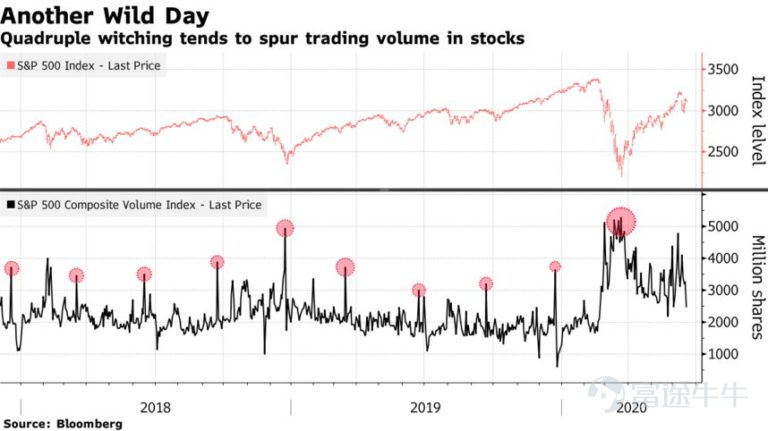
How will the market behave on this day? All contracts must be exercised, closed, or rolled over before the market closes, leading to a significant spike in trading volume, rapid capital flows, and heightened price volatility. Particularly in the last hour before the close, it is usually the most volatile and highest-volume trading period of the day.
![This article comes from the 'Options Market Insights' column, which aims to position itself at the forefront of investment trends, providing readers with insights into market opportunities and teaching them how to seize these opportunities using options. If you are interested, feel free to subscribe.[Share Link: Click here]Upon joining the learning platform, you will receive notifications when subsequent columns are updated. This Friday (December 19), marks the final 'Triple Witching Day' of 2025, a day traditionally known for both volatility and opportunity. Below, we will delve into what 'Triple Witching Day' entails, from foundational explanations to analysis of current trends and practical strategies, providing a comprehensive guide on how to seize potential opportunities. What exactly is 'Triple Witching Day'? What patterns does it follow? Triple Witching Day refers to the quarterly expiration date for derivatives in the U.S. stock market, occurring on the third Friday of March, June, September, and December each year.On this day, three types of quarterly contracts—stock index futures, stock index options, and stock options—all expire simultaneously. You may have heard of 'Quadruple Witching Day,' which refers to the same event. Previously, it included single-stock futures as an additional quarterly contract, hence the term 'Quadruple.' After OneChicago Exchange ceased operations in September 2020, single-stock futures were no longer traded, leaving only three types of contracts, thus becoming 'Triple Witching.' What typically happens in the market on this day? All contracts must be exercised, closed, or rolled over before the market closes, leading to a significant increase in trading volume within a short period, rapid fund flows, and price...](https://nnqimage.futunn.com/sns_client_feed/999908/20251218/web-1766043761668-pDwDaHGY3E.png/big?area=2&is_public=true&imageMogr2/ignore-error/1/format/webp)
(The chart below shows the closing prices and trading volume changes of the S&P 500 Index from 2018 to 2020, with red dots on the volume curve representing performance on Triple Witching Days.)
Does this mean the market is more likely to rise or fall? In fact, Triple Witching Day itself does not determine market direction. While volatility tends to be higher, the direction remains uncertain. If market sentiment is optimistic, volatility will push prices upward; if concerns prevail, volatility will drive prices downward. ThereforeThe risk on triple witching days does not necessarily lie in a market decline, but rather in volatility that exceeds expectations, especially when compounded by other market events, which can amplify fluctuations.
However, there may be some unique phenomena, such as:
One isthe price of the underlying asset may be pulled toward the strike price with the highest concentration of open interest, fluctuating near that strike price.。
This presupposes that the overall gamma of the options portfolio held by market makers is positive. Gamma represents the rate of change of delta, while delta indicates how much the option price will change for every one-unit move in the stock price. When gamma is positive, a rise in stock prices increases the market maker's delta, and a fall in stock prices decreases their delta.
Market makers aim to maintain a delta-neutral position to manage risk. To achieve this, they must execute offsetting hedging operations: selling stocks when prices rise to counteract increasing delta, and buying stocks when prices fall to offset decreasing delta. This high-selling, low-buying behavior tends to dampen market volatility, creating what is known as the "pinning effect."
Of course,However, if market makers are in a negative gamma position, their hedging activities no longer serve as stabilizers but instead act as amplifiers, exacerbating volatility and potentially leading to sharp rallies or crashes.
Another ismarket volatility may intensify in the week following triple witching day.This occurs because the hedging activities of market makers may temporarily stabilize prices, but once this "short-term stabilizer" is removed, the market becomes more vulnerable. Additionally, after investors settle expiring contracts, large-scale repositioning in varying directions may trigger new price fluctuations.
However, there is no need to be overly concerned.The impact of the triple witching day today may not be as strong as it was more than two decades ago.At that time, futures/options contracts were only quarterly, and all market pressures were concentrated on a single day, occasionally causing significant volatility. However, exchanges have since introduced monthly, weekly, and even daily expirations for various options, effectively dispersing what was once concentrated risk.
For specific changes, you can refer to the statistical data calculated by Futubull AI regarding the performance of triple witching days over the past 20 years:
![This article comes from the 'Options Market Insights' column, which aims to position itself at the forefront of investment trends, providing readers with insights into market opportunities and teaching them how to seize these opportunities using options. If you are interested, feel free to subscribe.[Share Link: Click here]Upon joining the learning platform, you will receive notifications when subsequent columns are updated. This Friday (December 19), marks the final 'Triple Witching Day' of 2025, a day traditionally known for both volatility and opportunity. Below, we will delve into what 'Triple Witching Day' entails, from foundational explanations to analysis of current trends and practical strategies, providing a comprehensive guide on how to seize potential opportunities. What exactly is 'Triple Witching Day'? What patterns does it follow? Triple Witching Day refers to the quarterly expiration date for derivatives in the U.S. stock market, occurring on the third Friday of March, June, September, and December each year.On this day, three types of quarterly contracts—stock index futures, stock index options, and stock options—all expire simultaneously. You may have heard of 'Quadruple Witching Day,' which refers to the same event. Previously, it included single-stock futures as an additional quarterly contract, hence the term 'Quadruple.' After OneChicago Exchange ceased operations in September 2020, single-stock futures were no longer traded, leaving only three types of contracts, thus becoming 'Triple Witching.' What typically happens in the market on this day? All contracts must be exercised, closed, or rolled over before the market closes, leading to a significant increase in trading volume within a short period, rapid fund flows, and price...](https://nnqimage.futunn.com/sns_client_feed/999908/20251218/web-1766043761335-wihTi2I0Yp.png/big?area=2&is_public=true&imageMogr2/ignore-error/1/format/webp)
So, what happened during the last four triple witching days?
![This article comes from the 'Options Market Insights' column, which aims to position itself at the forefront of investment trends, providing readers with insights into market opportunities and teaching them how to seize these opportunities using options. If you are interested, feel free to subscribe.[Share Link: Click here]Upon joining the learning platform, you will receive notifications when subsequent columns are updated. This Friday (December 19), marks the final 'Triple Witching Day' of 2025, a day traditionally known for both volatility and opportunity. Below, we will delve into what 'Triple Witching Day' entails, from foundational explanations to analysis of current trends and practical strategies, providing a comprehensive guide on how to seize potential opportunities. What exactly is 'Triple Witching Day'? What patterns does it follow? Triple Witching Day refers to the quarterly expiration date for derivatives in the U.S. stock market, occurring on the third Friday of March, June, September, and December each year.On this day, three types of quarterly contracts—stock index futures, stock index options, and stock options—all expire simultaneously. You may have heard of 'Quadruple Witching Day,' which refers to the same event. Previously, it included single-stock futures as an additional quarterly contract, hence the term 'Quadruple.' After OneChicago Exchange ceased operations in September 2020, single-stock futures were no longer traded, leaving only three types of contracts, thus becoming 'Triple Witching.' What typically happens in the market on this day? All contracts must be exercised, closed, or rolled over before the market closes, leading to a significant increase in trading volume within a short period, rapid fund flows, and price...](https://nnqimage.futunn.com/sns_client_feed/999908/20251218/web-1766043761329-uJ5T7Zb9aw.png/big?area=2&is_public=true&imageMogr2/ignore-error/1/format/webp)
The charts above represent $S&P 500 Index (.SPX.US)$ the intraday fluctuations on the following four triple witching days: September 19, 2025; June 20, 2025; March 21, 2025; and December 20, 2024. Below is a summary in tabular form highlighting their respective volatility characteristics and core causes.
![This article comes from the 'Options Market Insights' column, which aims to position itself at the forefront of investment trends, providing readers with insights into market opportunities and teaching them how to seize these opportunities using options. If you are interested, feel free to subscribe.[Share Link: Click here]Upon joining the learning platform, you will receive notifications when subsequent columns are updated. This Friday (December 19), marks the final 'Triple Witching Day' of 2025, a day traditionally known for both volatility and opportunity. Below, we will delve into what 'Triple Witching Day' entails, from foundational explanations to analysis of current trends and practical strategies, providing a comprehensive guide on how to seize potential opportunities. What exactly is 'Triple Witching Day'? What patterns does it follow? Triple Witching Day refers to the quarterly expiration date for derivatives in the U.S. stock market, occurring on the third Friday of March, June, September, and December each year.On this day, three types of quarterly contracts—stock index futures, stock index options, and stock options—all expire simultaneously. You may have heard of 'Quadruple Witching Day,' which refers to the same event. Previously, it included single-stock futures as an additional quarterly contract, hence the term 'Quadruple.' After OneChicago Exchange ceased operations in September 2020, single-stock futures were no longer traded, leaving only three types of contracts, thus becoming 'Triple Witching.' What typically happens in the market on this day? All contracts must be exercised, closed, or rolled over before the market closes, leading to a significant increase in trading volume within a short period, rapid fund flows, and price...](https://nnqimage.futunn.com/sns_client_feed/999908/20251218/web-1766043761463-p45LuMFCNL.png/big?area=2&is_public=true&imageMogr2/ignore-error/1/format/webp)
Based on the performance of these triple witching days, we can see that while technical effects such as pinning and gamma squeezes can amplify trading volumes, the direction and magnitude of volatility are fundamentally determined by macro events and market sentiment at the time.
For example, optimistic PCE data could drive the market higher (December 2024), whereas tariff concerns could suppress market performance (March 2025). In the absence of strong macro factors, large-scale option expirations might even suppress volatility due to 'positive gamma' conditions (June 2025).
Therefore,When assessing potential volatility on future triple witching days, investors should focus not only on the scale of expirations but also on macro events and option structures.
Let's take a look at what might happen during this triple witching day.
In addition to the triple witching day itself, the market is currently at a relatively unique juncture.From macroeconomic policies and economic data to market structure and events, various factors have compounded, collectively leading to a situation of high short-term market uncertainty.
Although the Federal Reserve has already implemented its third rate cut of the year in December, the path for future rate cuts remains unclear. The market is currently in a wait-and-see period for new policy catalysts. Market expectations that the Bank of Japan may initiate a rate hike cycle could tighten global liquidity and put pressure on U.S. equity valuations.
The latest unemployment data from the U.S. shows an increase in the unemployment rate, a slowdown in wage growth, and a weakening labor market, though not to the extent of causing market panic. The upcoming release of CPI, PCE, and other data will provide more signals about the current economic situation and the future rate cut trajectory, thereby influencing market performance.
Adding to this, concerns over an AI bubble persist, with leading stocks such as Oracle continuing to weaken due to business issues, dragging down the entire technology sector. On the technical side, short-term momentum in the broader market has also shown signs of waning.
Moreover, being at the year-end point, whether it’s the so-called Santa Claus rally, institutional year-end rebalancing, or the upcoming $S&P 500 Index (.SPX.US)$ adjustments to major indices, all these factors are expected to bring additional uncertainties, which may have a compounding effect on the triple witching day.
Therefore,This triple witching day is likely to exhibit characteristics of 'high volatility, range-bound fluctuations, with any breakout requiring strong catalysts.'。
In particular, the impact of the Bank of Japan's decision and U.S. PCE data released on the same day will be highly pronounced.If the data leans generally dovish (e.g., mild PCE figures and no action from the Bank of Japan), the market may use this as an opportunity to rebound due to the relief of negative sentiment. However, if the data is hawkish overall, the downward volatility could exceed normal levels.
In addition to the large number of expiring index options, $NVIDIA (NVDA.US)$ 、 $Tesla (TSLA.US)$ the substantial open interest in tech giants such as NVIDIA and Tesla will also influence the movements of related sectors and the broader market. It is crucial to focus on their areas of high option concentration, such as the S&P 500 Index levels of 6700 and 6800, SPY levels of 660, 670, and 680, NVIDIA levels of 160 and 180, and Tesla's level of 500. If tech stocks continue to decline sharply and liquidity concerns remain unresolved, volatility could amplify downward.
The overall gamma status of the market remains unclear at present, but due to the significant correction in tech stocks earlier, there may be concentrated regions of negative gamma. If this is indeed the case, market makers' hedging activities could amplify volatility rather than dampen it.
![This article comes from the 'Options Market Insights' column, which aims to position itself at the forefront of investment trends, providing readers with insights into market opportunities and teaching them how to seize these opportunities using options. If you are interested, feel free to subscribe.[Share Link: Click here]Upon joining the learning platform, you will receive notifications when subsequent columns are updated. This Friday (December 19), marks the final 'Triple Witching Day' of 2025, a day traditionally known for both volatility and opportunity. Below, we will delve into what 'Triple Witching Day' entails, from foundational explanations to analysis of current trends and practical strategies, providing a comprehensive guide on how to seize potential opportunities. What exactly is 'Triple Witching Day'? What patterns does it follow? Triple Witching Day refers to the quarterly expiration date for derivatives in the U.S. stock market, occurring on the third Friday of March, June, September, and December each year.On this day, three types of quarterly contracts—stock index futures, stock index options, and stock options—all expire simultaneously. You may have heard of 'Quadruple Witching Day,' which refers to the same event. Previously, it included single-stock futures as an additional quarterly contract, hence the term 'Quadruple.' After OneChicago Exchange ceased operations in September 2020, single-stock futures were no longer traded, leaving only three types of contracts, thus becoming 'Triple Witching.' What typically happens in the market on this day? All contracts must be exercised, closed, or rolled over before the market closes, leading to a significant increase in trading volume within a short period, rapid fund flows, and price...](https://nnqimage.futunn.com/sns_client_feed/999908/20251218/web-1766043761356-uMtuKreCCM.png/big?area=2&is_public=true&imageMogr2/ignore-error/1/format/webp)
For SPY’s price range, one can observe whether the recent multiple tests and heavy trading volume around the 671-674 range form strong support. Next, watch if the historically high trading volume area between 650-655 provides secondary support. Assess whether the short-term moving average resistance near the 680 options strike zone can be broken, along with the resistance range of 685-689, which has been tested multiple times over the past six months.
If key supports are breached during the triple witching period, it could trigger technical selling; conversely, if support holds firm alongside positive data, a rebound might occur.
The final question: What should investors do?
Faced with such a complex situation, different investors may need to make varied preparations.
For medium- to long-term investments, stability remains the core principle.Since the fluctuations on triple witching days are more technical and short-term in nature, there is no need for panic buying or selling during intraday sharp swings if one holds shares in quality companies.
However, this could also present a better opportunity for portfolio adjustment. For instance, if certain individual stocks experience an unusually sharp increase during this period, it may be prudent to consider taking profits. Alternatively, one could preemptively purchase out-of-the-money Puts for existing holdings on a small scale, or $SPDR S&P 500 ETF (SPY.US)$ Puts related to broader market indices, or Calls linked to the volatility index as a form of insurance against significant declines in the portfolio. Moreover, if any target of interest is unjustly battered during the Triple Witching day, it might represent an opportunity to buy in batches based on rational assessment. $CBOE Volatility S&P 500 Index (.VIX.US)$
It is also important to pay attention to the rollover of options. If you have options nearing expiration but wish to maintain market exposure, consider rolling them over to a later expiration date before the Triple Witching day—closing out the expiring contracts while simultaneously opening new ones with the same strike price but a later expiration (e.g., the next quarter). This helps avoid forced liquidation due to contract expiration while extending your investment rationale and positioning. Avoiding trading on the actual Triple Witching day is advisable because the extremely congested trading environment could lead to inefficiencies and higher costs.
Of course,Some investors may also consider participating in short-term volatility trading; during this time, options become a highly effective tool, especially those nearing expiration—(with only a few days left until expiration) which, despite carrying very high risks, can offer substantial short-term opportunities.
1. One approach is: Being an options buyer—precise strikes, betting on direction
Suitable for traders who have strong convictions about intraday movements and are willing to risk limited capital for potentially high returns. Options expiring on the same day, known as 0DTE (zero days to expiration), can be chosen. These are characterized by extremely high Gamma values, meaning even minor fluctuations in the underlying asset can cause drastic changes in the option’s price, representing the pinnacle of leverage effects. However, the difficulty and risks are also significantly higher on such days.
![This article comes from the 'Options Market Insights' column, which aims to position itself at the forefront of investment trends, providing readers with insights into market opportunities and teaching them how to seize these opportunities using options. If you are interested, feel free to subscribe.[Share Link: Click here]Upon joining the learning platform, you will receive notifications when subsequent columns are updated. This Friday (December 19), marks the final 'Triple Witching Day' of 2025, a day traditionally known for both volatility and opportunity. Below, we will delve into what 'Triple Witching Day' entails, from foundational explanations to analysis of current trends and practical strategies, providing a comprehensive guide on how to seize potential opportunities. What exactly is 'Triple Witching Day'? What patterns does it follow? Triple Witching Day refers to the quarterly expiration date for derivatives in the U.S. stock market, occurring on the third Friday of March, June, September, and December each year.On this day, three types of quarterly contracts—stock index futures, stock index options, and stock options—all expire simultaneously. You may have heard of 'Quadruple Witching Day,' which refers to the same event. Previously, it included single-stock futures as an additional quarterly contract, hence the term 'Quadruple.' After OneChicago Exchange ceased operations in September 2020, single-stock futures were no longer traded, leaving only three types of contracts, thus becoming 'Triple Witching.' What typically happens in the market on this day? All contracts must be exercised, closed, or rolled over before the market closes, leading to a significant increase in trading volume within a short period, rapid fund flows, and price...](https://nnqimage.futunn.com/sns_client_feed/999908/20251218/web-1766043761278-wOIuk7bH2m.png/big?area=2&is_public=true&imageMogr2/ignore-error/1/format/webp)
2. Another approach is: Being an options seller—harvesting time decay and volatility, aiming for a high win rate
Appropriate for investors who believe the market will remain range-bound or that volatility will subside, and are willing to assume limited risk in exchange for a probabilistic advantage.
● Core Logic:Sell options to earn premiums that decay due to the passage of time and declining volatility. The high implied volatility (IV) on Triple Witching Day often makes premiums relatively higher than usual. Consider strategies such as the Short Iron Condor, a typical approach for selling volatility with controlled risk.
● How to Operate:Simultaneously sell one Put and one Call (collecting premiums), while buying one Put with a lower strike price and one Call with a higher strike price (as protection to lock in maximum loss). The difference between the strike prices of the two Puts should be equal to the difference between the strike prices of the two Calls.
● Profit and Loss Situation:
![This article comes from the 'Options Market Insights' column, which aims to position itself at the forefront of investment trends, providing readers with insights into market opportunities and teaching them how to seize these opportunities using options. If you are interested, feel free to subscribe.[Share Link: Click here]Upon joining the learning platform, you will receive notifications when subsequent columns are updated. This Friday (December 19), marks the final 'Triple Witching Day' of 2025, a day traditionally known for both volatility and opportunity. Below, we will delve into what 'Triple Witching Day' entails, from foundational explanations to analysis of current trends and practical strategies, providing a comprehensive guide on how to seize potential opportunities. What exactly is 'Triple Witching Day'? What patterns does it follow? Triple Witching Day refers to the quarterly expiration date for derivatives in the U.S. stock market, occurring on the third Friday of March, June, September, and December each year.On this day, three types of quarterly contracts—stock index futures, stock index options, and stock options—all expire simultaneously. You may have heard of 'Quadruple Witching Day,' which refers to the same event. Previously, it included single-stock futures as an additional quarterly contract, hence the term 'Quadruple.' After OneChicago Exchange ceased operations in September 2020, single-stock futures were no longer traded, leaving only three types of contracts, thus becoming 'Triple Witching.' What typically happens in the market on this day? All contracts must be exercised, closed, or rolled over before the market closes, leading to a significant increase in trading volume within a short period, rapid fund flows, and price...](https://nnqimage.futunn.com/sns_client_feed/999908/20251218/web-1766043761248-CGkiP6GiJb.png/big?area=2&is_public=true&imageMogr2/ignore-error/1/format/webp)
![This article comes from the 'Options Market Insights' column, which aims to position itself at the forefront of investment trends, providing readers with insights into market opportunities and teaching them how to seize these opportunities using options. If you are interested, feel free to subscribe.[Share Link: Click here]Upon joining the learning platform, you will receive notifications when subsequent columns are updated. This Friday (December 19), marks the final 'Triple Witching Day' of 2025, a day traditionally known for both volatility and opportunity. Below, we will delve into what 'Triple Witching Day' entails, from foundational explanations to analysis of current trends and practical strategies, providing a comprehensive guide on how to seize potential opportunities. What exactly is 'Triple Witching Day'? What patterns does it follow? Triple Witching Day refers to the quarterly expiration date for derivatives in the U.S. stock market, occurring on the third Friday of March, June, September, and December each year.On this day, three types of quarterly contracts—stock index futures, stock index options, and stock options—all expire simultaneously. You may have heard of 'Quadruple Witching Day,' which refers to the same event. Previously, it included single-stock futures as an additional quarterly contract, hence the term 'Quadruple.' After OneChicago Exchange ceased operations in September 2020, single-stock futures were no longer traded, leaving only three types of contracts, thus becoming 'Triple Witching.' What typically happens in the market on this day? All contracts must be exercised, closed, or rolled over before the market closes, leading to a significant increase in trading volume within a short period, rapid fund flows, and price...](https://nnqimage.futunn.com/sns_client_feed/999908/20251218/web-1766043761185-2LTw6jNUby.png/big?area=2&is_public=true&imageMogr2/ignore-error/1/format/webp)
● Key Considerations:Based on technical analysis and option data, establish a reasonable range within which you believe the underlying asset’s price will remain until expiration. A range too narrow risks being breached, while a range too wide yields insufficient returns. Choose out-of-the-money options with some margin of safety to allow a buffer against market fluctuations.
For example, the chart below illustrates $SPDR S&P 500 ETF (SPY.US)$ 's specific payoff diagram for this strategy on December 19 expiry (data as of pre-market opening on December 18). The image is for educational purposes only and does not constitute any investment advice.
![This article comes from the 'Options Market Insights' column, which aims to position itself at the forefront of investment trends, providing readers with insights into market opportunities and teaching them how to seize these opportunities using options. If you are interested, feel free to subscribe.[Share Link: Click here]Upon joining the learning platform, you will receive notifications when subsequent columns are updated. This Friday (December 19), marks the final 'Triple Witching Day' of 2025, a day traditionally known for both volatility and opportunity. Below, we will delve into what 'Triple Witching Day' entails, from foundational explanations to analysis of current trends and practical strategies, providing a comprehensive guide on how to seize potential opportunities. What exactly is 'Triple Witching Day'? What patterns does it follow? Triple Witching Day refers to the quarterly expiration date for derivatives in the U.S. stock market, occurring on the third Friday of March, June, September, and December each year.On this day, three types of quarterly contracts—stock index futures, stock index options, and stock options—all expire simultaneously. You may have heard of 'Quadruple Witching Day,' which refers to the same event. Previously, it included single-stock futures as an additional quarterly contract, hence the term 'Quadruple.' After OneChicago Exchange ceased operations in September 2020, single-stock futures were no longer traded, leaving only three types of contracts, thus becoming 'Triple Witching.' What typically happens in the market on this day? All contracts must be exercised, closed, or rolled over before the market closes, leading to a significant increase in trading volume within a short period, rapid fund flows, and price...](https://nnqimage.futunn.com/sns_client_feed/999908/20251218/web-1766043761208-F8oPRUZACL.png/big?area=2&is_public=true&imageMogr2/ignore-error/1/format/webp)
If you are unsure how to construct the strategy, you can follow these three steps to build it!
![This article comes from the 'Options Market Insights' column, which aims to position itself at the forefront of investment trends, providing readers with insights into market opportunities and teaching them how to seize these opportunities using options. If you are interested, feel free to subscribe.[Share Link: Click here]Upon joining the learning platform, you will receive notifications when subsequent columns are updated. This Friday (December 19), marks the final 'Triple Witching Day' of 2025, a day traditionally known for both volatility and opportunity. Below, we will delve into what 'Triple Witching Day' entails, from foundational explanations to analysis of current trends and practical strategies, providing a comprehensive guide on how to seize potential opportunities. What exactly is 'Triple Witching Day'? What patterns does it follow? Triple Witching Day refers to the quarterly expiration date for derivatives in the U.S. stock market, occurring on the third Friday of March, June, September, and December each year.On this day, three types of quarterly contracts—stock index futures, stock index options, and stock options—all expire simultaneously. You may have heard of 'Quadruple Witching Day,' which refers to the same event. Previously, it included single-stock futures as an additional quarterly contract, hence the term 'Quadruple.' After OneChicago Exchange ceased operations in September 2020, single-stock futures were no longer traded, leaving only three types of contracts, thus becoming 'Triple Witching.' What typically happens in the market on this day? All contracts must be exercised, closed, or rolled over before the market closes, leading to a significant increase in trading volume within a short period, rapid fund flows, and price...](https://nnqimage.futunn.com/sns_client_feed/999908/20251218/web-1766043762935-tdUBgI8JCQ.png/big?area=2&is_public=true&imageMogr2/ignore-error/1/format/webp)
Finally, a reminder: if you choose to speculate on short-term fluctuations during Triple Witching Day, remember to embrace uncertainty and abandon precise predictions. Additionally, before entering any trade, clearly define the maximum potential loss and ensure that it is an amount you can comfortably accept.
Surviving in the market over the long term often comes not from being smarter, but from making fewer mistakes and adhering to stricter discipline. Wishing everyone a clear mind and calm approach during this particularly unique trading Friday.
That’s all for today. WelcomeClick hereJoin the learning group, and you will receive notifications when new updates to the column are published. We also strongly welcome any specific content suggestions!
Finally, here’s a small perk for fellow investors. Welcome to claim it!Options Beginner's Package(*This event is exclusively for HK invited users. Click to learn more.Detailed event rules>>)
Risk Disclaimer: The above content only represents the author's view. It does not represent any position or investment advice of Futu. Futu makes no representation or warranty.Read more


Comments (211)
to post a comment
358
103