Targeting Power Shortages? NVIDIA's Closed-Door Summit May Be Held This Week.

Undervalued AI Winner! GEV's Surge in Orders Doubles Stock Price; This Infrastructure "Gold Mine List" is a Must-Have.
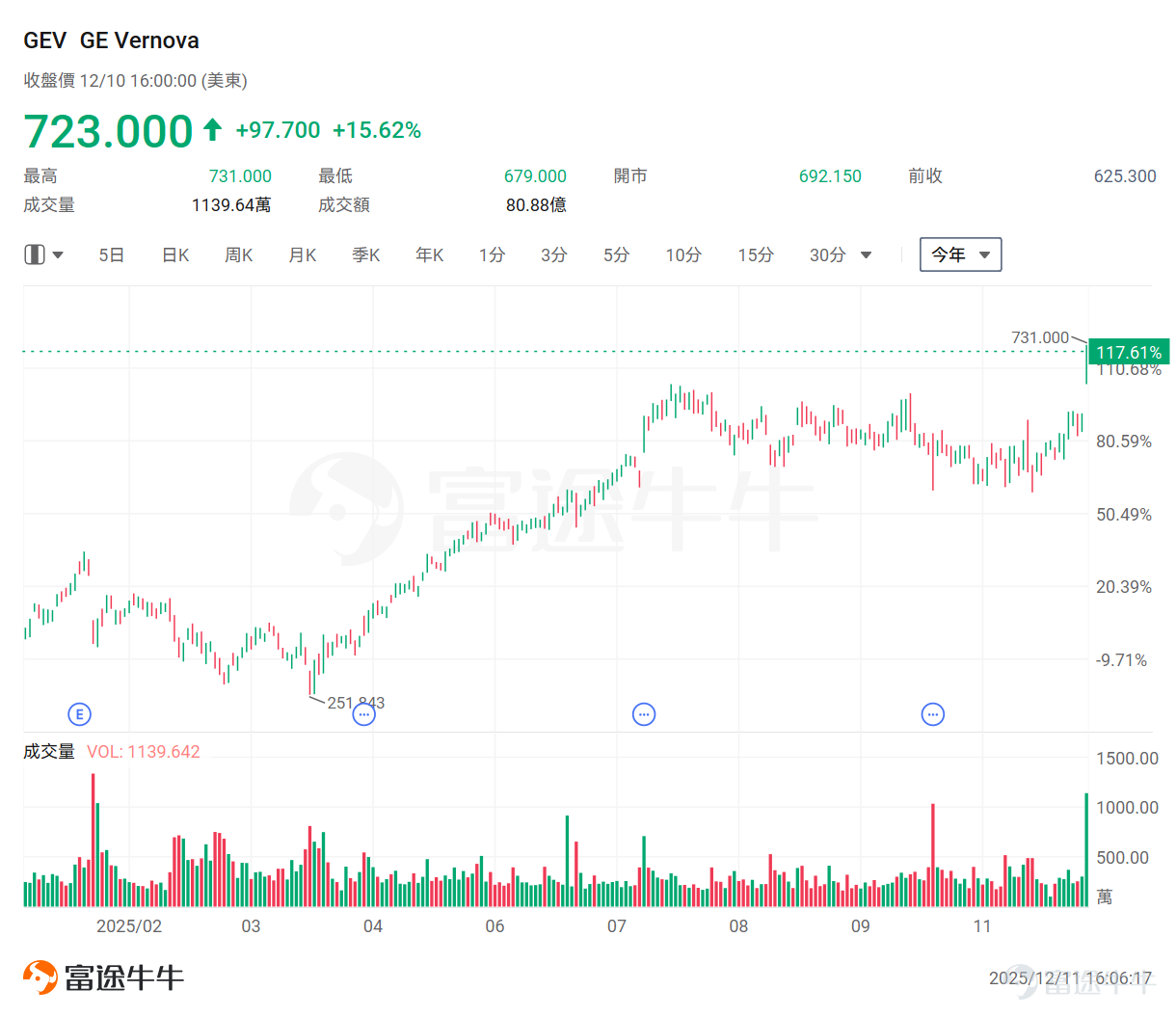
Benefiting from the explosive expansion of AI data centers, American Electric Power $GE Vernova (GEV.US)$ soared to an all-time high during Wednesday’s trading session after announcing higher earnings guidance for the coming years, doubling dividends, and increasing stock repurchase authorization. The company has surged over 117% year-to-date.
![Benefiting from the explosive expansion of AI data centers, American Electric Power $GE Vernova (GEV.US)$ soared to an all-time high during Wednesday’s trading session after announcing higher earnings guidance for the coming years, doubling dividends, and increasing stock repurchase authorization. The company has surged over 117% year-to-date. AI is pushing 'electricity' to the very center of the industrial chain. In fact, it was previously noted in[Share Link: The Second Half of the AI Race — Electricity! Four Key Investment Themes in US Stocks You Must Know]that by 2035, electricity demand from U.S. data centers will more than double, rising from nearly 35GW in 2024 to 78GW. Actual energy consumption growth will be even more pronounced, with average hourly electricity demand nearly tripling from 16GW in 2024 to 49GW in 2035. The core challenge currently facing the U.S. power grid is thatthe surge in electricity demand is colliding with long-term underinvestment in infrastructure.Low demand over the past decade led to stalled investments, and when demand eventually arrived, investment allocation was severely imbalanced. Compounding the issue, limited grid investments have been structurally inadequate: in distribution, over half of the funding is merely allocated to “maintaining the status quo” — 28% for replacing aging equipment and another 28% for reinforcing existing facilities. Only a meager 28% is actually directed toward capacity expansion. Why are gas turbines becoming the biggest beneficiaries? To meet the explosive growth in electricity demand driven by AI...](https://nnqimage.futunn.com/sns_client_feed/900080/20251211/web-1765452837826-ukDBd7peME.png/big?area=1&is_public=true&imageMogr2/ignore-error/1/format/webp)
AI is pushing 'electricity' to the very center of the industrial chain.
In fact, it was previously noted inThe Second Half of the AI Race — Electricity! Four Key Investment Themes in US Stocks You Must Knowthat by 2035, electricity demand from U.S. data centers will more than double, rising from nearly 35GW in 2024 to 78GW. Actual energy consumption growth will be even more pronounced, with average hourly electricity demand nearly tripling from 16GW in 2024 to 49GW in 2035.
![Benefiting from the explosive expansion of AI data centers, American Electric Power $GE Vernova (GEV.US)$ soared to an all-time high during Wednesday’s trading session after announcing higher earnings guidance for the coming years, doubling dividends, and increasing stock repurchase authorization. The company has surged over 117% year-to-date. AI is pushing 'electricity' to the very center of the industrial chain. In fact, it was previously noted in[Share Link: The Second Half of the AI Race — Electricity! Four Key Investment Themes in US Stocks You Must Know]that by 2035, electricity demand from U.S. data centers will more than double, rising from nearly 35GW in 2024 to 78GW. Actual energy consumption growth will be even more pronounced, with average hourly electricity demand nearly tripling from 16GW in 2024 to 49GW in 2035. The core challenge currently facing the U.S. power grid is thatthe surge in electricity demand is colliding with long-term underinvestment in infrastructure.Low demand over the past decade led to stalled investments, and when demand eventually arrived, investment allocation was severely imbalanced. Compounding the issue, limited grid investments have been structurally inadequate: in distribution, over half of the funding is merely allocated to “maintaining the status quo” — 28% for replacing aging equipment and another 28% for reinforcing existing facilities. Only a meager 28% is actually directed toward capacity expansion. Why are gas turbines becoming the biggest beneficiaries? To meet the explosive growth in electricity demand driven by AI...](https://nnqimage.futunn.com/sns_client_feed/900080/20251211/web-1765452837412-DZRAWtuA7K.webp/big?area=1&is_public=true&imageMogr2/ignore-error/1/format/webp)
The core challenge currently facing the U.S. power grid is thatthe surge in electricity demand is colliding with long-term underinvestment in infrastructure.Low demand over the past decade led to stalled investments, and when demand eventually arrived, investment allocation was severely imbalanced. Compounding the issue, limited grid investments have been structurally inadequate: in distribution, over half of the funding is merely allocated to “maintaining the status quo” — 28% for replacing aging equipment and another 28% for reinforcing existing facilities. Only a meager 28% is actually directed toward capacity expansion.
Why are gas turbines becoming the biggest beneficiaries?
To meet the explosive growth in electricity demand driven by AI, the market has developedfour main pathways: grid integration, behind-the-meter power supply, on-site self-built power sources, and mining facility retrofits.Four major pathways.GEV is the biggest beneficiary of the most mainstream pathway—on-site self-built power sources using gas turbines.
According to a research report by Minsheng Securities,Gas turbines, as power/backup power sources for data centers, offer the following features and advantages:① High energy density; ② High combined cycle efficiency, with efficiency exceeding 80% under combined heat (cooling) and power systems; ③ Modular design (plug-and-play); ④ Rapid startup (1-5 minutes); ⑤ Low backup costs, low usage and maintenance costs; ⑥ Automatic switching between primary and backup fuels during uninterrupted power supply.
Due to the bottleneck in electricity supply, an increasing number of American data centers are opting to build their own gas-fired power plants, leading to a surge in demand for gas turbines.For instance, Musk's xAI data center in Tennessee, USA (150MW), uses 100,000 of the latest NVIDIA H100 GPU chips to build today’s most powerful artificial intelligence training model. Due to high energy consumption, local residents are concerned about its impact on the local power grid.Musk has adopted gas turbines as the power supply for the data center.
Previously,The Era of AI Mega Factories Has Arrived! Who Is Joining NVIDIA's Ecosystem?As previously noted, the era of NVIDIA's AI super factories has arrived.This time, NVIDIA’s 'Electric Power Revolution' is a critical battle. NVIDIA announced over 20 'Electric Power Revolution Corps' partners, with GEV being one of them.
![Benefiting from the explosive expansion of AI data centers, American Electric Power $GE Vernova (GEV.US)$ soared to an all-time high during Wednesday’s trading session after announcing higher earnings guidance for the coming years, doubling dividends, and increasing stock repurchase authorization. The company has surged over 117% year-to-date. AI is pushing 'electricity' to the very center of the industrial chain. In fact, it was previously noted in[Share Link: The Second Half of the AI Race — Electricity! Four Key Investment Themes in US Stocks You Must Know]that by 2035, electricity demand from U.S. data centers will more than double, rising from nearly 35GW in 2024 to 78GW. Actual energy consumption growth will be even more pronounced, with average hourly electricity demand nearly tripling from 16GW in 2024 to 49GW in 2035. The core challenge currently facing the U.S. power grid is thatthe surge in electricity demand is colliding with long-term underinvestment in infrastructure.Low demand over the past decade led to stalled investments, and when demand eventually arrived, investment allocation was severely imbalanced. Compounding the issue, limited grid investments have been structurally inadequate: in distribution, over half of the funding is merely allocated to “maintaining the status quo” — 28% for replacing aging equipment and another 28% for reinforcing existing facilities. Only a meager 28% is actually directed toward capacity expansion. Why are gas turbines becoming the biggest beneficiaries? To meet the explosive growth in electricity demand driven by AI...](https://nnqimage.futunn.com/sns_client_feed/900080/20251211/web-1765452842294-fnb2AImZvs.png/big?area=1&is_public=true&imageMogr2/ignore-error/1/format/webp)
Notably, what further excited investors was GEV CEO Scott Strazik’s disclosure on Investor Day that the growing construction of large data centers is driving up electricity demand.The company anticipates signing combined-cycle gas turbine contracts totaling 80GW by year-end. Strazik further stated that all production capacity for the company’s gas turbines has been sold out through 2028, and only 10% of 2029’s capacity remains available.Specifically:
1. Orders: Gas turbines have secured 18GW in new contracts since Q4 (versus 19.6GW combined for the first three quarters of 2025, indicating substantial growth expectations for Q4 alone), with anticipated agreements and backlog reaching 80GW by the end of 2025. The total backlog is projected to increase from $135 billion to $200 billion by the end of 2028, while electrical backlog is expected to double from $30 billion to $60 billion.
2. Production Capacity: Annual delivery capacity for gas turbines is expected to reach 20GW by mid-2026, with revised expansion plans projecting an annual capacity of 24GW by 2028 (including 2GW for B&E class and 2GW for F&H class). Currently, all new equipment production capacity has been sold out through 2028, with less than 10GW remaining available for 2029.
3. Upward revision of overall guidance: GEV’s total revenue is projected to reach $52 billion by 2028 (up from the previous estimate of $45 billion, representing a 16% increase), with an adjusted EBITDA margin of 20% (up from the previous estimate of 14%). Specifically, revenue CAGR for power and electrification segments is expected to achieve high double-digit growth rates (15-19%) through 2028, with EBITDA margins increasing from 16% to 22%.
From a financial perspective, we have moved beyond mere 'logical deduction' into the 'performance realization' phase. This is a perfect closed-loop system now being validated by reality:AI → Electricity → Equipment → Services → Cash Flow → Shareholder Returns. The certainty of each link in this chain is driving a revaluation.
Which other companies are worth watching?
The essence of the artificial intelligence race is a competition over physical infrastructure. In this unprecedented gold rush ignited by AI,supply chain giants that master core cooling and power supply technologies—capable of 'cooling' and 'powering' massive computing capabilities—will undoubtedly emerge as the true winners.
The trend of GEV shows that traditional enterprises' profit models are undergoing structural upgrades. Infrastructure sectors, represented by power, energy, transmission and distribution, and operation and maintenance services, do not rely on hype, market sentiment, or short-term narratives; their growth logic is solid and clear: as long as artificial intelligence continues to expand, the demand for corresponding supporting facilities will inevitably continue to rise.
Previously,Who Are the Hidden Forces Behind Data Centers? A Comprehensive Look at the Supporting Infrastructure Industry Chain!Relevant companies have been identified:
![Benefiting from the explosive expansion of AI data centers, American Electric Power $GE Vernova (GEV.US)$ soared to an all-time high during Wednesday’s trading session after announcing higher earnings guidance for the coming years, doubling dividends, and increasing stock repurchase authorization. The company has surged over 117% year-to-date. AI is pushing 'electricity' to the very center of the industrial chain. In fact, it was previously noted in[Share Link: The Second Half of the AI Race — Electricity! Four Key Investment Themes in US Stocks You Must Know]that by 2035, electricity demand from U.S. data centers will more than double, rising from nearly 35GW in 2024 to 78GW. Actual energy consumption growth will be even more pronounced, with average hourly electricity demand nearly tripling from 16GW in 2024 to 49GW in 2035. The core challenge currently facing the U.S. power grid is thatthe surge in electricity demand is colliding with long-term underinvestment in infrastructure.Low demand over the past decade led to stalled investments, and when demand eventually arrived, investment allocation was severely imbalanced. Compounding the issue, limited grid investments have been structurally inadequate: in distribution, over half of the funding is merely allocated to “maintaining the status quo” — 28% for replacing aging equipment and another 28% for reinforcing existing facilities. Only a meager 28% is actually directed toward capacity expansion. Why are gas turbines becoming the biggest beneficiaries? To meet the explosive growth in electricity demand driven by AI...](https://nnqimage.futunn.com/sns_client_feed/900080/20251211/web-1765452844865-iZCDNcznA9.png/big?area=1&is_public=true&imageMogr2/ignore-error/1/format/webp)
I. Power System: Ensuring stable power supply and distribution
⚡ Power supply and distribution (Uninterruptible Power Supply/Switchgear/Busbar/Power Distribution Unit)
Positioning and Value:As the 'last mile' before electrical energy reaches IT loads, this stage is crucial for ensuring the continuity of data center power supply and the quality of electrical energy.
Relevant companies:
🔌 Backup power generation (diesel/fuel cell)
Positioning and Value:As the ultimate power defense line for data centers, it assumes the full load during complete mains power outages, ensuring zero business interruption. The technological trajectory is moving towards low-carbonization and diversified fuel solutions.
Relevant companies:
🔋Energy Storage and Microgrids
Positioning and Value:Going beyond traditional backup functions, reducing electricity costs through 'peak shaving and valley filling,' while supporting grid stability with rapid response, is central to building a green and efficient energy system for data center campuses.
Relevant companies:
II. Cooling Systems: Ensuring Equipment Heat Dissipation and Environmental Temperature
❄️ Thermal Management (Chillers/Precision Air Conditioning)
Positioning and Value:As the cornerstone of data center temperature control, this segment is directly responsible for ensuring the operational environment of IT equipment through air cooling technology and centralized control systems. Its efficiency is a key factor influencing the overall PUE (Power Usage Effectiveness) metric.
Relevant companies:
💧 Liquid cooling (cold plate/immersion/heat exchanger)
Positioning and Value:Rising with the explosive demand for AI computing power, this technology is the inevitable choice for addressing heat dissipation in high-density cabinets exceeding 20kW. Not only can it significantly reduce PUE (Power Usage Effectiveness), but it also supports the evolution of future computing infrastructure.
🌊 Water-side infrastructure (cooling towers/pumps/water systems)
Positioning and Value:As the "final outlet" of the cooling cycle, this segment is responsible for efficiently dissipating the internal heat of the data center into the external environment. Its reliability and efficiency form the foundation for the stable operation of the entire chilled water system and liquid cooling system.
III. Networking and IT equipment: Core of data processing and transmission
🔗Fiber Optics and Cabling (Fiber/Copper/Connectors)
Positioning and Value:As the "neural network" of data centers, this segment serves as the physical foundation for ensuring high-speed data transmission, connecting servers and network equipment, and enabling interconnection across campus and backbone networks. Its performance directly determines the overall bandwidth and latency of the data center.
Relevant companies: $Corning (GLW.US)$ , $Vistance Networks (VISN.US)$ , $Belden (BDC.US)$ , $WESCO International (WCC.US)$
🖥️IT Equipment and Servers
Positioning and Value:As the ultimate carrier for data centers to realize their computing power functions, this segment covers network switching and computing hardware. Network equipment serves as the "transportation hub" for data interaction, while servers act as the "work units" for executing computational tasks, collectively determining the core performance and efficiency of data centers.
Companies related to server manufacturers: $Dell Technologies (DELL.US)$ , $Hewlett Packard Enterprise (HPE.US)$ , $Super Micro Computer (SMCI.US)$
IV. Others
📦Racks / Enclosed pathways / Data center infrastructure
Positioning and Value:As the "physical carrier" and "spatial unit" of IT equipment, this segment utilizes cabinet integration and aisle containment technologies to construct independent hot and cold aisles, effectively improving cooling efficiency and supporting higher deployment density. It serves as the foundational infrastructure for achieving green, low-carbon data centers.
🏢 Building Automation / Fire Protection / Security
Positioning and Value:As the "nerve center" and "security guardian" of data centers, this segment achieves comprehensive monitoring and energy efficiency optimization through Building Management Systems (BMS) and Data Center Infrastructure Management (DCIM). It integrates fire protection and security systems, ensuring stable operations of the infrastructure and adherence to stringent safety standards, forming the core of unmanned and intelligent operation and maintenance.
Overall, in this unprecedented gold rush ignited by AI,supply chain giants that possess core cooling and power supply technologies, enabling them to 'cool down' and 'power' massive computing capabilities, will undoubtedly emerge as the silent but true winners of this era.
Risk Disclaimer: The above content only represents the author's view. It does not represent any position or investment advice of Futu. Futu makes no representation or warranty.Read more


Comment (1)
to post a comment
86
157