Healthcare giant Medline surged 41% on its first day of trading!

The largest IPO of the year in the US stock market is about to debut! Could healthcare giant Medline become the market's new favorite?
The largest U.S. IPO of 2025 is here!
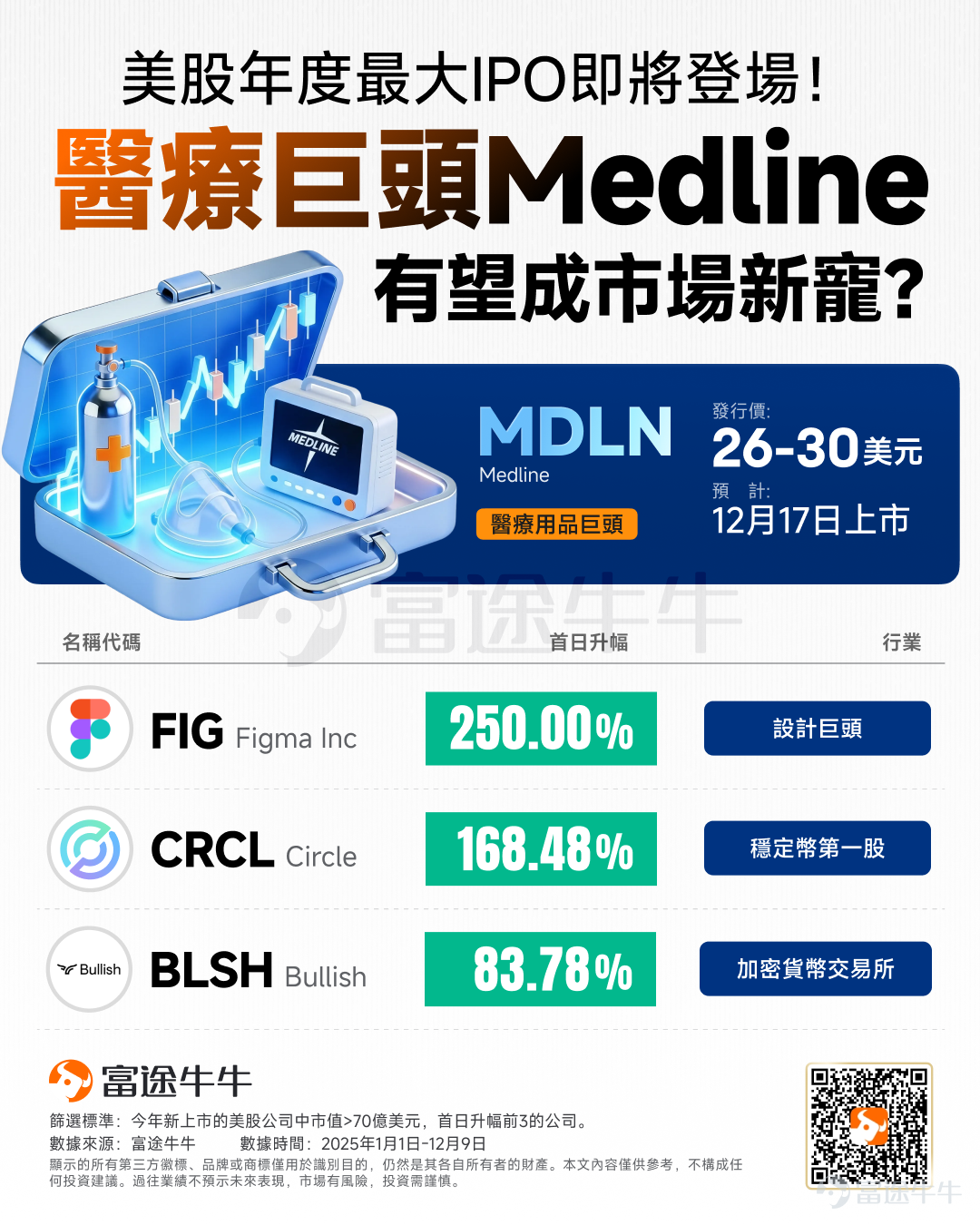
The largest distributor of medical consumables in the United States $Medline (MDLN.US)$ plans to go public on December 17.The company has set its IPO price range at $26-$30 per share, corresponding to a valuation of $55.3 billion, with a planned fundraising size of $5.37 billion, expected to become the largest IPO of the year.
Looking back at U.S.-listed companies this year, the strongest debut was Figma—surging 250%, followed by Circle with nearly a 170% increase, and BULLISH rising over 80%.As popular new stocks continue to generate wealth, market capital is poised and ready. Can Medline continue the streak of first-day surges?

At this point, many fellow investors are curious: What kind of company is this? How is its performance? We will address these questions one by one.
Who is Medline?
Medline, the largest private manufacturer and distributor of medical supplies in the United States, provides products across all aspects of healthcare — from disposable gloves used by doctors, sterile surgical packs on operating tables, to various nursing supplies in hospital wards, many of which may originate from Medline's supply chain.It is often referred to as the Costco of the medical industry.
In 2021, a private equity consortium composed of Blackstone, Carlyle, and Hellman & Friedman jointly acquired a majority stake in Medline for approximately $34 billion (including debt), setting one of the largest leveraged buyout records in the medical technology sector at the time.
As a global leader in medical consumables and supply chain solutions, Medline’s core strengths can be summarized in the following three areas:
1. Scale and Network Advantage
Operating 33 manufacturing plants and 69 distribution centers globally, with business covering over 100 countries and employing approximately 43,000 people, Medline has established an efficient and synergistic global supply chain system.

2. Deep Customer Ties and Recurring Revenue
Its proprietary branded products are used by all of the top 100 healthcare systems in the U.S., and through a model of 'long-term contracts + supply chain integration solutions,' the company builds strong, sticky customer relationships, ensuring a highly repeatable and predictable revenue structure.
3. Dual-Engine Profit Model
The company’s operations span both ends of the value chain: on one hand, it generates manufacturing and sales profits through its own branded products, while on the other hand, it earns service revenue by providing distribution and supply chain services for third-party brands. This dual revenue stream comes from both product profits and supply chain service fees. Specifically:
Medline Brand:
Business: Producing and selling its own branded products (approximately 190,000 SKUs, such as surgical packs, gloves, etc.).
Characteristics: High profitability. Although this segment accounts for only 49% of revenue, it contributes over 80% of profits. This is Medline's core profit engine.
Supply Chain Solutions:
Business: Distributing products from other third-party brands (approximately 145,000 SKUs).
Characteristics: Traffic generation and service provision. This segment accounts for 51% of revenue but contributes relatively lower profits (around 16-18%). Its role is to make hospital clients reliant on Medline’s logistics services, thereby encouraging them to purchase more high-margin Medline-branded products.

The prospectus particularly highlights their competitive advantage—The "Prime Vendor" model.
Once Medline becomes a hospital’s primary supplier, they can leverage their logistics advantages to help hospitals save costs.
After hospitals save costs, they will be more inclined to purchase Medline’s private-label products, which offer a high cost-performance ratio.
As the sales of private-label products increase, Medline's production scale expands, further reducing costs and creating a positive feedback loop.

A strong shareholder base
Notably, the highlights of this IPO lie not only in its business scale but also in its robust shareholder and investor foundation. Following the listing, the company's equity structure will include three well-known private equity funds as long-term major shareholders — Blackstone, Carlyle, and Hellman & Friedman — each expected to hold approximately 18% of the voting rights.
The Mills family, which founded and has long operated the company, remains the largest individual shareholder after the privatization transaction and is expected to hold 17.8% of the voting rights post-listing. They also plan to personally invest up to US$250 million in this offering.
To ensure the smooth execution of the offering, Medline has secured cornerstone investment commitments from several top-tier global investment institutions, with a total subscription amount of approximately US$2.35 billion. Participants include Baillie Gifford, Capital Group, Morgan Stanley’s Counterpoint Global, and Singapore’s sovereign wealth fund GIC, among others.

How are the financial results?
The prospectus also disclosed for the first time the vast scale of the company’s operations:
– Revenue scale:Full-year revenue for 2024 reached US$25.5 billion.
– Profitability:Net profit in 2024 was $12 billion, with an adjusted EBITDA (Earnings Before Interest, Taxes, Depreciation, and Amortization) of $34 billion.

– Growth Rate:Despite its massive size, the company is still growing at a rapid pace. Revenue for the first half of 2025 has reached $135 billion. The compound annual growth rate (CAGR) over the past decade was approximately 14%, with 90% of that growth being organic (i.e., driven by increased sales rather than acquisitions).

According to the 2025 'Medical Design & Outsourcing' Top 100 ranking, Medline's annual revenue reached $25.5 billion, making it the third-largest company after Medtronic and Johnson & Johnson Medical.

However, investors should also note that,High leverage remains a notable characteristic left over from the company’s previous privatization.As of September 27, 2025, the company's total debt amounted to approximately $16.8 billion. One of the core purposes of this IPO is to repay about $4 billion in debt.
Risk Disclaimer: The above content only represents the author's view. It does not represent any position or investment advice of Futu. Futu makes no representation or warranty.Read more


Comments (2)
to post a comment
30
135