Space Emerges as a New Focal Point! RKLB Soars 84% in a Month to Reach a New High

Is Musk building another trillion-dollar empire? Rumors of SpaceX's IPO have ignited the market, and these related stocks are worth watching!
SpaceX is advancing its IPO plans, with a proposed fundraising size significantly exceeding USD 300 billion,poised to become the largest IPO in history.
On December 9, Bloomberg reported that SpaceX, under Elon Musk, is planning to go public as early as mid-to-late 2026, with fundraising expected to far exceed USD 300 billion,with a targeted valuation of approximately USD 1.5 trillion.
Following this news, space-related stocks collectively surged, with StarHub, which has agreed to sell spectrum licenses to SpaceX, $EchoStar (ECHO.US)$ rising by 12% at one point during trading before retreating to close up about 6%; $Rocket Lab (RKLB.US)$ Rocket Lab gained 3.6%.
Upon reading this, Many fellow investors likely want to understand what events are driving SpaceX's valuation surge and what opportunities might be embedded within?The following analysis will address these questions one by one.
What events are driving SpaceX's valuation surge?
Morgan Stanley stated that Elon Musk’s next grand narrative could be space data centers, a concept that is significantly boosting SpaceX’s valuation.
Morgan Stanley pointed out that Musk is outlining a blueprint for SpaceX to enter the orbital data center market.The core logic lies in addressing physical bottlenecks on Earth:
 Electricity shortages:Easily accessible power resources on Earth are becoming increasingly scarce.Economies of Scale:Musk envisions deploying satellite constellations capable of providing an additional 100 GW of AI computing power by launching one million tons of payload annually.Zero operational costs:These facilities will have no traditional operational or maintenance costs and will connect to the Starlink constellation via high-bandwidth laser links.
In an interview with investor Ron Baron, Musk described this concept as the upcoming “convergence” of SpaceX and Tesla:By leveraging the upgraded Starlink V3 satellites equipped with GPUs and interconnected via high-speed laser links, a vast computational cloud can be formed in orbit.
Elon Musk subsequently indicated that, assuming technical obstacles are overcome, Starship is expected to achieve an annual delivery capacity of 100GW within four to five years. Meanwhile,Morgan Stanley’s research report elaborates on the key advantages of relocating data centers to space:
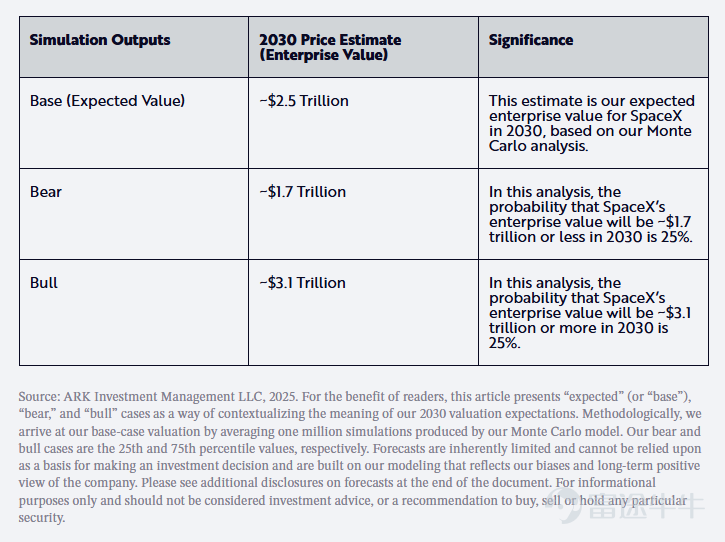
Extreme cooling:Up to 40% of energy consumption in ground-based data centers is used for cooling. In contrast, the temperature in space is approximately 2.7 Kelvin (about -270°C). Although radiative cooling requires large metal radiators, industry experts argue that dissipating heat into deep space is far more efficient than terrestrial refrigeration methods.Unlimited energy:Space offers nearly the full solar constant (approximately 1361 W/m²), which is about 30% higher than the best illumination conditions on Earth. Moreover, it is unaffected by atmospheric attenuation, weather conditions, or day-night cycles, providing reliable 24/7 energy supply.Global edge connectivity:Computational resources positioned in low Earth orbit (LEO) can significantly reduce latency for globally distributed users, enabling access to computing power within milliseconds for most population centers.Transportation barriers:According to Musk, SpaceX currently accounts for 90% of the world's orbital payload capacity. As reusable rockets like Starship mature, the cost per kilogram for orbital launches is expected to decrease significantly, enabling large-scale modular deployments.More notably, on June 10, 2025, ARK Investment Management, led by Cathie Wood (also known as "Wood") released an open-source valuation model report predicting that SpaceX’s enterprise value could reach approximately $2.5 trillion by 2030.
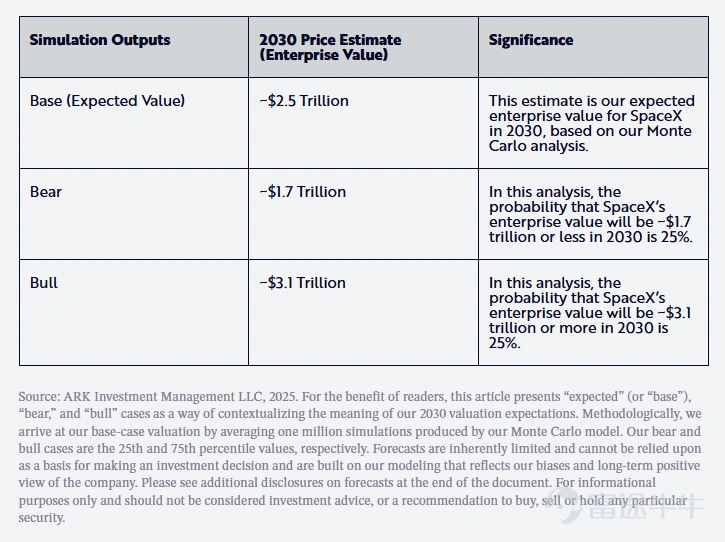
Source: ARK
According to ARK Investment's estimates,SpaceX's future cornerstone will lie in the full deployment of the "Starlink" satellite constellation, a process anticipated to be completed by 2035.Once operational, Starlink is projected to generate annual revenues of up to $300 billion, accounting for approximately 15% of global communications spending. This expansion underscores the transformative impact of providing affordable and high-speed satellite internet on a global scale.
What opportunities should be closely watched?
SpaceX's largest long-term investors include venture capital firms such as Peter Thiel's Founders Fund, 137 Ventures, and Valor Equity Partners. Fidelity Investments and Google are also significant investors.
In early September, SpaceX acquired AWS-4 and H-block spectrum licenses for satellite and mobile communications from $EchoStar (ECHO.US)$Acquisition of AWS-4 and H-block spectrum licenses for satellite and mobile communications.Due to the share exchange agreement, purchasing EchoStar Communications is equivalent to holding shares of SpaceX as well,SATS surged nearly 6% yesterday and has risen more than twofold since the announcement of its acquisition by SpaceX.
Fellow investors have also compiled a list of SpaceX-related concept stocks for investor reference:
![SpaceX is advancing its IPO plans, with the intended fundraising amount expected to far exceed $30 billion.This could become the largest IPO in history. On December 9, Bloomberg reported that SpaceX, under Musk, is planning to go public as early as the second half of 2026, with fundraising expected to significantly surpass $30 billion.The company’s targeted valuation is approximately $1.5 trillion. Following this news, space-related stocks collectively surged. StarHub, which has agreed to sell spectrum licenses to SpaceX, $EchoStar (ECHO.US)$ rose by as much as 12% during intraday trading before retreating to close up about 6%; $Rocket Lab (RKLB.US)$ Rocket Lab gained 3.6%. Upon reading this, Many fellow investors may be wondering what events are driving SpaceX’s valuation surge and what opportunities might arise from this?The following will analyze each point in detail. What events are driving SpaceX's valuation surge? Morgan Stanley stated that Elon Musk’s next grand vision could be space-based data centers, a concept that is significantly boosting SpaceX’s valuation. Morgan Stanley pointed out that Musk is outlining a blueprint for SpaceX to enter the orbital data center market,with its core logic rooted in addressing physical bottlenecks on Earth: [Cool Guy]Power shortages:Easily accessible power resources on Earth are becoming increasingly scarce. [Cool Guy]Economies of Scale:Musk envisions deploying satellite constellations capable of delivering an additional 100 GW of AI computing power by launching one million tons of payload annually. [Cool Guy]Zero operational costs:These...](https://nnqimage.futunn.com/sns_client_feed/900080/20251210/web-1765360630174-AB136bJtwF.png/big?area=1&is_public=true&imageMogr2/ignore-error/1/format/webp) Musk's "Holding Empire"
Musk's "Holding Empire"$Tesla (TSLA.US)$SpaceX and Tesla are the "twin pillars" of Musk’s business empire,In a previous interview, Musk hinted at launching a new initiative called "Galaxy Mind," aimed at integratingSpaceX, Tesla, and xAIthe core capabilities of these three companies,to deploy AI satellites powered by solar energy into deep space.Specifically, the realization of this blueprint depends on the clear division of labor and collaboration among the three companies.
SpaceX: Offers mature rocket launch and spacecraft manufacturing capabilities, responsible for deploying AI satellites into deep-space orbits.
Tesla: Leveraging its expertise in solar energy and battery technology, provides efficient and long-lasting energy solutions for satellites.
xAI: Responsible for developing cutting-edge artificial intelligence models capable of large-scale operation on satellites.
Core CompetitorsAs SpaceX’s valuation rises, its competitors may benefit from increased 'industry热度,' but in the medium to long term, the scarcity of these companies may diminish. If SpaceX goes public, capital may be withdrawn from $Rocket Lab (RKLB.US)$ and $AST SpaceMobile (ASTS.US)$ and redirected towards SpaceX.
$Rocket Lab (RKLB.US)$ :Recognized by the market as a 'mini SpaceX' and referred to by investors as 'Little Rocket', it is one of only two private aerospace companies globally capable of achieving routine, high-frequency successful launches.Not only has it established itself with the highly reliable small rocket Electron, but it has also successfully transitioned into an integrated provider of satellite manufacturing, software, and launch services through its 'space systems' business.An end-to-end service provider in the U.S. stock market,is the only company with solid performance and the most significant scarcity value as a "SpaceX alternative".The leading space company is currently developing a medium-sized reusable rocket, Neutron, which is considered a key trump card to potentially break SpaceX’s Falcon 9 monopoly in the future.
$AST SpaceMobile (ASTS.US)$:It is regarded by the market as the "space version of AT&T."orThe leader in the "direct satellite-to-smartphone" sector, its core vision is to build the world’s firstspace-based cellular broadband network,using large low-orbit satellites as "space base stations," allowing ordinary smartphones on the groundto connect without hardware modifications or the need for specialized equipment.Devices such as satellite dish antennas can directly connect to satellite signals. Despite fierce competition from SpaceX's Starlink, its deep partnerships with AT&T, Verizon, Vodafone, and Google , combined with strong patent barriers, have made it the most explosive (albeit highly volatile) pure-play investment in the U.S. stock market for a trillion-dollar revolution aimed at "eliminating signal dead zones."
$Firefly Aerospace (FLY.US)$:It is currently a formidable dark horse in the commercial aerospace sector, second only to the leading duo (SpaceX/Rocket Lab), thanks to its successful orbital launches using lightweight rockets. Alpha It has distinguished itself in the U.S. Department of Defense’s “Tactical Space” rapid response launch missions. Unlike single-launch providers, it boasts a high-barrier "Earth-Moon ecosystem chain", featuring its Blue Ghost lunar lander, which holds major NASA commercial payload contracts. The company is also collaborating with defense giant Northrop Grumman to develop a medium-lift launch vehicle (MLV) to fill market gaps.。
PartnersSpaceX's IPO serves as a "shot in the arm" for its partners, implying greater cash reserves and enhanced contract fulfillment capabilities.
$EchoStar (ECHO.US)$:In September 2025, SpaceX acquired EchoStar’s AWS-4 and H-band spectrum licenses for satellite and mobile communications. This unique transaction involved up to $8.5 billion in cash and $8.5 billion worth of SpaceX stock. At the time, with SpaceX valued at approximately $400 billion, this equity stake represented roughly 2% of SpaceX’s total shares. Additionally, SpaceX agreed to assume responsibility for EchoStar’s debt interest payments totaling approximately $2 billion through November 2027.
$Planet Labs PBC (PL.US)$:The relationship between Planet Labs and SpaceX can be summarized in one phrase: a "long-term and deeply integrated passenger-driver relationship." Planet Labs operates the world’s largest fleet of Earth observation satellites (hundreds), which have relatively short lifespans (about 3-5 years) and require frequent replenishment and updates. As one of SpaceX’s most loyal commercial launch customers, Planet Labs' business continuity heavily relies on the timely launches provided by SpaceX rockets.
$Amazon (AMZN.US)$:The collaboration between Amazon and SpaceX represents a dramatic commercial turnaround. As the parent company of Blue Origin, Amazon has long been regarded as one of SpaceX’s primary competitors in the commercial space industry. However, delays in the development of Blue Origin’s New Glenn rocket forced Amazon to adjust its strategy. In 2025, Amazon entrusted SpaceX to launch 24 Kuiper satellites.
Starlink Business Related$T-Mobile US (TMUS.US)$: The "primary ally" in the commercialization of Starlink and a pioneer in its implementation,T-Mobile is SpaceX's most important telecommunications partner for its "Direct to Cell" satellite business. The two parties signed a historic agreement named "Coverage Above and Beyond," with the key breakthrough being that "no phone replacement is required"—utilizing T-Mobile's existing 5G spectrum to use Starlink satellites as "space base stations." This not only helps T-Mobile address terrestrial signal dead zones but also opens up a vast consumer market for SpaceX, serving as a critical monetization pathway for Starlink services transitioning from "niche broadband" to "mass-market telecom."
$Qualcomm (QCOM.US)$: The "enabler of foundational technology" connecting earth and space communications If T-Mobile provides the "road" (spectrum and users), Qualcomm provides the "engine" (chips). As the global leader in communication chips, Qualcomm is collaborating deeply with SpaceX, focusing on optimizing the 5G NTN (Non-Terrestrial Network) standard. SpaceX requires Qualcomm’s mobile modem and RF front-end technology support to ensure future smartphones can efficiently and with low power consumption "understand" satellite signals. Qualcomm is a key hardware driver in achieving the standardization of satellite communications and making satellite functionality a "standard feature" in smartphones.
Investment Company1. $Alphabet-A (GOOGL.US)$& $Bank of America (BAC.US)$: Google is one of SpaceX's most important early strategic shareholders (holding approximately 7%), with deep integration in cloud and edge computing; andBank of Americahas previously participated in SpaceX's financing.
If SpaceX goes public:For Google, this represents a significant 'asset revaluation,' with the value of its $900 million investment potentially multiplying several-fold, directly enhancing investment returns on its financial statements; for BAC, it means earning substantial IPO underwriting fees and mitigating debt risks. Both are 'passive beneficiaries' with vested interests.
2. $Destiny Tech100 (DXYZ.US)$ & $Entrepreneur Private-Public Crossover ETF (XOVR.US)$: These two fundsare currently the only 'premium channels' for individual investors to buy SpaceX shares in the secondary market. Their business model involves 'accumulating scarce private equity stakes and reselling them to individual investors at a markup.'
If SpaceX goes public:This would be a devastating 'valuation correction' blow to them. Although the stock price may surge due to pre-IPO speculation, once SpaceX officially lists, investors will be able to purchase common shares directly, and no one will be willing to pay DXYZ’s current premium of over 100%. At that point, DXYZ’s share price will undergo a sharp correction (falling back to net asset value), losing its scarcity.
In addition to the aforementioned concept stocks,"AI Reaches for the Sky! Musk and OpenAI Race to Dominate Space Data Centers—Which Companies Are Poised to Benefit?"A previous article also pointed out thatestablishing data centers in space has become the next battleground in the AI competition,and outlined relevant concept stocks, which interested fellow investors can click to view.
![SpaceX is advancing its IPO plans, with the intended fundraising amount expected to far exceed $30 billion.This could become the largest IPO in history. On December 9, Bloomberg reported that SpaceX, under Musk, is planning to go public as early as the second half of 2026, with fundraising expected to significantly surpass $30 billion.The company’s targeted valuation is approximately $1.5 trillion. Following this news, space-related stocks collectively surged. StarHub, which has agreed to sell spectrum licenses to SpaceX, $EchoStar (ECHO.US)$ rose by as much as 12% during intraday trading before retreating to close up about 6%; $Rocket Lab (RKLB.US)$ Rocket Lab gained 3.6%. Upon reading this, Many fellow investors may be wondering what events are driving SpaceX’s valuation surge and what opportunities might arise from this?The following will analyze each point in detail. What events are driving SpaceX's valuation surge? Morgan Stanley stated that Elon Musk’s next grand vision could be space-based data centers, a concept that is significantly boosting SpaceX’s valuation. Morgan Stanley pointed out that Musk is outlining a blueprint for SpaceX to enter the orbital data center market,with its core logic rooted in addressing physical bottlenecks on Earth: [Cool Guy]Power shortages:Easily accessible power resources on Earth are becoming increasingly scarce. [Cool Guy]Economies of Scale:Musk envisions deploying satellite constellations capable of delivering an additional 100 GW of AI computing power by launching one million tons of payload annually. [Cool Guy]Zero operational costs:These...](https://nnqimage.futunn.com/sns_client_feed/900080/20251210/web-1765360591274-nQJGrNPcZt.png/big?area=1&is_public=true&imageMogr2/ignore-error/1/format/webp)
Summary
The rumors surrounding SpaceX's IPO are not only a preview of a capital feast but also mark a critical turning point where commercial aerospace transitions from 'science fiction narrative' to 'performance realization.' For investors, this historically largest IPO is both an opportunity and a litmus test.
Short-term focus on sentiment, long-term focus on logic:The expectations of an IPO will allow companies like RKLB and ASTS in the same sector to enjoy a 'sector premium,' but as SpaceX becomes more financially transparent, capital will ultimately flow to firms with genuine competitive advantages (such as T-Mobile’s spectrum superiority, Qualcomm’s standard-setting capabilities, Rocket Lab’s differentiated capacity, and ASTS’s seamless integration technology with terrestrial cellular networks).
Beware of the valuation correction for 'pseudo-concepts': As noted in the article, companies like DXYZ that rely on 'unavailability' to generate premium channels will face the risk of value regression after SpaceX goes public. The true beneficiaries will be those deeply tied to Musk’s empire—'picks-and-shovels stocks' and core shareholders (such as Google and SATS).
Overall, when 'space-based data centers' and 'direct-to-mobile connectivity' transition from blueprints to reality, what we’re investing in is no longer just rockets but the infrastructure of the next era.
Fellow investors, who do you think will be most hurt and who will benefit the most after SpaceX goes public?Risk Disclaimer: The above content only represents the author's view. It does not represent any position or investment advice of Futu. Futu makes no representation or warranty.Read more


Comments (18)
to post a comment
147
573