
Focus on the Super Macro Week! Japan raises interest rates by 25 basis points

What to Do as Hong Kong Stocks Face Pressure? Goldman Sachs Points the Way: Cloud and Data Centers Emerge as Top Picks, These Eight Companies Are Worth Watching
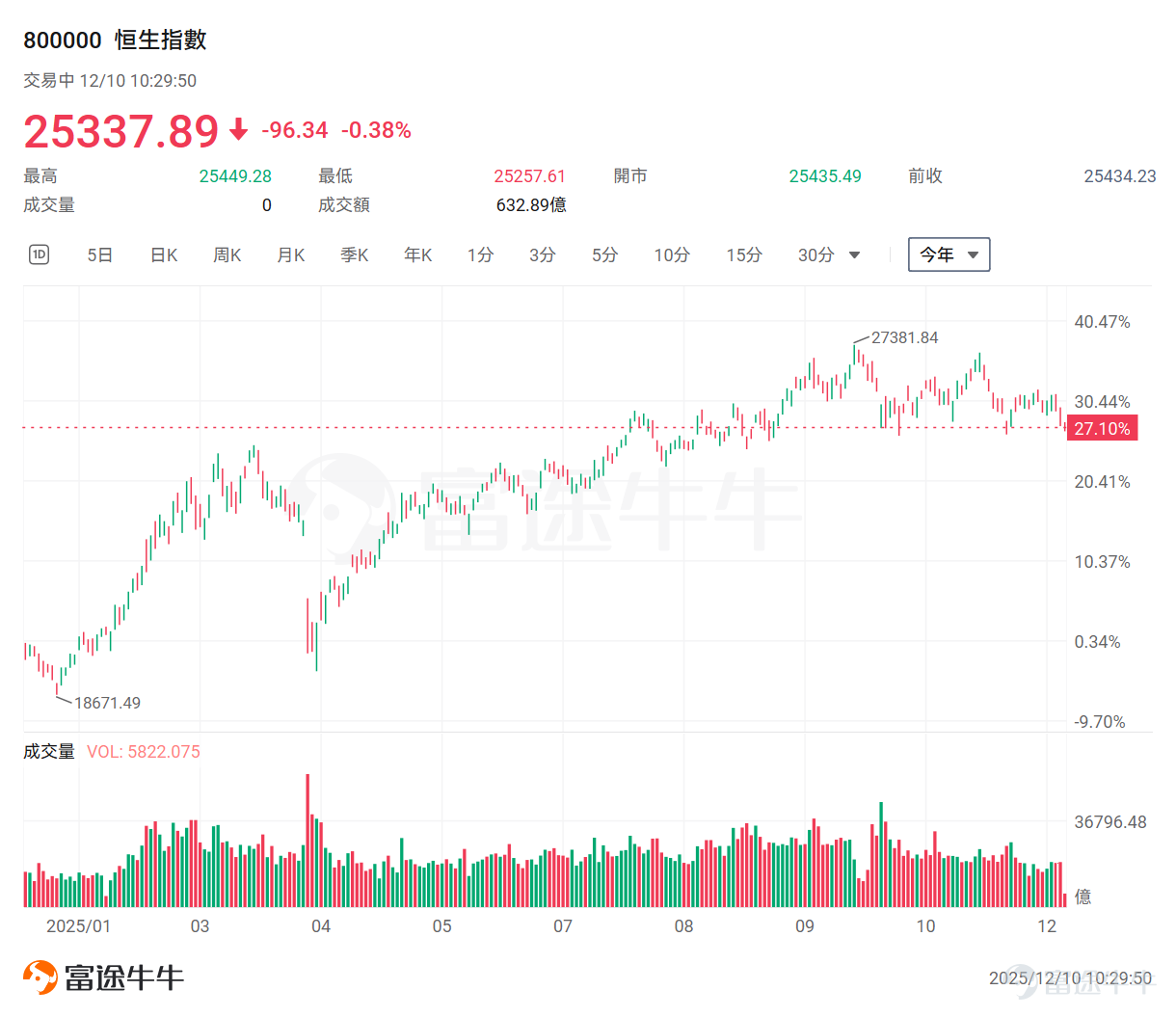
Recently, the Hong Kong stock market has continued to face pressure, with the Hang Seng Index weakening amid volatility. The current market lacks significant variable stimuli, making it difficult to break the existing equilibrium.

CICC released a strategy report stating that Hong Kong stocks have been particularly weak among the three regional markets recently, which can be partially explained by some factors:1) Southbound flows have continued to shrink over the past few weeks,If Hong Kong stocks are not included in benchmarks, it may lead to portfolio adjustments; in contrast, Hong Kong IPOs remain numerous, and large-cap stocks concentrated in the first half of the year are approaching their six-month lock-up period.2) Concerns over the Bank of Japan raising interest rates next week persist.;3) Although the Fed cut interest rates this week, it remains unlikely to adopt a dovish stance.As a result, U.S. Treasury yields did not rise but fell instead, among other similar phenomena.
However, CICC also noted that liquidity will have short-term impacts, especially on Hong Kong stocks, which are more reliant on capital (as well as structural issues related to the high proportion of technology stocks and domestic public funds' benchmarking). This is still not the long-term fundamental factor. The key lies in the downturn of the credit cycle inflection point, which is why the firm has maintained its forecast of 26,000 points for the Hang Seng Index this year without an upward revision. It was simply overlooked and overshadowed due to earlier optimistic expectations.
CICC stated that, preliminarily, this pattern will likely continue in the short term unless the new Fed Chair adopts a more dovish stance and expands the balance sheet, or if the economic work conference exceeds expectations. Among the four major sectors: 1) AI requires new industrial catalysts (thus hardware visibility is greater than applications, with the former being more prevalent in A-shares and the latter in H-shares), or liquidity catalysts (depending on the Fed); 2) Strong cyclicality, driven by U.S. fiscal and real estate demand in the first quarter and a rise in domestic PPI; 3) Broad-based consumption, lacking fundamental support; 4) Dividend stocks, hedging against broad-based consumption and a weakening credit cycle.
How should one select Chinese internet-related stocks in the current environment?
Goldman Sachs recently released a new research report, primarily discussing strategic adjustments, industry focus areas, and key investment targets for China's internet sector following the Q3 earnings season.
The most noteworthy aspect is that Goldman Sachs has adjusted its preference ranking for sub-sectors within China’s internet industry, marking the report’s most significant strategic shift.
First Place (Upgraded): Cloud and Data Centers
Goldman Sachs has been particularly decisive this time, elevating the cloud and data center sector from its previous third place to first. The rationale is strong: ongoing surges in demand for AI training and inference, coupled with tech giants adopting "multi-chip strategies," have led to robust order volumes for data centers.
Core Logic: It’s not just NVIDIA; as domestic chip supply ramps up, the utilization rate and return on investment for computing infrastructure are improving.
Second Place: Gaming
Reason: Defensive characteristics, favorable competitive dynamics, and pricing power.
Third Place: Travel
Reason: Equally defensive.
Laggard sectors: By contrast, a weak macroeconomic backdrop may put pressure on e-commerce and non-e-commerce advertising sub-sectors.

Based on this, Goldman Sachs updated its preferred list according to the latest sector preferences:
Cloud/Data Center: $Alibaba (BABA.US)$ / $BABA-W (09988.HK)$、 $GDS Holdings (GDS.US)$ / $GDS-SW (09698.HK)$、 $21Vianet (VNET.US)$。
Goldman Sachs believes that Alibaba’s EPS will rebound from a low base next year, supported by its full-stack AI strategy. This year's losses in immediate retail will provide room for further AI To-C investments next year while achieving group profit growth. GDS Holdings shows strong data center orders and overseas financing benefits, while 21Vianet is benefiting from rapid growth in wholesale IDC orders and rising AI computing power demand.
Goldman Sachs notes that Tencent demonstrates stable EPS growth, monetization within the WeChat ecosystem, and key applications of AI. NetEase’s gaming business is defensive with potential for overseas expansion.
Didi’s domestic profit margins are improving, with added value from Robotaxi and Latin American operations; Full Truck Alliance shows upward potential in monetization rates and higher shareholder return prospects.
Newly added to the preferred list, Goldman Sachs is optimistic about the breakthrough and monetization potential of its 'Kling' AI model.
Notably, the median forward P/E ratio for Chinese internet stocks in 2026 currently stands at approximately 18x. The previous rally has been primarily driven by AI narratives and multiple expansion rather than being fully supported by earnings growth.

Goldman Sachs believes that subsequent stock price performance will depend on three key factors:
1) Can earnings keep up?With rising stock prices, performance must follow suit. The key question now is whether real EPS growth can sustain current valuation multiples.
2) Will the market buy into the new narrative?Market preferences have shifted, with greater emphasis now placed on companies with 'AI content' and 'global expansion capabilities.' Can these new assets command higher premiums?
3) Can they fend off ByteDance’s advances?The 'ByteDance ecosystem' is aggressively expanding across various fields (AI assistants, e-commerce, social media). Can the established giants defend their turf?
Overall, there has been a structural shift in investment trends: the market is increasingly prioritizing 'hard tech' infrastructure (data centers), viewing them as definitive beneficiaries of the AI era. In contrast, the traditional 'pure traffic monetization' model is facing significant challenges due to the emergence of new interactive formats like AI agents, which are reshaping competitive moats.
Risk Disclaimer: The above content only represents the author's view. It does not represent any position or investment advice of Futu. Futu makes no representation or warranty.Read more


Comments (7)
to post a comment
48
56