Space Emerges as a New Focal Point! RKLB Soars 84% in a Month to Reach a New High

AI is 'reaching for the skies'! Musk and OpenAI are racing to establish space-based data centers. Which companies are at the forefront of this trend?
As demand for AI computing power grows exponentially, ground-based data centers face insurmountable bottlenecks related to energy consumption and heat dissipation.Recently, tech giants in Silicon Valley have increasingly turned their attention to space, with the establishment of space-based data centers becoming the next battleground in their AI competition.

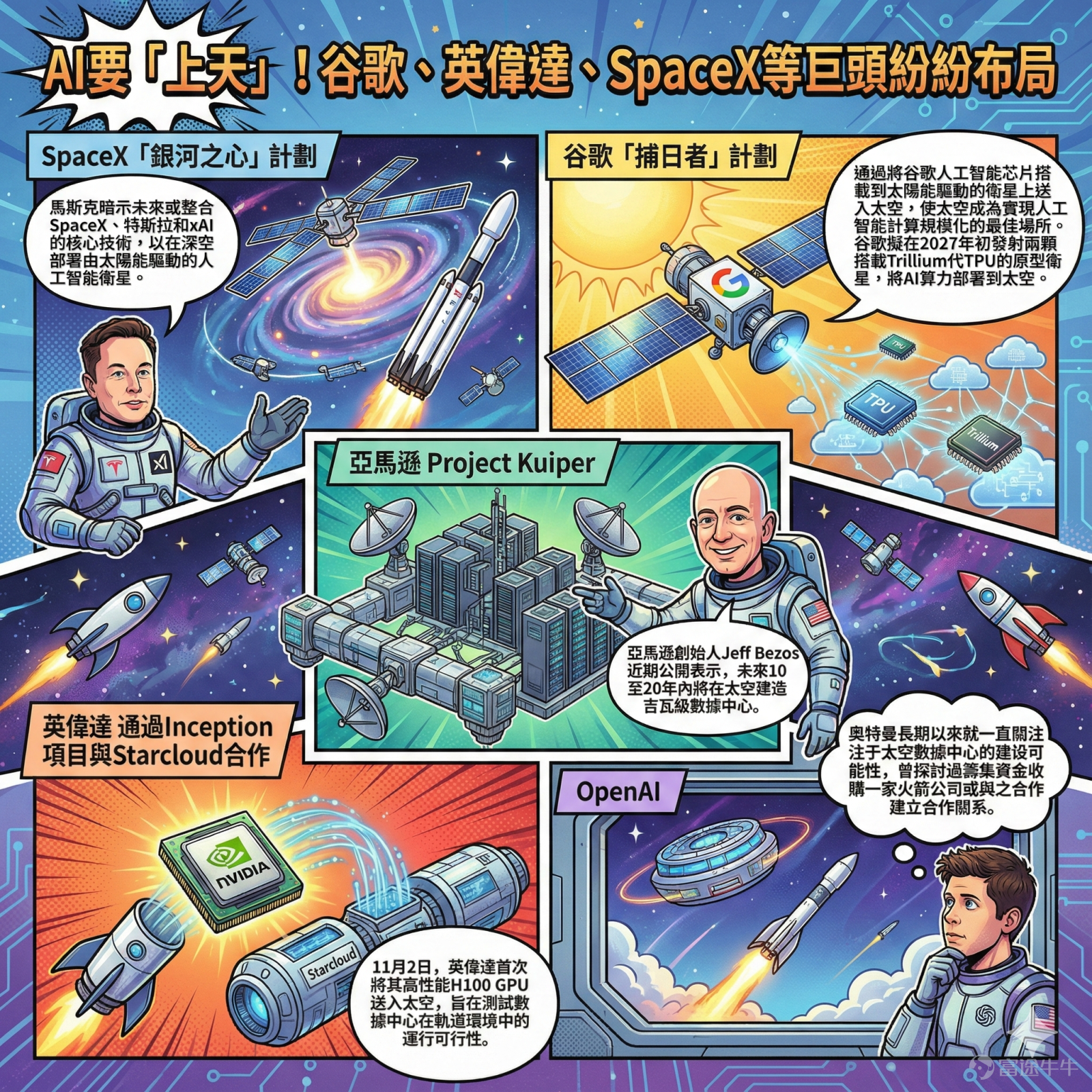
On November 4, $Alphabet-C (GOOG.US)$Google announced the initiation of the "Sun Harvester Project," planning to launch two prototype satellites equipped with its self-developed TPU AI chips by early 2027. The project will also collaborate with satellite company Planet Labs to develop the hardware. Google CEO Sundar Pichai stated that preliminary research indicates their chips can withstand the radiation environment in low Earth orbit.
Meanwhile, $Amazon (AMZN.US)$Founder Jeff Bezos also predicted that gigawatt-scale data centers would emerge in space within a decade. Meanwhile, startup Starcloud has already successfully launched a test satellite equipped with NVIDIA GPUs, adding to the growing list of participants in this race.
Musk has also publicly stated that his company SpaceX "will undertake this endeavor." He explained that by expanding the scale of its V3 version of the Starlink satellites, it would be possible to build space-based data centers. Additionally, Musk hinted at launching a new initiative called "Galactic Heart," aimed at integrating the core capabilities of SpaceX, Tesla, and xAI to deploy solar-powered AI satellites into deep space.
Just yesterday, media reports revealed that OpenAI had discussed raising funds this summer to acquire or establish a partnership with a rocket company. Altman has long been focused on the potential construction of space-based data centers, believing that the insatiable demand for computational resources by artificial intelligence systems will eventually lead to enormous electricity consumption, making space a more viable option due to environmental considerations.
At this point, many fellow investors are curious as to why space? Which companies are worth watching? This article will address these questions one by one.
Why space? The answer lies in energy.
The idea of sending data centers into space, though seemingly science fiction, is driven by a core factor—Energy.
With the explosive growth in demand for AI model training and inference, the scale, electricity consumption, and cooling costs of terrestrial data centers are rising sharply, placing immense pressure on Earth's resources such as land, water, and electricity.Space, therefore, offers a theoretical ultimate solution.
Musk pointed out that as computing clusters continue to expand, the combined demand for power supply and cooling systems will soon exceed the capacity limits of terrestrial infrastructure. He mentioned that achieving a sustained computing capacity of 200 to 300 gigawatts annually would require constructing power plants of enormous scale and cost—whereas a typical nuclear power plant generates only about 1 gigawatt of continuous power.
Meanwhile, the United States' current total sustained power generation is approximately 490 gigawatts (note that although Musk used the term "annually," he was referring to continuous output over a specific period). Therefore, dedicating a significant portion of this electricity solely to artificial intelligence is impractical. Musk believes that the near-terawatt-level power demands of AI cannot be met within Earth's power grid.
“It is impossible to construct a power plant of that scale, for instance, one with a continuous output of 1 terawatt—it simply cannot be done on Earth. It must be achieved in space. In space, continuous solar energy can be harnessed without even the need for batteries, as sunlight is perpetual. Solar panels would also be more cost-effective, requiring no glass or frames, and cooling could rely solely on radiative heat dissipation.” He explained this way.
Which space stocks are worth watching?
Previously,《The impending arrival of Trump 2.0 may "ignite" U.S. space-related stocks.、Are Space-Based AI Data Centers on the Horizon? In the Era of Trump 2.0, Which Space-Related Stocks Are Likely to Benefit?It was previously noted thatIn the era of Trump 2.0, the space sector is expected to present significant opportunities.

Specifically:
1. Launch service provider
American commercial small rocket company $Rocket Lab (RKLB.US)$is a commercial aerospace enterprise specializing in small and medium-sized rocket launch services, holding an absolute leading position globally, second only to SpaceX.
"The first stock in space tourism" $Virgin Galactic (SPCE.US)$ is the world's first publicly listed human space commercial flight company, offering suborbital flight services. The company has completed two test flights to the edge of space and has already received deposits totaling nearly $80 million from 603 individuals across 60 countries and regions who have reserved seats.
2. Space infrastructure and services
"the first stock of lunar infrastructure", American space exploration company $Intuitive Machines (LUNR.US)$ : As an emerging player in lunar exploration, this company plans to launch its IM-2 mission to the Moon by late 2024 or early 2025.The company also announced that it has signed additional contracts with NASA's Near Space Network (NSN) program, which will enable the company to fully leverage the maximum potential value of the $4.82 billion Near Space Network initiative.。
A cornerstone of space infrastructure, $Redwire (RDW.US)$this company distinguishes itself from other space firms’ flashy packaging by positioning itself as 'pragmatic,' serving as the 'nuts and bolts' of the foundational layer of space infrastructure. As a leading enterprise in space infrastructure, Redwire’s business spans multiple critical areas, including space manufacturing and advanced space exploration robotics. Its core technologies are essential for future space missions and the commercialization of activities beyond Earth.
In addition, this includes commercial space companies, $Momentus (MNTS.US)$pioneers of space infrastructure, $Sidus Space (SIDU.US)$ 、aerospace and defense technology company. $Voyager Technologies (VOYG.US)$,Voyager is collaborating with NASA and has secured a $217.5 million R&D grant to design the 'Starlab' commercial space station, which is expected to replace the soon-to-be-retired International Space Station by 2030.
3. Satellite Communications
The first US low Earth orbit satellite stock $AST SpaceMobile (ASTS.US)$ Committed to building a global low-orbit satellite internet, utilizing existing 4G/5G communication frequency bands and standards to enable direct satellite connectivity for devices such as smartphones without modifications.
In addition, there are two major operators providing geostationary orbit (GEO) broadband services in North America — $EchoStar (ECHO.US)$ and $Viasat (VSAT.US)$ 。
Satellite communications service provider $Iridium Communications (IRDM.US)$ , which delivers global voice and data services through a constellation of 66 satellites, with potential for steady growth by expanding its user base and securing government contracts.
American low-orbit satellite communications company $Globalstar (GSAT.US)$ One of the earliest companies to enter the low Earth orbit satellite communications sector and achieve commercial success, it has been in operation for two decades and remains a key industry player. However, its user base has seen limited growth, profitability is insufficient, and operational pressures are significant.
4. Earth Observation and Imaging
$Planet Labs PBC (PL.US)$ An Earth imaging company with over 13 years of history, it has an important and intriguing mission: to capture images of the Earth every day. The company operates the world's largest constellation of remote sensing satellites, providing change monitoring and geospatial insights to governments and commercial clients globally through high-frequency collection of surface imagery and advanced AI analysis techniques.
$BlackSky Technology (BKSY.US)$ A leading provider of real-time geospatial intelligence services, the company operates a small constellation of high-resolution remote sensing satellites and offers high-frequency imaging, analysis, and monitoring services for targeted areas or objects. Notably, this company has also entered into a strategic partnership with $Palantir (PLTR.US)$ Palantir, integrating its imagery and data into Palantir's platform.
$Spire Global (SPIR.US)$ A space data, analytics, and services provider, the company recently announced a collaboration with NVIDIA to develop AI-driven weather forecasting. It stated that it would be capable of delivering rapid updates to global forecasts and other functionalities unattainable by traditional numerical weather prediction models.
5. Technological Instruments
$Teledyne Technologies (TDY.US)$ Specializes in advanced aerospace systems and solutions, such as avionics, defense systems, and satellite technology, while also serving markets including factory automation, environmental tracking, and pharmaceutical research.
6. Space Batteries
$KULR Technology (KULR.US)$ A battery technology company primarily offering cutting-edge energy storage solutions for space, aerospace, and defense applications.The National Aeronautics and Space Administration (NASA) is also one of its clients.
7. Aerospace and defense companies
Among its contributions, Lockheed Martin has provided NASA with various technical support and projects, including the development of supersonic aircraft and participation in other space exploration initiatives.
In addition,Heavily invested closed-end funds focused on SpaceX $Destiny Tech100 (DXYZ.US)$are also noteworthy.
Summary
The competition for computational power in space has transcended a mere technological race. It represents the strategic convergence of three cutting-edge fields—artificial intelligence, semiconductors, and aerospace—and is set to shape the future industrial ecosystem and the geopolitical landscape of technology. A systemic contest that will define the future is now unfolding on all fronts.
However, numerous analyses have pointed out that this concept faces a series of significant challenges. The advantage emphasized by proponents—that space can avoid natural disasters—is itself offset by inherent risks in the space environment: intense radiation, collisions with space debris, and disruptions to communication caused by solar flares, all of which are threats not present on Earth. More importantly, sending a large number of artificial objects into orbit without reliable cleanup or maintenance plans could lead to catastrophic consequences. In the event of a major collision triggering a chain reaction, many critical technologies supporting the operation of modern society may be paralyzed.
Risk Disclaimer: The above content only represents the author's view. It does not represent any position or investment advice of Futu. Futu makes no representation or warranty.Read more


Comments (13)
to post a comment
95
244