
NVIDIA Refutes AI Bubble Theory Again! Is the AI Express Still on Track?

Backed by Huang Renxun and heavily bet on by Trump! Is nuclear power the ultimate solution for AI? Here's a list of key players in this industrial chain to watch.
As is well known, AI is an undeniable "power-guzzling behemoth." Consequently, the United States’ "AI gold rush" may soon face a severe energy bottleneck.
To address the significant electricity shortfall driven by AI development,the Trump administration is planning to deploy "tens of billions of dollars" in federal funding to finance the construction of new nuclear power plants.This move aims to ensure the energy foundation required for the AI revolution and position the government as the ultimate capital backer supporting the development of this critical industry.
According to a report by Reuters, U.S. Energy Secretary Chris Wright clearly stated at a conference hosted by the American Nuclear Society that the Loan Programs Office (LPO) under the Department of Energy will allocate the vast majority of its funds to support the construction of nuclear power plants. The LPO has the authority to provide financing assistance worth hundreds of billions of dollars, including loan guarantees for projects that struggle to secure bank loans.
Additionally, NVIDIA CEO Jensen Huang stated on December 4 that energy has become the next global bottleneck for artificial intelligence.It is predicted that within the next decade, small modular reactors will be widely utilized to power AI systems.
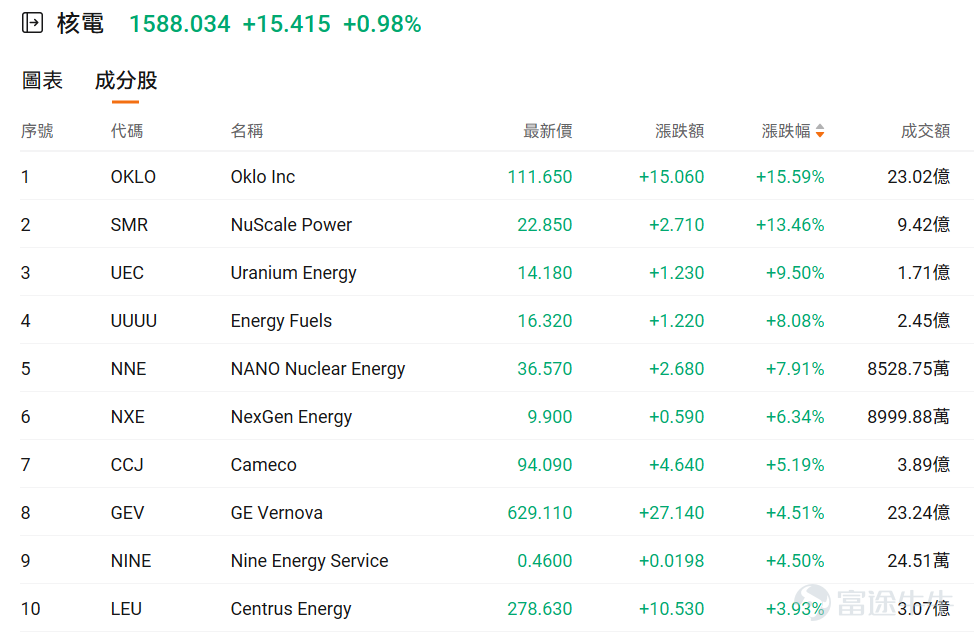
Overnight, U.S.-listed nuclear power stocks experienced a strong rebound, $Oklo Inc (OKLO.US)$ rising more than 15%, $NuScale Power (SMR.US)$ climbing over 13%, $GE Vernova (GEV.US)$ with others following suit. This sector has shown robust performance this year but recently underwent a notable pullback in November due to cracks emerging in the AI narrative.

Overall, against the backdrop of a looming electricity shortage, the application of nuclear energy has once again drawn significant attention. So, what is the current extent of the power shortage? Which companies in the nuclear power supply chain are worth monitoring?
The AI race has now shifted to the 'energy battlefield,' with Morgan Stanley predicting a 20% electricity shortfall in the U.S. by 2028.
Morgan Stanley has recently warned that by 2028, the United States could face a potential electricity shortfall of up to 20% due to AI data centers consuming large amounts of power. The bank estimates that if new electricity capacity cannot be rapidly added, the potential power deficit could reach between 13 and 44 gigawatts (GW), equivalent to the electricity consumption of over 33 million American households.

This latest figure marks an upward revision from Morgan Stanley's December forecast last year, which projected a 36 GW gap. According to the report, converting this into nuclear power plant output, 44 GW is equivalent to approximately 44 nuclear reactors.
The report mentions that the Loan Programs Office under the U.S. Department of Energy has recently stated its readiness to provide hundreds of billions of dollars in financing for nuclear projects to boost clean energy capacity and alleviate potential power supply pressures.
U.S. Secretary of Energy Chris Wright stated that he expects the electricity demand driven by artificial intelligence will attract tens of billions of dollars in equity capital to build new nuclear power capacity for "creditworthy suppliers." He noted that the Department of Energy can match private investment at a ratio of up to four-to-one through low-cost debt financing provided by the loan office.
In summary, there is growing consensus among governments, businesses, and the public thatnow is an opportune time for a nuclear renaissance.Even though ambitious construction projects may take a decade or longer and cost hundreds of billions of dollars, they will ultimately benefit both traditional nuclear companies and emerging nuclear startups, the tech industry obsessed with artificial intelligence, and investors betting on their success.
Which companies in the nuclear power supply chain are worth watching?
As early as the end of last year,"Tech Giants Race to Deploy! Could Nuclear Power Stocks Break Out by 2025, Becoming the Next Battleground for AI?" An article highlighted investment opportunities in the nuclear power industry, indicating that AI data centers will become the new "electricity guzzlers." The proportion of electricity consumed by data centers will further increase, and nuclear power will become the next battleground for AI.

From this year's market performance, these companies have also recorded significant gains, with $Oklo Inc (OKLO.US)$ rising more than fourfold, $Centrus Energy (LEU.US)$ increasing over threefold, $Energy Fuels (UUUU.US)$ surging more than twofold, $Uranium Energy (UEC.US)$ seeing its share price double, $GE Vernova (GEV.US)$ climbing over 90%.

In terms of the upstream and downstream segments of the supply chain, the SMR (Small Modular Reactor) nuclear power industry chain covers all aspects from upstream uranium mining to midstream R&D and construction, as well as downstream operations and waste management.
Upstream: Raw Materials and Processing
The upstream industrial chain primarily involves the supply of basic raw materials, key equipment, and nuclear fuel required for nuclear energy development, mainly including uranium mining and uranium enrichment.
Specifically, uranium mining includes $Cameco (CCJ.US)$ 、$Uranium Energy (UEC.US)$ 、$Energy Fuels (UUUU.US)$ 、$Denison Mines (DNN.US)$ 、$NexGen Energy (NXE.US)$ ; nuclear fuel processing$Centrus Energy (LEU.US)$ 。
UBS Group believes that the global nuclear energy renaissance is driving uranium demand into a long-term growth trajectory, with expectations that demand will increase by over 50% by 2035. On the supply side, the market is highly concentrated, and major producers are adopting a 'value-first' strategy, leading to a structurally expanding shortage expected to persist after 2030.Once utilities sign large-scale long-term contracts, it may trigger a stepwise increase in uranium prices, ushering in a decade-long bull market cycle.
Midstream: Design, Research and Development, and Construction
The midstream sector includes design, research and development, and construction. Among these,
$NuScale Power (SMR.US)$ is the first publicly listed SMR nuclear power vendor, with its core product being the SMR power module;
$Oklo Inc (OKLO.US)$ focuses on developing small modular reactors (SMRs), a company invested in by 'ChatGPT's father,' Altman;
Most notably, this year Oklo was selected as a potential power supplier for Eielson Air Force Base in Alaska, USA,and has received a 'Notice of Intent to Award' issued by the Energy Division of the U.S. Defense Logistics Agency. However, after today's market close, the company announced a stock offering plan worth up to $1.5 billion,causing its share price to decline by 7.8% during after-hours trading.
$NANO Nuclear Energy (NNE.US)$ specializes in developing small modular reactors, covering four key areas of SMR-related content, including manufacturing, fuel, transportation, and other aspects, aiming to create a diversified vertically integrated industrial chain;
$BWX Technologies (BWXT.US)$ focuses on nuclear reactor component manufacturing and nuclear technology. The biggest difference between BWXT and SMR/OKLO is that BWXT serves as a large-scale equipment supplier and technical service provider, primarily offering nuclear reactor components, nuclear fuel, and defense-related nuclear technologies for both government and commercial sectors. Its clients include the U.S. government (such as providing nuclear reactors for naval submarines).
Downstream: Operations, Sales, and Waste Management
The downstream sector mainly involves nuclear power plant operations and energy supply,Participants include $Constellation Energy (CEG.US)$ 、 $Vistra Energy (VST.US)$ 、 $American Electric Power (AEP.US)$ 、 $Southern (SO.US)$ 、 $Exelon (EXC.US)$ 、 $Duke Energy (DUK.US)$ 、 $Entergy (ETR.US)$ 、 $Public Service Enterprise Group (PEG.US)$ among others.
In addition, electrical power equipment includes $GE Vernova (GEV.US)$ 、 $Eaton (ETN.US)$ 、 $Honeywell (HON.US)$ 、 $Emerson Electric (EMR.US)$ 、 $Graham (GHM.US)$ among others.
Summary
Morgan Stanley also pointed out a key contradiction: there are currently no new nuclear reactors under construction in the United States, while the construction of nuclear power plants typically takes at least a decade. To support the expansion pace of AI, the market must rely onnatural gas, fuel cells, and grid upgrades in the short term.To address urgent needs. If you wish to explore investment opportunities in these "emergency" sectors, it is highly recommended to review this informative article:The Second Half of the AI Race — Electricity! Four Key Investment Themes in U.S. Stocks You Must Know。
Of course, looking ahead,nuclear energy remains the "comeback king."The target announced at COP28 to "triple nuclear power capacity by 2050" clearly demonstrates the global demand for low-carbon, stable baseload electricity.This demand is propelling the nuclear power sector into a new cycle of robust deployment.
Risk Disclaimer: The above content only represents the author's view. It does not represent any position or investment advice of Futu. Futu makes no representation or warranty.Read more


Comments (4)
to post a comment
76
234