
V-shaped Rebound? Is It Time to Invest in Xiaomi After Its Continuous Share Repurchases?

For the first time in history! Lei Jun takes action to increase his stake. Can Xiaomi's stock price stabilize and rebound?
Overnight, a piece of news ignited the confidence of Xiaomi Group's shareholders.
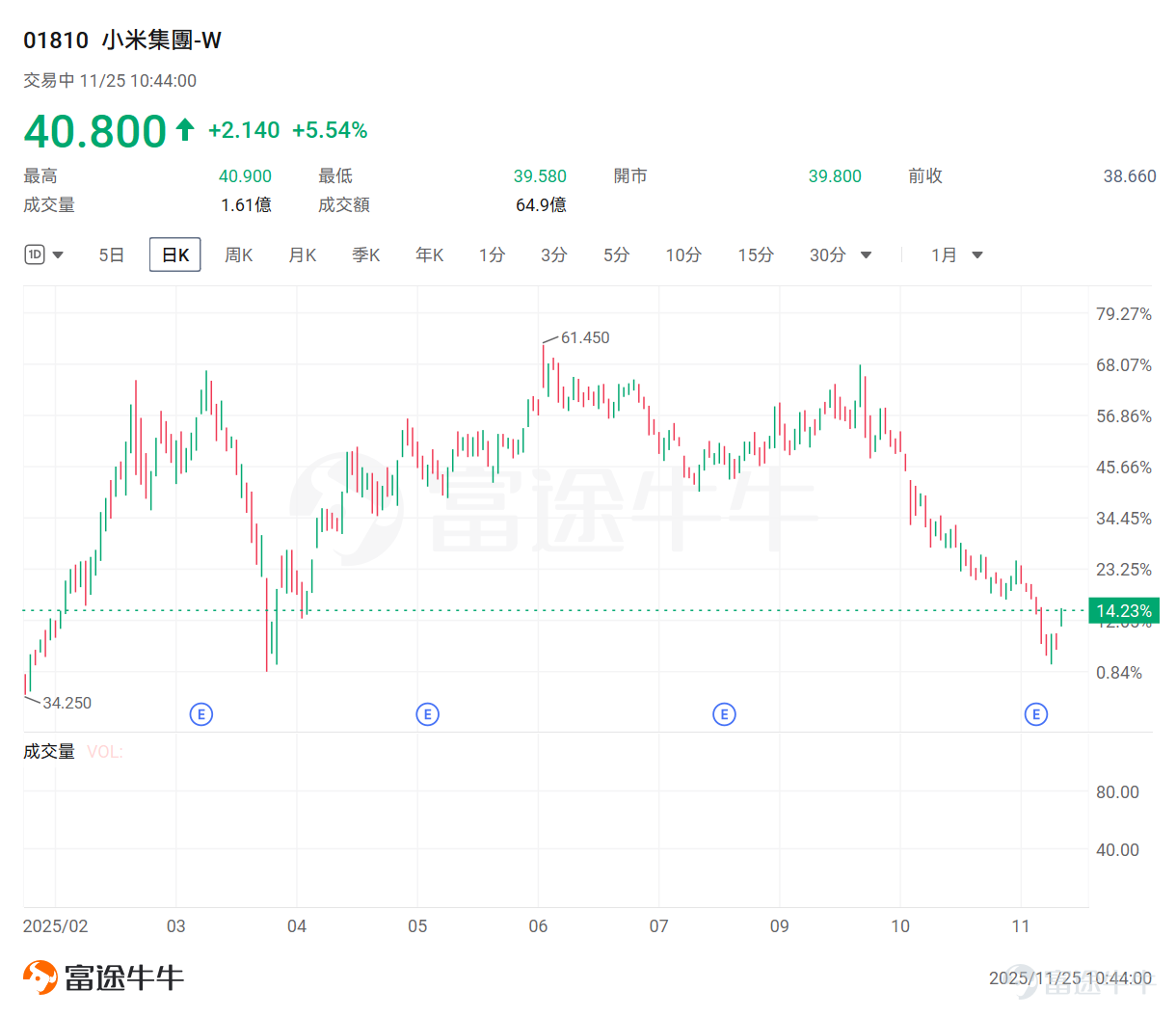
On November 24, $XIAOMI-W (01810.HK)$ According to an announcement on the Hong Kong Stock Exchange, Lei Jun, founder, chairman, and CEO of Xiaomi Group, personally invested over HKD 100 million to acquire an additional 2.6 million shares of Xiaomi Group at an average price of approximately HKD 38.58 per share, increasing his stake to 23.26%.This marks the first time Lei Jun has increased his stake in Xiaomi under his personal name, coinciding with a period of stock price correction for the company.Spurred by this news, Xiaomi reversed its recent downturn, with the stock price rebounding above HKD 40.

Notably, Xiaomi Group repurchased 21.5 million shares over two consecutive days on the 20th and 21st, spending over HKD 800 million in total.
Upon reading this, many fellow investors are interested in understanding the historical stock price trends during Xiaomi’s previous buybacks and how the future outlook should be assessed. The analysis will follow.
Reviewing Xiaomi's past operations: Can the stock price stabilize and rebound?
As can be seen from the chart below, since its listing on the Hong Kong Stock Exchange in 2018 at a price of HKD 17 per share, Xiaomi Group completed its initial fundraising, raising approximately HKD 24 billion. Subsequently, its stock price gradually retreated to around HKD 8 per share.
In 2019, taking advantage of the low stock price, Xiaomi launched a HKD 12 billion share repurchase plan. Following this, Xiaomi's stock price rebounded, reaching a high of HKD 36 per share. In 2020, the company capitalized on this peak by conducting another equity financing round, raising approximately HKD 23 billion.
However, following this round of financing, the stock price retreated once again to the HK$8 level. In 2022, Xiaomi Group initiated a new round of share repurchases. Subsequently, its stock price rose steadily from HK$8, reaching a peak of HK$60 at one point.
In March 2025, Xiaomi announced a placement of 800 million shares while the stock was trading at a high level, raising HK$42.5 billion. The stock price then dropped significantly, falling below HK$40.At this juncture, Lei Jun’s move to increase his stake inevitably led investors to speculate: Will Xiaomi's stock price stabilize and rebound?

How should we view the outlook?
Previous research has indicated thathedge funds considered Xiaomi a 'consensus short/sell' target in the short term due to the lack of catalysts.Negative sentiment stemming from factory delays and low market acceptance of electric vehicles erased most of Xiaomi's stock price gains this year, making it one of the poorer-performing stocks among Chinese technology companies.
However, Goldman Sachs’ latest research report highlighted that Xiaomi recently announced the full open-sourcing of its embodied large model MiMo-Embodied, which integrates autonomous driving and embodied intelligence technologies to achieve efficient operation in dynamic physical environments. Additionally, Xiaomi launched an enhanced version of its end-to-end assisted driving system, Hyper-Assisted Driving (HAD). The system currently boasts approximately 473,000 active users and has accumulated over 300 million kilometers of assisted driving mileage.
Goldman Sachs noted that the upgrade to the HAD system reflects the continuous evolution of Xiaomi’s autonomous driving technology, transitioning from early high-definition mapping solutions and lightweight map versions to the current integrated world model and reinforcement learning-based end-to-end architecture, enhancing decision-making capabilities. Xiaomi plans to invest over RMB 7 billion in AI research and development in 2025. Goldman Sachs expects the group to disclose more AI-related technological achievements in the coming quarters, as well as advancements in applying AI across Xiaomi’s ecosystem to promote differentiated development in its human-vehicle-home ecosystem.Goldman Sachs maintained its 'Buy' rating for Xiaomi with a target price of HK$53.5, noting that the risk-reward profile remains attractive.
In addition, Lei Jun's recent purchase of 2.6 million shares, amounting to over HKD 100 million, marks the first significant增持 by Xiaomi since its initial public offering.Market analysts indicate that share repurchases and增持s by companies and their founders are often critical signals for identifying stock price bottoms.This operation by Lei Jun and Xiaomi not only highlights the current investment value at the bottom but also reflects the strong intention of the management to align with market interests and stabilize the stock price. This action is undoubtedly a key measure to signal confidence in the company’s long-term development. As market confidence recovers, it is anticipated that the stock price will gradually reflect its true value.
Risk Disclaimer: The above content only represents the author's view. It does not represent any position or investment advice of Futu. Futu makes no representation or warranty.Read more


Comments (24)
to post a comment
63
106