
In-depth Analysis of Top Institutions' 13F Report Portfolio Adjustments

13F Disclosure | What is the logic behind the big short sellers targeting NVIDIA and Palantir? Is there currently a bubble in AI, and how should one position themselves?
Michael Burry, the investment guru who was the real-life inspiration for the protagonist in the movie 'The Big Short' and who accurately predicted the 2008 U.S. subprime mortgage crisis, has once again sparked heated market discussions.
Over the past two weeks, his Scion fund first released its 13F filing ahead of schedule,revealing bearish options positions on major AI software and hardware companies. $Palantir (PLTR.US)$ 、 $NVIDIA (NVDA.US)$ respectively.He then made several comments on social media, emphasizing that the market is currently in a bubble state and accusing tech giants of covertly extending the depreciation period of their computing chips to minimize the impact of large-scale investments on their income statements.
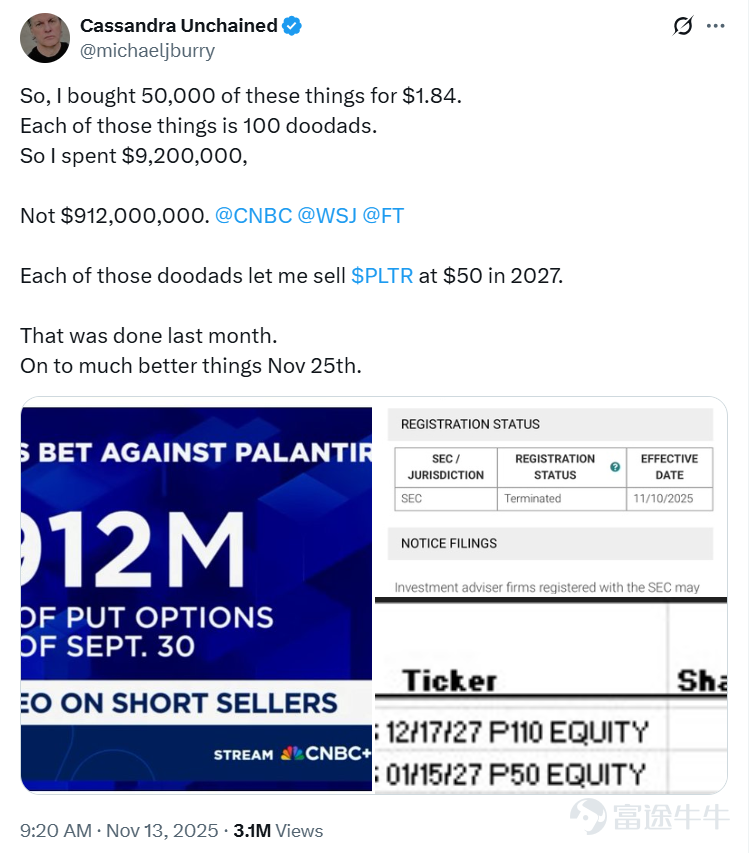
Interestingly,Burry expressed strong dissatisfaction with media reports exaggerating his "billion-dollar short," and in an unusual move, disclosed the details of his short positions to refute the claims.
The screenshots he provided clarified that his holding of 50,000 Palantir put options represented an actual investment of only $9.2 million, rather than the $912 million notional value reported by the media. Additionally, he holds 10,000 NVIDIA put options (expiring December 2027). The total actual investment for these two short positions is a far cry from their notional values.

Source: X
What is the truth behind this trade? What is the logic?
This discrepancy arises from the disclosure method used in the 13F filings.
In SEC filings, institutions are required to report their option positions based on "notional value," which reflects the theoretical exposure calculated using the market value of the underlying stock.Media outlets often mistakenly interpret this figure as the actual amount of invested capital.
For instance, Burry’s purchase of put options corresponds to 5 million shares of Palantir, with the stock price at approximately $182 at the time, leading to a reported "notional size" of $912 million. However, this represents only potential exposure, not the actual invested capital.
In other words,Burry’s actual expenditure on betting against AI stocks was just over $9 million.
Specifically, the actual situation is that he purchased $Palantir (PLTR.US)$ deep out-of-the-money LEAPS Puts expiring in 2027 with a strike price of $50.This is a typical 'tail risk hedging' strategy: by paying a limited cost, high leverage is utilized to guard against extreme market risks, with maximum losses fixed, making it a commonly used tool by professional institutions for 'high returns at low risk while protecting assets.'Essentially, this operation is not aimed at 'shorting Silicon Valley,' but rather constructing an insurance structure — should the AI bubble burst, this hedge position is expected to yield explosive profits.
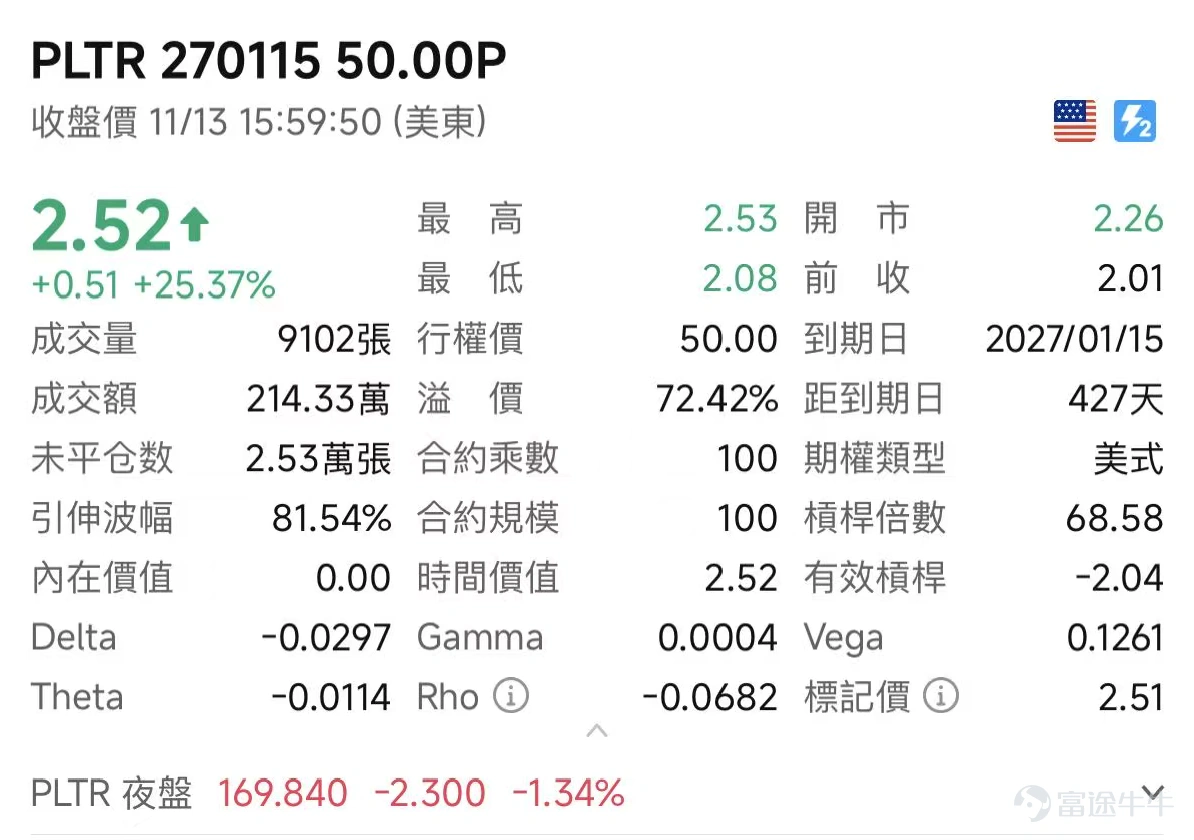
Additionally, he holds 10,000 contracts of $NVIDIA (NVDA.US)$ Puts expiring on December 17, 2027, with a strike price of $110, though the price remains undisclosed.Based on Thursday’s closing prices, these options are currently valued at $10.35 million.
Some market observers believe that Michael Burry's gains are driven by volatility. His choice of NVIDIA and Palantir as targets is primarily due to their high liquidity and beta values, which make them more suitable for executing such strategies. In the second quarter of this year, particularly in August, U.S. equity market volatility was at a low point, making it a classic setup to establish positions betting on rising volatility. The selection of these two popular stocks is because they exhibit higher betas relative to the broader market — once overall U.S. equity market volatility rebounds, these high-beta names will offer greater profit potential.
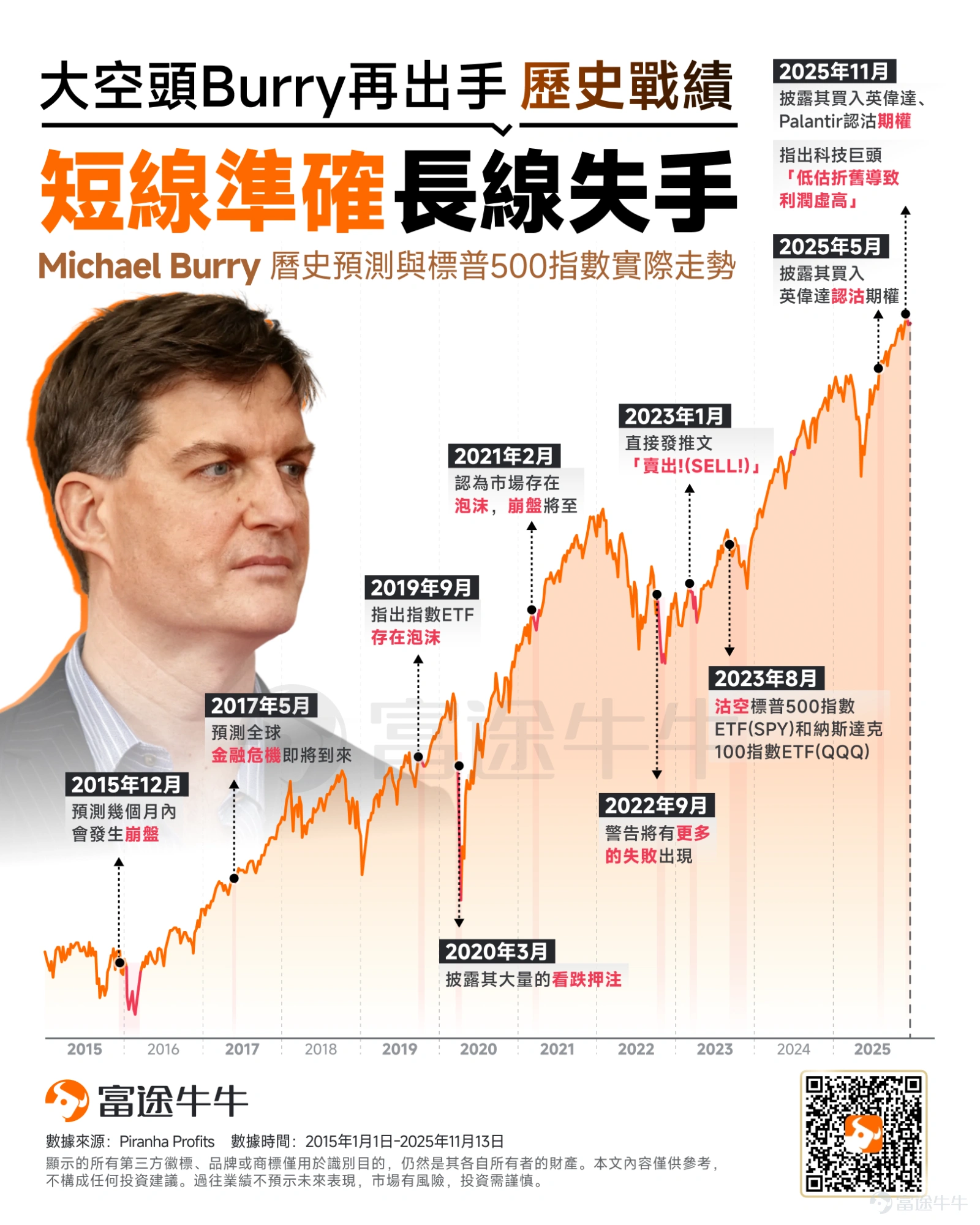
What is Michael Burry’s historical track record?
Based on the historical track record of major short sellers,they have been accurate in the short term, but the long-term trend of the U.S. stock market remains bullish.
Palantir CEO Alex Karp has also fiercely criticized Michael Burry's large-scale short selling of his company and NVIDIA, calling it "completely insane" and questioning potential market manipulation. Karp was outspoken in his criticism of short sellers, stating:
The fact that he chose to short two companies with such outstanding performance is itself highly peculiar. Attempting to short chips and ontology (referring to core AI areas) is simply madness.
He believes Burry is essentially "shorting AI," and directed his criticism at the entire practice of short selling. Karp suggested that market manipulation may be taking place:
Short selling is extremely complex. Frankly, I believe market manipulation is occurring here. We have delivered the best results in our history. I even suspect he is using public opinion to cover his position unwinding. These individuals claim to uphold morality while shorting some of the most innovative companies in the world, which is deeply hypocritical.
Interestingly, SoftBank Group disclosed in its latest earnings statementthat it had sold all of its NVIDIA shares in October. However, unlike the major short sellers, SoftBank will make an additional investment of $22.5 billion in OpenAI through Vision Fund 2 in December.This marks the Japanese giant'sfurther doubling down on artificial intelligence.,Especially after OpenAI completed its restructuring into a public benefit corporation.
Is there really a bubble in AI?
Following NVIDIA's market capitalization reaching the US$5 trillion mark, concerns over an AI bubble began to gradually emerge in global capital markets by November.
First, as 'the weakest link in AI,' the credit default swap (CDS) prices for Oracle, the most aggressive data center giant, surged overnight (with red indicating inversion), while its once surging stock price (green line) has fallen back to September levels.
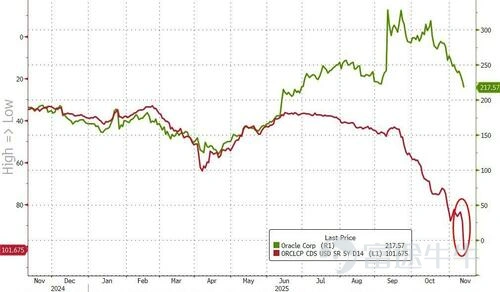
Oracle faces the challenge of needing to make multi-year capital expenditures to build infrastructure in order to meet large-scale, cash-burning orders from customers with multiple billion-dollar spending commitments. This risk exposure is beginning to raise market concerns.The market’s repricing of risks is becoming increasingly refined.
However, Mary Callahan Erdoes, CEO of JPMorgan Asset & Wealth Management, stated,Investors should focus on future opportunities brought about by artificial intelligence rather than whether there is currently a bubble.She argued: 'Artificial intelligence itself is not a bubble. It's an absurd notion...'We are on the verge of a significant, transformative shift in how businesses operate.」
Notably, Michael Arougheti, CEO of Ares Management, a global leader in alternative investment management, also stated,that he believes the current level of investment is minuscule compared to the immense potential that artificial intelligence holds.
Michael Arougheti remarked, "In terms of economic investment relative to the scale of the economy, we still have a long way to go. We cannot ramp up supply fast enough to meet near-term demand.So I think concerns about a bubble just because the valuation figures are large are unnecessary, and AI truly is revolutionary.」
Currently, investments in large AI models, computing power, and data have reached scales comparable to national budgets, with participating companies going all-in to build what they call 'capabilities.' However, behind all this,there lies a core concern: if future market demand is insufficient or lacks corresponding purchasing power, these massive investments may fail to yield substantial returns, potentially proving to be a massive bubble.
In fact, the effects of AI are already beginning to show.
Palantir, a major AI application stock that has been heavily shorted, delivered a better-than-expected Q3 earnings report and an extremely optimistic future outlook, driven by the wave of artificial intelligence.Its CEO described the growth as "extraordinary."
The growth engine of Palantir is its Artificial Intelligence Platform (AIP).Chief Revenue Officer Ryan Taylor stated during a conference call that there is "unlimited demand" for AIP, adding that "true enterprise AI at scale requires Palantir." This demand is driving a fundamental shift in customer collaboration models.
One notable trend is thatcustomers are rapidly moving from exploring individual AI use cases to enterprise-wide transformations driven by the C-suite.
Taylor cited examples such as a leading medical device manufacturer expanding its Annual Contract Value (ACV) more than eightfold just five months after signing the initial contract, with its CEO personally involved in planning the enterprise-wide AIP deployment. At another large insurance company, the CEO is directly overseeing the AI transformation, regularly meeting with Palantir's team to restructure every business process from underwriting to claims. This top-down impetus resulted in Palantir securing a record total contract value (TCV) of $2.8 billion in Q3.
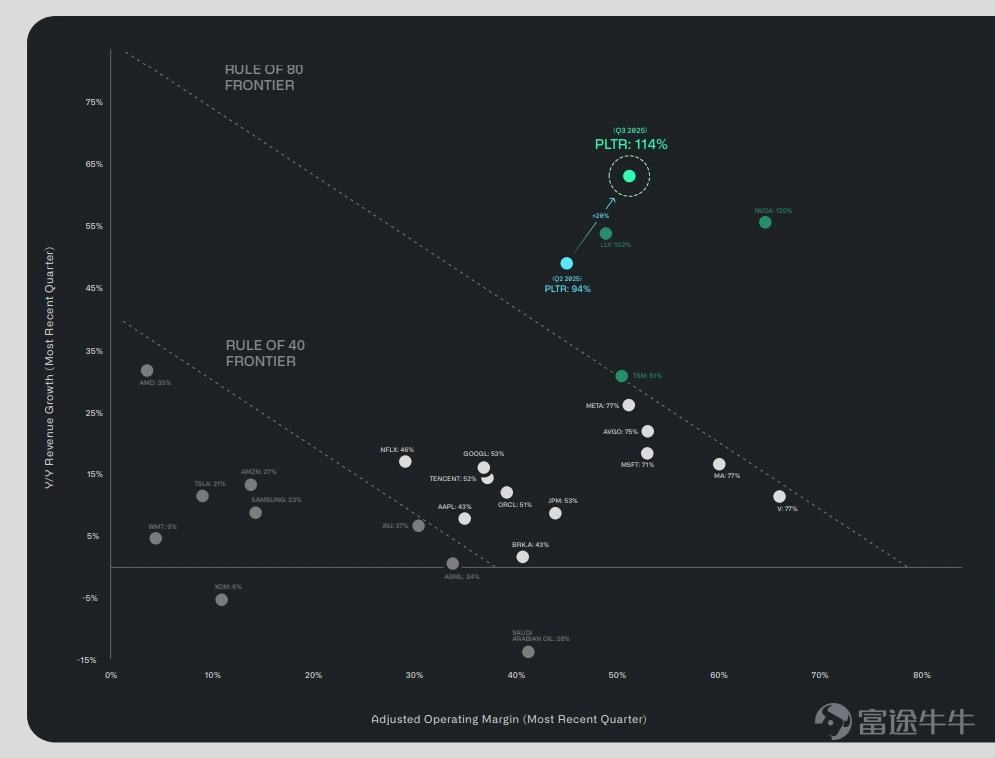
The company’s "Rule of 40" score reached 114%, achieving 63% revenue growth alongside a 51% adjusted operating margin—a rare feat in the software industry.
Source: Palantir
However, risks should not be overlooked as Q3 performance gradually comes to light.Investors have begun reassessing the lofty valuations of companies with little to no correlation to profitability.
When large, fundamentally strong companies generally report outstanding results, it becomes increasingly difficult to justify continued enthusiasm for speculative targets with weak ties to profitability.
Looking at the overall trend of the U.S. stock market, the true major trend will not reverse due to a brief pullback.On the contrary, short-term corrections during a bull market are a healthy norm, helping the market build momentum for further upward movement. As long as the primary bullish structure remains intact, there is no need for overinterpretation. At this juncture,when high-quality stocks return to reasonable valuation levels, it may be an opportune time for investors to gradually increase their positions or establish new ones.
 Stay informed about institutional holdings and keep up with the latest investment trends! Click Market > U.S. Stocks > Institutional Tracker to learn more about institutional movements!
Risk Disclaimer: The above content only represents the author's view. It does not represent any position or investment advice of Futu. Futu makes no representation or warranty.Read more


Comments (29)
to post a comment
75
245