
Options Trading Strategies | NVIDIA’s Recent Volatility: Sharp Rises and Falls?! Use Options to Secure Gains Before Earnings!
This article comes from the 'Options Market Insights' column, which aims to position itself at the forefront of investment trends, providing readers with insights into market opportunities and teaching them how to seize these opportunities using options. If you are interested, feel free to subscribe.Click hereJoin the learning experience, and you will receive notifications when subsequent updates to the column are published.
$NVIDIA (NVDA.US)$ It has always been a focal point of great market attention, and the recent sharp rise and fall in trading activity has further heightened concerns.
On October 29, the company's market capitalization reached a new high, breaking through the $5 trillion mark, accounting for approximately 8.5% of the S&P 500 Index’s weighting—surpassing the combined total of the bottom 240 companies within the index. However, the share price soon reversed downward, and by last Friday’s U.S. stock market close, its market value had shrunk to $4.57 trillion. On November 10, bolstered by positive developments in U.S. government shutdown negotiations, NVIDIA shares surged nearly 6% in a single day.
![This article comes from the 'Options Market Insights' column, which aims to position itself at the forefront of investment trends, providing readers with insights into market opportunities and teaching them how to seize these opportunities using options. If you are interested, feel free to subscribe.[Share Link: Click here]Join the learning experience, and you will receive notifications when subsequent updates to the column are published. $NVIDIA (NVDA.US)$ NVIDIA has always been a key focus in the market, and its recent sharp price fluctuations have drawn significant attention. On October 29, the company's market capitalization hit a new high, surpassing the $5 trillion mark, accounting for approximately 8.5% of the S&P 500 Index’s weight—higher than the combined value of the 240 smallest companies in the index. However, the stock price soon reversed, and by last Friday’s close on the U.S. stock market, its market cap had dropped to $4.57 trillion. On November 10, driven by positive developments in U.S. government shutdown negotiations, the stock surged nearly 6% in a single day. How should one interpret the tug-of-war between bulls and bears on NVIDIA? What are its future opportunities and challenges? What catalysts will be brought by the upcoming earnings release? At this stage, what options strategies would be suitable to capture opportunities while managing risks?Let’s address these questions one by one. How should one interpret the tug-of-war between bulls and bears on NVIDIA? First, let's discuss the previous short selling. Renowned investors such as Michael Burry (the real-life basis for the protagonist in the movie 'The Big Short') made significant short bets (with the notional value of his put options targeting NVIDIA reaching $187 million). He believes that the AI hype...$NVIDIA (NVDA.US)$ (His bet involved put options on NVIDIA with a notional value of $187 million.) He believes that the AI hype...](https://nnqimage.futunn.com/sns_client_feed/999908/20251111/web-1762846920917-T25uRqQXnE.png/big?area=2&is_public=true&imageMogr2/ignore-error/1/format/webp)
How should we interpret the tug-of-war between bulls and bears surrounding NVIDIA? What are its future opportunities and challenges? What catalysts will the upcoming earnings release bring? At this stage, what options strategies can be used to capture opportunities while managing risks?Let us address these questions one by one.
How should we interpret the tug-of-war between bulls and bears surrounding NVIDIA?
First, let us discuss the previous short-selling activities. Renowned investors such as Michael Burry (the real-life inspiration for the protagonist in the movie 'The Big Short') made significant bets against NVIDIA$NVIDIA (NVDA.US)$ (his wager on NVIDIA-targeted put options reached a notional value of $187 million). He believes that the AI boom shows signs of a bubble, with the stock price already reflecting growth expectations far into the future. Additionally, many hedge funds have taken profits, resulting in short-term selling pressure.
![This article comes from the 'Options Market Insights' column, which aims to position itself at the forefront of investment trends, providing readers with insights into market opportunities and teaching them how to seize these opportunities using options. If you are interested, feel free to subscribe.[Share Link: Click here]Join the learning experience, and you will receive notifications when subsequent updates to the column are published. $NVIDIA (NVDA.US)$ NVIDIA has always been a key focus in the market, and its recent sharp price fluctuations have drawn significant attention. On October 29, the company's market capitalization hit a new high, surpassing the $5 trillion mark, accounting for approximately 8.5% of the S&P 500 Index’s weight—higher than the combined value of the 240 smallest companies in the index. However, the stock price soon reversed, and by last Friday’s close on the U.S. stock market, its market cap had dropped to $4.57 trillion. On November 10, driven by positive developments in U.S. government shutdown negotiations, the stock surged nearly 6% in a single day. How should one interpret the tug-of-war between bulls and bears on NVIDIA? What are its future opportunities and challenges? What catalysts will be brought by the upcoming earnings release? At this stage, what options strategies would be suitable to capture opportunities while managing risks?Let’s address these questions one by one. How should one interpret the tug-of-war between bulls and bears on NVIDIA? First, let's discuss the previous short selling. Renowned investors such as Michael Burry (the real-life basis for the protagonist in the movie 'The Big Short') made significant short bets (with the notional value of his put options targeting NVIDIA reaching $187 million). He believes that the AI hype...$NVIDIA (NVDA.US)$ (His bet involved put options on NVIDIA with a notional value of $187 million.) He believes that the AI hype...](https://nnqimage.futunn.com/sns_client_feed/999908/20251111/web-1762846926313-XmuO8c7R5E.png/big?area=2&is_public=true&imageMogr2/ignore-error/1/format/webp)
The core logic of the bearish argument centers around several key points::
One is concern over valuation bubbles.As of the U.S. stock market opening on November 11, NVIDIA's price-to-earnings ratio was 56.71 (nearly 60 times on October 29), and its price-to-sales ratio was 29.28 (30.45 on October 29). This level not only far exceeds that of its peers but also surpasses the risk-reward red line set by most institutions.
Some institutions believe that at such a valuation level, investors face greater risks than potential returns. Nearly 60% of NVIDIA's revenue depends on AI server orders, while global demand for AI servers has slowed from its peak in 2024. Should growth fall short of expectations, its high valuation may face significant downward pressure.
Second, competition is intensifying.
$Advanced Micro Devices (AMD.US)$ The explosive shipment volume of the MI300 series has turned it into a strong competitor to NVIDIA. There are also reports that Microsoft and other large cloud providers have deployed MI300X in their Azure cloud services to run OpenAI’s models, which indeed poses a substantial challenge to NVIDIA's dominant position.
Meanwhile, $Intel (INTC.US)$ is also making significant investments in AI chips. Its Gaudi 3 chip aims to compete with NVIDIA's H100 products. Additionally, $Alphabet-C (GOOG.US)$ 、 $Amazon (AMZN.US)$ 、 $Microsoft (MSFT.US)$ these companies are also continuously advancing their self-developed AI chips. While they have yet to shake NVIDIA's leading market position, in the long term, they could pose a potential threat to NVIDIA's pricing power and market share.
Third, geopolitical risks.The U.S. export controls on high-end chips have restricted NVIDIA's sales in key global markets such as China, raising market concerns that this could become a ceiling for NVIDIA's growth.Fourth is the amplification effect of sentiment.In a market environment characterized by high positions and high congestion, large-scale short selling can easily trigger quant strategies to follow suit and retail panic selling, further exacerbating stock price volatility.
However, data shows that the overall short interest in the market is declining. Compared to late October, both the total volume and proportion of short selling have significantly decreased. The put/call ratio in options also dropped from a peak of 0.75 on November 6 to 0.48 at the close of the U.S. stock market on November 10, indicating a notable increase in call option trading.
![This article comes from the 'Options Market Insights' column, which aims to position itself at the forefront of investment trends, providing readers with insights into market opportunities and teaching them how to seize these opportunities using options. If you are interested, feel free to subscribe.[Share Link: Click here]Join the learning experience, and you will receive notifications when subsequent updates to the column are published. $NVIDIA (NVDA.US)$ NVIDIA has always been a key focus in the market, and its recent sharp price fluctuations have drawn significant attention. On October 29, the company's market capitalization hit a new high, surpassing the $5 trillion mark, accounting for approximately 8.5% of the S&P 500 Index’s weight—higher than the combined value of the 240 smallest companies in the index. However, the stock price soon reversed, and by last Friday’s close on the U.S. stock market, its market cap had dropped to $4.57 trillion. On November 10, driven by positive developments in U.S. government shutdown negotiations, the stock surged nearly 6% in a single day. How should one interpret the tug-of-war between bulls and bears on NVIDIA? What are its future opportunities and challenges? What catalysts will be brought by the upcoming earnings release? At this stage, what options strategies would be suitable to capture opportunities while managing risks?Let’s address these questions one by one. How should one interpret the tug-of-war between bulls and bears on NVIDIA? First, let's discuss the previous short selling. Renowned investors such as Michael Burry (the real-life basis for the protagonist in the movie 'The Big Short') made significant short bets (with the notional value of his put options targeting NVIDIA reaching $187 million). He believes that the AI hype...$NVIDIA (NVDA.US)$ (His bet involved put options on NVIDIA with a notional value of $187 million.) He believes that the AI hype...](https://nnqimage.futunn.com/sns_client_feed/999908/20251111/web-1762846923842-Wj3EdVLCCg.jpeg/big?area=2&is_public=true&imageMogr2/ignore-error/1/format/webp)
On the other side, the bulls remain steadfast. Several institutions (Citi, Goldman Sachs, Morgan Stanley, etc.) have raised their target prices over the past two weeks, with the average market target price currently around $237. In terms of institutional holdings, top-tier institutions such as Vanguard, Blackrock, and State Street collectively hold nearly 30% of NVIDIA’s shares, with total institutional ownership at 67.84%, showing no signs of significant reductions. This cornerstone demonstrates these professional institutions' recognition of NVIDIA’s long-term value.
![This article comes from the 'Options Market Insights' column, which aims to position itself at the forefront of investment trends, providing readers with insights into market opportunities and teaching them how to seize these opportunities using options. If you are interested, feel free to subscribe.[Share Link: Click here]Join the learning experience, and you will receive notifications when subsequent updates to the column are published. $NVIDIA (NVDA.US)$ NVIDIA has always been a key focus in the market, and its recent sharp price fluctuations have drawn significant attention. On October 29, the company's market capitalization hit a new high, surpassing the $5 trillion mark, accounting for approximately 8.5% of the S&P 500 Index’s weight—higher than the combined value of the 240 smallest companies in the index. However, the stock price soon reversed, and by last Friday’s close on the U.S. stock market, its market cap had dropped to $4.57 trillion. On November 10, driven by positive developments in U.S. government shutdown negotiations, the stock surged nearly 6% in a single day. How should one interpret the tug-of-war between bulls and bears on NVIDIA? What are its future opportunities and challenges? What catalysts will be brought by the upcoming earnings release? At this stage, what options strategies would be suitable to capture opportunities while managing risks?Let’s address these questions one by one. How should one interpret the tug-of-war between bulls and bears on NVIDIA? First, let's discuss the previous short selling. Renowned investors such as Michael Burry (the real-life basis for the protagonist in the movie 'The Big Short') made significant short bets (with the notional value of his put options targeting NVIDIA reaching $187 million). He believes that the AI hype...$NVIDIA (NVDA.US)$ (His bet involved put options on NVIDIA with a notional value of $187 million.) He believes that the AI hype...](https://nnqimage.futunn.com/sns_client_feed/999908/20251111/web-1762846922305-ShM7kEGmkL.jpeg/big?area=2&is_public=true&imageMogr2/ignore-error/1/format/webp)
The bull case is also clear: confidence in its unshakable moat, robust order books, and strong financial performance, coupled with vigorous industry demand driving momentum.
$NVIDIA (NVDA.US)$ The biggest barrier is not a single chip but rather NVIDIA’s CUDA ecosystem. Millions of developers globally are 'tied' to this ecosystem, with extremely high costs and thresholds for switching to competing platforms. On the hardware side, through deep integration with Taiwan Semiconductor, NVIDIA reportedly has secured priority access to key capacities of next-generation A16 processes and CoWoS advanced packaging, solidifying its leading position on the supply side.
Market expectations for future growth are extremely high. At the GTC conference, NVIDIA revealed that its Blackwell and next-generation Rubin architecture products have a potential market size of $500 billion over their lifecycle, showcasing immense market opportunities. Additionally, industry developments such as OpenAI signing a $3.8 billion computing power contract with AWS indirectly lock in long-term demand for NVIDIA’s high-end chips.
Looking at one piece of data regarding industry demand: $Alphabet-C (GOOG.US)$ 、 $Meta Platforms (META.US)$ 、 $Microsoft (MSFT.US)$ 、 $Amazon (AMZN.US)$ The combined capital expenditures of the four companies in the third quarter amounted to $112.5 billion, marking an 18.4% increase from the previous quarter with an increment of $17.5 billion. It is evident that investment in computing infrastructure remains robust, providing NVIDIA with a solid foundational support.
The core of the tug-of-war between bulls and bears is essentially the contest between 'valuation' and 'growth.' NVIDIA may currently be at the crossroads of 'short-term correction' and 'long-term value.'
What can be anticipated is as follows:The wave of applications for generative AI is far from over, spanning text, images, and video. The iterative advancements in models are driving ever-increasing demand for computational power, positioning NVIDIA as the most critical infrastructure provider in this transformation. Additionally, NVIDIA is expanding its technological footprint into areas such as quantum computing, 6G communications, biomedicine, and robotics, representing vast potential markets for the future.
Perhaps the concept of 'AI factories' proposed by Jensen Huang will one day come to fruition, enabling AI computing to permeate every industry from cloud data centers, becoming as fundamental as utilities like water and electricity.
Nevertheless, it is important to remain cautious,as market expectations for NVIDIA continue to rise. Any shortfall in performance could lead to short-term headwinds. This includes factors such as valuation, competition, policy, and sentiment, as well as potential risks on the supply side (the CoWoS capacity bottleneck at Taiwan Semiconductor), and their subsequent impact on financial results.
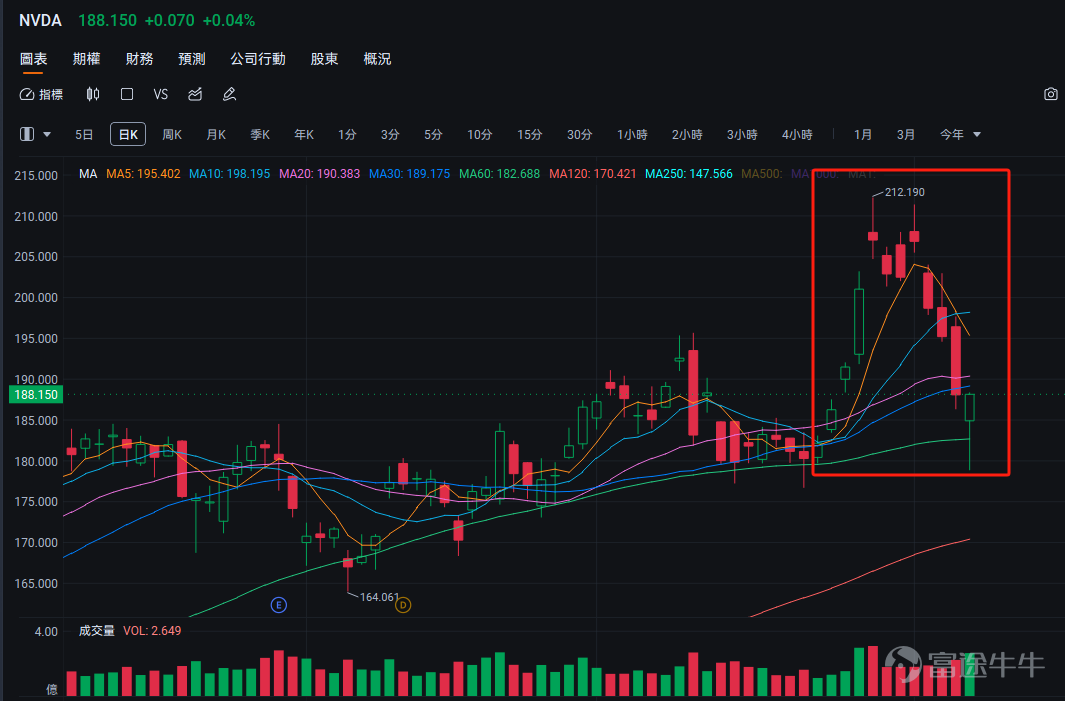
From a technical perspective,As of the opening of the U.S. stock market on November 11, the stock price has risen above all moving averages, indicating a strong rebound trend. The RSI shows a golden cross signal, suggesting potential short-term upward movement. The histogram of the MACD below the zero axis has narrowed, indicating weakened downward momentum, but a golden cross has yet to form, so the medium-term trend has not fully turned bullish.
From the perspective of the BOLL line, the stock price is currently above the middle band. If it continues to approach or even break through the upper band (209.968), an accelerated upward movement may occur; if it falls back to or below the middle band (190.919), the trend may shift to consolidation.
In terms of resistance and support, the psychological level of $200, the historical high (207.04), and the upper BOLL line (209.968) constitute strong resistance levels. A breakout will require increased trading volume. If successful, the stock could target the psychological level of $215. For support, attention should be paid to the 20-day moving average (190.92). If broken, potential support may be found at the 60-day moving average (182.998) and the November 7 low (178.91).
![This article comes from the 'Options Market Insights' column, which aims to position itself at the forefront of investment trends, providing readers with insights into market opportunities and teaching them how to seize these opportunities using options. If you are interested, feel free to subscribe.[Share Link: Click here]Join the learning experience, and you will receive notifications when subsequent updates to the column are published. $NVIDIA (NVDA.US)$ NVIDIA has always been a key focus in the market, and its recent sharp price fluctuations have drawn significant attention. On October 29, the company's market capitalization hit a new high, surpassing the $5 trillion mark, accounting for approximately 8.5% of the S&P 500 Index’s weight—higher than the combined value of the 240 smallest companies in the index. However, the stock price soon reversed, and by last Friday’s close on the U.S. stock market, its market cap had dropped to $4.57 trillion. On November 10, driven by positive developments in U.S. government shutdown negotiations, the stock surged nearly 6% in a single day. How should one interpret the tug-of-war between bulls and bears on NVIDIA? What are its future opportunities and challenges? What catalysts will be brought by the upcoming earnings release? At this stage, what options strategies would be suitable to capture opportunities while managing risks?Let’s address these questions one by one. How should one interpret the tug-of-war between bulls and bears on NVIDIA? First, let's discuss the previous short selling. Renowned investors such as Michael Burry (the real-life basis for the protagonist in the movie 'The Big Short') made significant short bets (with the notional value of his put options targeting NVIDIA reaching $187 million). He believes that the AI hype...$NVIDIA (NVDA.US)$ (His bet involved put options on NVIDIA with a notional value of $187 million.) He believes that the AI hype...](https://nnqimage.futunn.com/sns_client_feed/999908/20251111/web-1762846921134-x1nIHzBWCy.png/big?area=2&is_public=true&imageMogr2/ignore-error/1/format/webp)
It can be said that the current battle between bulls and bears represents the market recalibrating its expectations for NVIDIA. The bears are leveraging short-term negative factors and valuation pressures, while the bulls remain confident in NVIDIA's ecosystem moat and long-term growth narrative.The outcome of this tug-of-war will hinge on whether NVIDIA can demonstrate, through robust data and guidance in its earnings report scheduled for November 19, that its growth engine remains strong enough to justify or even exceed current valuation levels.
What catalysts will the upcoming earnings release bring?
$NVIDIA (NVDA.US)$ NVIDIA’s earnings releases have always been pivotal market events, often triggering significant stock price volatility. Over the past ten quarters, the average daily volatility on NVIDIA’s earnings day has been approximately 7.21%, ranging from 0.1% to 24.37%. For this upcoming release, the market anticipates a volatility range of ±7.72% (based on data as of the opening of the U.S. stock market on November 11).
![This article comes from the 'Options Market Insights' column, which aims to position itself at the forefront of investment trends, providing readers with insights into market opportunities and teaching them how to seize these opportunities using options. If you are interested, feel free to subscribe.[Share Link: Click here]Join the learning experience, and you will receive notifications when subsequent updates to the column are published. $NVIDIA (NVDA.US)$ NVIDIA has always been a key focus in the market, and its recent sharp price fluctuations have drawn significant attention. On October 29, the company's market capitalization hit a new high, surpassing the $5 trillion mark, accounting for approximately 8.5% of the S&P 500 Index’s weight—higher than the combined value of the 240 smallest companies in the index. However, the stock price soon reversed, and by last Friday’s close on the U.S. stock market, its market cap had dropped to $4.57 trillion. On November 10, driven by positive developments in U.S. government shutdown negotiations, the stock surged nearly 6% in a single day. How should one interpret the tug-of-war between bulls and bears on NVIDIA? What are its future opportunities and challenges? What catalysts will be brought by the upcoming earnings release? At this stage, what options strategies would be suitable to capture opportunities while managing risks?Let’s address these questions one by one. How should one interpret the tug-of-war between bulls and bears on NVIDIA? First, let's discuss the previous short selling. Renowned investors such as Michael Burry (the real-life basis for the protagonist in the movie 'The Big Short') made significant short bets (with the notional value of his put options targeting NVIDIA reaching $187 million). He believes that the AI hype...$NVIDIA (NVDA.US)$ (His bet involved put options on NVIDIA with a notional value of $187 million.) He believes that the AI hype...](https://nnqimage.futunn.com/sns_client_feed/999908/20251111/web-1762846920867-V8KdC32BeV.png/big?area=2&is_public=true&imageMogr2/ignore-error/1/format/webp)
Market expectations for the upcoming earnings release (to be announced after the U.S. market close on November 19) are extremely high. Revenue is expected to reach $54.768 billion, marking a 17% quarter-over-quarter increase. Earnings per share (EPS) are forecasted at $1.194, representing a year-over-year growth of approximately 25%. Data center revenue is anticipated to surpass $50 billion, accounting for 88% of total revenue with a year-over-year growth rate maintained above 50%.
If actual results fall short of or merely meet expectations, it could trigger a sharp 'expectation gap' sell-off.
History provides precedent: In the earnings report published in August 2025, NVIDIA’s data center revenue came in at $41.1 billion, slightly below market expectations of $41.3 billion (a shortfall of just $200 million), which caused the stock to plummet over 5% in after-hours trading, wiping out more than $100 billion in market capitalization instantly. During this sensitive period, any minor flaw could be interpreted as a signal of 'peak growth.'
If actual performance significantly exceeds expectations, it will strongly reinforce investor confidence, demonstrating that the growth engine remains robust enough to support or even surpass current high valuations.
More specifically, several key areas of market focus should be closely monitored:
One is the delivery progress of Blackwell.Investors are paying close attention to management's solutions for overheating issues and the mass production timeline. If confirmed,the goal of shipping 20 million units by 2026 remains unchanged,it will greatly boost confidence. Conversely, any delay could trigger a sell-off. This aspect largely determines whether data center revenue can maintain high growth.
Another focal point is the trend in gross margin.The market expects it to remain at a high level of 70-73%. However, initial mass production costs for Blackwell and inventory write-downs for H20 may exert pressure. If the gross margin falls below70%, it will be considered a significant negative factor.
Another one is the management's forward guidance.This is a very important source of market confidence, and the key is to...Forecast of Revenue Growth for Fiscal Year 2027。
What options strategy is suitable for capturing opportunities and controlling risks at present?
Let's look at it from several situations:
1. If you do not hold$NVIDIA (NVDA.US)$Stocks, but if considering buying at a relatively low price, then one might consider a selling Put strategy. When the stock price retraces again, or when the implied volatility (IV) rises to its peak before earnings, it may be a better timing. IV reflects the expectation of future price fluctuations; the higher the IV, the greater the market anticipates future stock price volatility. Generally speaking, before earnings announcements, IV tends to gradually rise to its highest point and then quickly decline after the announcement.
2. If you hold NVIDIA stock but are concerned that short-term uncertainty may lead to significant pullbacks, you might consider generating some income by selling calls to partially offset the losses from a decline in stock price, forming a Covered Call strategy. Alternatively, you could buy puts to hedge against downside risk, or you could implement both strategies simultaneously (which would create a Long Collar strategy).
3. If you only want to trade options and do not want to get involved with stocks:
● When expecting a rise in stock price, consider implementing a Bull Call Spread strategy. Purchase one Call option to bet on the stock price increase while simultaneously selling another Call with a higher strike price to reduce the cost of the bullish strategy.
● When expecting a decline in stock price, consider implementing a Bull Put Spread strategy. Purchase one Put option to bet on the stock price decrease while simultaneously selling another Put with a lower strike price to offset the cost of the bearish strategy.
● If uncertain about the direction of stock price volatility but anticipate significant fluctuations after earnings, consider implementing a Long Straddle strategy. Simultaneously purchase one Call and one Put option with the same strike price. As long as the stock price fluctuates significantly, profits from one side can offset losses from the other.
BelowTaking the strategies of [Not holding stock + Selling Put] and [Holding stock + Selling Call] as examples,a more detailed explanation will be provided.
1. [Not holding stock + Selling Put strategy]
● Applicable Scenarios:What do you think?$NVIDIA (NVDA.US)$ The stock price is not expected to fall significantly in the near term, and there is a desire to purchase NVIDIA at a relatively low price (while maintaining sufficient cash to cover the purchase). Additionally, it is acceptable if the stock price does not reach the option's strike price, resulting in no shares being acquired.
● Operation:Click hereYou can directly access NVIDIA’s options chain. Sell out-of-the-money Puts. Choose a strike price at which you are willing to take delivery of the shares. Regarding expiration dates, both near-term and long-term options have their respective advantages and disadvantages: nearer expirations carry higher delivery risk but allow premiums to be secured more quickly, whereas longer-dated options work conversely. However, if you are indeed willing to take delivery, nearer expirations may be worth considering.
![This article comes from the 'Options Market Insights' column, which aims to position itself at the forefront of investment trends, providing readers with insights into market opportunities and teaching them how to seize these opportunities using options. If you are interested, feel free to subscribe.[Share Link: Click here]Join the learning experience, and you will receive notifications when subsequent updates to the column are published. $NVIDIA (NVDA.US)$ NVIDIA has always been a key focus in the market, and its recent sharp price fluctuations have drawn significant attention. On October 29, the company's market capitalization hit a new high, surpassing the $5 trillion mark, accounting for approximately 8.5% of the S&P 500 Index’s weight—higher than the combined value of the 240 smallest companies in the index. However, the stock price soon reversed, and by last Friday’s close on the U.S. stock market, its market cap had dropped to $4.57 trillion. On November 10, driven by positive developments in U.S. government shutdown negotiations, the stock surged nearly 6% in a single day. How should one interpret the tug-of-war between bulls and bears on NVIDIA? What are its future opportunities and challenges? What catalysts will be brought by the upcoming earnings release? At this stage, what options strategies would be suitable to capture opportunities while managing risks?Let’s address these questions one by one. How should one interpret the tug-of-war between bulls and bears on NVIDIA? First, let's discuss the previous short selling. Renowned investors such as Michael Burry (the real-life basis for the protagonist in the movie 'The Big Short') made significant short bets (with the notional value of his put options targeting NVIDIA reaching $187 million). He believes that the AI hype...$NVIDIA (NVDA.US)$ (His bet involved put options on NVIDIA with a notional value of $187 million.) He believes that the AI hype...](https://nnqimage.futunn.com/sns_client_feed/999908/20251111/web-1762846922769-la0DoDhds6.jpeg/big?area=2&is_public=true&imageMogr2/ignore-error/1/format/webp)
(The above image is for educational purposes only and does not constitute any investment advice.)
● Is this an appropriate time?The optimal timing for this strategy is when the stock price falls to a support level and implied volatility (IV) is at a high, though these two conditions do not always coincide. You can execute when one condition reaches its peak. For instance, operating when IV spikes to a high on earnings day allows you to benefit to some extent from the decline in IV after the earnings release.
● What are the costs and potential returns?
Below is an example of selling one Put option with a strike price of $185 and an expiration date of November 28, 2025, based on closing data from the U.S. stock market on November 10. This transaction initially generates a net income of $373, with a required margin of approximately $4,600.
1) If the stock price does not fall below $185 until the close on November 28, your profit will be maximized. Excluding fees, your profit would be $373.
2) If the stock price falls below $185 before expiration and the options market remains sufficiently liquid, it is highly likely that the option will not be exercised. In this case, you may choose to take no action. The unrealized loss displayed in your account might appear significant, requiring some tolerance for such figures—unrealized losses on open positions are not actual realized losses. Conversely, if the stock price rises significantly prior to expiration and the option becomes deeply in-the-money, you may consider taking partial profits to trade potential gains for time.
3) If the stock price is below $185 at the close on November 28, it is highly probable that you will be assigned, requiring you to purchase 100 shares of NVIDIA stock at $185 per share, which would cost approximately $18,500. Therefore, ensure sufficient funds are available. At this point, your effective purchase cost, after deducting the premium received (excluding fees), would be approximately $181.27 ($185 - $3.73).
4) Lastly, I remind everyone to manage their risk carefully, with the most important aspect being to monitor your position size. The capital utilization ratio for this transaction should not be too high, and you should calculate the number of options contracts you can trade based on the maximum amount of stock your net assets can support, leaving a margin to avoid potential liquidation.
Risk Warning: Options trading involves risks. The premium paid for buying options may be entirely lost, and the potential maximum loss when selling options can be substantial. The information above is for reference only and does not constitute any investment advice. Investors should make decisions cautiously based on their own risk tolerance.
2. [Stock Holding + Sell Call Strategy]
● Applicable Scenarios:You hold NVIDIA stock but are concerned about downside risk and are willing to accept the possibility of being exercised when the stock price reaches the strike price of the call option, thereby forfeiting further upside profit potential.
● Operation:Click hereYou can directly access NVIDIA's options chain. While holding the stock, sell an out-of-the-money Call. Choose a strike price that you believe will not be breached. The expiration date can be set for a period when you anticipate higher downside risk.
● Is now an appropriate time?The best timing for this strategy is when the stock price rises to a resistance level and cannot break through, and implied volatility (IV) is at a high point. However, these two conditions do not necessarily occur simultaneously, so you can act when one condition reaches its peak. For instance, if IV surges to a high on earnings day, you can benefit to some extent from the decline in IV after the earnings announcement.
● What are the costs and benefits?
Below is an example of 'selling 1 call option expiring on November 28 with a strike price of $220,' based on the closing data of the US stock market on November 10. This transaction initially yields a net income of $265. Assuming you hold 100 shares of NVIDIA stock, there would essentially be no margin requirement.
1) If the stock price does not rise above $220 until the close on November 28, your profit will be maximized. Excluding transaction fees, your profit will be $265, which can partially offset losses caused by a decline in the stock price.
2) If the stock price rises above $220 before expiration and liquidity in the options market is sufficient, it is highly likely that the option will not be exercised. In this case, you can choose to take no action. At this point, your account may show significant unrealized losses, requiring a certain tolerance for such figures, as unrealized losses on open positions are not actual losses. Additionally, if the stock price falls significantly before expiration and the option becomes deeply out-of-the-money, you may consider taking partial profits to trade time for potential further upside.
3) If the stock price is above $220 at the close on November 28, it is highly likely that you will be assigned, requiring you to sell 100 shares of NVIDIA stock at $220. Afterward, any further increase in NVIDIA's share price will no longer affect you.
4) Finally, a reminder to everyone to manage risk appropriately. Since this is a hedging strategy against potential declines in stock prices, ensure that the number of Calls sold and the corresponding number of shares do not exceed the quantity of NVIDIA shares you currently hold.
Risk Warning: Options trading involves risks. The premium paid for buying options may be entirely lost, and the potential maximum loss when selling options can be substantial. The information above is for reference only and does not constitute any investment advice. Investors should make decisions cautiously based on their own risk tolerance.
That’s all for today. WelcomeClick hereJoin the learning group, and you will receive notifications when new updates to the column are published. We also strongly welcome any specific content suggestions!
Lastly, fellow investors looking to start investing in Hong Kong stock options in the current market might considerClick hereclaiming a beginner's options package worth up to HK$2188! If you are new to options, you can start by practicing with simulated trading to take advantage of these popular opportunities!
Futu Securities Analyst Wei Wenbo
License Number: BUI890
(The author is a licensed person with the Securities and Futures Commission, and neither they nor their associates hold any financial interest in the recommended stock issuer.)
Risk Disclaimer: The above content only represents the author's view. It does not represent any position or investment advice of Futu. Futu makes no representation or warranty.Read more


Comments (147)
to post a comment
205
75