
Inflation heats up, central banks turn hawkish! Is the wind changing for gold prices?

When Gold Becomes an Alternative to U.S. Treasuries: The Logic of Stock Picking in Hong Kong Amid $75 Oil Prices
In October, after repeatedly hitting record highs, the gold price nearly reached $4,400 per ounce on October 20 before swiftly adjusting. Within six trading days, it once fell below the $4,000 mark, exhibiting roller-coaster-like volatility. Is this the end of the gold rally, or are there still opportunities for medium- to long-term bottom-fishing investments?
The previously soaring gold prices have suddenly made gold the "belief" of global investors. However, if asked to elaborate on the reasons behind the surge in gold prices, many might feel perplexed, such as:
The mainstream view holds that the rise in gold prices is driven by geopolitical uncertainties worldwide, prompting central banks to hoard gold as a hedge against risks, rapidly pushing up gold prices.
This perspective has garnered significant support and is quite popular in the global capital markets. We also acknowledge its partial validity, but remain skeptical when it comes to verification.
This article will adopt a fresh perspective by placing gold prices within the analytical framework of the global financial and capital markets. It will deduce the formation of high gold prices, forecast the medium- and short-term trends of gold, and infer the medium- and short-term performance of gold-related enterprises in the secondary market.
Core Viewpoint:
Firstly, behind the rise in gold prices lies the slump in oil prices; under the influence of geopolitical factors, a strong linkage among gold, U.S. Treasury bonds, and oil has emerged, driving up gold prices.
Secondly, considering the current international situation and U.S. domestic politics, as long as oil prices remain below $75 per barrel, gold prices will be highly predictable, with gold serving as an alternative to U.S. Treasury bonds.
Thirdly, the stability of gold directly benefits gold mining companies, and this sector in the Hong Kong stock market will likely remain bullish in the medium to short term.
The Anchor of Rising Gold Prices: The Slump in Oil Prices
In the mainstream global asset valuation models, the discount rate (based on the yield of the 10-year U.S. Treasury bond) is a crucial variable; in other words, when global interest rates rise, it should generally be bearish for capital valuations.
This round of gold price increases began at the start of 2024, when factors such as interest rate hikes caused the yield on US ten-year treasury bonds to exceed 4%, a recent high. At this exact moment, the rally in gold prices began, which clearly contradicts the mainstream analytical framework.
Even though many have explained this using 'geopolitical' factors, arguing that central banks worldwide are aggressively increasing their gold reserves to hedge against dollar risk, causing a surge in demand that has driven gold prices sharply higher.
At first glance, this view seems quite reasonable; however, geopolitical tensions erupted in early 2022 (with the Russia-Ukraine war). Why did it take two years for gold prices to rebound (by which time the war had already become normalized)? What accounts for the two-year lag? Many remain divided on this question. Later, some introduced the risk of US deficits, suggesting that as the credibility of the United States comes under scrutiny, global investors are compelled to seek safer investment products.
While these perspectives all hold some merit, none can be considered entirely flawless when applied to real-world scenarios.
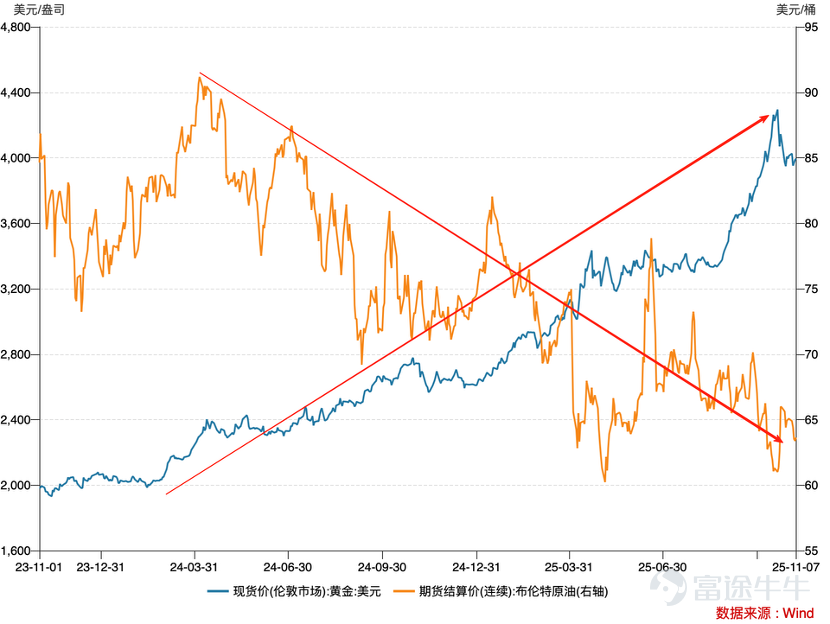
In our analysis, we first established a strong correlation between gold and oil prices to develop a new analytical framework, as shown in the figure below.

As gold stands at the starting point of a new surge, global oil prices have begun to decline (thereby bidding farewell to the $90 per barrel price). Subsequently, the two trend lines in the above chart move almost in completely opposite directions, with rising gold prices coinciding with falling oil prices.
Why is there such a strong correlation between gold prices and oil prices—is this merely a coincidence or an inevitable relationship?
Here, let us revisit the concept of the 'petrodollar': In the 1970s, the United States reached an agreement with Saudi Arabia, then the world's largest oil producer, to establish the US dollar as the currency for pricing oil, a decision subsequently endorsed by other OPEC member states. The US dollar became tightly linked to oil, and economies engaging in oil transactions on international markets required dollars, naturally leading to the dollar's status as a global reserve currency.
Thereafter, the dollar became highly correlated with oil, with the latter's price influencing the strength or weakness of the dollar to some extent.

Following 2022, oil prices fell amid the Federal Reserve's interest rate hikes, and after 2024, they declined even more rapidly. Correspondingly, the US Dollar Index showed signs of fatigue, once again validating the strong correlation between oil prices and the dollar.
Previously, the capital market believed that the decline in the US Dollar Index was mainly driven by interest rate cuts. However, within the analytical framework of this article, the sluggish oil prices represent an often overlooked but highly significant 'hidden factor.'

For global capital markets, the dollar weakness caused by falling oil prices has significantly reduced the attractiveness of US Treasuries. Since 2024, US Treasury yields have remained relatively stable (with bond market prices also stable but insufficient buyer demand). In contrast, the decline in the US Dollar Index has been more pronounced: due to concerns over continued dollar depreciation, global investors have adopted a more cautious stance towards US Treasuries. For instance, from late 2024 to now, the US Dollar Index has fallen nearly 10%, rendering the approximately 4% bond yield negligible in the face of dollar depreciation.
From this, we have essentially clarified the transmission mechanism behind the rise in gold prices:
Decline in oil prices — Dollar depreciation — Insufficient demand for US Treasuries — Gold becomes an alternative to US Treasuries — Surge in gold prices.
Oil prices below $75 benefit Hong Kong stock market gold mining companies.
At this point in the analysis, many readers are already highly concerned about the sustained trend of gold prices and the positive implications for related investment opportunities. Continuing along the same line of thought, we will now forecast the future trajectory of oil prices.
The fluctuations in oil prices from 2022 to the present can be divided into the following phases:
1) Early 2022 to 2024: The Federal Reserve entered a rate hike cycle to combat inflation, and the global market fully accepted and anticipated the decline in oil prices, meaning market forces determined oil prices;
2) Late 2024 to the present: Although the US CPI has stabilized, oil prices have continued to fall uncontrollably. At this stage, the main determinant of oil prices is no longer the market, but rather 'geopolitics.' Simply put,in order to suppress Russia in financial and foreign exchange markets, major Western countries have depressed oil prices (a key source of Russia's foreign exchange revenue), making the US dollar a casualty of this round of geopolitical tensions.
Following Donald Trump's inauguration as the U.S. President in 2025, his immediate mediation efforts between Russia and Ukraine implicitly suggest that:If the Russia-Ukraine war cannot be resolved appropriately — global oil prices will struggle to rise — demand for U.S. Treasury bonds will remain insufficient — gold is likely to maintain its upward trajectory.
Based on the above analysis, when we assess gold prices, we are essentially forecasting oil prices. Recent reports from multiple media outlets (indicating weaker-than-expected global economic growth), combined with the current state of oil prices, lead us to believe that:
Oil prices are unlikely to improve significantly in the short term, and when the price per barrel of oil remains below $75 (based on previous data), gold prices will be considered highly secure.(If oil prices exceed this level, the U.S. dollar may return to an appreciation phase, which would enhance the attractiveness of U.S. Treasuries to global investors.)
More importantly, the exhaustion of the U.S. dollar directly leads to a significant shortfall in demand for U.S. Treasuries, which would severely impact the U.S. fiscal deficit issue, forming a vicious cycle with the weakening dollar.
The implications for the capital markets are also quite clear: Assets of enterprises engaged in gold mining operations and processing will continue to be revalued amid rising gold prices, making this sector the most direct beneficiary of gold price increases.

The chart above shows Hong Kong-listed gold mining companies, whose market capitalization has generally increased by 2 to 3 times year-to-date (Dragon Resources (01712.HK) $DRAGON MINING (01712.HK)$ and Lingbao Gold (03330.HK) $LINGBAO GOLD (03330.HK)$, which have risen by approximately 3 to 5 times. In contrast, Zhaojin Mining (01818.HK) and Zijin Mining (02899.HK) have shown more modest gains. $ZIJIN MINING (02899.HK)$at around 1.4 to 1.8 times), maintaining a high correlation with the global gold price.
When oil prices are below the $75/barrel range, the safe range for gold prices will be directly projected onto such companies, making them the most important investment target within the Hong Kong stock market's gold concept sector.
In this analysis, we have clarified the main transmission mechanisms of gold prices. Beyond the broad-brush 'geopolitical' factors, we introduced the key element of 'petrodollar,' anchoring oil prices as an inverse indicator of gold prices and, in turn, linking Hong Kong-listed gold mining enterprises as a positive indicator of gold prices. Ultimately, we deduced that: In the medium to short term, Hong Kong-listed gold mining companies will continue to experience significant dividend periods. The size of these dividends will closely relate to the companies’ gold production capacity and gold reserves (determining the scale of asset revaluation).
Going forward, we will continue to explore outstanding gold companies along this line of thinking. Everyone is welcome to stay tuned.
Author: Tie Xin
Risk Disclaimer: The above content only represents the author's view. It does not represent any position or investment advice of Futu. Futu makes no representation or warranty.Read more

Comments
to post a comment
6
7