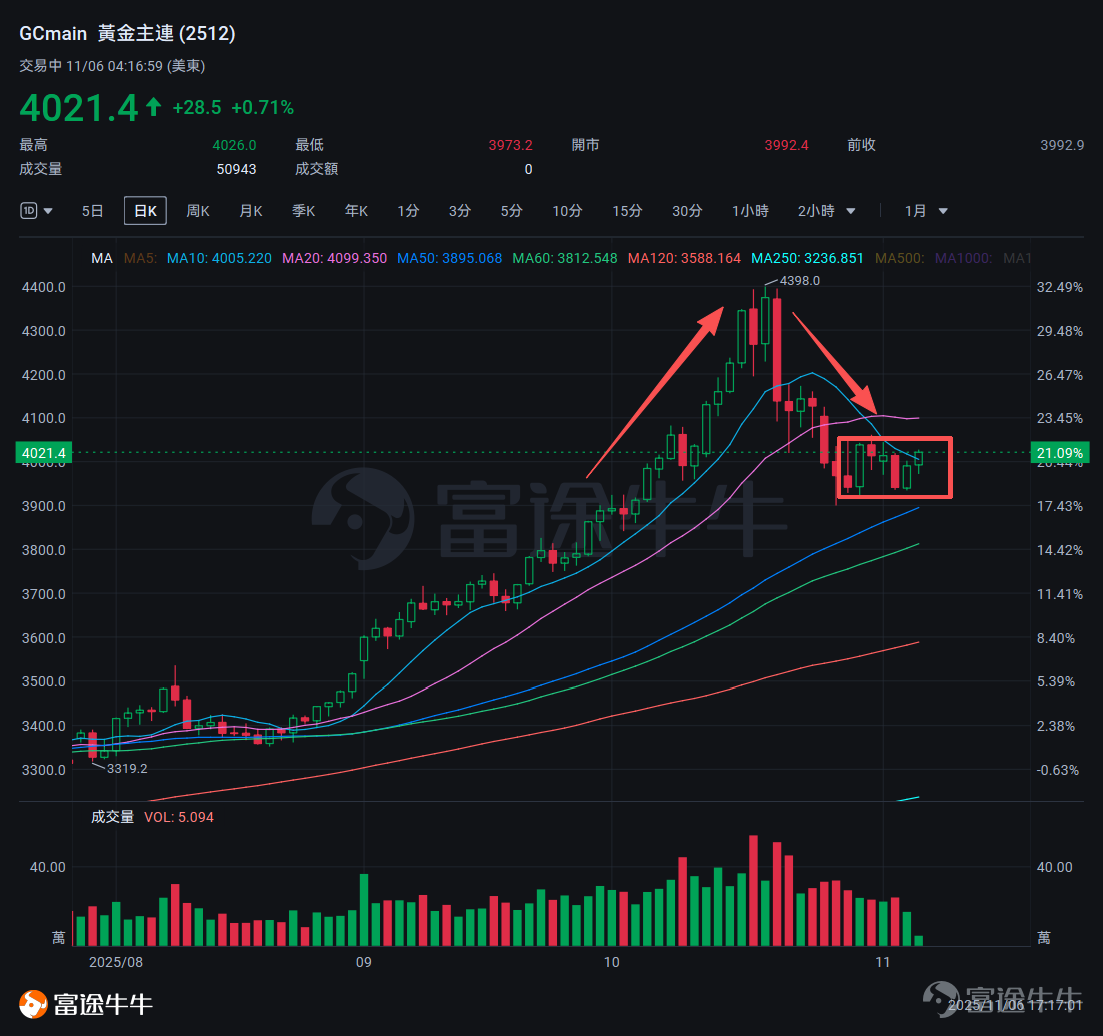

As geopolitical risk premiums fade and Waller turns hawkish, when will precious metals hit bottom?

Options Market Insights | Gold Price Volatility at USD 4,000! Is This the Right Time to Position in GLD?
This article is from the "Options at the Investment Frontier" column, which aims to position itself at the forefront of investment trends. It interprets opportunities presented by these trends and teaches readers how to use options to seize such opportunities. If you are interested, you are welcome to subscribe.Click hereJoin the learning experience, and you will receive notifications when subsequent updates to the column are published.
In the recently concluded month of October, gold experienced a roller-coaster-like price movement. At the beginning of October, gold embarked on a steep upward trajectory, repeatedly setting new historical highs. By October 20, it was just one step away from the $4,400 per ounce mark.
The situation then took a sudden downturn, with gold plummeting over 5% on October 22 alone. Following this, prices continued to retreat, breaking below the $4,000 level. In November, the trend has remained volatile. Does the recent decline signify the end of this rally, or does it present an opportunity for strategic positioning? What options strategies can be considered?
![This article comes from the 'Options Market Insights' column, which aims to position itself at the forefront of investment trends, providing readers with insights into market opportunities and teaching them how to seize these opportunities using options. If you are interested, feel free to subscribe.[Share Link: Click here]Join the learning experience, and you will receive notifications when subsequent updates to the column are published. In October alone, gold experienced a roller-coaster ride. At the start of the month, gold embarked on a steep upward trajectory, repeatedly setting new all-time highs. By October 20, it was just one step away from breaking the USD 4,400 per ounce mark. However, the situation took a sharp turn for the worse on October 22 when gold plummeted by over 5%. Following this, prices continued to retreat, falling below the USD 4,000 threshold. Since entering November, volatility has persisted. Does the recent decline signal the end of the rally, or does it present an opportunity for strategic positioning? What options strategies are available to consider? Multiple factors intertwined, swiftly transitioning from hot to cold. Overall, the recent decline in gold prices is "overbought correction" + "easing of risk aversion sentiment" + "shift in monetary policy expectations" the result of resonance among these three aspects. Starting from the end of August, the price of gold surged from $3,300 per ounce, posting a nearly 30% increase within just two months, with the market accumulating substantial profit-taking positions. The rapid rise in the price of gold caused long positions in the market to reach an extremely crowded state.The implied volatility of gold prices rose at an extremely fast pace, indicating overheated speculative sentiment in the market, which itself serves as a contrarian indicator, signaling the risk of a pullback.Once there is any fluctuation in the market, ...](https://nnqimage.futunn.com/sns_client_feed/999908/20251107/web-1762505046258-a3AG63cp2E.png/big?area=2&is_public=true&imageMogr2/ignore-error/1/format/webp)
Multiple factors intertwined, rapidly shifting from hot to cold
Overall, the recent decline in gold prices is... "Overbought Correction" + "Easing of Risk-Aversion Sentiment" + "Shift in Monetary Policy Expectations" The result of resonance from three aspects.
Since the end of August, gold prices surged from $3,300 per ounce, posting a nearly 30% increase within just two months, leading to significant profit-taking in the market.
The rapid rise in gold prices led to an extremely crowded state of long positions in the market.The implied volatility of gold prices rose at a very fast pace, indicating overheated speculative sentiment. This itself serves as a contrarian indicator, signaling risks of a pullback.Once there is any sign of instability in the market, the extremely crowded long positions will prompt investors to take profits en masse, putting pressure on the market.
![This article comes from the 'Options Market Insights' column, which aims to position itself at the forefront of investment trends, providing readers with insights into market opportunities and teaching them how to seize these opportunities using options. If you are interested, feel free to subscribe.[Share Link: Click here]Join the learning experience, and you will receive notifications when subsequent updates to the column are published. In October alone, gold experienced a roller-coaster ride. At the start of the month, gold embarked on a steep upward trajectory, repeatedly setting new all-time highs. By October 20, it was just one step away from breaking the USD 4,400 per ounce mark. However, the situation took a sharp turn for the worse on October 22 when gold plummeted by over 5%. Following this, prices continued to retreat, falling below the USD 4,000 threshold. Since entering November, volatility has persisted. Does the recent decline signal the end of the rally, or does it present an opportunity for strategic positioning? What options strategies are available to consider? Multiple factors intertwined, swiftly transitioning from hot to cold. Overall, the recent decline in gold prices is "overbought correction" + "easing of risk aversion sentiment" + "shift in monetary policy expectations" the result of resonance among these three aspects. Starting from the end of August, the price of gold surged from $3,300 per ounce, posting a nearly 30% increase within just two months, with the market accumulating substantial profit-taking positions. The rapid rise in the price of gold caused long positions in the market to reach an extremely crowded state.The implied volatility of gold prices rose at an extremely fast pace, indicating overheated speculative sentiment in the market, which itself serves as a contrarian indicator, signaling the risk of a pullback.Once there is any fluctuation in the market, ...](https://nnqimage.futunn.com/sns_client_feed/999908/20251107/web-1762505046123-epVjh3M0OZ.png/big?area=2&is_public=true&imageMogr2/ignore-error/1/format/webp)
Gold is traditionally considered a safe-haven asset, but some signs that emerged in late October have also eased market concerns over certain risk events.
First, high-level trade talks between China and the US in Malaysia and elsewhere sent out signals of easing tensions, with the market expecting tariff threats to potentially decrease. Additionally, rumors spread that the Russia-Ukraine conflict might be nearing an end, such as Europe and Ukraine possibly accepting the actual control line as a starting point for negotiations. Although later disproved, these developments still had a tangible impact on market sentiment.
The Federal Reserve's interest rate meeting at the end of the month delivered the 'final blow' to gold in October.Despite a 25-basis-point rate cut as expected, Fed Chair Jerome Powell's comments after the meeting were relatively hawkish, emphasizing that it remains 'undecided' whether another rate cut will occur in December.
Before the interest rate meeting, the probability of another rate cut in December was already close to 95%, but it quickly dropped after Powell's speech and is now less than 70%.
![This article comes from the 'Options Market Insights' column, which aims to position itself at the forefront of investment trends, providing readers with insights into market opportunities and teaching them how to seize these opportunities using options. If you are interested, feel free to subscribe.[Share Link: Click here]Join the learning experience, and you will receive notifications when subsequent updates to the column are published. In October alone, gold experienced a roller-coaster ride. At the start of the month, gold embarked on a steep upward trajectory, repeatedly setting new all-time highs. By October 20, it was just one step away from breaking the USD 4,400 per ounce mark. However, the situation took a sharp turn for the worse on October 22 when gold plummeted by over 5%. Following this, prices continued to retreat, falling below the USD 4,000 threshold. Since entering November, volatility has persisted. Does the recent decline signal the end of the rally, or does it present an opportunity for strategic positioning? What options strategies are available to consider? Multiple factors intertwined, swiftly transitioning from hot to cold. Overall, the recent decline in gold prices is "overbought correction" + "easing of risk aversion sentiment" + "shift in monetary policy expectations" the result of resonance among these three aspects. Starting from the end of August, the price of gold surged from $3,300 per ounce, posting a nearly 30% increase within just two months, with the market accumulating substantial profit-taking positions. The rapid rise in the price of gold caused long positions in the market to reach an extremely crowded state.The implied volatility of gold prices rose at an extremely fast pace, indicating overheated speculative sentiment in the market, which itself serves as a contrarian indicator, signaling the risk of a pullback.Once there is any fluctuation in the market, ...](https://nnqimage.futunn.com/sns_client_feed/999908/20251107/web-1762505046326-0D88Hktj93.png/big?area=2&is_public=true&imageMogr2/ignore-error/1/format/webp)
From a technical perspective, the October monthly candlestick chart formed a 'shooting star' pattern.This is a single-candlestick pattern that typically appears during an uptrend, suggesting a possible reversal from bullish to bearish sentiment.
The shooting star has a small body, a long upper shadow, and an extremely short or even non-existent lower shadow. This usually indicates that the bulls are losing control of the market, allowing bears to quickly take the dominant position. If the next monthly candlestick closes below the body of the shooting star, the bearish signal may be further confirmed.There is considerable market opinion that gold may enter a consolidation phase in November-December 2025.
![This article comes from the 'Options Market Insights' column, which aims to position itself at the forefront of investment trends, providing readers with insights into market opportunities and teaching them how to seize these opportunities using options. If you are interested, feel free to subscribe.[Share Link: Click here]Join the learning experience, and you will receive notifications when subsequent updates to the column are published. In October alone, gold experienced a roller-coaster ride. At the start of the month, gold embarked on a steep upward trajectory, repeatedly setting new all-time highs. By October 20, it was just one step away from breaking the USD 4,400 per ounce mark. However, the situation took a sharp turn for the worse on October 22 when gold plummeted by over 5%. Following this, prices continued to retreat, falling below the USD 4,000 threshold. Since entering November, volatility has persisted. Does the recent decline signal the end of the rally, or does it present an opportunity for strategic positioning? What options strategies are available to consider? Multiple factors intertwined, swiftly transitioning from hot to cold. Overall, the recent decline in gold prices is "overbought correction" + "easing of risk aversion sentiment" + "shift in monetary policy expectations" the result of resonance among these three aspects. Starting from the end of August, the price of gold surged from $3,300 per ounce, posting a nearly 30% increase within just two months, with the market accumulating substantial profit-taking positions. The rapid rise in the price of gold caused long positions in the market to reach an extremely crowded state.The implied volatility of gold prices rose at an extremely fast pace, indicating overheated speculative sentiment in the market, which itself serves as a contrarian indicator, signaling the risk of a pullback.Once there is any fluctuation in the market, ...](https://nnqimage.futunn.com/sns_client_feed/999908/20251107/web-1762505047058-DqI3NZx8UY.png/big?area=2&is_public=true&imageMogr2/ignore-error/1/format/webp)
If you wish to learn more about technical patterns and their interpretations, you can refer to NiuNiu’sCandlestick Pattern Series Course.~
Do short-term fluctuations alter long-term trends?
Does this mean that the trend has come to an end? When viewed on a longer timescale, the long-term logic for gold remains not only very clear but is also considered one of the strongest narratives under the current macroeconomic backdrop.
Ray Dalio, founder of Bridgewater Associates and a prominent investor, released a memo at the end of October titled "Gold Is the Safest Currency." He explicitly stated that"For thousands of years, gold has been considered currency in almost every country, while all other currencies have eventually perished."
Dalio analyzed fiscal options under different monetary systems and concluded that gold is the currency with the strongest store of value over the long term.
![This article comes from the 'Options Market Insights' column, which aims to position itself at the forefront of investment trends, providing readers with insights into market opportunities and teaching them how to seize these opportunities using options. If you are interested, feel free to subscribe.[Share Link: Click here]Join the learning experience, and you will receive notifications when subsequent updates to the column are published. In October alone, gold experienced a roller-coaster ride. At the start of the month, gold embarked on a steep upward trajectory, repeatedly setting new all-time highs. By October 20, it was just one step away from breaking the USD 4,400 per ounce mark. However, the situation took a sharp turn for the worse on October 22 when gold plummeted by over 5%. Following this, prices continued to retreat, falling below the USD 4,000 threshold. Since entering November, volatility has persisted. Does the recent decline signal the end of the rally, or does it present an opportunity for strategic positioning? What options strategies are available to consider? Multiple factors intertwined, swiftly transitioning from hot to cold. Overall, the recent decline in gold prices is "overbought correction" + "easing of risk aversion sentiment" + "shift in monetary policy expectations" the result of resonance among these three aspects. Starting from the end of August, the price of gold surged from $3,300 per ounce, posting a nearly 30% increase within just two months, with the market accumulating substantial profit-taking positions. The rapid rise in the price of gold caused long positions in the market to reach an extremely crowded state.The implied volatility of gold prices rose at an extremely fast pace, indicating overheated speculative sentiment in the market, which itself serves as a contrarian indicator, signaling the risk of a pullback.Once there is any fluctuation in the market, ...](https://nnqimage.futunn.com/sns_client_feed/999908/20251107/web-1762505046022-4bQxsJC8V8.png/big?area=2&is_public=true&imageMogr2/ignore-error/1/format/webp)
He emphasized the strategic allocation value of gold: "When I consider how much gold to hold in an investment portfolio, I view it as a strategic asset allocation rather than a tactical or market-timing decision.What I mean is, you should regard gold as a foundational asset. At the very least, you should hold a certain proportion of it, but most investors do not currently own gold.」
Over the past few decades, the global economy has operated on a credit-based monetary system centered around the U.S. dollar. The foundation of this system is now being shaken. Gold, asthe only currency that does not rely on any sovereign nation's credit and serves as an ultimate supranational monetary asset,is having its value rediscovered and re-evaluated within this context.
The U.S. federal government debt has exceeded $37 trillion, with a debt-to-GDP ratio as high as 119% and a fiscal deficit nearing 7%. Such massive debt can only be sustained through continuous monetary expansion, which implies the long-term, systematic erosion of the dollar’s purchasing power. This has prompted central banks worldwide to seek diversification of their reserve assets, leading to sustained gold purchases.
The pricing logic of gold has also undergone a significant transformation.In the past, gold prices were primarily driven by real interest rates (nominal interest rates minus inflation expectations). A decline in real interest rates meant a reduction in the opportunity cost of holding gold, leading to an increase in its price. However, since 2022, the negative correlation between gold and real interest rates has significantly weakened. Gold has begun to appreciate against "all fiat currencies," reflecting the pricing of instability within the global monetary system.
![This article comes from the 'Options Market Insights' column, which aims to position itself at the forefront of investment trends, providing readers with insights into market opportunities and teaching them how to seize these opportunities using options. If you are interested, feel free to subscribe.[Share Link: Click here]Join the learning experience, and you will receive notifications when subsequent updates to the column are published. In October alone, gold experienced a roller-coaster ride. At the start of the month, gold embarked on a steep upward trajectory, repeatedly setting new all-time highs. By October 20, it was just one step away from breaking the USD 4,400 per ounce mark. However, the situation took a sharp turn for the worse on October 22 when gold plummeted by over 5%. Following this, prices continued to retreat, falling below the USD 4,000 threshold. Since entering November, volatility has persisted. Does the recent decline signal the end of the rally, or does it present an opportunity for strategic positioning? What options strategies are available to consider? Multiple factors intertwined, swiftly transitioning from hot to cold. Overall, the recent decline in gold prices is "overbought correction" + "easing of risk aversion sentiment" + "shift in monetary policy expectations" the result of resonance among these three aspects. Starting from the end of August, the price of gold surged from $3,300 per ounce, posting a nearly 30% increase within just two months, with the market accumulating substantial profit-taking positions. The rapid rise in the price of gold caused long positions in the market to reach an extremely crowded state.The implied volatility of gold prices rose at an extremely fast pace, indicating overheated speculative sentiment in the market, which itself serves as a contrarian indicator, signaling the risk of a pullback.Once there is any fluctuation in the market, ...](https://nnqimage.futunn.com/sns_client_feed/999908/20251107/web-1762505046325-44luUeAwly.png/big?area=2&is_public=true&imageMogr2/ignore-error/1/format/webp)
Following the collapse of the Bretton Woods system in the 1970s, the price of gold, which had previously been anchored at $35 per ounce, soared to over $800, marking an increase of more than 20-fold. The decade-long bull market in gold that began in the early 2000s achieved gains of nearly 500%. The current bull market for gold, which started at the end of 2018, has seen an increase of approximately 230% so far.If we are indeed in the midst of a new process of restructuring the monetary system, the revaluation of gold may have only just begun.
Of course, upward trends do not happen overnight; there may be short-term or medium-term fluctuations along the way.
![This article comes from the 'Options Market Insights' column, which aims to position itself at the forefront of investment trends, providing readers with insights into market opportunities and teaching them how to seize these opportunities using options. If you are interested, feel free to subscribe.[Share Link: Click here]Join the learning experience, and you will receive notifications when subsequent updates to the column are published. In October alone, gold experienced a roller-coaster ride. At the start of the month, gold embarked on a steep upward trajectory, repeatedly setting new all-time highs. By October 20, it was just one step away from breaking the USD 4,400 per ounce mark. However, the situation took a sharp turn for the worse on October 22 when gold plummeted by over 5%. Following this, prices continued to retreat, falling below the USD 4,000 threshold. Since entering November, volatility has persisted. Does the recent decline signal the end of the rally, or does it present an opportunity for strategic positioning? What options strategies are available to consider? Multiple factors intertwined, swiftly transitioning from hot to cold. Overall, the recent decline in gold prices is "overbought correction" + "easing of risk aversion sentiment" + "shift in monetary policy expectations" the result of resonance among these three aspects. Starting from the end of August, the price of gold surged from $3,300 per ounce, posting a nearly 30% increase within just two months, with the market accumulating substantial profit-taking positions. The rapid rise in the price of gold caused long positions in the market to reach an extremely crowded state.The implied volatility of gold prices rose at an extremely fast pace, indicating overheated speculative sentiment in the market, which itself serves as a contrarian indicator, signaling the risk of a pullback.Once there is any fluctuation in the market, ...](https://nnqimage.futunn.com/sns_client_feed/999908/20251107/web-1762505046451-sEq1nefKOb.png/big?area=2&is_public=true&imageMogr2/ignore-error/1/format/webp)
How to Deploy Using Options
$SPDR Gold ETF (GLD.US)$ It is currently the largest and most liquid gold ETF globally, with total assets exceeding $100 billion. Investors can trade it as easily as buying or selling stocks, without worrying about storage, transportation, or insurance issues associated with physical gold. The price per share is much lower than that of physical gold bars, making it suitable for investors to participate in the gold market at a lower cost.
Its daily trading volume is substantial, with tight bid-ask spreads, making it an appropriate instrument for deploying option strategies.Through options, you can potentially transform a simple gold position into a multidimensional investment strategy that generates cash flow, controls costs, and manages risks more precisely.Below, we explore several examples to illustrate how options can enrich your gold investment strategy:
(1) You already hold a position but believe that there will be short-term volatility.
Assume that in August 2025, you purchased 100 shares $SPDR Gold ETF (GLD.US)$ at a cost basis of $300 per share and are still holding the position. You believe that the price of gold may not rise again to reach the high seen in October, but you also do not want to sell your holdings too quickly. In this scenario, you could employ a Covered Call by selling a covered call option, selling a call option expiring at the end of the year with a strike price of $400 while holding the underlying stock.
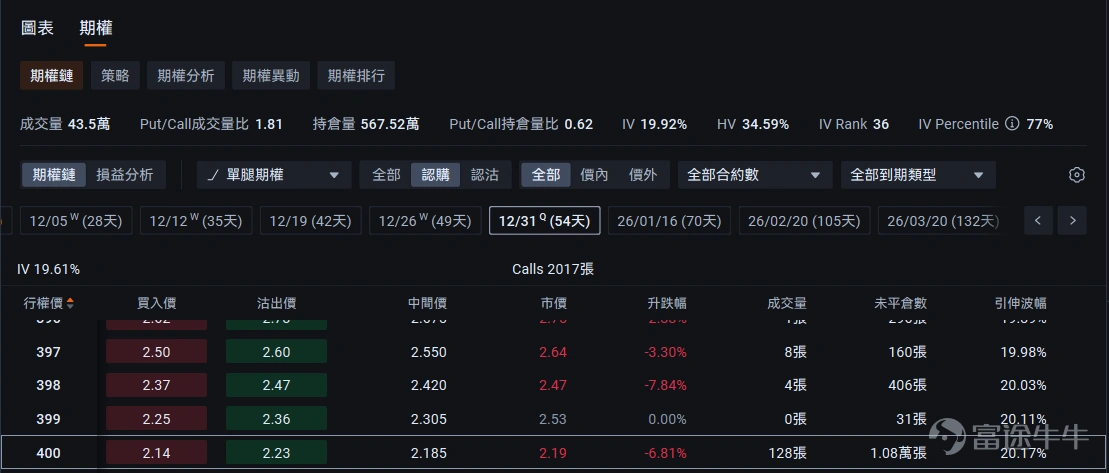
(The design images displayed on the screen are for illustrative purposes only and do not constitute any investment advice or guarantees.)
If by the expiration date, the price of gold is still consolidating, then while holding GLD, you would have pocketed the full premium of $2.19 * 100 = $219. If the price of gold surges, you can sell your holdings near the previous all-time high, although you would not benefit from any subsequent price increases.
(2) You are optimistic about the future performance of gold and are looking for an opportunity to enter the market.
Suppose you do not currently hold any gold assets but see a pullback as an opportunity to buy at a lower price; in this case, you could adopt Cash-secured Put options.Assuming you believe that the price of gold may consolidate to the level seen in early October, you sell a put option with a strike price of $356 that expires in one month.
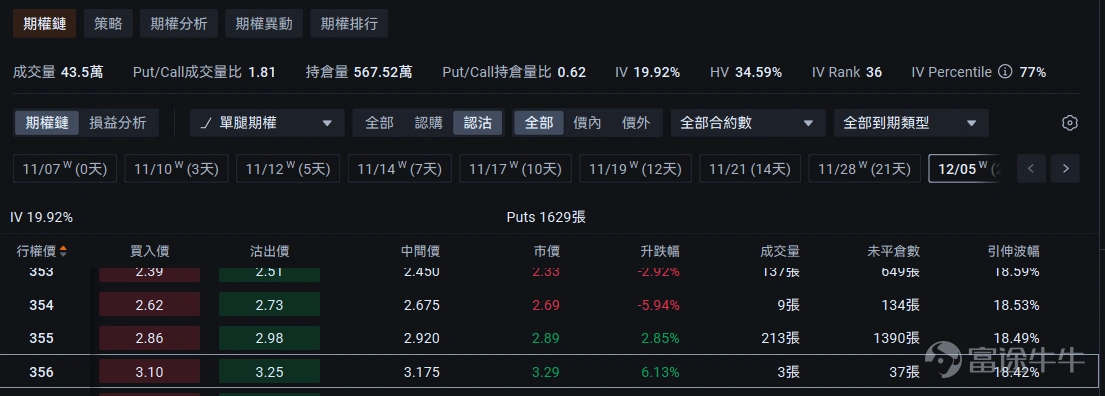
(The design images displayed on the screen are for illustrative purposes only and do not constitute any investment advice or guarantees.)
If by the expiration date $SPDR Gold ETF (GLD.US)$ the price falls below this level, you can buy 100 shares of GLD at the set price of $356. If it remains above this level, you can collect a premium of $3.29 * 100 = $329. Note that your account must hold sufficient cash to purchase GLD in case the put option is exercised. Otherwise, margin financing may be required or it could affect your account's liquidity.
On the individual stock page for options strategies, six different icons categorize various scenarios, covering market conditions such as upward movement, volatility, stability, and downward trends, along with detailed explanations of corresponding options strategies. Fellow investors who have confirmed their chosen strategy can click "Trade" to place an order directly.
![This article comes from the 'Options Market Insights' column, which aims to position itself at the forefront of investment trends, providing readers with insights into market opportunities and teaching them how to seize these opportunities using options. If you are interested, feel free to subscribe.[Share Link: Click here]Join the learning experience, and you will receive notifications when subsequent updates to the column are published. In October alone, gold experienced a roller-coaster ride. At the start of the month, gold embarked on a steep upward trajectory, repeatedly setting new all-time highs. By October 20, it was just one step away from breaking the USD 4,400 per ounce mark. However, the situation took a sharp turn for the worse on October 22 when gold plummeted by over 5%. Following this, prices continued to retreat, falling below the USD 4,000 threshold. Since entering November, volatility has persisted. Does the recent decline signal the end of the rally, or does it present an opportunity for strategic positioning? What options strategies are available to consider? Multiple factors intertwined, swiftly transitioning from hot to cold. Overall, the recent decline in gold prices is "overbought correction" + "easing of risk aversion sentiment" + "shift in monetary policy expectations" the result of resonance among these three aspects. Starting from the end of August, the price of gold surged from $3,300 per ounce, posting a nearly 30% increase within just two months, with the market accumulating substantial profit-taking positions. The rapid rise in the price of gold caused long positions in the market to reach an extremely crowded state.The implied volatility of gold prices rose at an extremely fast pace, indicating overheated speculative sentiment in the market, which itself serves as a contrarian indicator, signaling the risk of a pullback.Once there is any fluctuation in the market, ...](https://nnqimage.futunn.com/sns_client_feed/999908/20251107/web-1762505047059-WoGhBzxVlN.png/big?area=2&is_public=true&imageMogr2/ignore-error/1/format/webp)
That’s all for today. What strategy would you adopt for deploying GLD? Feel free to leave a comment and share!
Finally, for fellow investors looking to start investing in options in the current market, it might be best to first...Click hereClaim an options beginner’s package worth up to HK$2188!
Risk Disclaimer: The above content only represents the author's view. It does not represent any position or investment advice of Futu. Futu makes no representation or warranty.Read more


Comment (1)
to post a comment
29
53