

How to Interpret the Central Bank's Resumption of Treasury Bond Trading | Chongyang Q&A
Q: May I ask Chongyang Investment, how do you interpret the central bank resuming government bond purchases and sales?
A: On October 27, Pan Gongsheng, Governor of the People’s Bank of China, stated at the Financial Street Forum that the current operation of the bond market is generally sound and that open market treasury bond trading operations will be resumed. After being suspended in January this year, this monetary policy tool has been reactivated after a 10-month hiatus.
Why is treasury bond trading being restarted at this time?The phased mitigation of interest rate risks in the bond market and the provision of liquidity support to the market are important reasons. The reason the central bank suspended treasury bond trading earlier this year was due to overly optimistic sentiment in the bond market, a rapid decline in treasury yields, the continuous accumulation of interest rate risks, and an excessive widening of the China-US interest rate differential caused by the rapid decline in treasury yields, which increased pressure to stabilize the exchange rate. Since July this year, as risk appetites in the stock and commodity markets improved, some speculative and allocation-type funds flowed out of the bond market, causing it to fall rapidly under a fragile trading structure. The yield on 10-year government bonds rose quickly from 1.6% to above 1.8%, where it has remained within a narrow range for about a month. Interest rate risks in the bond market have been significantly alleviated. Additionally, with the Federal Reserve restarting rate cuts, U.S. Treasury yields have turned downward, narrowing the China-U.S. interest rate differential. The central bank has further guided the gradual appreciation of the renminbi through adjustments in the central parity rate, making exchange rate risks more controllable. This macroeconomic backdrop provides favorable conditions for the central bank to restart treasury bond trading. Furthermore, there has been a relatively high issuance of long-duration government bonds this year, leading to tight long-term liquidity in the banking system. To ensure sufficient room for next year’s fiscal policy, the central bank also needs to broaden channels for base money issuance and enrich its monetary policy toolkit. For the central bank, treasury bond trading can provide the market with medium- to long-term zero-cost liquidity support, helping to enhance coordination between monetary policy and fiscal policy.
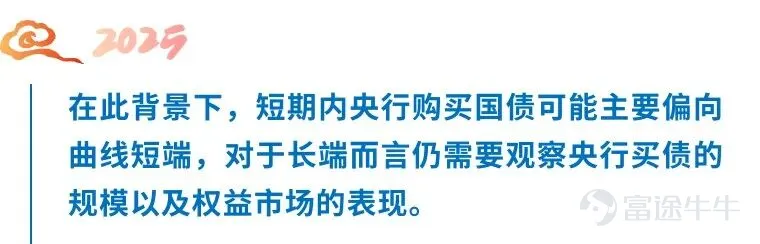
For the market, the central bank's resumption of treasury bond trading establishes a top range for the bond market.The central bank’s resumption of open market treasury bond trading operations at this point indicates that the current level of medium- to long-term interest rates already aligns with the central bank’s desired range, leaving limited room for further increases in the 10-year government bond yield. Governor Pan Gongsheng described the treasury bond trading tool as 'an important measure to enhance the financial function of government bonds, reinforce the role of the government bond yield curve as a pricing benchmark, and promote synergy between monetary and fiscal policies.' Since October, short-term treasury yields have risen significantly, narrowing the spread between 10-year and 1-year treasury yields. The central bank’s resumption of treasury bond trading at this time also helps guide the government bond yield curve to steepen again, reinforcing its role as a pricing benchmark. Against this backdrop, in the short term, the central bank’s purchases of government bonds may focus more on the short end of the curve; for the long end, it remains necessary to observe the scale of the central bank’s bond purchases and the performance of the equity market.
▲ Swipe up to read more【Disclaimer】
This material is original and published by Shanghai Chongyang Investment Management Co., Ltd. (hereinafter referred to as "Chongyang Investment"), and is intended solely for informational and investor education purposes. The information and data this material is based on come from public channels (e.g., Wind, Bloomberg) and internal research results, and the relevant information is considered reliable; however, Chongyang Investment makes no express or implied representations or warranties regarding its completeness or accuracy. The information provided is for reference only and does not constitute an advertisement, sales offer, or advice to trade any securities, funds, or investment products. Any entities, brands, goods, etc. referenced in this material are used solely for research and analytical purposes and do not represent actual operations of Chongyang Investment. Due to various factors such as investment restrictions of fund products, portfolio adjustments, and transaction costs, the actual operations of Chongyang Investment may differ from the conclusions drawn in this material.
This material does not take into account any specific investment needs, investment objectives, or risk tolerance of any reader. Readers should carefully read the product's legal documents and risk disclosures before investing, fully understand the risk-return characteristics and product features, and thoroughly consider their own risk tolerance to make rational judgments and prudent investment decisions.
The copyright of this material belongs to Chongyang Investment. Without authorization from Chongyang Investment, no institution or individual may forward, reproduce, copy, publish, modify, imitate, or quote the contents of this material in any form.
If you are interested in Chongyang products, please feel free to inquire.
The public account has changed its push rules.
our articles may get lost in the vast information flow. Your
oneShare, Like, 'Looking At',
Let us draw closer together,
to meet in a better way,
pinning us to the top of your listis also a great idea.
Reorient Investment, always with you.
Risk Disclaimer: The above content only represents the author's view. It does not represent any position or investment advice of Futu. Futu makes no representation or warranty.Read more
Comments
to post a comment