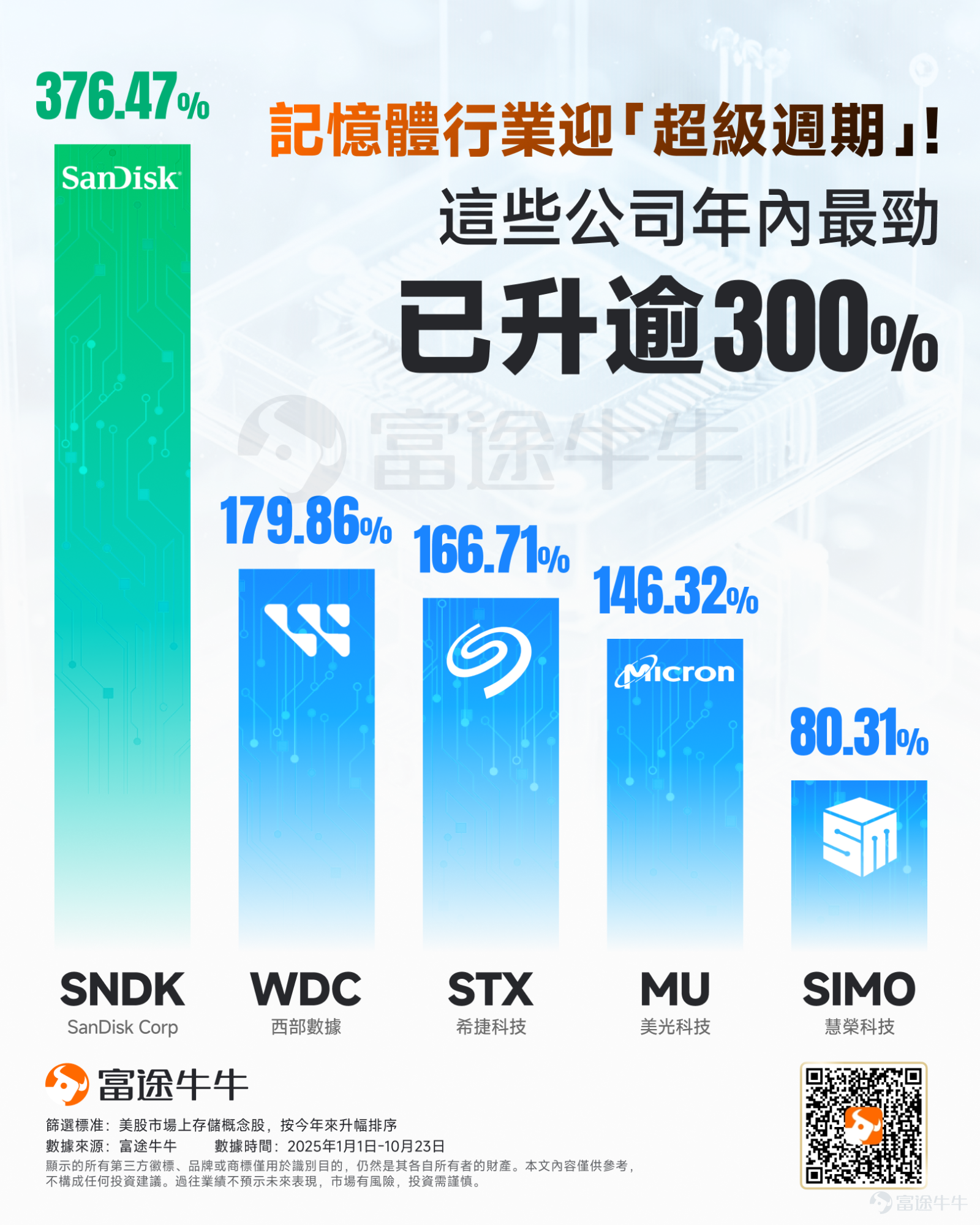

The storage industry is entering a super cycle! This year's standout "hit" of the AI boom: SanDisk and Micron Technology continue to hit new highs.
Amid the AI boom, this 'super cycle' for memory chips could be more enduring than previous ones.
According to a report by The Korea Economic Daily, major memory suppliers such as Samsung Electronics and SK Hynix,will continue to adjust their pricing for customers in the fourth quarter of this year.In terms of magnitude, prices for memory products, including DRAM and NAND, will increase by up to 30%, aligning with the surge in AI-driven demand for memory chips.
In fact, the global memory chip market is entering an unprecedented "Hunger Games."Looking at the U.S. stock market, storage-related stocks have recorded significant gains this year, such as $SanDisk (SNDK.US)$ with cumulative increases exceeding 370%, $Western Digital (WDC.US)$ rising nearly 180%, $Seagate Technology (STX.US)$ increasing over 166%, $Micron Technology (MU.US)$ gaining over 140%, $Silicon Motion Technology (SIMO.US)$ and rising more than 80%.

Upon reading this, many fellow investors may be curious about the origins of the storage industry entering a super cycle. How does Wall Street perceive it? How should related concept stocks be selected? These questions will be analyzed one by one below.
What is driving the semiconductor industry into a 'super cycle,' and how does Wall Street view it?
Before delving into the memory industry, let us first introduce fellow investors to the various technical terms and classifications:
DRAMDynamic Random Access Memory, used for temporary data storage, which disappears after power loss;
NAND FlashNon-volatile memory, where data remains intact even after power loss, commonly used in SSDs and USB drives;
HDD refers toTraditional hard disk drives, which store data magnetically. They are slower but offer lower costs and larger capacities.
In other words, Imagine we are someone working in an office: DRAM is your desk, NAND Flash is your filing cabinet, and HDD is the large archive placed in the corner of the office.
In summary: The CPU (you) retrieves items from DRAM (the desk) for processing, and once processed, the results or documents requiring long-term storage are saved back to NAND (the drawer) or HDD (the archive).

The entry of memory chips into a 'super cycle' ultimately cannot be separated from the explosive growth in demand for artificial intelligence and high-performance computing.
As Sumit Sadhana, Chief Commercial Officer of Micron Technology, stated, part of the reason for the rise in DRAM prices is supply tightness, a trend largely driven by surging demand for High Bandwidth Memory (HBM), which consumes more than three times the wafer capacity of standard DRAM. According to Morgan Stanley's forecast,This year, tech giants including Google, Amazon, Meta, and Microsoft will invest $400 billion in artificial intelligence infrastructure.
JPMorgan analysts noted that a 'memory-hungry' trend led by cloud service providers is driving the entire industry into a phase of structural growth. The report highlights that this cycle’s core driver is the enormous demand for high-performance memory created by AI computing,with impacts rapidly expanding from high-end High Bandwidth Memory (HBM) to traditional DRAM and NAND flash memory.Market dynamics indicate that suppliers may struggle to meet all demand within the next 12 months, thereby supporting sustained price strength.
This industry transformation is not limited to a price recovery in the DRAM market; the NAND flash market is also experiencing a strong rebound, partly due to a severe shortage of hard disk drives (HDD),forcing customers to shift toward enterprise solid-state drives (eSSD).
As a result, JPMorgan significantly raised its forecast for the global memory market size, increasing its prediction for the total addressable market (TAM) for 2025 to 2026 by 6% to 24%, and expects the market size to reach nearly $300 billion by 2027.
Morgan Stanley believes thatThe storage market—particularly NAND flash memory—is in the 'early stages' of a sustained upward cycle.The bank argues that, compared to the DRAM memory and mechanical hard drives that are more widely discussed in the market, the NAND flash market exhibits even greater upside potential due to a sharp reversal in its supply-demand dynamics.
Which companies are worth watching?
In the global storage landscape, the true core players are the oligopolistic firms that dominate the three key segments: DRAM/HBM, NAND, and HDD. These companies are not only price setters but also leaders in determining technological roadmaps. Previously,‘OpenAI Advances into AI Applications!’ The Two Key Sectors of Compute Power and Storage Enter a ‘Golden Cycle’—This Investment Map Is Worth Saving!an article outlined relevant concept stocks:

Specifically:
DRAM/HBM (High Bandwidth Memory):
Micron Technology—a core player as one of the world’s top three DRAM suppliers and the second-largest HBM supplier.
$Micron Technology (MU.US)$ Micron Technology is a global leader in memory and semiconductor solutions, specializing in the development and manufacturing of DRAM (Dynamic Random Access Memory), NAND (flash memory), and other storage and memory solutions. These products are widely used in data centers, artificial intelligence, mobile devices, automotive systems, embedded systems, and consumer electronics.Micron is also the only memory manufacturer based in the United States, holding significant strategic importance.

According to Micron’s latest quarterly earnings, both revenue and gross margin met market expectations,primarily driven by the growth in the DRAM business.In Micron's fourth fiscal quarter, DRAM (memory) revenue reached $9 billion, up 27% quarter-over-quarter, accounting for approximately 79% of total revenue; NAND (flash memory) revenue was $2.3 billion, up 5% quarter-over-quarter, representing about 20% of total revenue.
The company is betting that as the AI race intensifies,demand for its high-bandwidth memory chips (HBM) will remain strong.Company CEO Sanjay Mehrotra stated during the conference call following the earnings release,Micron expects to finalize deals to sell all of its HBM chips for 2026 in the coming months,with pricing agreements for the HBM3E chip largely set, while discussions involving the more advanced HBM4 chip are still ongoing.
However, despite the highly favorable environment of current price increases and strong demand for artificial intelligence, investors must weigh this against significant challenges, including fierce competition from rivals such as Samsung and SK Hynix, as well as the unpredictability of geopolitical tensions.
NAND (Flash Memory):
SanDisk — Positioned as the fifth-largest player in the global NAND market
$SanDisk (SNDK.US)$ Originally a NAND storage product supplier under Western Digital Group, primarily selling solid-state drives (SSDs), hard disk drives (HDDs), USB flash drives, and memory cards. In February this year, SanDisk successfully completed its spin-off from Western Digital and became independently listed. Since its listing, its stock price has surged over 376%.

According to a research report by Zheshang Securities, as downstream applications have gradually diversified and AI applications have seen explosive growth, demand for mobile terminals such as smartphones has gradually recovered. The demand for high-performance flash memory in data centers, client devices, and mobile sectors has shifted from basic capacity solutions to customized, high-bandwidth solutions.Overall industry demand has been steadily recovering since the second half of last year, with product prices gradually rising.
SanDisk has strengthened its premium product positioning through price adjustments,ensuring continued investment in R&D to meet performance requirements while avoiding price wars in low-margin markets. SanDisk raised prices in April this year due to anticipated supply shortages, and this strategy yielded significant returns. Driven by rising channel prices and restocking of consumer SSDs and retail products, SanDisk's third-quarter revenue increased 12.2% quarter-over-quarter to $1.9 billion.
According to TrendForce data, although SanDisk holds approximately 12% of the global flash memory market share, ranking fifth,its pricing signals carry significant influence.As a result, the top four NAND producers are expected to follow suit in adjusting prices, which will drive a broader upward trend in flash memory prices that may have lasting momentum.
$Silicon Motion Technology (SIMO.US)$ — A globally recognized leader in NAND flash controller solutions.
In the NAND supply chain, Silicon Motion Technology is often regarded as a quintessential "enabler."As the world's largest independent SSD controller supplier, while it does not directly manufacture NAND flash memory, it serves as the indispensable "brain" of solid-state drives (SSDs).
The controller is responsible for managing data read/write operations, performing error correction, and handling lifespan management.Thus, regardless of fluctuations in NAND pricing, Silicon Motion Technology can leverage its technical advantages to achieve stable revenue across market cycles.Currently, its PCIe Gen5 controllers have entered mass production and are widely applied in client and data center-grade SSDs, underscoring its significant technological standing.This focused "enabler" model, centered on critical segments, not only reduces the market risks associated with direct participation in flash memory manufacturing but also offers investors within the supply chain a relatively stable investment option.

Additionally, attention can be directed toward Japanese stocks.$Kioxia Holdings (285A.JP)$ — The company is positioned as the third-largest player in the global NAND market.
HDD (Hard Disk Drive):
Seagate Technology, Western Digital — the two leading manufacturers of HDDs globally
$Seagate Technology (STX.US)$、 $Western Digital (WDC.US)$ accounting for over 80% of global HDD shipments and nearly 90% of total HDD storage capacity shipped.
Among them,Seagate Technology is a global leader in data storage solutions,Since its founding in 1979, it has consistently held a significant position in the hard disk drive (HDD) industry. Initially, Seagate primarily served as a supplier of HDDs for personal computers; with the rise of solid-state drives (SSDs), the company successfully shifted its focus to enterprise-level high-capacity storage markets, particularly targeting the needs of massive data storage for data centers and cloud computing.
In the global hard disk drive (HDD) market, Seagate Technology, Western Digital, and Kioxia have formed a tripartite competitive landscape. In the field of high-capacity nearline HDDs designed for data centers, Seagate has emerged as one of the market leaders. Amidst the continuous growth in demand for data storage driven by artificial intelligence (AI) applications,Seagate, leveraging its leading-edge in Heat-Assisted Magnetic Recording (HAMR) technology, is poised to play an increasingly critical role in the data center and cloud storage markets.

$Western Digital (WDC.US)$ is a world-leading provider of data storage solutions, headquartered in San Jose, California, USA.Its product portfolio spans hard disk drives (HDD), solid-state drives (SSD), and related storage solutions.

Among these two giants,Western Digital's unique advantage lies in its balanced business structure: it generates stable cash flow through its traditional HDD operations while participating in the industry’s cyclical growth benefits via its NAND flash memory business.Although the spin-off of SanDisk (SNDK) reduced its direct exposure to flash memory, as a comprehensive storage solutions giant, WDC retains strategic balance across different storage mediums, allowing flexibility to adapt to market changes.
Morgan StanleyAt the end of September, the firm also significantly raised its target prices for both companies. The target price for Western Digital was increased from $99 to $171, while Seagate Technology’s target price was raised from $168 to $265.Western Digital is also the firm’s 'top pick' among its selections.
Morgan Stanley analysts stated: "We have been optimistic about HDDs for the past two years, but recent demand has reached an inflection point—driven by accelerated cloud infrastructure spending (cumulatively approximately $3 trillion by 2028), increased investment in data-enabling technologies, and the rise of AI inference (including agents and multi-modal applications), which have become new tailwinds for data-intensive content generation and storage demands."
He added that Western Digital and Seagate Technology are expected to achieve growth and profitability levels ranking in the top quartile or half of the industry among cloud-related hardware, semiconductor, and networking equipment vendors. By fiscal year 2028, Seagate Technology’s earnings per share are projected at $21, and Western Digital’s at approximately $13, representing a 30-60% increase from previous forecasts and a 40-70% increase over market consensus.
The analysts also noted,Data is the 'crude oil driving artificial intelligence,' and hard disk drive manufacturers will be significant beneficiaries.Analyst TableThe analysts stated: "Given the consistently cyclical nature of the HDD industry, we believe the market is currently overlooking a key point: as long-term growth momentum strengthens and structural profit margins improve, the valuations of Western Digital and Seagate will continue to surpass historical levels."
Summary
The driving force behind this memory supercycle is not limited to HBM but reflects comprehensive demand growth across the board.Analysts believe that the intensity and duration of this cycle will exceed previous ones.Driving factors include: massive new investments by enterprises in AI servers, memory upgrades for general servers to support AI applications, and the proliferation of 'on-device AI' functionalities in devices such as smartphones and PCs.
Morgan Stanley believes that, with the stabilization of the macroeconomic environment and the gradual recovery in demand, the fundamentals of the storage market are improving, and the industry is poised to enter a new upward cycle.
However,It should be noted that the storage industry itself is highly cyclical and is currently facing complex challenges from the macroeconomic environment. Investors should carefully assess the associated risks.
Risk Disclaimer: The above content only represents the author's view. It does not represent any position or investment advice of Futu. Futu makes no representation or warranty.Read more


Comments (8)
to post a comment
105
398