
Monthly Market Outlook: No Break for the Holidays! Will the Market Continue to Rise in October?

Meituan has dropped to HKD 100. Is it a good time to invest now?
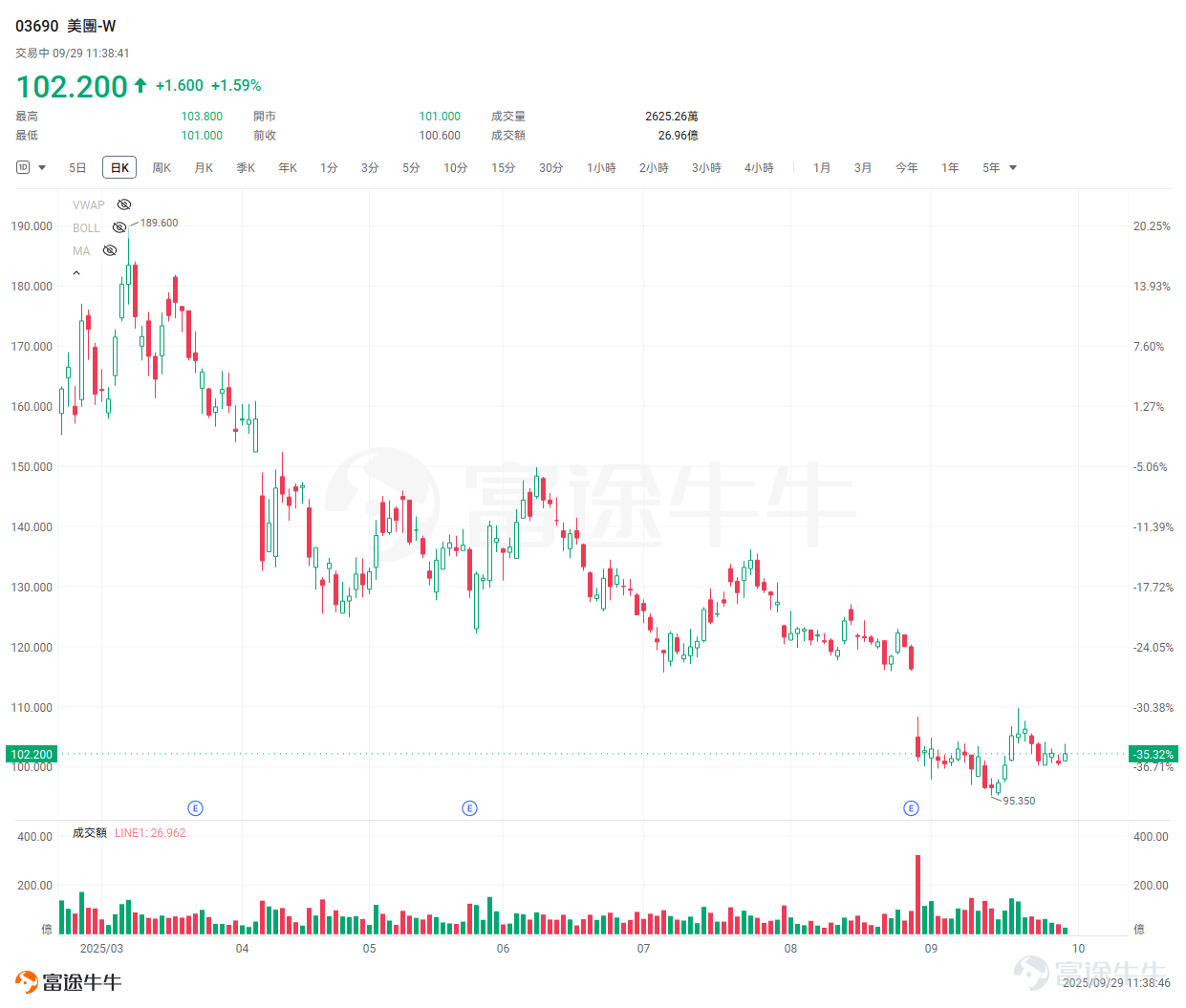
Following a disappointing Q2 performance, $MEITUAN-W (03690.HK)$ the share price has continued to decline, reaching HKD 100 as of September 29. In response to Alibaba's ongoing efforts to strengthen its position, Meituan has taken several countermeasures, including the launch of its personal AI Agent product, Xiao Mei. As the largest decliner year-to-date in the Hang Seng Index, there is growing investor interest in bottom-fishing opportunities for Meituan;So, has Meituan at HKD 100 reached a safe margin for investment? Should investors consider buying the dip?

The battle only began in July, and Q2 might have been 'the best' quarter.
Since most investors are already familiar with Meituan's Q2 results, we will provide a brief recap here as context.
Meituan's existing business is mainly divided into two major segments: core local commerce and new initiatives. Core local commerce serves as the fundamental base, including home delivery services (food delivery and express shopping) + in-store services (group buying and hotels); new initiatives act as growth drivers, represented by Meituan Preferred and Little Elephant Supermarket.
Overall, Meituan’s Q2 performance shows total revenue of RMB 91.84 billion, a year-on-year increase of 11.7%, which is acceptable for now. However, operating profit has significantly underperformed, shrinking from over RMB 10 billion to RMB 226 million, marking a 98% decline year-over-year—a strong negative signal. This was due to a drop in average order value for food delivery, increased subsidies for delivery riders, and rising marketing and advertising expenses, leading to a decline in net profit from food delivery operations.
The in-store business was not spared either. Increased subsidies led to higher operating costs, resulting in declines in both commission and advertising revenues from in-store services.
Although new businesses performed relatively well, with reduced loss rates compared to the previous two quarters, overall, Meituan's core business suffered setbacks. While new businesses are accelerating in growth, they remain in the cash-burning phase, requiring cash flow support, making the current situation challenging.

More concerning is that Taobao’s entry into the competition came late in Q2, during which Meituan and JD.com were fully engaged throughout the three months, while Alibaba participated for one and a half months (starting mid-May) under low total order volume conditions. In the Q2 earnings call, Meituan executives projected significant losses in core local commerce operations for the third quarter.Looking at the third quarter so far, there has been no noticeable reduction in competitive intensity, suggesting that Q3 results may worsen further.
The 'efficiency moat' has proven ineffective in front of capital; how long will the food delivery war continue?
There has consistently been a strong voice in the market affirming Meituan's operational and cost advantages in the instant retail space.Prior to the release of Q2 earnings, the market had generally believed that Meituan, with its refined operations and cost advantages, could respond to competition with lower subsidies (higher ROI). However, the three companies experienced a similar magnitude of profit decline due to food delivery in Q2 (approximately RMB 11-13 billion). Meituan's losses significantly exceeded expectations, leading the market to begin questioning the company’s competitive moat.
Despite Meituan's advantages in delivery efficiency and penetration in lower-tier markets, food delivery is a 'standardized product.'For the same restaurant package, consumer decision-making logic first considers price, then delivery time. There is a high overlap between Meituan and Taobao users, with both platforms primarily targeting consumers in first- and second-tier cities, resulting in nearly 100% overlap in their user base.If Alibaba can eliminate the gap in delivery experience with Meituan through substantial subsidies, it could attract 70% of price-sensitive consumers. As long as Alibaba is willing to subsidize, Meituan’s market share will continue to face pressure.
In Alibaba's renewed focus on its in-store group-buying business, AutoNavi (Gaode Map) plays a role beyond driving traffic; its newly released 'Street Sweep Rankings' directly targets Meituan's core business, similar to Meituan’s Dianping list.

So, when will the food delivery war end?
The essence of the food delivery war is a showdown of financial strength.。The second-quarter earnings reveal that the substantial subsidies for food delivery have nearly wiped out all the profits of Meituan and JD.com. In contrast, Alibaba, with its larger business scale, more diversified revenue structure, and stronger profitability, naturally demonstrates significantly greater resilience when facing losses of the same magnitude.
Before the food delivery war, Meituan earned RMB 1 to 1.5 per order, while Alibaba's food delivery business incurred a loss of RMB 3.7 billion in the local services segment during the fiscal year 2025, amounting to approximately RMB 0.5 loss per order.The unit economics gap per order between the two platforms is roughly RMB 1.5 to 2.。
Following sustained efforts in the second and third quarters, Taobao's flash purchase order volume experienced explosive growth within just a few months. In August this year, the daily peak order volume of Taobao's flash purchase reached 120 million orders, with the weekly average hitting 80 million orders. This drove the total number of monthly transacting buyers on the platform to 300 million, representing a 200% increase compared to April this year. The gap with Meituan’s expected daily average of 90 million orders is now “within reach.”
This has eliminated Meituan’s once-dominant advantage of 'economies of scale.' Once the gap in scale is closed, the ultimate outcome of this competition will depend on whether Alibaba can improve operational efficiency.If Alibaba can narrow the unit economics (UE) gap to within one yuan, it can sustainably operate flash purchases as a cost center, using high-frequency flash purchases to drive low-frequency e-commerce. For now, this strategy appears economically viable.
In response, Alibaba's management clearly stated in the conference call:“When the scale gap was enormous in the past, discussing efficiency was meaningless. However, now that the scale gap has been largely eliminated, Taobao Flash Sales will subsequently narrow its losses by optimizing user structure (from acquiring new users to increasing the frequency of repeat customer orders), order structure (raising high-ticket orders such as for main meals and daily necessities), and fulfillment costs, among other aspects. Starting from September, the UE (average loss per order) is expected to be reduced by half compared to the current level.”If Alibaba can successfully implement its strategy, Meituan's profit margins will be squeezed.
Where is the margin of safety for the stock price?
Compared to Alibaba, which boasts new narratives full of potential such as 'cloud services, computing power, and AI,' Meituan’s new businesses (such as the Xiaoxiang supermarket) have shown modest growth and lack compelling future growth stories to support a high valuation.Its most likely 'second growth curve' (overseas expansion, drones/vehicles) has seen limited progress. Moreover, innovation initiatives also require substantial capital investment, but due to competitive threats to its core business, losses in new ventures might temporarily contract.
Given that both competition and subsidies can simultaneously promote industry scale and penetration rates,The daily active users of all participating parties will grow, and the overall market size will expand; therefore, although Meituan's market share may decline subsequently, the overall order volume of instant retail may not necessarily drop significantly.However, the significantly higher profit margin that Meituan enjoyed during its near-oligopoly period (with a 70% market share) will likely no longer be sustainable.
Due to uncertainties in the food delivery war, Meituan is currently in a 'passive defensive' state, with the initiative not in its hands, necessitating sufficient safety margins. Conservatively, we use bottom-line thinking to project the safety threshold for Meituan’s stock price.
As Meituan no longer discloses instant retail order data, we make projections based on market share. According to The Paper, in 2024, the total daily order volume for food delivery and instant retail markets will reach around 100 million orders, with an estimated average daily volume of about 200 million orders in 2025 (based on subsidy-driven growth and peak data extrapolation, representing a full-year average estimate). In certain months, such as July 2025, this figure could reach 250 million orders. Some of this demand is subsidy-induced, but human needs do not change abruptly; thus, after subsidies are phased out, this portion of the volume will decline. Assuming real growth of 30% in food delivery and flash purchase volumes post-subsidy retraction, this would settle at approximately 130 million orders.
According to UBS Group research, measured by order volume, Ele.me’s market share has surged from approximately 11%/13% before/during Q2 competition to the latest 28%, demonstrating robust growth momentum.Meituan's share, on the other hand, has declined from a dominant position of 85%/74% before competition in the first/second quarter to the current 65%.;JD.com’s market share, however, dropped from 13% in Q2 to 7%.
According to Goldman Sachs’ earlier expert interview analysis, competition in the food delivery industry has reshaped the market landscape, and its long-term market share may permanently decline.

Assuming a 65% market share projection, we expect overall daily retail order volume in 2026 to reach 85 million, with a per-order net profit of RMB 0.5, contributing approximately RMB 15 billion in net profit. Due to subsidies making online food delivery more cost-effective, in-store business has also been affected to some extent, leading to a decline in monetization rates. The notably low number of stores listed on Amap Street View remains an issue that needs to be addressed urgently. Overall, the situation remains relatively stable, and in-store business is projected to contribute approximately RMB 20 billion in profits by 2026. Regarding new businesses, despite reduced investment due to declining core business profits, short-term profitability is unlikely.
Without considering the losses from new businesses,Assuming a PE ratio of 14 to 15x, this corresponds to a per-share price of approximately HKD 88 to 95. This can initially be regarded as a safe price under conservative assumptions.
In the medium to short term, it is still necessary to observe whether Alibaba, as well as JD.com, will change their willingness and intensity of subsequent investment.The downside risk factors here include:
1. Will Meituan fail to defend even a 65% market share?
2. Will Meituan fail to earn even RMB 0.5 per order?
On the upside, potential positive factors include:
1. If Meituan’s food delivery business can once again demonstrate that its market share cannot be taken away by competitors,;
2. Or if Meituan initiates a share buyback similar to its previous battle with Douyin, it would be seen as a “bottoming out” signal, which could help restore market confidence.
From a technical perspective,,The stock exhibits characteristics of a tug-of-war between bulls and bears. The current price oscillates around the 5-day and 10-day moving averages, with no clear short-term direction; the mid- to long-term downtrend remains intact: the 30-day and 60-day moving averages continue to decline, limiting the upside potential for price rebounds. The short-selling ratio recently fell to 13.68% (as of September 26), alleviating some bearish pressure. Short-term support levels are at HKD 97 (recent historical low and technical support) and HKD 93 (long-term psychological threshold), while resistance is at HKD 108.2 (a cluster of short-term moving averages and the previous rebound high).
In terms of option signals,the Put/Call Ratio (PCR) dropped to 0.38, reflecting a rise in bullish sentiment, though put options still dominate open interest. Near-month put options have strike prices concentrated around HKD 105, which could reinforce support at that level. Implied volatility (IV) stands at 45.47%, higher than the historical volatility of 35.19%, indicating that the options market is pricing in the possibility of increased short-term volatility.

*The following investment strategies are for investor education purposes only and do not constitute any investment advice or guarantee.
In terms of option strategies,investors who already hold the stock and believe that the current price volatility will not result in significant breakthroughscan adopt a covered call strategyby selling out-of-the-money short-term call options to hedge against potential volatility while maintaining their position. This allows them to capitalize on the currently high option premiums to enhance returns from their holdings. If the stock price does not exceed the strike price, they retain the full premium, offsetting possible paper losses from stock price fluctuations. Upon expiration, the strategy can be rolled over. However, the risk is that unexpected substantial price increases will constrain upside potential. Note that this strategy requires holding the underlying shares as a prerequisite.

If investors wish to buy at the bottom, they can achieve this by selling put options.The strike price should be below the safety line, and if the price falls below the strike price, the investor can purchase at that price to buy at the bottom, using the premium income to reduce holding costs.

In summary, the current competitive landscape in the food delivery market remains unclear, with no significant signs of improvement in fundamentals. If Meituan reports another larger-than-expected loss in its Q3 earnings or if Alibaba continues to take aggressive actions, it could further weigh down Meituan's stock price.
Conversely, the downside potential of the current share price is relatively limited (with a margin of safety between HKD 88 and HKD 95). Meituan still holds advantages in fulfillment capabilities and its merchant ecosystem. If Meituan can stabilize its market share in the food delivery business or even regain some lost ground, coupled with the initiation of a share buyback program, it would signal a positive opportunity for strategic investment. Investors seeking stability can afford to wait patiently for the right moment, as capital also incurs time costs.
Do you think Meituan is suitable for buying at the bottom now? Share your thoughts in the comments section~
 Finally, here is a small benefit for fellow investors; we welcome fellow investors to claim it.Options Beginner's Package
*This event is exclusive to HK invited users. Click to learn moreEvent details >>
With the market conditions being complex and ever-changing,Options StrategyToo many options and not sure how to choose? Futubull helps you build in three steps.Options Strategy, making investment simple and efficient!
Risk Warning: An option is a contract that grants the holder the right, but not the obligation, to buy or sell an asset at a fixed price on or before a specified date. The price of an option is influenced by various factors, including the current price of the underlying asset, the strike price, time to expiration, andimplied volatility。implied volatilityIt reflects the market's expectation of volatility over a future period, derived from the Black-Scholes (BS) option pricing model. It is generally considered an indicator of market sentiment. When investors expect higher volatility, they may be willing to pay more for options to help hedge risks, leading to higher implied volatility.implied volatilityTraders and investors useimplied volatilityto evaluateOption Priceto enhance its attractiveness, identify potential mispricings, and manage risk exposure.
Disclaimer: This content does not constitute an offer, solicitation, recommendation, opinion, or any guarantee regarding any securities, financial products, or instruments. The risks of trading options can be substantial. In certain circumstances, the losses you incur may exceed the initial margin amount deposited. Even if you set stop-loss or limit orders, such instructions may not necessarily prevent losses. Market conditions may prevent the execution of such orders. You may be required to deposit additional margin on short notice. Failure to meet the required amount by the specified time may result in the closure of your open contracts. However, you will still be responsible for any shortfall in your account resulting from this. Therefore, you should research and understand options before trading and carefully consider whether such trading is suitable for you based on your financial situation and investment objectives. If you trade options, you should familiarize yourself with the procedures for exercising options and the rights and obligations you have when exercising options and at the expiration of options.
Risk Disclaimer: The above content only represents the author's view. It does not represent any position or investment advice of Futu. Futu makes no representation or warranty.Read more


Comments (38)
to post a comment
83
247