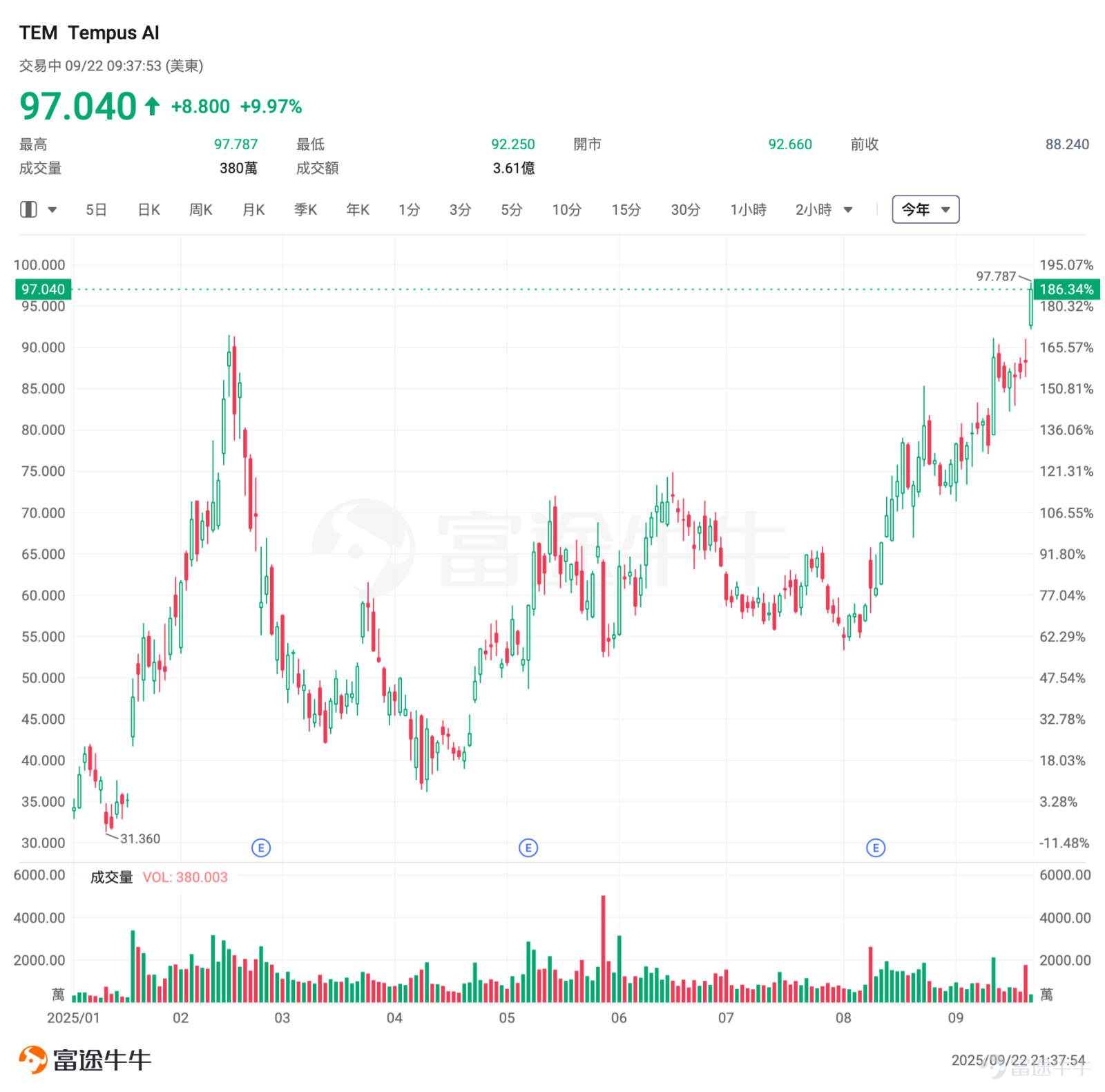

Stock price hits a historic high! What is the magic behind Tempus AI, backed by "Capitol Hill stock-picking guru" Pelosi?
This year, driven by the endorsement of 'Capitol Hill stock-picking guru' Pelosi and Cathie Wood, as well as the continued fermentation of AI and other multi-layered positive catalysts,AI + healthcare has become a major breakout area.
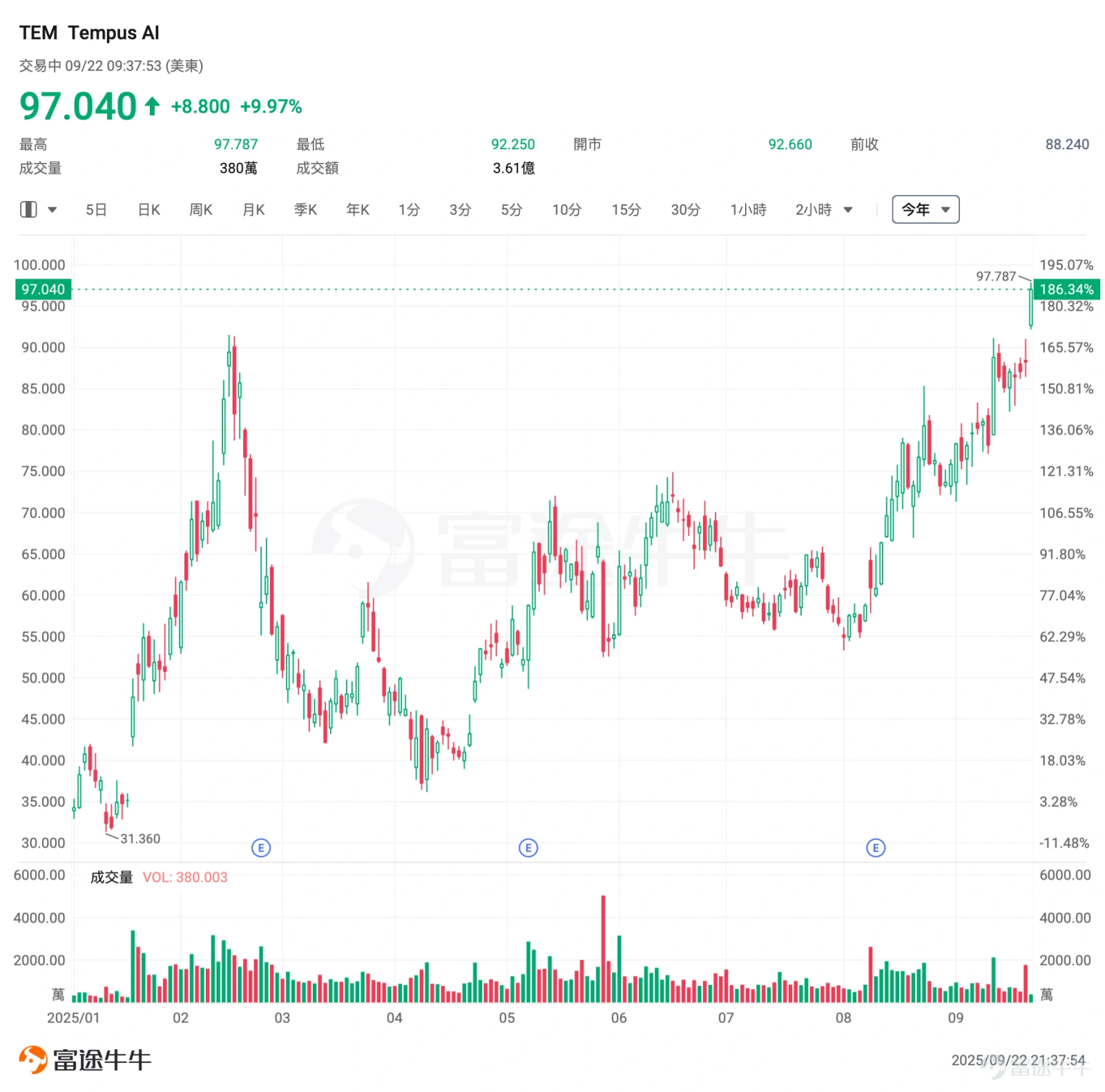
Among these, The AI + precision medicine company endorsed by Pelosi $Tempus AI (TEM.US)$made a strong upward move today, hitting a historic high with an accumulated increase of over 180% year-to-date. In terms of news, the company announced it had received U.S. FDA 510(k) clearance for its RNA NGS in vitro diagnostic device, Tempus xR IVD.
Previously, last week the company also announced that an updated version of its Tempus Pixel device received special 510(k) approval from the U.S. Food and Drug Administration (FDA). This marks an important regulatory milestone,signaling that the upgraded version of the device for cardiac imaging has been officially approved for commercial use in the United States.
At this point, many investors may be curious about the company’s business model, core competencies, and how to invest as an individual. The following analysis will address these questions one by one.
Tempus AI – Committed to driving a data-led healthcare revolution
Tempus AI was founded by technology entrepreneur Eric Lefkofsky, inspired by his wife’s experience of being diagnosed with breast cancer. During frequent visits to accompany his wife for medical treatment, Lefkofsky unexpectedly discovered thatoncologists relied on paper records and fragmented information when making critical treatment decisions, rather than on comprehensive and systematic data analysis.
After his wife recovered, this experience lingered in his mind. Consequently, Lefkofsky resolutely founded Tempus AI,with the mission of introducing data-driven decision-making into the healthcare field—especially in the complex and crucial domain of cancer treatment.
“Tempus” means “time”—symbolizing the most precious resource in cancer treatment, as well as embodying the company's mission to save time for doctors and enhance diagnostic efficiency.
How is the company performing?
Tempus’s business platform primarily consists of three product lines: genomic diagnostic testing, data services, and an AI application platform.The company emphasizes that these businesses are not isolated but form a highly synergistic and integrated organic whole. This “1+1>2” synergy significantly enhances the competitiveness of each product line, collectively highlighting Tempus’s unique value in the AI healthcare field.
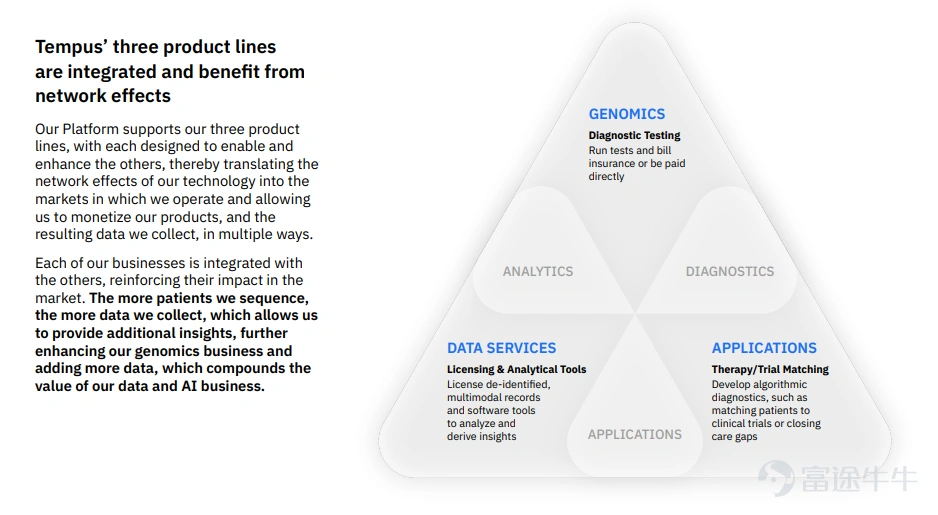
Source: Company website
Genomics operations are the core revenue source for Tempus, accounting for 76% of total revenue.This segment primarily provides genetic testing services to medical institutions.
In Q2 2025, oncology testing revenue reached $133 million, representing a year-over-year increase of 32.9%, with testing volumes growing by approximately 26%. Genetic testing revenue amounted to $97.3 million, up 33.6% year-over-year, with testing volumes increasing by about 32%.
Data and AI services contributed 24% of total revenue, with primary clients being pharmaceutical and biotechnology companies.In Q2 2025, this segment generated revenue of $72.8 million, reflecting a year-over-year growth of 35.7%. Notably, its data licensing business performed exceptionally well, with revenue increasing by 40.7% year-over-year.
The data licensing business also demonstrated strong customer retention rates, with a data licensing retention rate of approximately 140% as of the end of 2024 and a total remaining contract value exceeding $940 million. This indicates robust visibility into future revenue for this division.
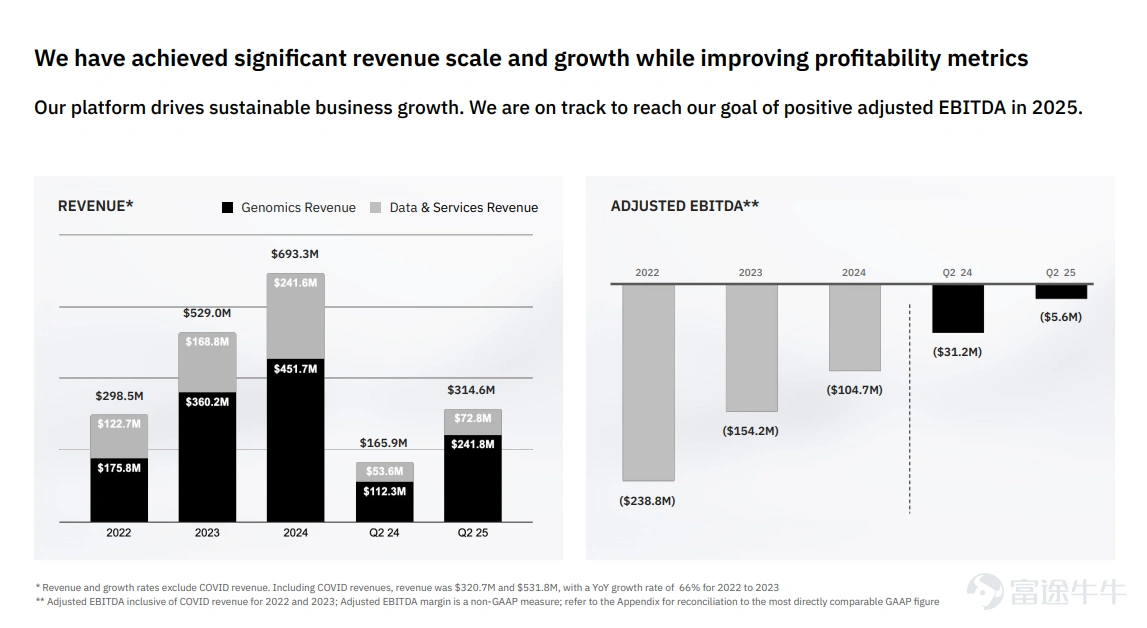
Source: Company website
Tempus updated its guidance for 2025, targeting revenue of approximately $1.26 billion, representing annual growth of around 82%. This is slightly higher than the $1.25 billion guidance provided after the Q1 earnings release.
More importantly, the company now expects to achieve positive adjusted EBITDA of approximately $5 million for the full year 2025, an improvement of $110 million compared to 2024.This will mark a significant milestone on the company’s path to profitability.
What are the core competitive advantages?
Tempus's business model is a quintessential example of the 'data flywheel' effect, with a clear and efficient operational logic:
Step One: Exchanging Services for Data
By offering hospitals free genetic testing and AI-assisted diagnostic services, Tempus generates service revenue while more crucially accumulating high-quality, multimodal healthcare data resources.
Step Two: Monetizing Data
Data licensing has become Tempus's core revenue source, reaching a scale of approximately USD 1 billion. After anonymization, this data is systematically provided to pharmaceutical companies for use in reducing new drug development cycles from 10 years to 5 years; precisely matching clinical trial patients, increasing recruitment success rates by 3 to 5 times; and predicting drug market potential, significantly lowering R&D investment risks.
Step Three: Accelerating the Flywheel Cycle
With more data continuously fed in, the accuracy and value of AI models are constantly optimized, enhancing their attractiveness to pharmaceutical companies. This drives higher-premium data collaborations, attracting more medical institutions to join—forming a closed-loop growth momentum.
Specifically, Tempus's core competitive advantage lies in its unique data assets.The strength of this database lies not only in its massive volume but also in its exceptional data quality and diversity. Tempus has integrated over 5.2 million de-identified electronic medical records, sourced from collaborations covering 65% of academic medical centers and 50% of oncology specialists across the United States. These records comprehensively present information from diagnosis, treatment to follow-up, providing a robust data foundation for disease progression research and efficacy assessment.
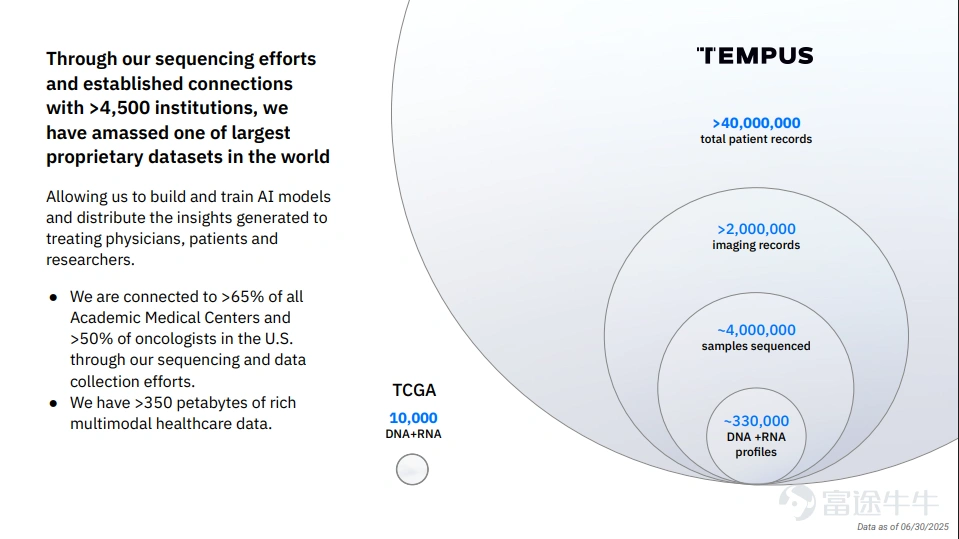
Source: Company official website
Furthermore,Tempus also possesses a total of over 350PB of medical imaging data,covering various types such as CT, MRI, X-ray, and digital pathology slides. Each image not only includes the raw data but also comes with diagnostic reports and professional annotations, significantly enhancing the interpretability and application value of the data.
Notably,Tempus has built one of the world's leading cancer databases, covering nearly a quarter of cancer patients in the United States.This database not only extensively includes common cancer types but also accumulates a large number of rare tumor cases, providing invaluable resources for addressing diseases that lack sufficient research data.
Data diversity is one of Tempus' core strengths. The company aggregates multi-dimensional data, including genomic data, electronic health records, medical imaging, transcriptomics data, proteomics data, and real-time monitoring data. This robust capability to integrate multimodal data allows Tempus to construct comprehensive and continuous patient health profiles, providing three-dimensional data support for precision medicine.
To efficiently manage and deeply analyze these massive datasets,Tempus independently developed the T-DAO system (Temporal-Data Association and Optimization).The system possesses dynamic data correlation capabilities, enabling the establishment of cross-temporal relationships to achieve dynamic optimization of clinical decision support.
In addition, Tempus has launched several innovative products.Among these, Tempus Next, an AI-driven intelligent care pathway platform, focuses on identifying and bridging gaps in oncology and cardiology treatments. By analyzing operational data from hundreds of medical institutions, the platform provides physicians with near real-time treatment insights and recommendations, significantly advancing clinical practices in precision medicine.
Most importantly, Tempus's AI tools have demonstrated clear clinical value. The most compelling evidence comes from its AI clinical trial matching system: this tool increases patient screening efficiency by 4.5 times, matching accuracy by 3.2 times, and ultimately boosts patient enrollment rates by 2.1 times.This fully demonstrates that Tempus's AI technology has successfully transitioned from theoretical validation to clinical empowerment, truly enhancing the efficiency and precision of medical practice.
However, as competition in the AI healthcare sector intensifies, Tempus's core challenge has shifted from technical validation to commercial validation. What Wall Street now expects is not just a growth narrative but a clear profit model and sustainable growth trajectory. With the company's 'data flywheel' now operating robustly, the next critical step is converting it into solid financial performance — requiring exceptional execution to complete the final leap from data advantage to commercial success.
How should investors place a better bet?
If investors remain optimistic about the company, in addition to investing in common stock, they can also purchase $Tradr 2X Long TEM Daily ETF (TEMT.US)$ 。
Additionally, one can refer to Pelosi’s purchase of LEAPS Calls,For instance, Pelosi purchased 50 call options of Tempus AI with an expiration date of January 26, 2026, at a strike price of $20 in early January.
Fellow investors observing Pelosi's stock trading records may notice that she frequently purchases call options with expiration periods exceeding one year and strike prices significantly lower than the current market price of the underlying stock. This type of option represents a specific strategy known as "LEAPS call." LEAPS stands for Long-Term Equity Anticipation Securities, which differ from standard options as their expiration periods typically extend beyond one year, with a maximum duration of up to three years. Due to their longer time horizon, LEAPS call strategies can leverage the advantages of options while effectively mitigating risks posed by short-term market volatility. Therefore, they are suitable for investors who are optimistic about a stock's long-term performance and wish to participate in potential upside with relatively low costs.
Risk Disclaimer: The above content only represents the author's view. It does not represent any position or investment advice of Futu. Futu makes no representation or warranty.Read more

Comments (3)
to post a comment
45
134