
[Opportunity Express] VRT, the global leader in liquid cooling technology, still has significant upside potential?
The rapid development of AI and high-performance computing is driving a "thermal management technology" revolution. As the global leader in liquid cooling, $Vertiv Holdings (VRT.US)$ , whose stock price has surged more than threefold from a low of $53 within the year, has emerged as a hidden beneficiary of this revolution! With liquid cooling becoming a standard feature for computational power advancement, how much growth potential does VRT still have? What are the prospects moving forward? This week’s [Opportunity Express] will explore these questions with you.
A good company meets a great opportunity
VRT’s predecessor was an electrical equipment company (named Liebert Corporation), which had focused on electrical power equipment for decades. It wasn’t until 2016, when it merged with Emerson’s Network Power division, that the current Vertiv was formed. In the following years, Vertiv continued to acquire companies such as E&I Engineering, USystems, and CoolTera Ltd. These acquisitions solidified Vertiv's leading position in power management and liquid cooling technology.
In simple terms, liquid cooling technology uses liquid to dissipate heat generated by electronic devices (such as server chips) during operation, thereby achieving effective temperature reduction.Imagine the traditional air-cooling technology of the past, akin to using an electric fan to blow air at a hot engine—its efficiency was very low. Liquid cooling, on the other hand, wraps water pipes around the engine, allowing cold water to continuously flow and remove heat, or even submerges the entire engine in non-conductive coolant to enhance cooling efficiency. The efficiency of liquid cooling technology is up to 3000 times higher than traditional air cooling solutions, which is why it has become a key enabler for computational power development.
At present, the mainstream use cases of liquid cooling technology are expanding, such asAI and high-performance computing data centers, which represent the most critical and fastest-growing application scenario currently.When training large AI models, we need to utilize tens of thousands of high-performance chips like NVIDIA GPUs, which consume an extraordinary amount of power—up to 700 watts or even over 1000 watts per chip—generating significant heat. Chips may throttle their performance due to overheating, affecting computational power; hence, liquid cooling technology becomes indispensable. Currently, major global cloud service providers such as Google, AWS, Microsoft Azure, and OpenAI are extensively adopting liquid cooling solutions. Beyond that, hyperscale cloud data centers, cryptocurrency mining, electric vehicle charging, quantum computing, and other frontier technologies are also exploring the application of liquid cooling technology.
According to data from Dell'Oro Group, revenue in the liquid cooling market is expected to approach USD 20 billion by 2027, with a compound annual growth rate (CAGR) as high as 60% from 2020 to 2027. Additionally, currently only about 20% of data centers globally adopt liquid cooling technology, but it is projected that 60%-65% of data centers will transition to liquid cooling in the future, which will continue to benefit VRT.
Growth Potential Driven by AI
$Vertiv Holdings (VRT.US)$ VRT could be considered a fortunate company, capitalizing on the dividends of the AI era and securing numerous large orders through its liquid cooling technology, resulting in outstanding performance.
Looking at VRT’s business structure, its operations mainly revolve aroundProductandServices and Accessories, with product-related revenue accounting for 82% of total revenue. Its core income is derived from thermal management solutions.VRT’s thermal management includes rear-door heat exchangers, direct-to-chip liquid cooling, and immersion cooling methods, catering to diverse heat dissipation needs across different densities and scales.For instance, the company recently launched the Vertiv™️ 360AI Full-Chain Intelligent Computing Solution, an 'all-in-one solution' specifically designed for AI data centers.
![The rapid development of AI and high-performance computing is driving a "thermal management technology" revolution. As the global leader in liquid cooling, $Vertiv Holdings (VRT.US)$ , whose stock price has surged more than threefold from a low of $53 within the year, has emerged as a hidden beneficiary of this revolution! With liquid cooling becoming a standard feature for computational power advancement, how much growth potential does VRT still have? What are the prospects moving forward? This week’s [Opportunity Express] will explore these questions with you. A good company meets a great opportunity VRT's predecessor was an electrical equipment company (named Liebert Corporation), which had been dedicated to manufacturing electrical power equipment for decades. It wasn't until 2016, when it merged with Emerson's Network Power division, a division of the industrial giant Emerson, that the current Vertiv was formed. In the following years, Vertiv successively acquired companies such as E&I Engineering, USystems, and CoolTera Ltd. This series of acquisitions reinforced Vertiv’s leading position in power management and liquid cooling technologies. In simple terms, liquid cooling technology uses liquid to dissipate heat generated by electronic devices (such as server chips) during operation, thereby achieving effective temperature reduction.Imagine traditional air-cooling technology from the past, akin to using an electric fan to blow air at a hot engine—its efficiency was very low. In contrast, liquid cooling technology is like wrapping pipes around the engine, allowing cold water to continuously flow and dissipate heat, or even submerging the entire engine...](https://nnqimage.futunn.com/sns_client_feed/900080/20250918/web-1758183930847-TJExhPDa0k.png/big?area=1&is_public=true&imageMogr2/ignore-error/1/format/webp)
In addition to its diverse product portfolio, VRT has more than 240 service centers worldwide, with over 3,500 field engineers and 190 technical response experts who can provide support to multiple regions around the globe at any time. This global service network has built a strong competitive moat for VRT.
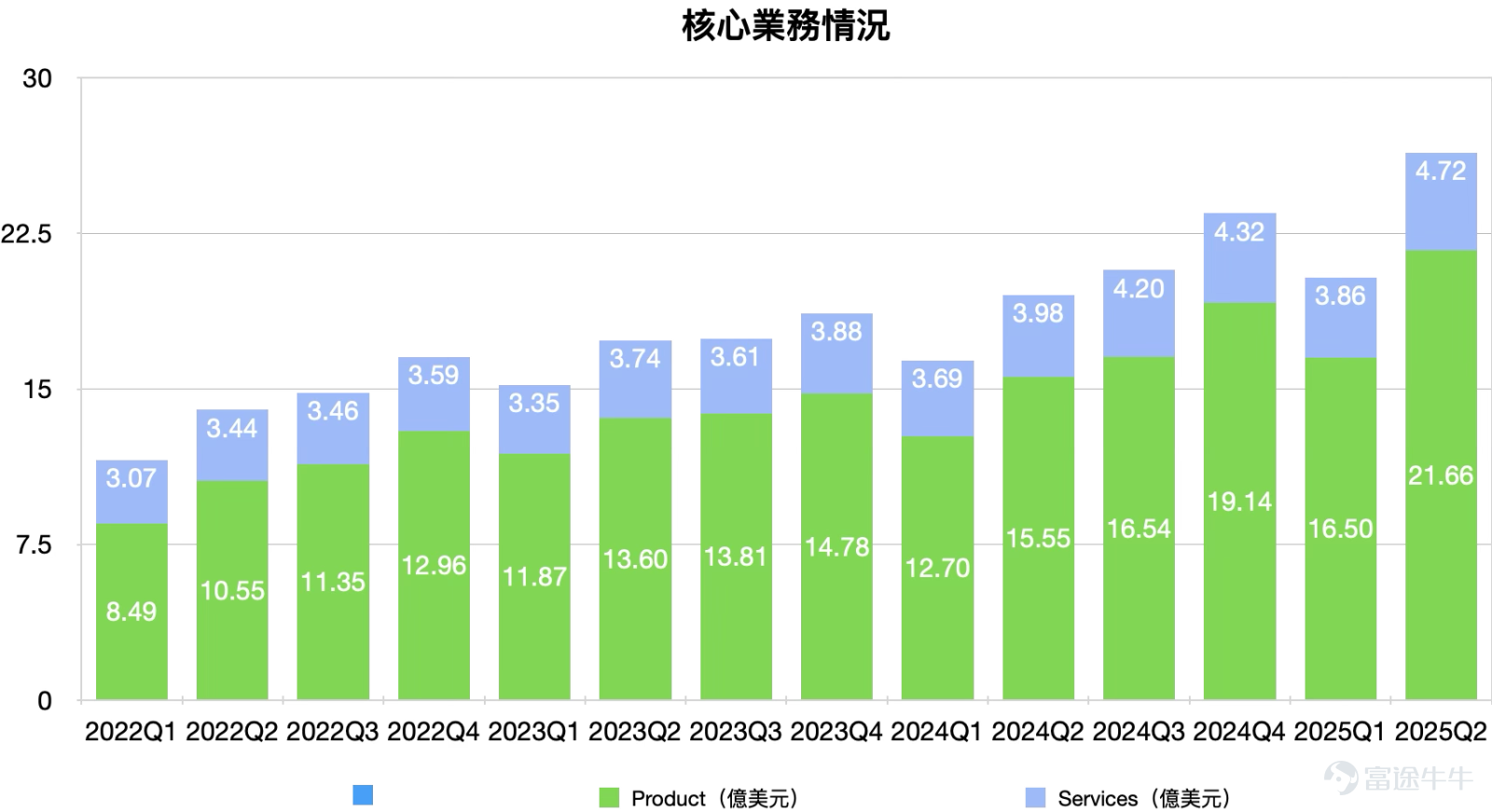
An analysis of several years of revenue shows that, whether from products or services, VRT's revenue has been steadily increasing and reached a new quarterly high in Q2 of 2025.
Overall, VRT’s total revenue in Q2 of 2025 reached $2.638 billion, marking a robust year-over-year increase of 35%, significantly surpassing expectations. Moreover, the company’s backlog of orders at the end of Q2 stood at $8.5 billion, representing a 7% growth compared to Q1, signaling strong future prospects.
![The rapid development of AI and high-performance computing is driving a "thermal management technology" revolution. As the global leader in liquid cooling, $Vertiv Holdings (VRT.US)$ , whose stock price has surged more than threefold from a low of $53 within the year, has emerged as a hidden beneficiary of this revolution! With liquid cooling becoming a standard feature for computational power advancement, how much growth potential does VRT still have? What are the prospects moving forward? This week’s [Opportunity Express] will explore these questions with you. A good company meets a great opportunity VRT's predecessor was an electrical equipment company (named Liebert Corporation), which had been dedicated to manufacturing electrical power equipment for decades. It wasn't until 2016, when it merged with Emerson's Network Power division, a division of the industrial giant Emerson, that the current Vertiv was formed. In the following years, Vertiv successively acquired companies such as E&I Engineering, USystems, and CoolTera Ltd. This series of acquisitions reinforced Vertiv’s leading position in power management and liquid cooling technologies. In simple terms, liquid cooling technology uses liquid to dissipate heat generated by electronic devices (such as server chips) during operation, thereby achieving effective temperature reduction.Imagine traditional air-cooling technology from the past, akin to using an electric fan to blow air at a hot engine—its efficiency was very low. In contrast, liquid cooling technology is like wrapping pipes around the engine, allowing cold water to continuously flow and dissipate heat, or even submerging the entire engine...](https://nnqimage.futunn.com/sns_client_feed/900080/20250918/web-1758183931110-0lq5j6ufyV.png/big?area=1&is_public=true&imageMogr2/ignore-error/1/format/webp)
In fact, starting from Q1 of 2024, the company experienced a significant rebound in performance growth, primarily driven by explosive demand under the AI wave. In particular, its deep integration with industry giants $NVIDIA (NVDA.US)$ has rapidly boosted the company’s production capacity. Additionally, in 2024, VRT established new factories in Pune, India, and South Carolina, USA, to expand capacity and meet demand across different regions.
Aside from NVIDIA, VRT has also formed partnerships with $Intel (INTC.US)$、 $Shell (SHEL.US)$、 $CoreWeave (CRWV.US)$、 $Dell Technologies (DELL.US)$ and other companies, creating a diversified client structure that reduces reliance on any single company and provides a stable foundation for sustained business growth.。
In terms of profitability, VRT's gross margin has remained stable at over 30%, and its net profit margin has shown significant improvement in recent quarters. Despite some negative impacts from tariffs, the overall effect has been minimal.
![The rapid development of AI and high-performance computing is driving a "thermal management technology" revolution. As the global leader in liquid cooling, $Vertiv Holdings (VRT.US)$ , whose stock price has surged more than threefold from a low of $53 within the year, has emerged as a hidden beneficiary of this revolution! With liquid cooling becoming a standard feature for computational power advancement, how much growth potential does VRT still have? What are the prospects moving forward? This week’s [Opportunity Express] will explore these questions with you. A good company meets a great opportunity VRT's predecessor was an electrical equipment company (named Liebert Corporation), which had been dedicated to manufacturing electrical power equipment for decades. It wasn't until 2016, when it merged with Emerson's Network Power division, a division of the industrial giant Emerson, that the current Vertiv was formed. In the following years, Vertiv successively acquired companies such as E&I Engineering, USystems, and CoolTera Ltd. This series of acquisitions reinforced Vertiv’s leading position in power management and liquid cooling technologies. In simple terms, liquid cooling technology uses liquid to dissipate heat generated by electronic devices (such as server chips) during operation, thereby achieving effective temperature reduction.Imagine traditional air-cooling technology from the past, akin to using an electric fan to blow air at a hot engine—its efficiency was very low. In contrast, liquid cooling technology is like wrapping pipes around the engine, allowing cold water to continuously flow and dissipate heat, or even submerging the entire engine...](https://nnqimage.futunn.com/sns_client_feed/900080/20250918/web-1758183931430-nAZqhOURCO.png/big?area=1&is_public=true&imageMogr2/ignore-error/1/format/webp)
Moreover, the company’s adjusted operating profit for Q2 increased by 28.2% year-over-year to USD 4.89 billion. By region, operating profits in the Americas and the Asia-Pacific grew by 28.2% and 83.3% respectively year-over-year, demonstrating outstanding performance. This also indicates that VRT has successfully capitalized on lucrative opportunities in regions with the most active AI computing power demand.
Overall, VRT's business performance has been excellent, with Q2 results further confirming that it is benefiting significantly from the AI wave, backed by solid order growth. Additionally, management raised their full-year 2025 guidance, projecting annual revenue between USD 9.925 billion and USD 10.075 billion, reflecting strong confidence in future prospects.
Technical Trading Opportunities
From a technical analysis perspective on the current stock price trend, $Vertiv Holdings (VRT.US)$ the daily K-line remains in an upward trend. The stock price attempted to break its historical high at the end of July but failed. Throughout August, the price continued to consolidate. Referring to the EMA line, the stock price has now stabilized and rebounded, gradually forming a bullish trend. Conservative investors may consider the EMA50 line (USD 129) as short-term support, with upside targets based on previous highs. The key will be whether the price can break through in subsequent sessions.
![The rapid development of AI and high-performance computing is driving a "thermal management technology" revolution. As the global leader in liquid cooling, $Vertiv Holdings (VRT.US)$ , whose stock price has surged more than threefold from a low of $53 within the year, has emerged as a hidden beneficiary of this revolution! With liquid cooling becoming a standard feature for computational power advancement, how much growth potential does VRT still have? What are the prospects moving forward? This week’s [Opportunity Express] will explore these questions with you. A good company meets a great opportunity VRT's predecessor was an electrical equipment company (named Liebert Corporation), which had been dedicated to manufacturing electrical power equipment for decades. It wasn't until 2016, when it merged with Emerson's Network Power division, a division of the industrial giant Emerson, that the current Vertiv was formed. In the following years, Vertiv successively acquired companies such as E&I Engineering, USystems, and CoolTera Ltd. This series of acquisitions reinforced Vertiv’s leading position in power management and liquid cooling technologies. In simple terms, liquid cooling technology uses liquid to dissipate heat generated by electronic devices (such as server chips) during operation, thereby achieving effective temperature reduction.Imagine traditional air-cooling technology from the past, akin to using an electric fan to blow air at a hot engine—its efficiency was very low. In contrast, liquid cooling technology is like wrapping pipes around the engine, allowing cold water to continuously flow and dissipate heat, or even submerging the entire engine...](https://nnqimage.futunn.com/sns_client_feed/900080/20250918/web-1758183931285-JeGKQ9et0b.png/big?area=1&is_public=true&imageMogr2/ignore-error/1/format/webp)
For investors with a higher risk appetite who are optimistic about future prospects, trading using options tools could be considered. For instance, buying Long Call options or selling Short Put options are relatively straightforward strategies that can help enhance returns within an uptrend.
Interested fellow investors can learn more about these strategies under the Options-Strategy section on the desktop platform.
![The rapid development of AI and high-performance computing is driving a "thermal management technology" revolution. As the global leader in liquid cooling, $Vertiv Holdings (VRT.US)$ , whose stock price has surged more than threefold from a low of $53 within the year, has emerged as a hidden beneficiary of this revolution! With liquid cooling becoming a standard feature for computational power advancement, how much growth potential does VRT still have? What are the prospects moving forward? This week’s [Opportunity Express] will explore these questions with you. A good company meets a great opportunity VRT's predecessor was an electrical equipment company (named Liebert Corporation), which had been dedicated to manufacturing electrical power equipment for decades. It wasn't until 2016, when it merged with Emerson's Network Power division, a division of the industrial giant Emerson, that the current Vertiv was formed. In the following years, Vertiv successively acquired companies such as E&I Engineering, USystems, and CoolTera Ltd. This series of acquisitions reinforced Vertiv’s leading position in power management and liquid cooling technologies. In simple terms, liquid cooling technology uses liquid to dissipate heat generated by electronic devices (such as server chips) during operation, thereby achieving effective temperature reduction.Imagine traditional air-cooling technology from the past, akin to using an electric fan to blow air at a hot engine—its efficiency was very low. In contrast, liquid cooling technology is like wrapping pipes around the engine, allowing cold water to continuously flow and dissipate heat, or even submerging the entire engine...](https://nnqimage.futunn.com/sns_client_feed/900080/20250918/web-1758183930726-m0CcLDIxQB.png/big?area=1&is_public=true&imageMogr2/ignore-error/1/format/webp)
Risk Disclosure: This content does not constitute a research report and is for reference only. It should not be used as the basis for any investment decision. The information provided does not fully describe the securities, markets, or developments mentioned. Although the sources of information are considered reliable, the accuracy or completeness of the above content is not guaranteed. Additionally, no guarantee is made regarding the accuracy of any statements, views, or forecasts provided in this article.
Risk Disclaimer: The above content only represents the author's view. It does not represent any position or investment advice of Futu. Futu makes no representation or warranty.Read more


Comments (216)
to post a comment
433
150