
Hong Kong stocks continue to recover! The Hang Seng Index briefly returned to 26,000 points.

Horizonrobot Soars Nearly 2x This Year! Should Investors Take Profits at Current Highs?
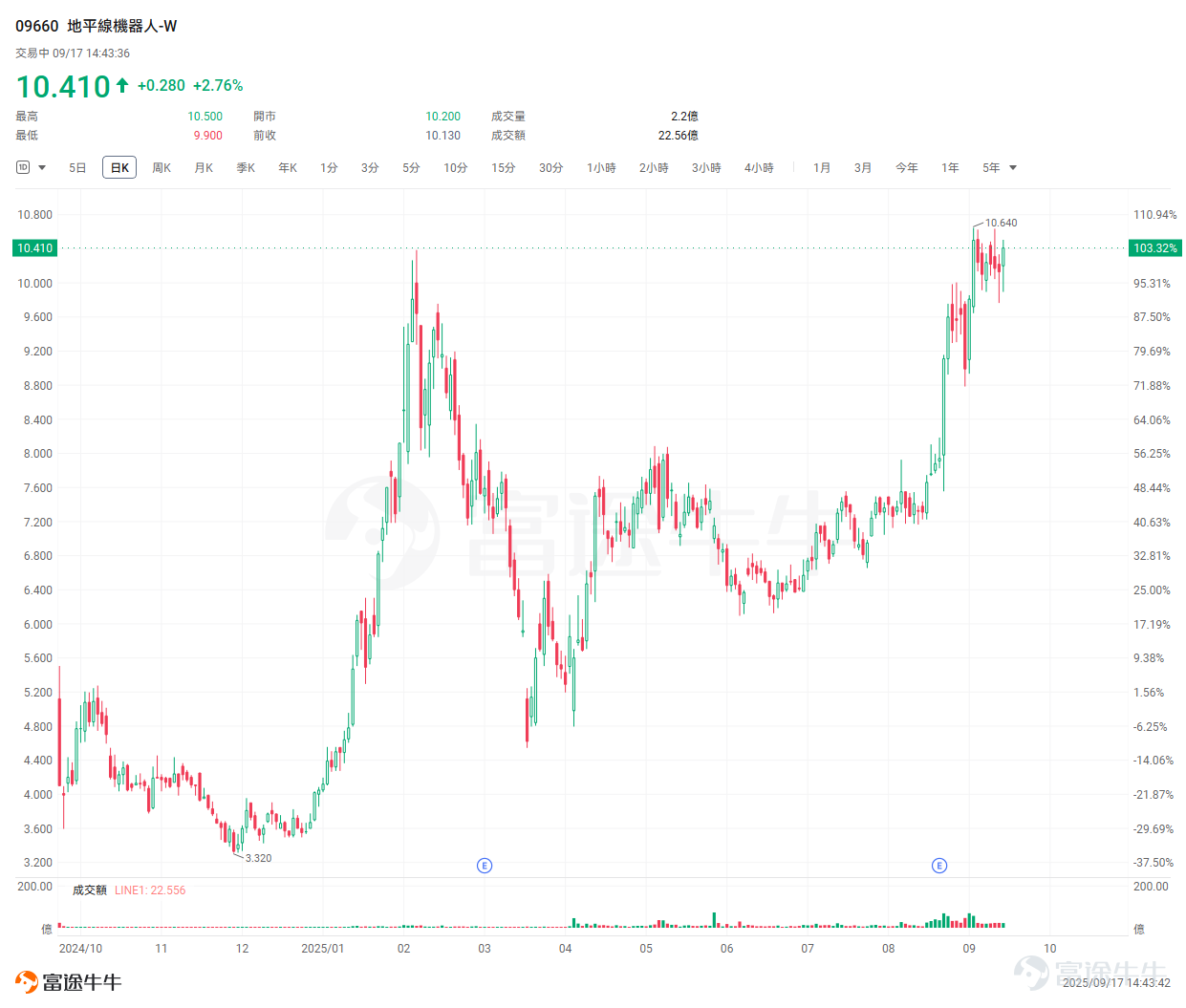
$HORIZONROBOT-W (09660.HK)$ The stock has shown strong performance recently. Year-to-date, the share price has surged by 188%, with a rise of 38.85% over the past month from HKD 7.31 to HKD 10.15.During this period, the stock reached a high of HKD 10.64 and a low of HKD 9.9. Notably, on August 28, following the earnings report release, the stock surged 21.6% in a single day, with a trading volume of HKD 6.913 billion, marking a one-month high.

In the first half of 2025, Horizonrobot achieved total revenue of RMB 1.567 billion (+67.6%), driven by robust shipment volumes and an increase in average selling prices. Revenue from automotive product solutions reached RMB 778 million (+250%), with product shipments doubling to 2 million units.
The current stock price is at a historic high since its listing, with a profit-taking ratio as high as 95%. The stock is under pressure at these levels. Is the current valuation reasonable? Should investors hold their positions or take profits now?
Essential Reading Before Investing: An Analysis of Horizonrobot's Business Structure
An analysis of Horizonrobot's business structure shows that its automotive solutions are primarily divided into two categories: product solutions and licensing and services.In the first half of 2025, automotive solutions accounted for 96.78% (RMB 1.516 billion) of revenue, mainly from ADAS and advanced autonomous driving technology licensing; non-automotive solutions accounted for only 3.22% (RMB 50.42 million), focusing on devices such as lawn mowers and fitness mirrors.
Product solutions mainly include Horizon Mono (Advanced Driver Assistance Systems, ADAS), Horizon Pilot 3 (Highway NOA), and Horizon SuperDrive (HSD, full-scenario urban NOA) modules, along with hardware products; the licensing and services business involves charging service fees by licensing algorithms and software to customers.
Previously, Horizonrobot benefited from vehicle intelligence, with its licensing and services business continuously expanding and accounting for a significant portion of overall revenue, while intelligent driving democratization has enabled dual growth drivers for its two core businesses.

The popularization of autonomous driving is driving a sharp increase in shipment volumes.
1. Under the wave of intelligent driving democratization, shipments of advanced intelligent driving solutions are accelerating.
We are entering a true era of 'intelligent driving democratization'—where intelligent driving technology, once a premium feature, is rapidly becoming standard equipment in mass-market models.Marked by BYD's integration of the advanced 'Sky God's Eye' intelligent driving system into models priced at the 100,000 yuan level in February 2025, $XPeng (XPEV.US)$ 、 $GEELY AUTO (00175.HK)$ major automakers such as Chery, Great Wall, GAC, and Changan have followed suit, collectively driving a rapid increase in the penetration rate of advanced intelligent driving systems within the 100,000–200,000 yuan price range.
Third-party data indicates that the penetration rate of NOA (Navigate on Autopilot) functionality in the Chinese market has rapidly increased (from 20% in 2024 to 32% in the first half), with urban NOA also entering an initial phase of widespread adoption. As more mainstream automakers invest, the scale of relevant data is expected to grow at an accelerated pace. Notably, during the early stages of the democratization of intelligent driving, the 100,000–200,000 yuan price range has become the core market for NOA adoption, achieving a penetration rate of 10.2% and surpassing other price segments with a market share exceeding 40%.This trend is also pressuring high-end models to accelerate the implementation of NOA features, driving an overall increase in the penetration rate of intelligent driving systems.BYD, for instance, plans to equip over 60% of its models with highway NOA or higher-level intelligent driving functions.

2. By securing partnerships with premium large clients, chip shipment volumes have achieved significant growth.
From January to April 2025, in the L2+ standard configuration market, $BYD COMPANY (01211.HK)$ , Huawei, $Li Auto (LI.US)$ Their market shares are 29.7%, 18.5%, and 15.3%, respectively, with the combined share exceeding 60%. Huawei has achieved a closed-loop layout through its self-developed chips and algorithms. So, who are the 'enablers' for BYD and Li Auto?
Horizon Robotics recently disclosed in an earnings call that BYD and Li Auto have become its two largest customers, accounting for over 50% of shipments. Meanwhile, several automakers, including Geely, Chery, and Changan, also plan to launch mass-produced models based on Horizon Robotics’ chips in the second half of 2025. Additionally, management has secured new orders from two Japanese automakers (with a total lifecycle volume exceeding 7.5 million units).Horizonrobot's business strategy does not rely on a single brand but benefits from the overall expansion of the intelligent driving market. As of mid-2025,the company has established cooperative relationships with 27 domestic and international OEMs (covering 42 brands),securing定点 for nearly 400 new models, of which more than 100 support high-speed NOA or higher-level functions. In the first half of the year, over 15 models equipped with Horizonrobot's advanced intelligent driving solutions have entered mass production and been launched in the market.
In 2024, shipments of Horizon Robotics’ Journey series chips reached 2.9 million units, with cumulative shipments surpassing 7.7 million units; in the first half of 2025, shipments reached 1.98 million units (+100% year-on-year), and the full-year forecast is expected to reach 4 million units.
Beyond scale growth,Technological iteration is also driving the continuous increase in product unit price and value. In H1 2025, the average unit price of chips increased by approximately 106% year-on-year, reflecting a gradual shift in the product mix towards higher-value offerings.
3. Localization of semiconductors accelerates as autonomous driving chips catch up to global leading standards.
In April 2024, Horizon Robotics officially launched its next-generation Journey 6 (J6) series of chips. The high-performance core chip J6P, designed for advanced intelligent driving, delivers 560 TOPS of computing power on a single chip, surpassing NVIDIA's Orin X, compared to the previous generation J5’s 128 TOPS. This solution is scheduled for mass production in 2025 alongside the HSD urban-assisted driving system. The introduction of J6P not only provides automakers with self-developed algorithms a cost-effective hardware option but also enhances the hardware value proposition of Horizon Robotics itself.
Intelligent driving R&D requires significant investment and carries high uncertainty, leaving automakers with long-term strategic decisions between in-house development and outsourcing. Currently, Tesla and Huawei are among the few companies in the industry that simultaneously develop both chips and algorithms in-house; emerging players like “NIO, XPeng, and Li Auto” tend to focus on algorithm development while outsourcing hardware procurement; in contrast, most traditional automakers still opt for fully outsourced solutions for both chips and algorithms to expedite their intelligent transformation.
Among intelligent driving suppliers, companies that can simultaneously provide both chip and algorithm solutions without competing against automakers are few and far between.With its comprehensive product portfolio, Horizon Robotics offers a highly cost-effective, integrated software and hardware solution that precisely meets the needs of traditional automakers for achieving parity in intelligent driving capabilities.
Currently, Horizon Robotics maintains a leading position in the Advanced Driver Assistance Systems (ADAS) solutions market, with a market share of 45.8% in China’s OEM ADAS market in the first half of 2025, ranking first in the industry. In the higher-end autonomous driving sector, its next-generation game-changer, Horizon SuperDrive (HSD), is poised for release.

Given its high valuation and substantial R&D expenditures, when will the company turn a profit?
Behind the robust revenue growth prospects lies a continuously rising valuation.As of September 16, 2025, Horizonrobot's PS ratio has reached as high as 42x.

Over the past few years, Horizonrobot’s R&D expenses have far exceeded its revenue (in 2024, R&D investment amounted to RMB 3.16 billion, accounting for 132% of revenue).In the first half of 2025, R&D expenses reached RMB 2.3 billion, a year-on-year increase of 62%, primarily allocated to cloud computing power leasing and core technology R&D. This resulted in an adjusted operating loss widening to RMB 1.111 billion, exceeding market expectations.
Although the scaling effect brought by increasing chip shipments and the ramp-up of high-value-added products will help reduce expense ratios and improve profitability over time, according to Wind's consensus forecast,the turning point for profitability may not occur until 2027, making it reasonable for some investors to express concerns about delayed profitability under high R&D investment.
Under such high valuations, the margin of safety for investors is limited and requires continuous upward momentum in the robotics industry and performance delivery to support the valuation.In the event of a risk incident, such as lower-than-expected new car orders, intensifying industry competition, or a weak macro consumption environment, sluggish new car sales data could trigger a significant pullback.
From a short-term technical perspective, the MACD indicator remains in a golden cross, but the histogram continues to converge, with momentum weaker than the previous two trading days. The KDJ approaches the overbought zone (J-value 79.35).This suggests that short-term upside potential may be limited.The MA5 (HKD 10.23) and MA10 (HKD 10.09) form a support band; the current share price is above the 5-day moving average but has approached the upper Bollinger Band at HKD 11.34, warranting caution against volatility within the bands.The current stock price is near the resistance level of the previous high at HKD 10.6. If it breaks through this level, it may attempt to surpass HKD 11.2; conversely, if it falls below the 10-day moving average at HKD 10.09, it could retreat to the support area around HKD 9.34.
In summary, Horizonrobot's business demonstrates extremely high growth potential in the long term, with strong customer resources and a clear competitive edge in the current intelligent driving market. However, its current valuation is relatively high, partially reflecting optimistic future expectations, and the breakeven point is projected to take longer to achieve, requiring robust performance delivery for support. Technically, short-term momentum appears limited; conservative investors may choose to moderately take profits at higher levels, while long-term-oriented investors can wait for the consolidation period to end before entering.
Are humanoid robots the next big trend?
Recently, there have been frequent catalysts for humanoid robots. Tesla CEO Elon Musk recently purchased an additional 2.5 million Tesla shares, stating that approximately 80% of Tesla’s long-term value will come from Optimus, signaling confidence in its humanoid robot business. Next week’s production meeting is expected to address market expectations for Gen3.
The industry widely considers 2025 to be the first year of mass production for humanoid robots, with Musk's target of delivering 1 million units potentially accelerating the mass production timeline. Tesla’s Optimus project is ready for mass production, with more positive catalysts anticipated in the second half of the year. Domestic and international companies are actively advancing new products and partnerships. Overall, the most pessimistic phase of June’s production cuts and model redesigns has passed. Looking ahead to the second half of the year, positive catalysts outweigh potential negatives. Institutions are optimistic about a resurgence in the robotics sector between September and December, driven by domestic developments (application scenarios + order confirmations + product launches + capital operation events) and overseas progress (continuous iteration + gradual start of mass production).
Companies related to the humanoid robotics industry chain include$DOBOT (02432.HK)$ 、 $UBTECH ROBOTICS (09880.HK)$ 、 $IMPRO PRECISION (01286.HK)$ 、 $SHOUCHENG (00697.HK)$ 、 $GEEKPLUS-W (02590.HK)$ 、 $SANHUA (02050.HK)$ 、 $JOHNSON ELEC H (00179.HK)$ and so on.
Are you optimistic about the performance of the robotics sector in the second half of the year? Share your strategy in the comments section below~
Futu Securities analyst Wei Wenbo.
CE:BUI890
(The author is a licensed person of the Securities and Futures Commission, and neither he nor his associates have any financial interests in the recommended issuers of shares.)
 Looking for more market analysis?Futubull AI is now online!Accurate answers, comprehensive insights, and mastery of key opportunities!
Risk Disclaimer: The above content only represents the author's view. It does not represent any position or investment advice of Futu. Futu makes no representation or warranty.Read more


Comments (10)
to post a comment
69
203