
Hong Kong stocks continue to recover! The Hang Seng Index briefly returned to 26,000 points.

How did the Hong Kong stock market ignite, and how has the Hong Kong Stock Exchange become the biggest beneficiary?
On August 20, the Hong Kong Exchange announced its interim results for 2025, achieving a record high. $HKEX (00388.HK)$ The Hong Kong Exchange recorded revenue and other income of HKD 14.1 billion, a year-on-year increase of 33%, and a net profit attributable to shareholders of HKD 8.5 billion, a year-on-year increase of 39%.
With a booming market for Hong Kong stocks and a surge of overseas capital flowing into the Hong Kong stock market, the stock price of the Hong Kong Exchange has also continued to rise, increasing by over 50% since the beginning of the year. Historical data indicates that when trading volumes in Hong Kong stocks increase, the stock price of the Hong Kong Exchange often performs strongly.So, how much room is there for the stock price of the Hong Kong Exchange to grow? How much market expectation is currently factored into the stock price?
For financial sellers, trading volume is the core of performance.
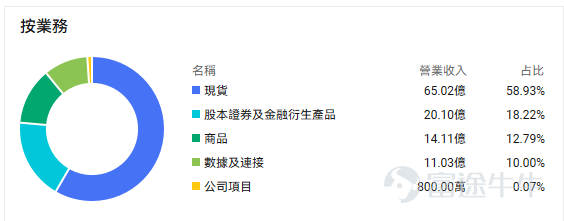
Through a breakdown of the main business structure of the Hong Kong Exchange, we can find that,when categorized by different products, the revenue from the spot market and derivatives market related to Hong Kong stock trading accounts for approximately 80%.
In the first half of 2025, the cash segment achieved revenue of HKD 6.7 billion, a year-on-year increase of 62%, accounting for 48% of total revenue. In the first half of 2025, the revenue from the equity securities and financial derivatives segment was HKD 3.6 billion, a year-on-year increase of 15%, primarily due to increased trading of structured products and listing activities, as well as record-high trading volumes in the derivatives market.

In terms of revenue sources, the majority of the Hong Kong Exchange's income primarily comes from transaction fees and settlement fees. In addition, a small portion comes from listing fees, market data fees, and other income. Regarding the calculation rules for transaction fees and settlement fees, the transaction volume serves as the basis for charging, with the fee rates being fixed over a certain period. Therefore, the scale of transaction volume significantly impacts the majority of the group's revenue.It can be said that the performance of the Hong Kong Exchange is highly correlated with the average daily transaction volume of the Hong Kong stock market.
Spot market (equity) transaction fee = average daily transaction volume * trading days * fee rate (%)
Derivative market transaction fee = number of derivative contracts * price per contract (HK$)
Commodity market transaction fee = number of commodity contracts * price per contract (HK$)
Settlement fee = average daily transaction volume * trading days * fee rate (%)
The trading volume in the spot market, derivatives market, and Stock Connect between Shanghai, Shenzhen, and Hong Kong all reached historical highs for the first half of 2025.The average daily transaction amount in the spot market reached HKD 240.2 billion, more than double that of the first half of 2024. The average daily number of derivative contracts traded was 1.7 million, representing an annual increase of 11%.

The cost investment required for core business operations is not significant, primarily consisting of employee and IT equipment costs. Among these, employee costs account for approximately 63% of total costs.

In summary, the Hong Kong Exchange operates on a light asset model, with revenues directly and highly correlated to the average daily trading volume, while costs are relatively rigid and fixed, primarily comprising employee expenses. This results in a strong leverage effect on revenue when trading volumes increase.
What market expectations are currently factored into the stock price?
From a long-term perspective, the stock price of the Hong Kong Exchange has experienced three phases: the wave of state-owned enterprises going public in 2005, the Shanghai-Hong Kong Stock Connect in 2015, and the listing reforms for new economy companies in 2018. In 2021, it reached a historical high of HKD 542 in a context of liquidity easing.

As mentioned earlier, the most critical variable indicator in the performance of the Hong Kong Exchange is trading activity—average daily trading volume. In comparison, the average daily trading volume in the first half of 2025 has already surpassed the level at the peak of the stock price in 2021.

According to the data released by the Hong Kong Exchange for June and July, the market continues to maintain a vibrant trend, with the average daily trading amount in July reaching HKD 262.9 billion, a month-on-month increase of 14%.Furthermore, historical experience indicates that during periods when the Federal Reserve begins to lower interest rates and global funding costs decrease, trading volumes in the Hong Kong stock market have shown a rebound.

Historically, the valuation of the Hong Kong Exchange has been nearly positively correlated with changes in trading volume indicators; once sentiment improves, valuations tend to rise accordingly.For instance, when the average daily trading volume hovers around HKD 100 billion, such as in the first half of 2024, it corresponds to a P/E valuation central tendency of 22x, whereas when the trading volume exceeds HKD 200 billion, as observed in early 2021, the valuation once surpassed 50 times.

Currently, it is evident that valuations have indeed priced in some expectations of an increase in trading volume.Since the third quarter, market sentiment has remained buoyant. Additionally, with policy support, an increasing number of mainland enterprises are going public in Hong Kong, and the return of Chinese concept stocks is expected to continue bringing new trading increments to the Hong Kong stock market. The trading volume in the second half of the year is anticipated to maintain a high growth trajectory.
Under a neutral assumption, based on an estimated full-year net profit attributable to shareholders of HKD 17 billion, the current stock price corresponds to a 25-year price-to-earnings ratio of around 32 times, which has reached the historical median level. However, under optimistic expectations, if sentiment remains strong, the valuation is likely to elevate further, suggesting an upside potential of approximately 15% to 20%.
Options Signals
From the perspective of options trading volume, the put/call ratio stands at 1.62,indicating a rise in short-term bearish sentiment.

From the open interest distribution on September 5 and September 12, call options are concentrated at a strike price of HKD 460, while put options are concentrated at strike prices of HKD 430 and 440.

The implied volatility (IV) of the Hong Kong Exchange has decreased following the earnings report, currently at 30%, which is at a historical low, approximately at the 18th percentile, favorable for options buyers. This indicates that the market expects relatively stable movements in the near term, without significant fluctuations.

In summary, driven by market sentiment and trading activity, the performance outlook for the Hong Kong Exchange in the second half of the year is positive. If we refer to historical valuations, there remains room for upward adjustment under optimistic scenarios.。From the perspective of stock investment, long-term investors who already have positions can maintain their holdings, while investors without positions may consider entering the market after a short-term pullback.
Regarding options, investors optimistic about future market movements may choose to buy near-the-money call options with lower implied volatility, such as purchasing a call option with a strike price of HKD 450 expiring on September 29. If the stock price rises to HKD 457, a profit can be realized. Investors can also opt for a call option vertical spread strategy, which involves buying a lower strike call and selling a higher strike call, with defined profit and loss limits. Maximum profit is achieved when the stock price exceeds the higher strike price. For those already holding positions but believing that short-term upside potential is limited, the attractiveness of the covered call strategy is reduced due to low IV, potentially missing out on gains from stock price increases.

This concludes the discussion on investment strategies for the Hong Kong Exchange. We will provide further long-term tracking of more popular companies in the future. Feel free to leave your thoughts on the Hong Kong Exchange in the comments section!
Wenbo Wei, Analyst at Futu Securities
License number: BUI890.
(The author is a licensed person under the China Securities Regulatory Commission, and neither they nor their associates have financial interests in the advised issuer of shares.)
 Finally, Futu Information brings a small benefit to fellow investors, and we welcome fellow investors to claim it.Options Beginner's Package
*This event is exclusive to HK invited users. Click to learn moreEvent details >>
Options StrategyWith numerous options, how can you easily navigate performance periods? FutuBull's new desktop helps you establish an options strategy in three simple steps, making investment straightforward and efficient!
Futu offers even more options tools to assist you! Go to the individual stock quote page > Options Activity > Filter > Customize filter conditions to obtain the desired options activity information.

Disclaimer: This content does not constitute an offer, solicitation, recommendation, opinion, or any guarantee regarding any securities, financial products, or instruments. The risks of trading options can be substantial. In certain circumstances, the losses you incur may exceed the initial margin amount deposited. Even if you set stop-loss or limit orders, such instructions may not necessarily prevent losses. Market conditions may prevent the execution of such orders. You may be required to deposit additional margin on short notice. Failure to meet the required amount by the specified time may result in the closure of your open contracts. However, you will still be responsible for any shortfall in your account resulting from this. Therefore, you should research and understand options before trading and carefully consider whether such trading is suitable for you based on your financial situation and investment objectives. If you trade options, you should familiarize yourself with the procedures for exercising options and the rights and obligations you have when exercising options and at the expiration of options.
Risk Disclaimer: The above content only represents the author's view. It does not represent any position or investment advice of Futu. Futu makes no representation or warranty.Read more


Comment (1)
to post a comment
11
2