
The GPT-5 era has arrived! Can it reignite the AI market once again?

Lack of surprises with GPT-5? The AI commercialization wave is sweeping through U.S. stocks! These application stocks are poised to stand out.
At the press conference held at 1:00 AM Beijing time on August 8,GPT-5 has finally arrived after much anticipation, coming two and a half years after the release of GPT-4.
Compared to the impressive debut of ChatGPT, the significant upgrade of GPT-4, and the groundbreaking release of o1, this launch event was notably subdued: the benchmarks were not particularly impressive, there were no signs of new paradigms; the use case demonstrations were uninteresting and failed to distinguish it from competitors; and even a PPT error was caught by netizens, all contributing to the one hour and twenty-minute event.
However, there were some highlights worth noting. According to the Securities Times, the main highlights are as follows:
Integrated model:GPT-5 is an integrated model that combines the large language model GPT series and the reasoning model o series, meaning users no longer need to manually switch between different models.
Enhanced Capabilities:According to OpenAI's publicly released test data, GPT-5 has demonstrated top-tier performance in areas such as mathematics, programming, visual perception, and health, significantly surpassing its predecessors and becoming the most powerful model currently available.
Reduced Hallucinations:Compared to GPT-4o, GPT-5 has a 45% lower factual error rate; in deep thinking mode, the factual error rate is 80% lower than o3, making it more accurate and reliable.
Compared to major competitors Anthropic and Google,OpenAI's GPT-5 model is either equally or less expensive for developers.
Nick Turley, the head of the ChatGPT team, stated,The new model outperforms its predecessor in terms of response speed, answer accuracy, and reduction of 'hallucinations'.

Although GPT-5 has few highlights, its good instruction compliance and the stability of model code output will substantially enhance the monetization capabilities of AI applications.This will have a strong catalytic effect on increasing the penetration rate of AI applications, further improving the success rate of AI application investments.
Global AI application monetization is accelerating.
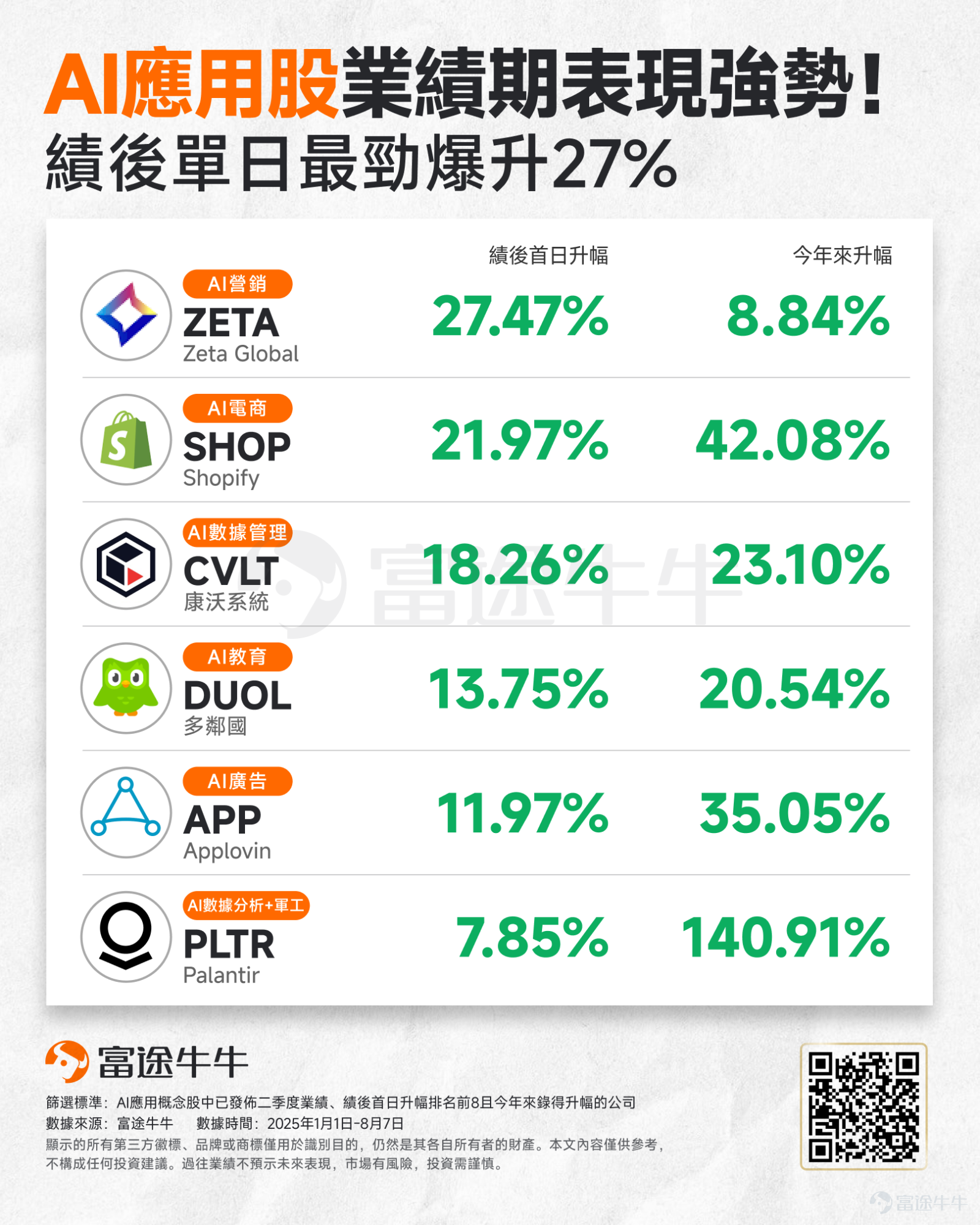
In fact, from the second-quarter earnings reports, the performance of leading US-listed AI application stocks has been impressive. AI marketing $Zeta Global (ZETA.US)$ saw a surge of over 27% on the first day after the earnings report, while AI e-commerce $Shopify (SHOP.US)$ Rising nearly 22%, AI data management $CommVault Systems (CVLT.US)$ Up over 18%, AI education $Duolingo (DUOL.US)$ Increasing nearly 14%, AI advertising $Applovin (APP.US)$ Rising nearly 12%, AI data analysis and defense $Palantir (PLTR.US)$ Up nearly 8%.

Specifically,US AI marketing technology company $Zeta Global (ZETA.US)$reported strong revenue growth in the second quarter, with a year-over-year increase of more than 35%, and impressive core customer data.
As of June 30, 2025, the number of Zeta's scale customers increased by 21% year-over-year, reaching 567.
Among them, the number of high-spending 'super customers' grew from 144 in the same period last year to 168. The average revenue per user (ARPU) for scale customers increased by 11% year-over-year, reaching $532,000; while the ARPU for 'super customers' surged by 19%, reaching an impressive $1.6 million.
This growth is a testament to the appeal of its AI data marketing platform to large enterprises.
The Canadian e-commerce platform $Shopify (SHOP.US)$ Shopify reported Q2 revenue of $2.68 billion, a 31% increase year-over-year.The core indicator measuring the 'true sales activity' of the e-commerce platform—Gross Merchandise Volume (GMV)—reached $87.8 billion, a 29% increase year-over-year.
In addition to the impressive figures in the Earnings Reports, Shopify has made significant investments in artificial intelligence to attract and retain more merchants. In May this year, Shopify launched an 'AI website building tool,' which can automatically generate an online store with just a few keywords. Most recently, Shopify released a new set of tools that support shopping operations through AI agents.
AI data management company $CommVault Systems (CVLT.US)$Second-quarter total revenue hit a record high of $282 million, up 26% year-over-year; annual recurring revenue (ARR) grew to $996 million, up 24% year-over-year.
AI Education $Duolingo (DUOL.US)$Both second-quarter revenue and profit exceeded expectations, and the full-year guidance was revised upward.Daily active users (DAU) surged 40% year-over-year, with DAU growth outpacing MAU growth, indicating a significant increase in user engagement.
AI has become the core driver of the company's growth and profitability. AI-enhanced subscription services (Duolingo Max) have become key in attracting paying users. Additionally, the company revealed that the cost of using AI tools is much lower than expected, directly boosting gross margin. Furthermore, AI is being used to efficiently generate course content, significantly enhancing expansion efficiency.
AI mobile advertising giant $Applovin (APP.US)$reported second-quarter revenue of $1.259 billion, a 9% increase from the previous quarter, exceeding Wall Street consensus estimates.
AppLovin's core competitiveness lies in its AXON AI engine, which optimizes ad placements through machine learning, achieving industry-leading conversion rates.
Notably, during the Applovin earnings call, management expressed a positive outlook on both the current development and future prospects. A new referral program will be launched on October 1, 2025, aimed at reaccelerating the onboarding of large e-commerce advertisers. The self-service platform for e-commerce, set to go live in the first half of 2026, is expected to unlock significant advertising demand from small and medium-sized enterprises.
AI Data Analysis + Defense $Palantir (PLTR.US)$Undoubtedly, it is the leader in AI applications, with U.S. commercial business revenue growing 93% year-over-year, total revenue surpassing $1 billion, an adjusted operating margin of 46%, a free cash flow margin of 57%, and a Rule of 40 index as high as 94%.
Palantir's growth is driven by three major trends: the surge in demand for customized AI applications, increased investment in data infrastructure, and the modernization of defense technology. Palantir's CEO, Alex Karp, stated that AI has had a 'staggering impact' on their business, leading to a second upward revision of the full-year guidance.
Which other AI application software stocks are worth watching?
Overall, In 2025, AI applications will be the core focus.There are numerous AI application software stocks in the current U.S. market. Futubull has also compiled a list of relevant symbols for investors' reference:

Specifically, the current U.S. stock market AI application stocks mainly include:
AI + Big Data: $Snowflake (SNOW.US)$、 $MongoDB (MDB.US)$ 、 $Confluent (CFLT.US)$ 、 $Oracle (ORCL.US)$ ;
AI + Corporate Services: $Zoom Communications (ZM.US)$ 、 $UiPath (PATH.US)$ 、 $Workday (WDAY.US)$ 、$Salesforce (CRM.US)$ 、 $monday.com (MNDY.US)$ 、 $SAP SE (SAP.US)$ 、 $C3.ai (AI.US)$ 、 $HubSpot (HUBS.US)$ 、 $Gitlab (GTLB.US)$ 、 $Atlassian (TEAM.US)$ 、 $Asana (ASAN.US)$ ;
Overall, from a long-term perspective, the potential applications of AI technology will benefit various industries and become a new growth direction for technology companies.
Risk Disclaimer: The above content only represents the author's view. It does not represent any position or investment advice of Futu. Futu makes no representation or warranty.Read more


Comments (6)
to post a comment
129
295