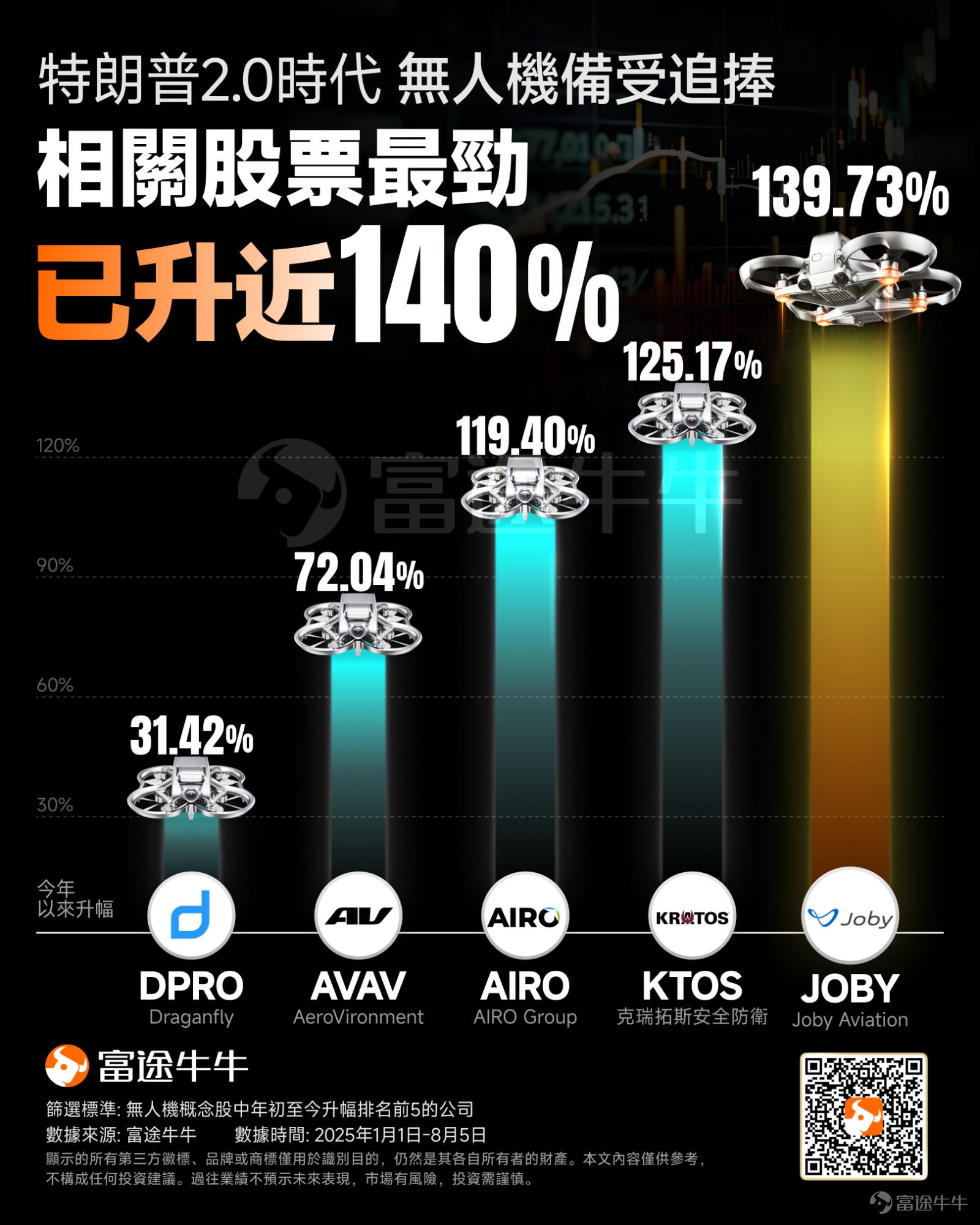

New regulations for the low-altitude economy in the U.S. are here! Joby has surged nearly 140%, which other companies in this sector are worth watching?
The Trump administration has proposed a revision to the current drone regulations, allowing more commercial drones to fly beyond visual line of sight (BVLOS). This is good news for drone delivery companies such as Alphabet's Wing and Walmart.
On Tuesday, U.S. Secretary of Transportation Sean Duffy unveiled a proposal to end the current federal government's 'case-by-case' approval process for long-range drone flights, clearing years of obstacles for companies' drone delivery operations.
Analysts stated thatThe new regulations, once implemented, will end the cumbersome case-by-case approval process of the U.S. Federal Aviation Administration (FAA), seen as a key deregulation for the low-altitude economy in the U.S., and will expand the use of drones in other sectors such as agriculture and manufacturing.
In fact, Since the start of the Trump 2.0 era, the U.S. government has placed a high emphasis on the application of drones and counter-drone technologies.The Trump administration also signed three executive orders: 1) forming a federal task force to review the existing oversight framework and enhance counter-drone capabilities; 2) allowing drones to fly beyond visual line of sight; and 3) lifting the 1973 ban on supersonic air transportation over land.
This year, several drone-related stocks have surged, with the pioneer of electric air taxis rising over 70%. $Joby Aviation (JOBY.US)$ $Kratos Defense & Security Solutions (KTOS.US)$ Rising over 125%, $AIRO Group (AIRO.US)$ Northrop Grumman has gained nearly 120%, and the small tactical drone company $AeroVironment (AVAV.US)$ The company, which focuses on public safety and medical delivery drones, has seen a significant increase in its stock price. $Draganfly (DPRO.US)$ AgEagle Aerial Systems, has risen over 30%.

Previously,Hidden Winners in the U.S. Election! The Trump 2.0 Era is Approaching, Will Drone Stocks in the U.S. Market Experience a Boom?Several articles have previously suggested that drone stocks in the U.S. market could experience a boom in the Trump 2.0 era.

Specifically, current drone stocks can be categorized intomilitary drones, civilian/commercial drones, electric vertical take-off and landing aircraft (eVTOL), and drone software.The business models of these companies will be analyzed one by one.
Military Drones
Military drone stocks specifically include AIRO Group, Kratos Defense & Security Solutions, AeroVironment, Northrop Grumman, and Red Cat Holdings.
AIRO Group is a technology-driven and diversified company focused on aerospace and defense opportunities in the 21st century. The company leverages decades of industry experience and an extensive network of relationships in the unmanned aerial vehicles, aviation, and avionics markets to provide leading solutions for the global market. Since its listing on June 13, the company's stock has risen by nearly 120%.
According to the prospectus, the company operates four divisions:Unmanned Aerial Systems,Avionics、Training,andElectric Air MobilityThe combined potential market size targeted by these four sectors is expected to exceed $315.4 billion by 2030.

The primary revenue for AIRO Group comes from drone-related businesses.The company has deployed equipment in NATO and EU countries and has participated in real combat tests during the conflict in Ukraine.Its drones, equipped with AI capabilities, can perform reconnaissance, target identification, and strike guidance. These drones are very difficult to shoot down due to their artificial intelligence features.
Furthermore,The company plans to produce military drones in the United States and aims to obtain Department of Defense certification within six months to enter the Pentagon's procurement system.
Airo Chairman Kathuria stated:
Modern warfare has been fundamentally altered by drones. While we certainly hope for a peaceful resolution between Iran and Israel, such tensions tend to heighten market interest in the aerospace and defense sectors.
Kratos Defense & Security Solutions was founded in 1994 and primarily provides critical national security products, services, and solutions to the U.S. government. Its technological strengths include satellite communication systems, electronic warfare, unmanned control systems, and cybersecurity. The company offers information technology products and wireless communication systems to the U.S. Department of Defense, the Department of Homeland Security, and various industrial clients.The company's stock has risen by more than 125% this year.

The company operates through six segments: Unmanned Systems, Microwave Electronics, Space & Training and Cybersecurity, Defense and Rocket Support Services, Turbine Technologies, and C5ISR Systems.
Kratos has a significant presence in the unmanned systems sector, covering Unmanned Aerial Systems (UAS), Unmanned Ground Systems (UGS), and Unmanned Surface Vehicles (USV). These systems are widely used in military, intelligence, and national security applications.
Unmanned Aerial Systems (UAS): Include high-performance drones with capabilities for reconnaissance, surveillance, strike, and training.
Unmanned Ground Systems (UGS): Unmanned vehicles used for ground combat or support missions. For example, Ukraine has increasingly utilized unmanned combat vehicles for various tasks such as mine clearance, reconnaissance, ammunition transport, and suppressing enemy infantry.
Unmanned Surface Vessels (USV): Unmanned ships (commonly referred to as ghost fleets) used for maritime reconnaissance and surveillance missions.
AeroVironment is a global leader in military and commercial unmanned aircraft systems (UAS), focusing on small drones and tactical missile systems. It is the primary supplier of small UAS to the U.S. military and its allies.The company is known for systems such as the Switchblade loitering munitions and Puma reconnaissance drones. It typically holds strong government and military contracts. The company's stock has risen by over 70% this year.

This company gained significant attention during the 2022 Russia-Ukraine conflict due to its products being rapidly adopted by NATO. The company's offerings include small drones, ground robots, and support services such as training and maintenance.
Notably, since May 2025, after AeroVironment completed a major acquisition of BlueHalo, the company reorganized its business structure and now operates two divisions: the Autonomous Systems division and the Space, Cyber, and Directed Energy division.
The Autonomous Systems division includes:Unmanned aircraft systems, defense systems, unmanned ground and maritime systems, loitering munitions systems, and MacCready Works.
Among these, MacCready Works is AeroVironment’s innovation and R&D department, focusing on the integration of autonomy, AI, and advanced platform technologies to provide next-generation combat capabilities.
The Space, Cyber, and Directed Energy division includes:Space technology, directed energy solutions, cyber solutions, and mission services.

Northrop Grumman is one of the largest weapons and military technology manufacturers in the United States, specializing in military aircraft, space, and defense technologies. It is responsible for producing most of the U.S. bombers and supplies fighter components to other companies. In addition to being a leader in stealth technology for the U.S. aviation industry, it also plays a significant role in several space projects.The stock has risen more than 26% this year.

Northrop Grumman is also a leader in drone technology.Its renowned RQ-4 Global Hawk is one of the world's most advanced high-altitude, long-endurance unmanned reconnaissance aircraft, widely used for military surveillance and information gathering.The company has also developed the X-47B, an unmanned combat aircraft capable of taking off from an aircraft carrier, which represents the future trend in drone technology.
Red Cat Holdings is a company focused on military and commercial drones, with its subsidiaries Teal Drones and FlightWave Aerospace providing a wide range of drone software and hardware solutions.
Despite a poor performance this year, with a 22% decline, Red Cat saw a 13-fold increase in 2024. The company successfully collaborated with Palantir last year, integrating AI-driven visual navigation technology (VNav) into its drones.

The most eye-catching of their core products is—Black Widow (Black Widow).This small unmanned surveillance and reconnaissance system has won the U.S. Army's Short-Range Reconnaissance (SRR) project contract.

Notably, the drone industry in which Red Cat operates is rapidly developing, especially in military and government applications. The industry is showing significant market potential due to technological innovation and growing global demand, particularly for drones used in reconnaissance, surveillance, and precision strikes.
The recent Short-Range Reconnaissance (SRR) project by the U.S. Army is a key driver of demand for drones. Red Cat’s Black Widow drone emerged as the winner in this project, securing orders for the company.
Furthermore,Red Cat also announced its official entry into the maritime autonomous systems market, expanding its multi-domain defense systems to the maritime sector.The company is combining aerial drones with autonomous maritime platforms to produce unmanned surface vessels. It will produce a 7-meter-long 'Expeditionary Multi-Purpose Vessel' in the third quarter of this year, featuring 'greater payload, longer endurance, and enhanced firepower,' which will seamlessly integrate with the company’s aerial unmanned platforms to build a multi-domain intelligent combat system, strengthening the manufacturing base for maritime defense for the U.S. and its allies.
Civilian/Commercial Drones
Civilian and commercial drones specifically include Ondas Holdings, Draganfly, ParaZero Technologies, and AgEagle antenna systems.
Ondas Holdings focuses on an 'industrial-grade wireless communication platform',Providing solutions for connecting devices, sensors, and networks to corporate and government clients, covering areas such as the Internet of Things (IoT), smart infrastructure, public safety, logistics, and industrial automation.
Ondas Holdings is a leading provider of private wireless data solutions, offering wireless data services through its wholly-owned subsidiary Ondas Networks Inc., and providing commercial drone solutions through its wholly-owned subsidiaries American Robotics, Inc. and Airobotics LTD. This part operates as an independent business unit named Ondas Autonomous Systems.
The Ondas Autonomous Systems business unit operates through Optimus System™️Scout System™️ and Raider™️ (collectively referred to as the 'Autonomous Drone Platform') designs, develops, and sells commercial drone solutions.

Optimus System™️ is the world's first small Unmanned Aircraft System (sUAS) to receive certification from the Federal Aviation Administration (FAA), specifically developed for aerial security and data collection;and Iron Drone Raider™️is a counter-drone system,designed to address the growing threat of hostile drones.
Optimus and Iron Drone Raider platforms are highly automated, AI-driven drone systems capable of continuous remote operation. They are marketed as an integrated security and data solution, known as a 'drone-in-a-box.' These systems are deployed in critical defense, industrial, and government applications requiring security, data collection, and information processing.
Additionally, it is worth noting thatIron Drone Raider is an advanced, patented counter-drone solutionDesigned to protect assets from enemy drones in complex environments while minimizing collateral damage, Iron Drone is a fully automated interception system that reduces human involvement. It can more efficiently, sustainably, and cost-effectively detect, classify, and neutralize enemy drones, surpassing the limitations of traditional counter-drone systems.Recently, Ondas successfully completed pilot projects for counter-drone solutions led by European and Asian governments, paving the way for long-term homeland security deployments.
Overall, Ondas' drone segment focuses on commercial applications, particularly in the areas of industrial monitoring and network communications, including logistics delivery, energy pipeline inspection, and agricultural monitoring.As a provider of wireless data solutions, the company has advantages in long-range communication and large-scale drone operations.
Draganfly is a pioneer in the drone industry, focusing on the design and development of advanced drone systems. The company was among the first to apply drones to life-saving missions.and developed the first quadcopter drone. Since June, the company's stock has risen by over 160%.

Draganfly offers a variety of drone platforms and technologies.suitable for aerial photography, film production, public safety, industrial inspections, and agricultural mapping, among other fields.The company excels in engineering and research, equipping its drones with advanced flight control systems, high-resolution cameras, thermal imaging technology, and autonomous flight modes, allowing users to obtain high-quality images and data to meet various professional needs.
However, former U.S. Acting Secretary of Defense Christopher C. Miller, who served during the Trump administration, has joined the company's board of directors. On July 22, 2025, Draganfly has also announced a strategic contract with the U.S. Department of Defense.The contract involves supplying the Commander 3XL multi-rotor drone, which is designed for ISR (Intelligence, Surveillance, and Reconnaissance), light logistics, and advanced reconnaissance with extended endurance capabilities.
The Pentagon chose the Commander 3XL primarily to acquire autonomous tactical ISR capabilities, meeting the urgent need for forward, real-time intelligence under the emerging 'multi-domain operations' concept.
This acquisition reflects the growing importance of lightweight drones in contemporary military systems.It also highlights a deeper trend: the emergence of tactical drones as a critical tool for information and logistical superiority on the modern battlefield.
ParaZero Technologies is an Israeli aerospace company specializing in defense and commercial drone safety systems, as well as urban air mobility aircraft. The company's stock has risen over 70% since June.

The company primarily designs, develops, manufactures, distributes, and sells autonomous parachute safety systems for commercial drones. Additionally, it offers the SafeAir system, an intelligent parachute system that monitors the flight of unmanned aerial systems in real-time and automatically triggers the parachute in case of critical failures during emergencies.
Furthermore, as drone technology becomes more widespread and subject to misuse, counter-drone systems have become an urgent need for protecting critical assets and personnel. ParaZero's DefendAir system, with its unique net interception technology and modular design, offers a highly effective, safe, and adaptable solution.
Notably, the company announced on Tuesday that it has received marketing approval from the Israeli Defense Export Control Agency (DECA),allowing it to integrate and sell its DropAir precision airdrop system with Steadicopter's unmanned aerial vehicle (UAV) platform.
The authorization allows the two companies to promote their joint solutions to customers in the global commercial, defense, and humanitarian sectors.The system is designed to deliver medical supplies, tactical equipment, and humanitarian aid in complex terrain.
AgEagle Aerial Systems is a globally recognized pioneer in the drone industry, offering integrated solutions of high-performance flight hardware, sensors, and software.
The company's eBee TAC tactical mapping UAV uses advanced imaging systems to ensure high-precision data collection, while also supporting real-time data processing. It is widely used in precision agriculture and crop management.
AgEagle's drone solutions cover multiple industries, including agriculture, environmental protection, and sustainability. Additionally, AgEagle has further solidified its position in the drone industry through significant partnerships. For example, it collaborates with Agribotix to leverage advanced drone technology for precision agriculture, providing high-quality aerial imagery and data analysis for crop management.
Furthermore, the company has partnered with the Kansas Department of Transportation to apply drone technology to infrastructure inspections and other transportation-related areas.
One point that investors should pay particular attention to is that, although the company primarily focuses on agricultural applications, this year, the company's eBee TAC received Blue UAS certification, This certification qualifies the company for procurement by the U.S. Department of Defense and other federal agencies, indicating that its drones meet the security and performance standards required by the Department of Defense. The company's CEO believes that,this is a transformative moment, enabling the company to provide the military with the equipment and technology needed to address modern battlefield threats.
Electric Vertical Take-Off and Landing (eVTOL) aircraft
eVTOL companies listed on the U.S. stock market include Joby Aviation, Archer Aviation, Eve Holding, EHang, Vertical Aerospace, and Lilium.
Electric Vertical Take-Off and Landing (eVTOL) aircraft combine the convenience of helicopters with the efficiency of electric propulsion, offering a convenient, fast, and environmentally friendly mode of air travel.
According to a report by MarketsandMarkets, the eVTOL market size was $760 million in 2024 and is expected to reach $4.67 billion by 2030, with an annual growth rate of 35.3%. Ken Griffin, the founder of Citadel Securities, holds shares in both JOBY and ACHR, betting on the broad commercial prospects of the drone market.
Joby Aviation is a leader in the eVTOL sector.Its innovative technology and market strategy have attracted significant investment, including from Toyota. The company's stock has risen nearly 140% this year, with particularly strong performance since June.

Joby's strategic layout is very solid. First, given Toyota's advantages in hydrogen energy, Joby introduced the manufacturing giant Toyota early on; additionally, Uber and Delta Air Lines have also invested. Uber's experience in on-demand dispatch management and information systems in the ground taxi sector provides important references for Joby Aviation's air taxi business; while the collaboration with Delta Air Lines helps Joby to launch the 'from home to airport' shuttle routes first.
Furthermore, on August 5, it was reported that Joby Aviation will acquire Blade Air Mobility (Blade)'s air passenger business for up to $125 million.to accelerate the deployment of electric air taxis for commercial service.
According to Moeller's prediction, The electric aircraft from Archer and Joby may begin operations in the UAE as early as this year and are expected to receive certification from the U.S. Federal Aviation Administration (FAA) by 2026.
Archer Aviation was founded in 2018 and is headquartered in San Jose, California.The company aims to provide a sustainable solution for urban air mobility (UAM) through the development of all-electric eVTOL aircraft, transforming urban transportation.However, the company's performance this year has been quite volatile, with a cumulative gain of less than 10%, underperforming its competitor Joby Aviation.

Specifically, the company is divided into the following three business segments:
Urban Air Mobility Solutions: Archer's eVTOL aircraft are designed for urban air mobility, aiming to transport passengers quickly and safely across cities. The company's goal is to alleviate traffic congestion and improve travel efficiency through electric air taxi services. For example, its Midnight aircraft can complete a single flight in 10-20 minutes, replacing what would otherwise be a 60-90 minute car commute.
Defense Application Collaborations: In February 2024, Archer announced the establishment of a defense division and entered into a partnership with Anduril Industries to develop a hybrid electric propulsion model based on the Midnight platform, in response to a directed solicitation from the U.S. Department of Defense.This move not only highlights the potential of its technology in the civilian sector but also expands its application prospects in the military field, thereby enhancing the company's technological value and market competitiveness.
Customized Services: Archer also provides customized services, designing and manufacturing eVTOL aircraft according to the specific needs of customers in areas such as urban air mobility, tourism, and logistics. This flexibility effectively meets diverse requirements and expands its market coverage.
Archer Aviation announced a partnership with Palantir to establish an artificial intelligence foundation for the future of next-generation aviation technology.
In addition, Archer announced a comprehensive "Launch Edition" commercialization plan for its Midnight aircraft. The goal of this plan is to create a practical and repeatable playbook for the commercial deployment of Midnight in dozens of early-adopter markets before the FAA certifies the aircraft. This approach aims to enable Archer to build operational expertise, generate revenue, and continue to strengthen long-term demand.
Eve Holding, a leader in the development of next-generation Urban Air Mobility (UAM) solutions, is a spin-off subsidiary of Embraer.
Specifically, they design and produce electric vertical takeoff and landing (eVTOL) aircraft. Additionally, they provide related maintenance, support services, and Urban Air Traffic Management (UATM) systems.
According to the Q1 2025 financial results, the company invested $44 million in eVTOL research and development, with plans to conduct the first hover flight by the end of 2025 and begin assembling a certification prototype, aiming for certification by 2027.
In summary, Eve Holding is committed to building a comprehensive urban air mobility ecosystem, providing a full range of solutions from aircraft research and development to operations and maintenance.
EHang is a leading eVTOL company in China.
According to TFS Securities, the company's new-generation long-range composite-wing eVTOL, the VT35 (an upgraded version of the VT30), is currently applying for Chinese airworthiness certification. The CAAC has accepted its type certification application; the first VT35 prototype has been manufactured and is undergoing airworthiness verification tests and comprehensive flight tests, with a planned release in Q3 2025.
Additionally, on March 28, 2025, the Civil Aviation Administration of China (CAAC) issued the first batch of Chinese civil manned unmanned aerial vehicle operation certificates (OCs) to two EH216-S operators (EHang and HeYi Aviation). After obtaining the certification, both companies can use the EH216-S to conduct manned commercial flight services in designated operational areas. The company plans to gradually expand its commercial operations in phases, including transitioning from segregated airspace to integrated airspace, extending from aerial sightseeing to passenger services, expanding from pilot regions to more operational locations, and opening services to the public from invited passengers.
Vertical, a UK-based eVTOL developer, recently announced that it successfully completed the world's first inter-airport manned flight mission using a full-scale, winged tilt-rotor configuration electric vertical takeoff and landing (eVTOL) aircraft.This marks a significant advancement in the practical application of the company's electric aviation technology in real-world operational scenarios.
With the recent launch of hybrid models, Vertical Aerospace stated that its technology platform is ready to provide cleaner, quieter, and more adaptable aviation solutions for a range of government and military use cases. This suggests a broad application potential for eVTOLs in specialized transportation and logistics support.
However, investors should be cautious as the company is burning through cash at an alarming rate, with a net cash consumption of $100 million in 2024, expected to increase to $110-125 million in 2025. The company just completed a $60 million fundraising round in July, which is projected to cover only about six months of expenses, indicating that another round of financing will be necessary by mid-2026.
drone software, core technologies, etc.
Palladyne AI is an artificial intelligence software developer focused on space orbits, industrial unmanned platforms, and defense. Last year, this software company, which specializes in the autonomy of robotic systems, announced thatthe Palladyne Pilot AI software platform supports the identification, prioritization, and automatic tracking of Earth-based targets by third-party drones.
In 2024, Palladyne AI announced the successful maiden flight of a third-party small unmanned aerial vehicle (UAV) capable of identifying and prioritizing ground targets of interest, then interfacing with the UAV's autonomous flight software to autonomously track the prioritized target.
Denis Garagic, Chief Technology Officer of Palladyne AI, emphasized that the company's first use of Palladyne Pilot for an autonomous flight, which was able to track and follow the target, demonstrated the effectiveness of its AI platform.
SES AI is a pre-commercialization company focused on developing and producing high-performance lithium-metal rechargeable battery technology for electric vehicles, urban air mobility, and other applications.
In mid-September last year, SES AI announced a groundbreaking initiative on its official website aimed at accelerating material discovery in the field of electric transportation. SES AI stated, "The company is using state-of-the-art supercomputers optimized for AI to map the universe of small molecules, a pioneering project designed to revolutionize our understanding of battery chemistry, enhance energy storage solutions, and advance energy-saving technologies. This initiative will leverage Crusoe's innovative and purpose-built AI cloud platform, supported by NVIDIA and Supermicro, showcasing a unique collaboration at the intersection of science, computing, and sustainable computation."
In June this year, SES AI announced that it will no longer produce batteries for electric vehicles but will instead focus on lithium-metal batteries for aerial applications such as drones and urban air mobility (UAM). The company has already secured drone customers.
Unusual Machines primarily provides a 'sky-to-cloud' (Drone-to-Cloud) unmanned aerial vehicle (UAV) rendering data center solution—combining GPU cloud rendering with real-time drone footage for film production, real-time simulations, and game development. The company offers a UAV Data Center (UDC) solution tailored for cloud rendering.
The business model is a combination of hardware and cloud service subscriptions, primarily targeting the creative industry and military training simulation users. Previously, Donald John Trump Jr. became an advisor to Unusual Machines.
Overall, in the Trump 2.0 era, the drone industry is expected to become a key focus, and related companies are poised to enter their own era of growth.
Risk Disclaimer: The above content only represents the author's view. It does not represent any position or investment advice of Futu. Futu makes no representation or warranty.Read more


Comments (5)
to post a comment
118
433