
A Second Space Race? NASA to Accelerate Nuclear Reactor Construction on the Moon, Two Investment Themes Poised for a Boom!
On August 4th, local time, according to Fox News, Acting NASA Administrator Sean Duffy will unveil a major space energy plan this week:to build nuclear reactors on the lunar surface.Duffy stated that NASA has received clear instructions to immediately initiate the process of soliciting industry proposals to advance the implementation of the program.
A senior NASA official noted, "This is about winning the second space race."。Duffy also issued an order to accelerate the replacement of the International Space Station, another core goal for NASA. These two initiatives will expedite the United States' return to the Moon and its mission to land on Mars.
Duffy's reactor directive requires NASA to solicit proposals from the industry to build a 100-kilowatt nuclear reactor, to be launched by 2030, as a key supporting technology for future astronauts returning to the Moon. Previously, NASA had funded the development of a 40-kilowatt lunar reactor, with the aim of being ready for launch in the early 2030s.
Market analysts believe that this plan marks a further push by the United States in the space race, This will directly benefit space, nuclear, and related supply chain companies.So, which specific companies are worth watching?
I. Space Industry
Previously,Is the Trump 2.0 Era Approaching, Potentially Igniting U.S. Space Stocks?、Are Space AI Data Centers on the Horizon? In the Trump 2.0 Era, Which Space Stocks Are Expected to Benefit?As previously mentioned, 在特朗普2.0時代,太空領域有望迎來重大的機遇。
![On August 4th, local time, according to Fox News, Acting NASA Administrator Sean Duffy will unveil a major space energy plan this week:to build nuclear reactors on the lunar surface.Duffy stated that NASA has received clear instructions to immediately initiate the industry proposal solicitation process to advance the implementation of the program. A senior NASA official noted, "This is about winning the second space race."。Duffy also issued an order to accelerate the replacement of the International Space Station, another core goal for NASA. These two initiatives will expedite the United States' return to the Moon and its mission to land on Mars. Duffy's reactor directive requires NASA to solicit proposals from the industry to build a 100-kilowatt nuclear reactor, to be launched by 2030, as a key supporting technology for future astronauts returning to the Moon. Previously, NASA had funded the development of a 40-kilowatt lunar reactor, with the aim of being ready for launch in the early 2030s. Market analysts believe that this plan marks a further push by the United States in the space race, This will directly benefit space, nuclear, and related supply chain companies.So, which specific companies are worth watching? I. Space Industry Previously,[Share Link: Is the Trump 2.0 Era Imminent, and Could It Ignite U.S. Space Stocks?]、[Share Link: Are Space AI Data Centers on the Horizon? In the Trump 2.0 Era, Which Space Stocks Stand to Benefit?]As previously mentioned, in the Trump 2.0 era, the...](https://nnqimage.futunn.com/sns_client_feed/900080/20250805/web-1754396478631-CTlbX6MqKo.png/big?area=1&is_public=true&imageMogr2/ignore-error/1/format/webp)
Specifically:
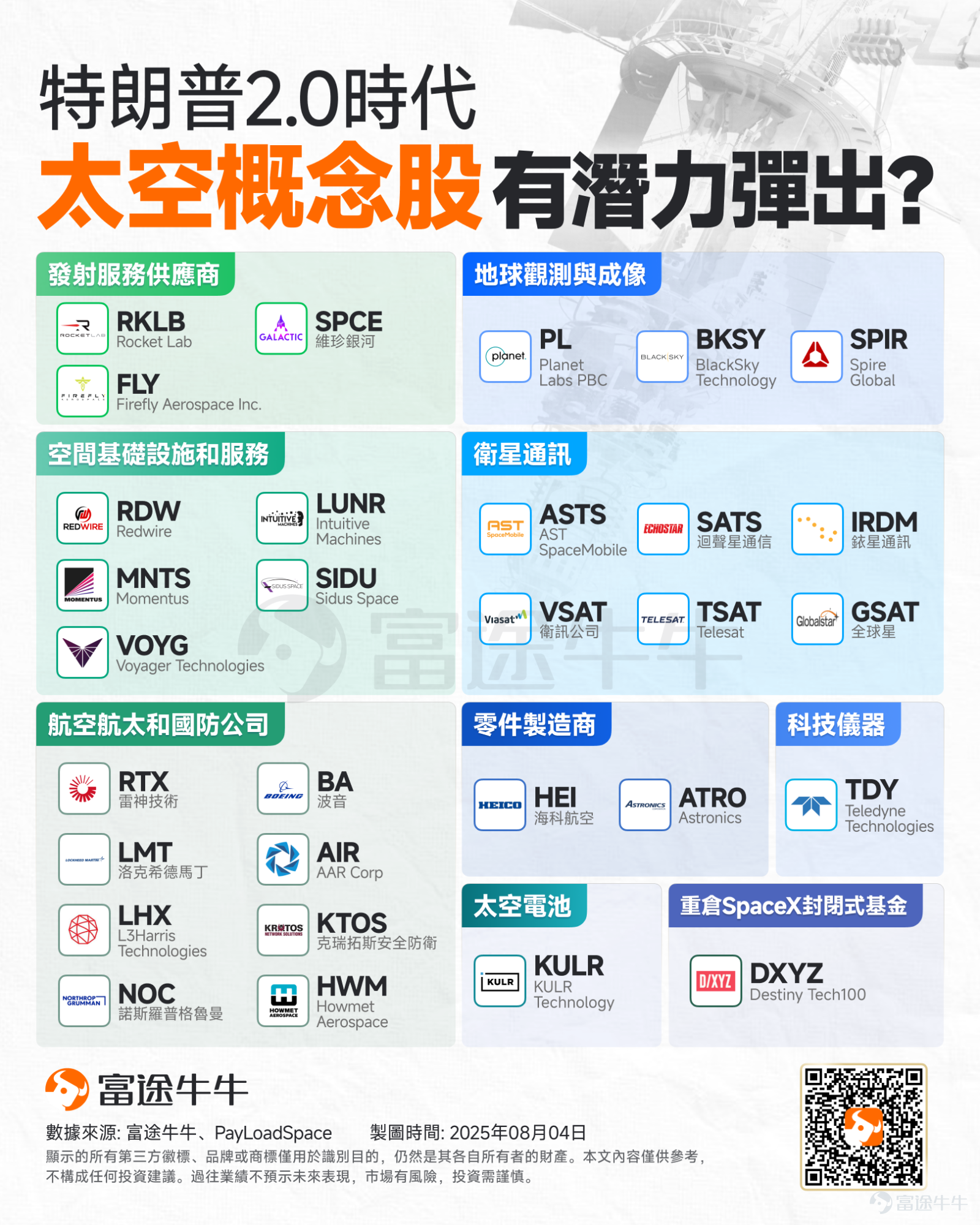
Launch service provider
American small commercial rocket company $Rocket Lab (RKLB.US)$ is a commercial space company that specializes in small and medium-sized rocket launch services and holds a leading position globally, second only to SpaceX.
Notably, The Washington Post, citing sources familiar with the matter, reported that after a dispute between Trump and Musk, representatives from NASA and the Pentagon called on SpaceX's competitors to expedite the development of alternative rockets and spacecraft. The report stated, 'Government officials contacted at least three commercial space companies, including Rocket Lab.'
The 'First Space Tourism Stock', $Virgin Galactic (SPCE.US)$ is the world's first publicly listed human spaceflight company, offering suborbital flights. The company has completed two test flights to the edge of space and has received nearly $80 million in deposits from 603 people across 60 countries and regions.
2. Space Infrastructure and Services
The 'First Lunar Infrastructure Stock', U.S. space exploration company $Intuitive Machines (LUNR.US)$As a new player in the lunar exploration sector, the company plans to launch its IM-2 mission to the moon by the end of 2024 or early 2025.The company also announced that it has signed additional contracts with NASA's Near Space Network (NSN) program,which will enable the company to fully leverage the maximum potential value of the $4.82 billion Near Space Network program.。
The Pillar of Space Infrastructure $Redwire (RDW.US)$ Unlike other space companies with flashy packaging, Redwire positions itself as 'pragmatic,' acting as the 'nuts and bolts' of the space infrastructure. As a leading company in space infrastructure, Redwire's business scope covers multiple critical areas, from space manufacturing to advanced space exploration robotics. Its core technologies are crucial for future space missions and commercialization beyond Earth.
In addition, it includes commercial space companies $Momentus (MNTS.US)$ and space infrastructure pioneers $Sidus Space (SIDU.US)$ 、space and defense technology companies $Voyager Technologies (VOYG.US)$ ,Voyager is collaborating with NASA and has secured a $217.5 million R&D grant to design the "Starlab" commercial space station, which is expected to replace the retiring International Space Station by 2030.
3. Satellite Communications
First U.S. Low-Earth Orbit Satellite Stock $AST SpaceMobile (ASTS.US)$ Committed to building a global low Earth orbit (LEO) satellite internet, leveraging existing 4G/5G communication bands and standards, to enable direct satellite connectivity for mobile terminals without modifications.
Additionally, high-orbit satellite (GEO) broadband services in North America are provided by two major operators— $EchoStar (ECHO.US)$ and $Viasat (VSAT.US)$ 。
satellite communication service providers $Iridium Communications (IRDM.US)$ The company provides global voice and data services through 66 satellites and is expected to achieve stable growth by expanding its user base and securing government contracts.
U.S. LEO satellite communications company $Globalstar (GSAT.US)$ One of the earliest companies to enter the LEO satellite communications sector and achieve commercial success, it has been operating for over two decades and remains a significant player in the industry. However, user growth is limited, and profitability is insufficient, leading to significant operational pressures.
4. Earth Observation and Imaging
$Planet Labs PBC (PL.US)$ It is an Earth imaging company with over 13 years of history. The company has a significant and intriguing mission: to capture images of the Earth every day. It operates the world's largest constellation of remote sensing satellites, collecting high-frequency Earth surface imagery data and using advanced AI analysis to provide change monitoring and geospatial insights to government and commercial clients globally.
$BlackSky Technology (BKSY.US)$ It is a leading provider of real-time geospatial intelligence services. The company operates a small constellation of high-resolution remote sensing satellites, providing high-frequency imagery, analysis, and monitoring services for specific targets or areas. Notably, this company also collaborates with $Palantir (PLTR.US)$ Palantir, integrating its imagery and data into Palantir's platform.
$Spire Global (SPIR.US)$ is a provider of space data, analytics, and space services. This year, the company announced it will collaborate with NVIDIA to develop AI-driven weather forecasting.itsIt is indicated that it will be able to provide rapidly updated global forecasts and other features, which are not achievable with traditional numerical weather prediction models.
5, Scientific Instruments
$Teledyne Technologies (TDY.US)$ Focused on advanced aerospace systems and solutions, such as aircraft electronics, defense systems, and satellite technology, while also serving markets like factory automation, environmental tracking, and pharmaceutical research.
6. Space Batteries
$KULR Technology (KULR.US)$ is a battery technology company that primarily provides cutting-edge energy storage solutions for space, aerospace, and defense.The National Aeronautics and Space Administration (NASA) is also one of its clients.
7. Aerospace and Defense Companies
Among these, Lockheed Martin has provided a variety of technological support and projects to NASA, including the development of supersonic aircraft and participation in other space exploration initiatives.
Furthermore,Heavily invested in the SpaceX closed-end fund, $Destiny Tech100 (DXYZ.US)$it also merits attention.
II. Nuclear Technology
The nuclear energy theme has received a new catalyst — the U.S. announced plans for a lunar nuclear power reactor, which overnight led to a broad rebound in nuclear power stocks. In fact, nuclear energy is also a very important field in the AI era. Previously, we have also reviewed related companies:
![On August 4th, local time, according to Fox News, Acting NASA Administrator Sean Duffy will unveil a major space energy plan this week:to build nuclear reactors on the lunar surface.Duffy stated that NASA has received clear instructions to immediately initiate the industry proposal solicitation process to advance the implementation of the program. A senior NASA official noted, "This is about winning the second space race."。Duffy also issued an order to accelerate the replacement of the International Space Station, another core goal for NASA. These two initiatives will expedite the United States' return to the Moon and its mission to land on Mars. Duffy's reactor directive requires NASA to solicit proposals from the industry to build a 100-kilowatt nuclear reactor, to be launched by 2030, as a key supporting technology for future astronauts returning to the Moon. Previously, NASA had funded the development of a 40-kilowatt lunar reactor, with the aim of being ready for launch in the early 2030s. Market analysts believe that this plan marks a further push by the United States in the space race, This will directly benefit space, nuclear, and related supply chain companies.So, which specific companies are worth watching? I. Space Industry Previously,[Share Link: Is the Trump 2.0 Era Imminent, and Could It Ignite U.S. Space Stocks?]、[Share Link: Are Space AI Data Centers on the Horizon? In the Trump 2.0 Era, Which Space Stocks Stand to Benefit?]As previously mentioned, in the Trump 2.0 era, the...](https://nnqimage.futunn.com/sns_client_feed/900080/20250805/web-1754396479726-wHozEOX4xz.png/big?area=1&is_public=true&imageMogr2/ignore-error/1/format/webp)
In detail, uranium mining includes $Cameco (CCJ.US)$ 、$Uranium Energy (UEC.US)$ 、$Energy Fuels (UUUU.US)$ 、$Denison Mines (DNN.US)$ 、$NexGen Energy (NXE.US)$ Nuclear fuel processing$Centrus Energy (LEU.US)$ 。
The midstream includes design, research and development, and construction, which encompasses:
$NuScale Power (SMR.US)$ is the first SMR (Small Modular Reactor) nuclear power company to go public, with its core product being the SMR power module.
$Oklo Inc (OKLO.US)$ focuses on the development of small modular reactors (SMRs). The company has received investment from Sam Altman, the 'father of ChatGPT';
$NANO Nuclear Energy (NNE.US)$ Focused on the development of small modular reactors, the main business covers four areas related to SMRs, encompassing multiple stages such as manufacturing, fuel, and transportation, with the aim of building a diversified vertically integrated industrial chain;
$BWX Technologies (BWXT.US)$ focuses on the manufacturing of nuclear reactor components and nuclear energy technology. The main difference between BWXT and SMR/Oklo is that BWXT is a major supplier of large equipment and technical services, primarily providing nuclear reactor components, nuclear fuel, and defense-related nuclear technologies to the government and commercial sectors, with clients including the U.S. government (such as providing nuclear reactors for naval submarines).
Among these, the most noteworthy is,BWX Technologies, which previously collaborated with NASA to develop nuclear-powered rockets. BWXT was responsible for the design and manufacture of the nuclear reactors and the required nuclear fuel.
Overall, investors are focusing on the order expectations of space stocks in the short term, and can position themselves in the nuclear energy industry chain (such as uranium mining, reactor technology) for the long term. NASA's accelerated programs may bring policy support and funding, potentially catalyzing the performance of related companies.
Risk Disclaimer: The above content only represents the author's view. It does not represent any position or investment advice of Futu. Futu makes no representation or warranty.Read more


Comments (17)
to post a comment
134
391