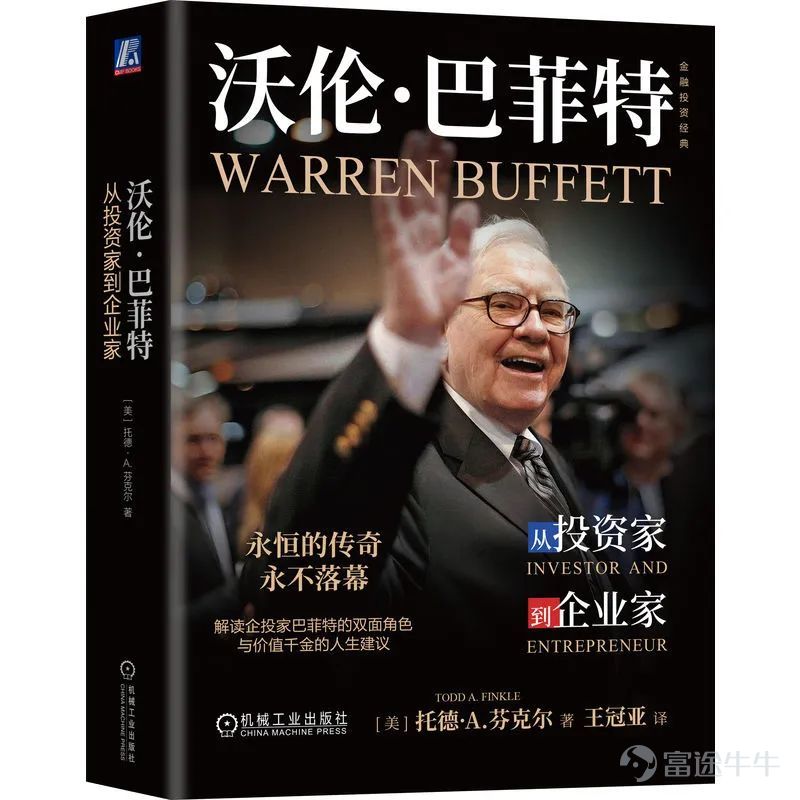

[Here is a good book for you] Born during the Great Depression, experiencing several financial crises in his life, Buffett won big by relying on "inaction".
Chongyang Speaking
Mr. Charlie Munger has a famous saying: "In my life, I have never seen anyone who is wise without reading. Not one. Warren (Buffett)'s reading volume may astonish you. I am like him. My kids joke that I am a book with two legs."
Friends familiar with Chongyang surely know that reading has always been a highly regarded path for growth.
Now, we hope to persist in reading together with you.
In each column, we will continue to discuss books, which may include book reviews, reading lists, or excerpts.
Each issue will have a communication topic, and we hope you will interact with us through comments.
We select high-quality books and will randomly send them out based on the quality of the comments.
The world is vast, and time is desolate; reading generates the power of thought. May you feel that your thoughts have depth and direction, opening up everywhere, allowing you to wander freely.
Notice: The content published by this public account is for reference only and does not constitute any investment advice or sales offer. If you are interested in Chongyang products, feel free to inquire.
[Good Book] Issue 292: "Warren Buffett: From Investor to Entrepreneur"
![Chongyang Speaking Mr. Charlie Munger has a famous saying: "In my life, I have never seen anyone who is wise without reading. Not one. Warren (Buffett)'s reading volume may astonish you. I am like him. My kids joke that I am a book with two legs." Friends familiar with Chongyang surely know that reading has always been a highly regarded path for growth. Now, we hope to persist in reading together with you. In each column, we will continue to discuss books, which may include book reviews, reading lists, or excerpts. Each issue will have a communication topic, and we hope you will interact with us through comments. We select high-quality books and will randomly send them out based on the quality of the comments. The world is vast, and time is desolate; reading generates the power of thought. May you feel that your thoughts have depth and direction, opening up everywhere, allowing you to wander freely. Notice: The content published by this public account is for reference only and does not constitute any investment advice or sales offer. If you are interested in Chongyang products, feel free to inquire. [Good Book] Issue 292: "Warren Buffett: From Investor to Entrepreneur" [American] Todd A. Finkle (Todd A. Finkle) authored Wang Guanya translated by the Machinery Industry Press. Recommender: Marketing editor Guo Biao July 2025 Interactive Topics: Based on this book, , Please share your views on 'How Buffett navigates through crises.' 。...](https://nnqimage.futunn.com/32735900/9733bc19b03d10e6c1c355abb9d21cae.jpeg/big?imageMogr2/ignore-error/1/format/webp)
[American] Todd A. Finkle (Todd A. Finkle) authored
Wang Guanya, translated by the Machinery Industry Press.
Recommender: Marketing editor Guo Biao
July 2025
Interactive Topics:
Based on this book,
,
Please share your views on 'How Buffett navigates through crises.'
。
Message time: July 9, 2024 - July 16, 2025.
(Encouraging originality, as long as your content is excellent enough, there's a chance of being selected every time.)
Screening and sending of books (single volume): after July 17, 2025.
(If selected, a private message will be sent to provide the delivery address. Failure to submit or incomplete information after the deadline will be regarded as a forfeiture. During the participation period, try not to change your profile picture and nickname to avoid missing opportunities.)
Born during the Great Depression, experienced several financial crises throughout life.
Author/Mechanical Publishing Excerpted from the Mechanical Industry Press's "Warren Buffett: From Investor to Entrepreneur".
From the global economic depression to the COVID-19 pandemic and tariff disputes, the Capital Markets have experienced ongoing turmoil, and most investors often make erroneous decisions driven by panic. However, Warren Buffett has repeatedly avoided risks and achieved value during financial crises through his exceptional wisdom. This book, "Warren Buffett: From Investor to Entrepreneur," organizes Buffett's investment wisdom and entrepreneurial spirit. Although Buffett and Munger do not explicitly mention the term "behavioral finance," they profoundly embody its principles, providing us with an effective methodology to cope with turbulent markets.
01. Behavioral finance concepts that investors should understand.
Warren Buffett advises thatto become a successful investor, you must understand two things. The first is how to evaluate a company, and the second is how to understand human nature.
Regarding the second point, it is necessary to understand the concept of Behavioral Finance—although Buffett and Munger do not explicitly use the term "Behavioral Finance," they practice it daily. They know thatwhen making investment decisions, it is not enough to simply assess the value of a company. It is equally important to check for biases that may lead to mistakes by investors and to cultivate good habits.
Behavioral Finance is built on the pioneering research of Daniel Kahneman and Amos Tversky. In 2002, Kahneman was awarded the Nobel Prize in Economic Sciences, and in 2011 published the famous book "Thinking, Fast and Slow," which explores various algorithms and biases that affect human behavior, many of which extend beyond our understanding. These include loss aversion, overconfidence, optimism, the framing effect, and the term "Behavioral Finance."
When making investment decisions, it is not enough to assess the value of a company; it is also equally important to check for biases that may lead to investor mistakes and to develop good habits.
Behavioral Economics is a broader field of study that denies the classical assumption that people act in a completely rational manner, and examines how cultural, psychological, and other factors affect economic decisions. The research of Kahneman and Tversky clarified these thinking habits and demonstrated how they can lead to irrational decisions and incorrect choices.
Behavioral Finance applies the general findings of Behavioral Economics to a specific category: the investor cohort. Behavioral Finance posits that, like other behavioral economists, investors are also influenced by psychological biases, which classical economics considers to be irrational.
Investors are influenced by cognitive and emotional biases. On one hand, cognitive biases stem from the failures or limitations of economic models, incomplete or inaccurate information, and other erroneous factors. On the other hand, emotional biases may not necessarily be erroneous, but they can arise when investors are guided by the pleasure or pain of certain investment activities, affecting their analysis of potential outcomes.
One of the most notable figures in the field of Behavioral Finance is Richard Thaler, a distinguished professor of behavioral science and economics at the University of Chicago, awarded the Nobel Prize in Economic Sciences in 2017 for his contributions to Behavioral Economics. Thaler has also authored several bestselling books on Behavioral Economics and is the head of Fuller-Thaler Asset Management, where he applies his insights on Behavioral Finance to investment decisions. Thaler and his co-author Cass Sunstein wrote in their 2008 book "Nudge: Improving Decisions About Health, Wealth, and Happiness": "People often make bad choices and feel confused when looking back. We wrote this book because, as human beings, we are all susceptible to a variety of common biases that can lead us to make embarrassing mistakes in areas such as education, personal finance, healthcare, mortgage and credit card spending, and leading a happy life."
What should be done if you find that the stock market has fallen by 3% while watching television? Many viewers would immediately start selling Stocks to cut losses, right? According to Thaler, this is completely the wrong approach. He told the Financial Times of the United Kingdom: "Change the channel. Turn off the program."My strategy is to trade as little as possible, only buy Stocks, and then not pay attention to the market, which has been greatly beneficial to me.”
Another leading figure in the field of behavioral finance is Dan Ariely, a professor of psychology and behavioral economics at Duke University.
Like Thaler, Ariely also does not encourage investors to regularly check the value of their investment portfolios, as market fluctuations and the potential for erroneous decisions can cause anxiety, even for financial experts. During the financial crisis from 2007 to 2009, Ariely deliberately locked his Account at one point. He told CNBC: "If we look at the Account fluctuations, we will only suffer more. Moreover, we will want to act on it."
02. Buffett during Several Crises
1. COVID-19
In recent years, one example affecting global financial markets is the outbreak of COVID-19 in the United States at the beginning of 2020. The halt of business activities to curb the spread of the virus resulted in the U.S. stock market plummeting 34% from its peak in mid-February, reaching a low on March 23, 2020, marking the fastest drop in U.S. stock market history. This triggered the most serious economic crisis since the Great Depression of the 1930s.
In fact, according to economists, the recession itself only lasted for two months and ended in April. However, for many who suddenly lost their jobs or had reduced working hours, the situation was not the same.
As usual, when a crisis occurs, the media seeks financial advice from Buffett. What is his advice? To hold steady and not make major changes. In other words, do nothing.
In fact, with the support of the U.S. government, the economic situation would improve on its own. The Federal Reserve began injecting more liquidity into the market by purchasing various Bonds. Within eight weeks, the Federal Reserve injected more liquidity into the American Financial system than during the Great Recession. This, in turn, pushed up asset prices and supported the economy. Buffett was right. The best approach is to maintain confidence in the American economy and not panic.
2. The Great Recession: 2007~2009
In August 2007, the overheated U.S. Real Estate market began to collapse. As a result, the Dow Jones Industrial Average fell more than 50% after reaching its peak, and speculation and reckless lending by Financial Institutions further exacerbated the collapse of the Real Estate market. Many investors went on a selling spree. But by March 2009, the market began to recover. Four years later, in March 2013, the Dow Jones Industrial Average surpassed its 2007 high. Once again, sitting quietly and waiting for the crisis to pass was the best course of action. This is the consistent recommendation from Buffett and behavioral finance scholars.
3. The Internet Technology Bubble: 2000~2002
From 1995 to 2000, the Market Cap of Internet companies soared. The vast majority of these companies did not actually have profits to support the surge in their stock prices. However, the Nasdaq continued to rise, increasing by over 440%. In 1999, Buffett was criticized for the underperformance of Berkshire Hathaway (about 40 percentage points below the S&P 500 Index). In hindsight, Buffett's actions seemed prudent; he was not misled by the mirage of Internet stocks, the prices of which were based purely on market frenzy. In fact, the Nasdaq reached a peak of 5048.62 points on March 10, 2000, and fell to a trough of 1139.90 points on October 4, 2002, experiencing a 76.81% drop during this period. In other words, this was a crash.
Buffett insists on independent thinking. This contrarian thinking may cause him stress in the short term, but in the long run, it is very beneficial. The Nasdaq Index has struggled to recover; even considering dividends, it took 12 years, until November 2014, to return to the level of March 2000. Due to Berkshire Hathaway's performance lagging behind the market in recent years, one might wonder if today's economy exhibits the bubble characteristics Buffett observed in the past.
4. The Great Depression
On September 3, 1929, the Dow Jones Industrial Average peaked at 381.17 points.
After the Great Depression, it was not until November 23, 1954, 25 years later, that the Dow Jones Industrial Average returned to the 1929 peak. Official data shows that the economic depression lasted for more than 10 years from the 1929 stock market crash until the United States entered World War II. At the lowest point in 1933, 25% of American workers were unemployed. The painful and slow economic recovery led many Americans to call for a greater role for the government. This contributed to the establishment of social security for the elderly and unemployment compensation systems.
Crisis Summary
As you can see, the time it took for these indices to return to their original peaks varies. However, over time, it seems we have learned how to cope with these crises, as the recovery time of our stock market has shortened from 25 years (Great Depression) to 14 years (Internet Technology Bubble), then to 4 years (Great Recession), and finally to two months (COVID-19 pandemic). It is also noteworthy that the shortening of time frames seems to correlate positively with the intensity of government intervention in the market. Due to the existence of moral hazard, this has become one of the subjects of intense debate. In general, the term "moral hazard" refers to situations in business contracts where one party has the incentive to take excessive risks, attempting to earn profits recklessly before the contract settles. In this context, the concern about moral hazard raised by government intervention in the market is that investors may be more likely to take reckless risks, believing that the government will rescue the market during economic disasters.
Content summary
This book introduces Buffett's "dual role" as an investor and entrepreneur, including interviews with various personalities, analyses of classic investment cases, Buffett's letters to shareholders over the years, and related books, as well as the author's three in-person visits to Buffett. It systematically reviews Buffett's education, growth, and entrepreneurial journey, discusses the influences of Benjamin Graham, Philip Fisher, and Charlie Munger on Buffett, and introduces Buffett's investment methodology.
This book focuses on reviewing Buffett's classic investment cases, depicting the evolution of the 'Oracle of Omaha' in investing. It has dedicated chapters that discuss Buffett's failures and lessons learned, and especially noteworthy new content includes Buffett's major investments over the past decade and his attitude towards Technology stocks, as well as the widely discussed topics of Buffett's successor and Berkshire's future.
Buffett's entrepreneurial spirit runs throughout the book. This book not only helps readers learn about value investing but also inspires them to learn about Buffett's entrepreneurial spirit, investment philosophy, business management principles, and how to become wiser individuals and build a high-return, more valuable life.
Author Introduction
[American] Todd A. Finkle
A professor of entrepreneurship at Gonzaga University in the United States and a friend of the Buffett family. He is also an investor, entrepreneur, speaker, and consultant, having led students to visit Buffett three times.
Previous Issues Review
▲ Swipe up to read 【Disclaimer]
The text and images in this material are copyrighted by the original party or original author. Shanghai Chongyang Investment Management Co., Ltd. (referred to as "Chongyang Investment") has obtained authorization to reprint articles from the original party or original author.
The content of this material represents only the analysis, speculation, and judgment of the original party or author, and is published here solely for the purpose of information transmission and investor education. It does not imply that Chongyang Investment agrees with these views or confirms their descriptions, nor does it represent any agency or cooperative relationship between Chongyang Investment and the original party or author. Chongyang Investment makes no explicit or implicit declaration or guarantee regarding the authenticity, completeness, or timeliness of this article and its entire or partial content, and assumes no direct or indirect responsibility for the transmission of information. The related information is for reference only and does not constitute advertising, a sales offer, or advice to trade any securities, Funds, or investment products. Any entities, brands, or Commodities cited in this material do not represent the actual operations of Chongyang Investment. Due to various factors such as investment restrictions of Fund products, portfolio adjustments, and transaction costs, the actual operations of Chongyang Investment may differ from the conclusions drawn in this material.
This material does not take into account any specific investment needs, investment goals, or risk tolerance of the reader. Before investing, readers should carefully read the product's legal documents and risk disclosure statements, fully understand the risk-return characteristics and product features, consider their own risk tolerance, and make informed and prudent investment decisions.
If you are interested in Chongyang products, feel free to inquire.
The public account has changed the PUSH rules,
Our articles may get lost in the vast information flow.
A part of you,Share, like, and "looking at".,
can bring us a step closer,
for a better encounter,
star mark pinnedis also excellent.
Chongyang Investment is always with you.
Risk Disclaimer: The above content only represents the author's view. It does not represent any position or investment advice of Futu. Futu makes no representation or warranty.Read more
Comments
to post a comment