
Mid-year review of 2025: How to seize opportunities amidst volatility?

Mid-Year Review | 2025 Crypto Recap: Public companies crazily "hoarding coins" with Bitcoin reaching a new high of $0.11 million.
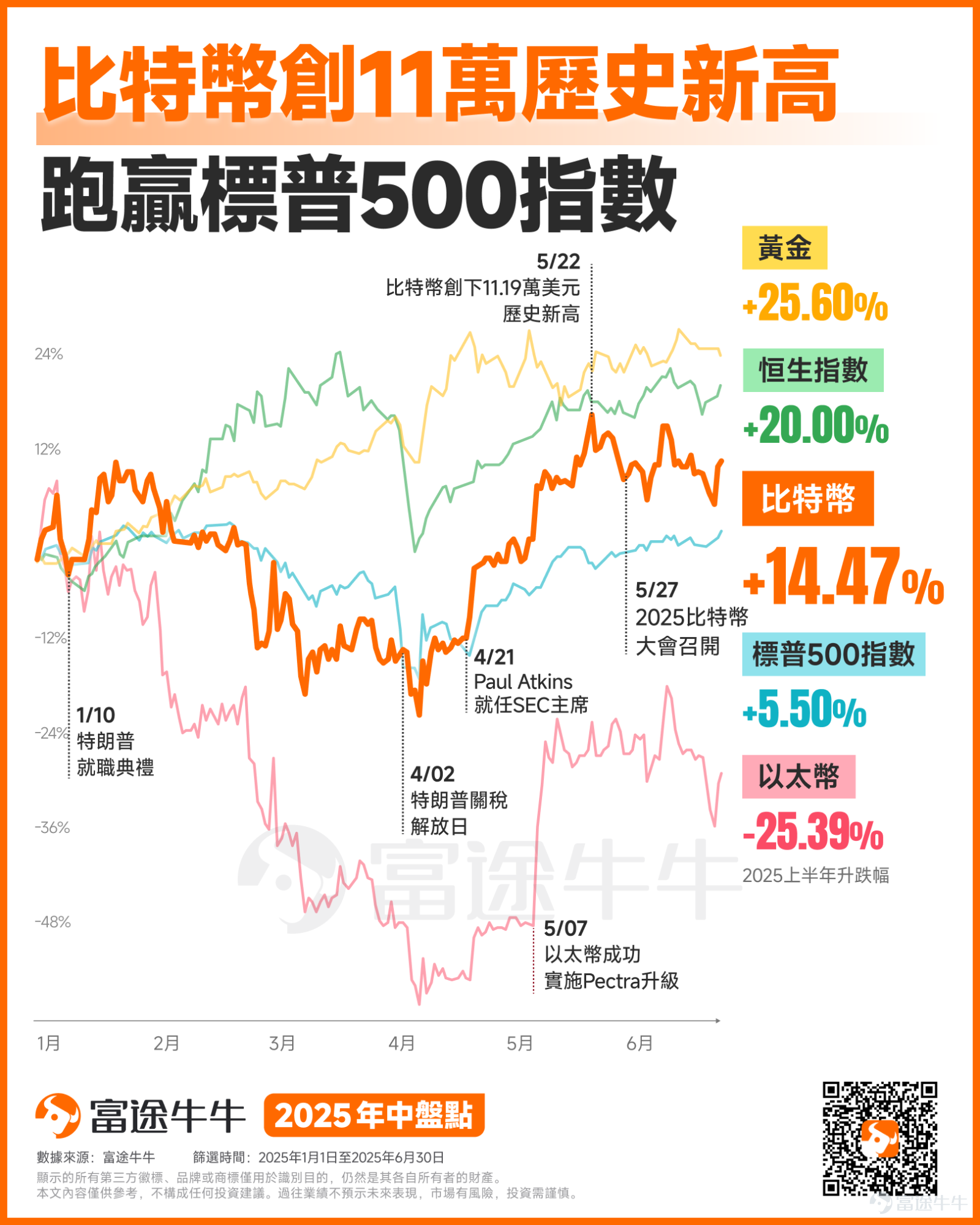
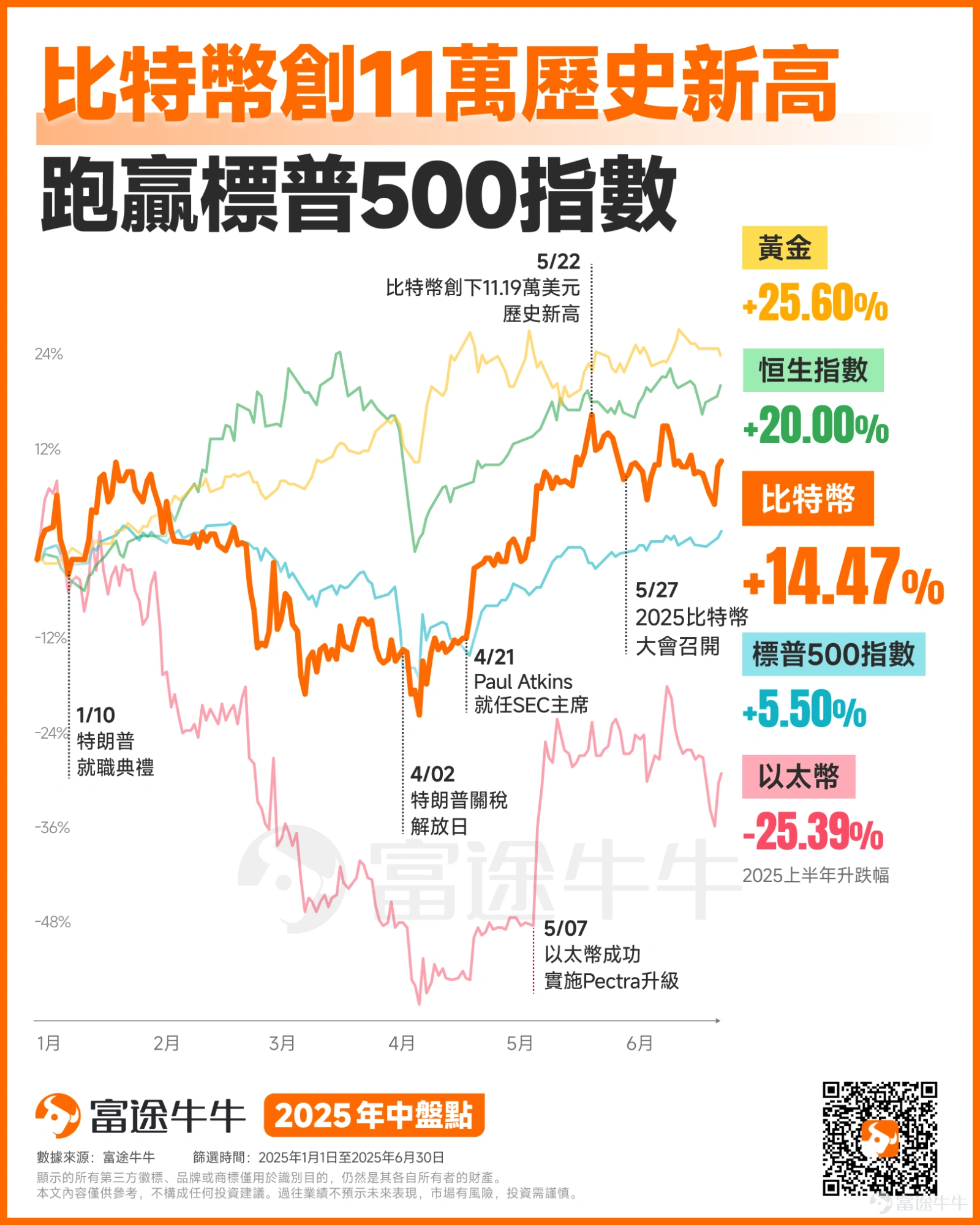
In the macro environment where the Federal Reserve maintains high interest rates, coupled with geopolitical tensions, including U.S. tariffs and turmoil in the Middle East,$Bitcoin (BTC.CC)$there has been continuous turbulence throughout the year. Comparing with various assets, in the first half of 2025, Gold remains the asset with the highest increase of 25%, followed closely by Hong Kong stocks$Hang Seng Index (800000.HK)$with a 20% increase, while Bitcoin closed with a 14% increase.
At the beginning of the year, after Trump took office as U.S. president, the market hoped he could achieve something in the cryptocurrency field. However, after nearly three months of waiting, the crypto community did not receive any Bullish news, and Bitcoin's price continued to decline from its previous high in January. Even in March, when Trump signed an executive order to announce the establishment of a U.S. strategic Bitcoin reserve, it failed to save the ongoing decline. In April, Trump's tariff policies caused turbulence in the global financial market, and Bitcoin also experienced a forced sell-off situation.
Things took a turn at the end of April. Paul Atkins, the newly sworn chairman of the SEC who supports cryptocurrency, is widely expected to lead a more cryptocurrency-friendly SEC compared to the previous chairman Gary Gensler during the Biden administration.
Of course, during this period, the relaxation of Trump's tariff policy provided a "strong Bid" for the cryptocurrency market, with Bitcoin first breaking the $0.11 million mark, breaking the record of $0.109 million set when Trump took office in January 2025, creating a historical new high.
In addition to Bitcoin reaching a historical new high, what other events in Crypto deserve a review for the first half of 2025?
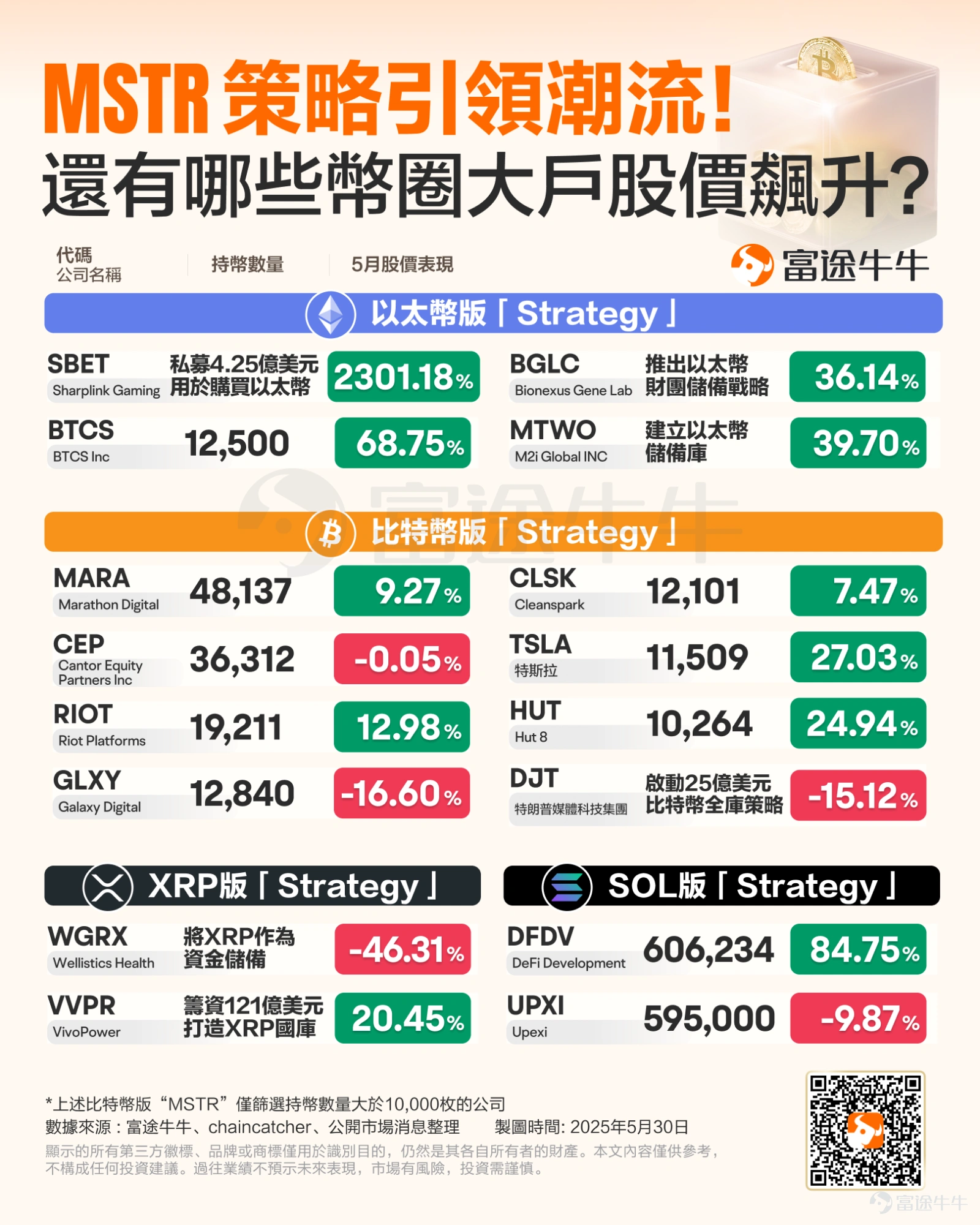
Listed companies and Institutions continue to Buy cryptocurrency.
Bitcoin is becoming a key component of corporate financial strategy. According to CryptoSlate, in the first half of 2025, global listed companies purchased a total of 245,510 Bitcoins - this number is 2.1 times the amount purchased by Bitcoin ETFs during the same period, and compared to only 0.0517 million Bitcoins purchased in the same period of 2024, this year the corporate Bitcoin purchasing volume has surged by 375%.
$Tesla (TSLA.US)$ 、 $Block (XYZ.US)$ and $Coinbase (COIN.US)$ Technology companies have also disclosed their plans to increase Shareholding in Bitcoin in their Earnings Reports.
Among them.$Strategy (MSTR.US)$The purchase volume was 135,600 units, accounting for 55%, which is a significant drop from 72% in the same period last year. However, this proportion is still an improvement from last year's 72%, indicating that more companies are beginning to include Bitcoin in their asset allocations.
Market analysis indicates that companies are motivated to purchase cryptocurrency for reasons such as hedging against inflation, optimizing cross-border liquidity, and coordinating with brand strategy, while also benefiting from tax and accounting advantages.
Interestingly, the purchase volume of Bitcoin spot ETF has sharply declined from 267,878 units in the first half of last year to 0.1184 million units, a decrease of over 55%. Market analysts point out that ETF purchase volume mainly reflects the short-term demand of retail and institutional investors, while corporate buying behavior represents a more long-term asset allocation strategy. For example, Strategy clearly stated in its Q2 2025 earnings report call that it will regard Bitcoin as a "long-term reserve asset."
Of course, many companies raise funds to purchase Bitcoin by issuing convertible bonds. The $0.6 billion convertible bond issued by Strategy in November last year is a typical example; this operation does indeed pose risks—if Bitcoin prices undergo a significant pullback, it could impact the company’s financial status.
Nevertheless, Institutions remain significant holders of Bitcoin. According to Lookonchain monitoring, the world's largest asset management firm, Blackrock, purchased 5,613 Bitcoins, valued at approximately $0.53 billion, bringing its total Bitcoin holdings to 620,252 units, worth around $58.51 billion. Since April 21, Blackrock has accumulated a total purchase of 47,064 Bitcoins, with a total value of approximately $4.44 billion.
Bloomberg senior ETF analyst Eric Balchunas stated on the Social Media platform, "Currently, Blackrock ranks second in Bitcoin holdings after Satoshi Nakamoto and is expected to become the world's largest holder of Bitcoin by late summer 2026."
He also mentioned, "As of June 3, Blackrock's Bitcoin spot ETF has entered the top 25 ETFs in the U.S. by asset size with $72.4 billion in assets. It is expected to surpass Satoshi Nakamoto by the end of 2026, becoming the largest Bitcoin holder in the world."
Ethereum's short squeeze market.
Starting from May 8, in just 72 hours. $Ethereum (ETH.CC)$ Surging by 40%, marking the best three-day performance since 2019 (when the price was less than 200 dollars), significantly outperforming other major cryptocurrency assets like Bitcoin. This market trend is boosted by macro factors, technical upgrades, and large investors increasing their shareholding.
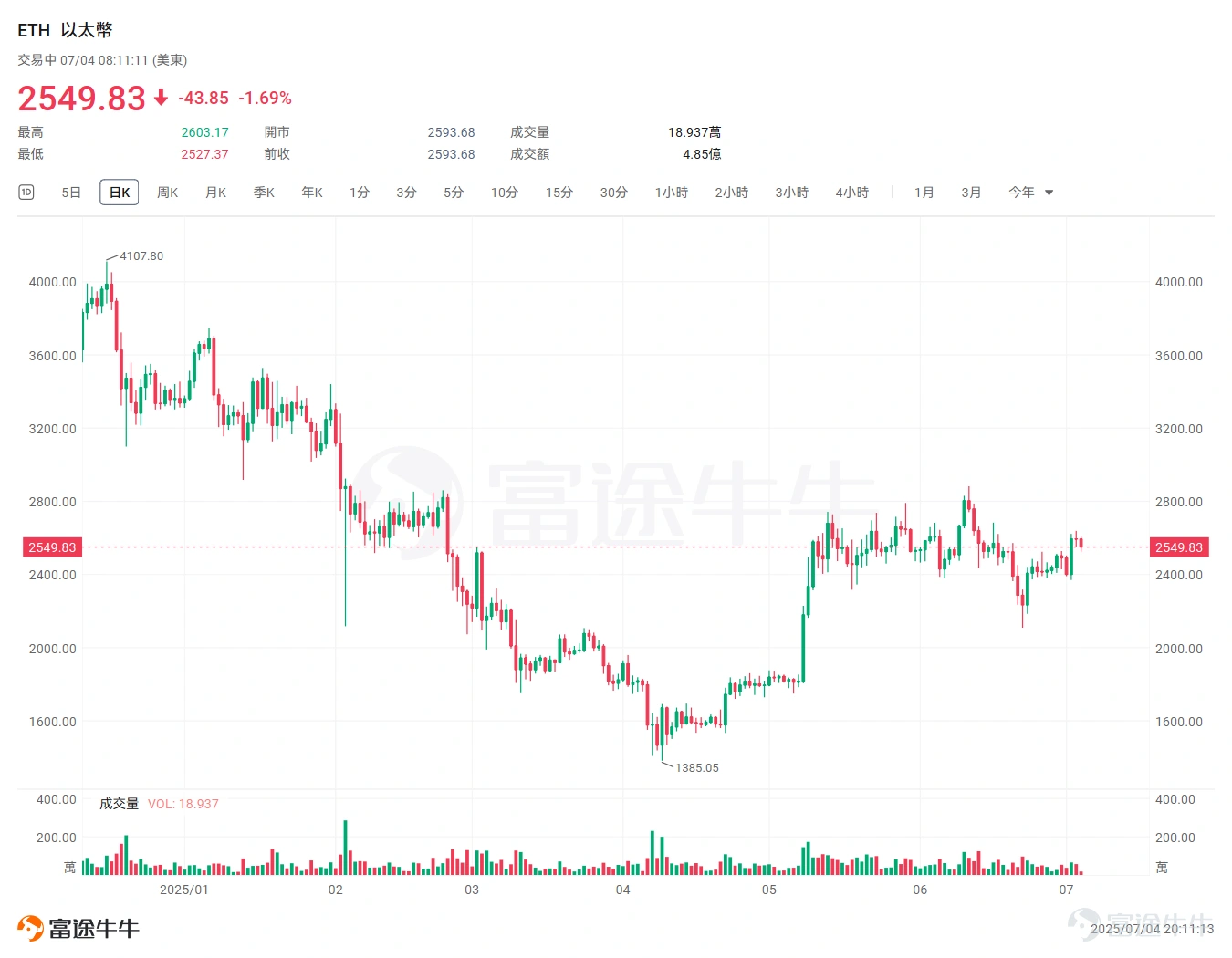
– Ethereum successfully implemented the Pectra upgrade.
In April 2025, Ethereum successfully implemented the Pectra upgrade, which is an important technical advancement following the Dencun upgrade in 2024. Pectra introduced the EIP-7702 proposal, allowing external accounts (EOA) to possess smart contract functionalities, streamlining the interaction process between users and smart contracts. Additionally, the EIP-7251 proposal increased the maximum effective stake limit for validators from 32 ETH to 2048 ETH, aimed at enhancing the network's security and efficiency.
As the core platform of the DeFi ecosystem, the application scope of Ethereum continues to expand. With Layer 2 solutions such as$Arbitrum (ARB.CC)$and$Optimism (OP.CC)$The maturity of the Trade has significantly reduced transaction costs and improved user experience. This has not only attracted more users to participate in DeFi activities but also promoted the activity and value growth of the Ethereum network.
– The "short squeeze" has driven the market.
Since May 8, the Ethereum Futures market has experienced a typical "short squeeze" scenario, significantly boosting the market. Data shows that since May 8, there has been a large-scale liquidation of short positions in the Ethereum Futures market, with a liquidation amount reaching 0.43794 billion USD, far exceeding the long liquidation amount of 0.21129 billion USD during the same period. The sharp price rise forced short traders to buy ETH to cover their positions, further driving up the coin price and forming a typical "short squeeze" upward spiral.
– "Whales" actively accumulate: consolidating bullish expectations.
According to data from Glassnode, since late April, the net position of these whale addresses has turned positive and has steadily increased their holdings. The total supply of ETH held by these large entities has risen to the highest level since March 2025, exceeding 40.75 million ETH. The continuous accumulation behavior of "whales" is usually interpreted by the market as a strong confidence from large, informed investors in future market trends, and their active positioning undoubtedly injects a strong impetus into the Ethereum market, consolidating bullish expectations.
The booming stablecoins.
Legislation on stablecoins has become one of the most important aspects of this year's cryptocurrency narrative.
On May 30th, the Hong Kong SAR government released the "Stablecoin Ordinance." According to the ordinance, any institution or individual issuing fiat stablecoins in Hong Kong or claiming to anchor the value to the Hong Kong dollar (regardless of where the issuer is located) must apply for a license from the Hong Kong Monetary Authority.
At the legislative level in the United States, the GENIUS Act (Guiding and Establishing U.S. Stablecoin National Innovation Act) was passed in the Senate on June 18, 2025, with 68 votes in favor and 30 against, marking a shift in the U.S. government's regulatory approach to the stablecoin industry from observing to active involvement.
The act provides a clear legal framework for stablecoins, with the main contents including:
Reserve requirements: Stablecoin issuers must hold safe assets (such as U.S. dollars or short-term government bonds) in a 1:1 ratio as backing.
Transparency and auditing: Issuers must publicly disclose the composition of reserves monthly and undergo independent audits.
Anti-money laundering compliance: Issuers must adhere to anti-money laundering (AML) and counter-terrorism financing (CFT) regulations.
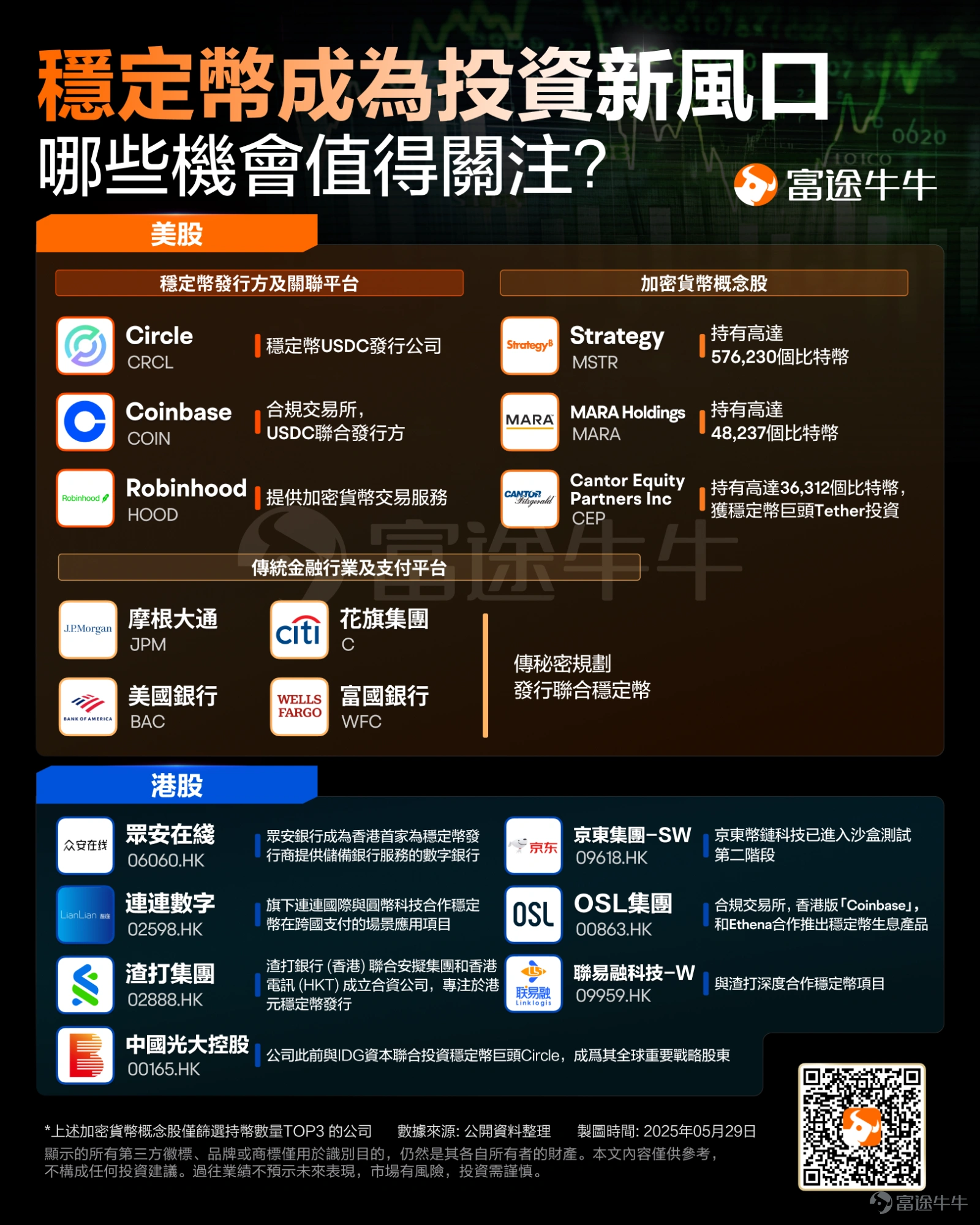
As the first IPO in the stablecoin sector,$Circle (CRCL.US)$The stock price has been wildly speculated, surging nearly three times since its listing on June 5th over the course of 12 trading days.

The GENIUS Act passed by the U.S. Senate establishes a clear regulatory framework for stablecoins, reducing uncertainty in the Industry, which the market interprets as a significant Bullish signal for compliant stablecoin issuers like Circle. $USD Coin (USDC.CC)$ Its transparency and regulatory compliance make it more competitive compared to Tether's USDT (which has reserves that include commercial papers and Bitcoin, with weaker compliance).
In addition, the application scenarios for stablecoins are rapidly expanding in cross-border payments, DeFi, NFT transactions, the Web3 ecosystem, and enterprise settlements. $Visa (V.US)$、$MasterCard (MA.US)$ For example, USDC has been integrated by giants like $PayPal (PYPL.US)$ and Stripe is also promoting stablecoin payments. This widespread practical application has led the market to view stablecoins as the closest track of blockchain technology to mainstream finance, attracting a large amount of capital chasing related concept stocks.
What is the outlook for Bitcoin in the second half of 2025? Standard Chartered predicts it will soar to 0.2 million dollars by year-end.
Although Bitcoin's gains in the first half of the year did not outperform Gold, JP Morgan Chase believes Bitcoin will surpass it in the second half.
JP Morgan Chase Analysts stated that the rise of Gold from mid-February to mid-April suppressed Bitcoin's performance, while Bitcoin rebounded by 18% in the last three weeks, and Gold fell by 8% during the same period, with funds shifting from Gold ETF to cryptocurrency funds. A series of catalysts include: Corporate Shareholding: Strategy plans to raise an additional 42 billion dollars to Buy Bitcoin before 2027, with companies like Metaplanet continuously buying Bitcoin; Government Reserves: New Hampshire allows 5% of state assets to be allocated to Bitcoin, and Arizona establishes digital asset reserves; The derivatives market is gradually maturing: Coinbase acquires Deribit, Kraken acquires NinjaTrader, and Gemini obtains European derivatives brand licenses.
Nikolaos Panigirtzoglou, Managing Director at JP Morgan Chase, pointed out that as more U.S. state governments consider including Bitcoin in their reserves, this could become a continued Bullish factor.
Coinbase's institutional report indicates that the cryptocurrency market outlook for the second half of 2025 is optimistic, mainly benefiting from economic optimism, increased corporate adoption rates, and regulatory progress. A significant trend noted in the report is the sharp increase in the number of Bitcoin (BTC) wallets holding balances over 1 million dollars.
In a research report on July 2, Geoffrey Kendrick, Head of Digital Asset Research at Standard Chartered Bank, predicted that ETF inflows and corporate treasury purchases of Bitcoin in the third and fourth quarters will exceed the levels of the second quarter. The forecast states that Bitcoin will reach 200,000 dollars by the end of the year, and updates the outlook for Bitcoin in the third quarter, predicting a price of 135,000 dollars.
Geoffrey Kendrick stated that with record ETF inflows, Federal Reserve policy risks, and the expansion of sovereign adoption, Bitcoin could experience the strongest half-year performance in history by the end of 2025.
It is noteworthy that during the geopolitical turmoil in the Middle East, the phenomenon of investors shifting from traditional safe-haven assets like Gold to Bitcoin has become increasingly evident, with Bitcoin ETF inflows reaching 12.4 billion dollars in the second quarter, surpassing Gold ETF. In Geoffrey Kendrick's view, this is an encouraging positive signal, showing that Bitcoin's positioning as a "macro asset" is accelerating its formation.
 Finally, CryptoSir brings a little benefit for mooers, welcome mooers to participate.Crypto limited-time rewards >>
*This event is limited to invited users in HK, click to learn more.Event detailed rules >>

Risk Disclaimer: The above content only represents the author's view. It does not represent any position or investment advice of Futu. Futu makes no representation or warranty.Read more


Comments (2)
to post a comment
23
5