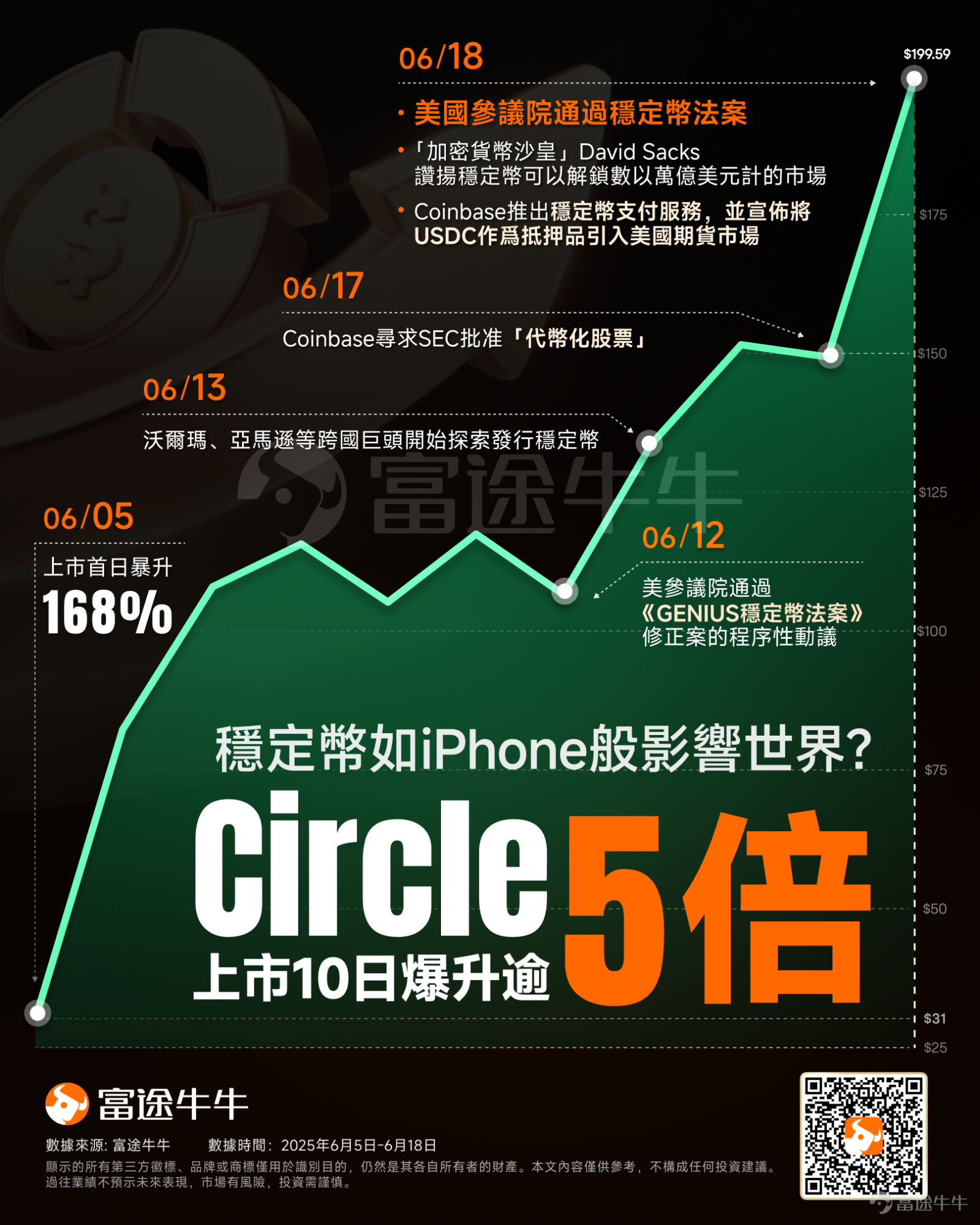

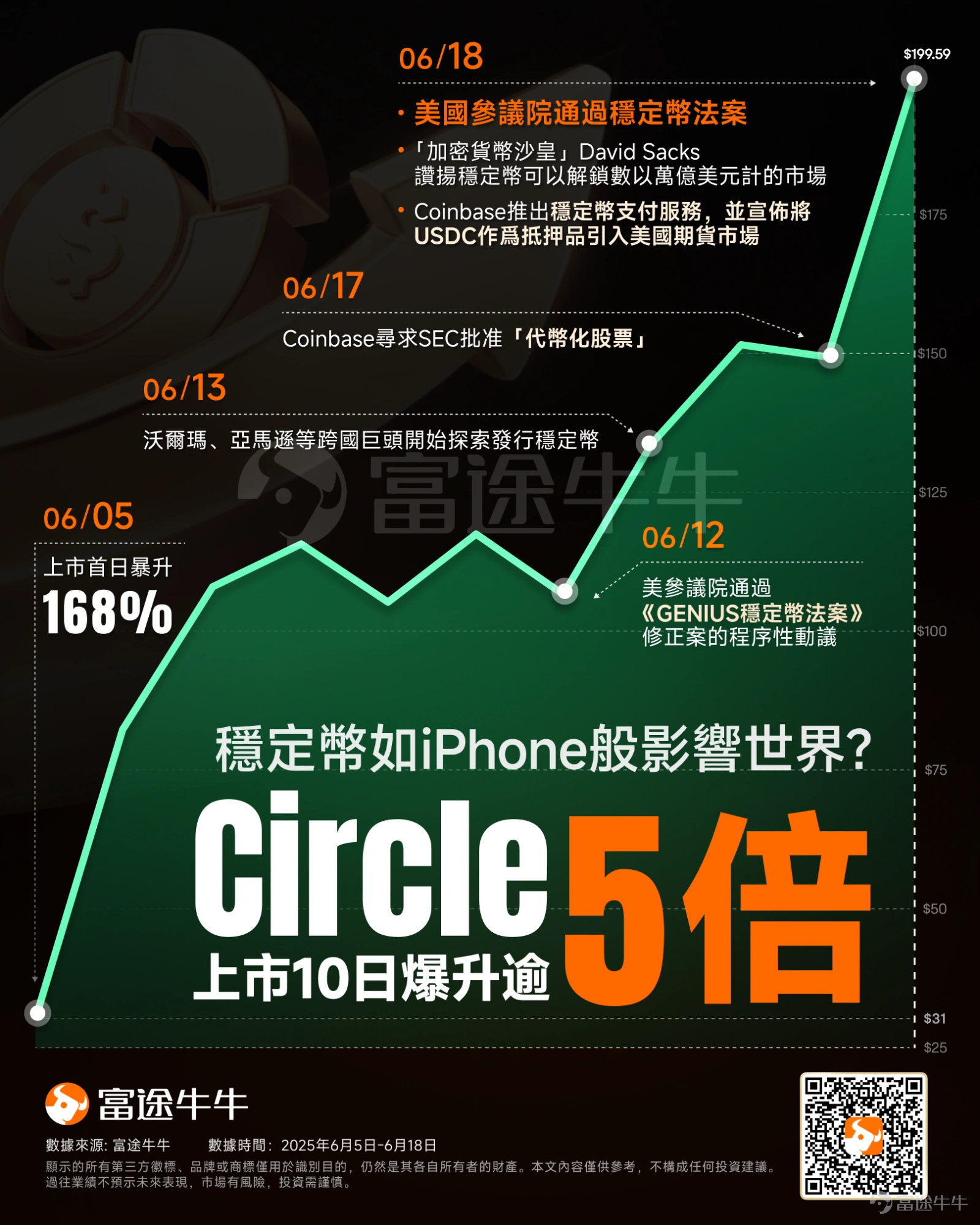
The 'Summer of Stablecoins' has fully arrived! Circle's stock surged over fivefold within 10 days of its listing—what other opportunities should be on the radar?
The summer of stablecoins is in full swing as Circle’s stock surged over fivefold within 10 days of its listing!
Recently, the most closely watched development in the U.S. stock market has been the 'first stablecoin stock.' $Circle (CRCL.US)$ 。
The passage of the GENIUS Act by the U.S. Senate fully ignited market sentiment. It is important to note that,this represents a milestone victory for stablecoins and even crypto assets, marking the digital asset industry's entry into a new era.
On June 18, the 'first stablecoin stock' $Circle (CRCL.US)$ soared nearly 34%, with its share price briefly surpassing $200. Over the 10 trading days since its IPO, the stock has risen more than fivefold. As of the time of writing, the company’s after-hours trading saw another gain of nearly 8%.
What is the Stablecoin Bill? What is Trump's objective in promoting this legislation?
According to a research report by Zheshang Securities, the GENIUS Act includes four key legislative components:
First, it provides a clear definition of stablecoins, explicitly categorizing them as non-interest-bearing, non-security settlement assets.Issuers of stablecoins are prohibited from offering interest or returns. The interest-related provisions of the GENIUS Act address the issue of the spread between interest-free liabilities and interest-bearing assets held by currency issuers. For example, the spread generated by the U.S. dollar belongs to the Federal Reserve, while the GENIUS Act explicitly stipulates that the spread for stablecoins belongs to the issuing company. This arrangement avoids the possibility of holding 'stablecoins' generating 'excess returns' relative to the U.S. dollar, thereby creating an asymmetric competitive advantage over U.S. dollar bank deposits.
Second, it establishes a clear regulatory framework.Currently, stablecoin issuance can be conducted under a dual-track licensing system at both federal and state levels. The act explicitly restricts foreigners from issuing stablecoins, mandating compliance with U.S. directives.
Third, it strengthens requirements for reserve quality and audits, reducing financial risks.The GENIUS Act mandates that issuing institutions must back stablecoins with high-quality liquid assets (including cash, short-term U.S. Treasury bonds with maturities of less than 90 days, Federal Reserve repurchase agreements, FDIC-insured deposits, etc.).
Fourth, it enhances regulatory oversight.The act brings stablecoin issuers under the scope of financial institution regulation, requiring strict adherence to anti-money laundering (AML) regulations. Issuers must verify user identities and report suspicious transactions to relevant authorities.
Trump's promotion of the GENIUS Act serves multiple purposes:
First, it helps with short-term debt financing,The U.S. Treasury estimates that stablecoins could generate approximately $880 billion in short-term debt demand by 2028. Currently, short-term debt issuance accounts for 84% of the total U.S. debt, and stablecoins anchored to short-term debt directly address a key issue.
Second, it benefits the cryptocurrency funds supporting Trump's election campaign,During Trump’s 2024 presidential campaign, funding from the cryptocurrency sector emerged as a major contributor. In 2024, cryptocurrencies became a pivotal donor in U.S. presidential elections for the first time in history.
Third, it benefits the Trump family.The Trump family has been actively involved in the digital currency market, including Trump Media establishing a $2.5 billion Bitcoin treasury, Eric Trump founding the Bitcoin mining company American Bitcoin, and the issuance of 'Trump Coin ($TRUMP)' and 'Melania Coin ($MELANIA)' by Donald and Melania Trump.
Will stablecoins have their iPhone moment? Which companies are likely to benefit?
On June 17, the U.S. Senate passed the GENIUS Act, establishing regulatory rules for dollar-pegged cryptocurrencies. The bill has now been submitted to the House of Representatives for review.President Trump stated that he hopes to sign stablecoin legislation before Congress recesses in August.
In the current stablecoin market, USDT and USDC are the two dominant players.
According to a research report by Guotai Junan Securities,with the advancement of the GENIUS Act, the issuer of USDC $Circle (CRCL.US)$may become the biggest winner. This is because it has proactively embraced regulation over the long term—continuously promoting transparency in asset audits, cooperating with guidance and recommendations from U.S. regulatory authorities, and maintaining reserves primarily in cash and short-term U.S. Treasury bonds. After the passage of the bill, USDC, with its unique attributes of 'being registered in the U.S., having clear audits, and being regulation-friendly,' is expected to see a further significant increase in penetration across payment networks such as Visa, Mastercard, and PayPal.
Meanwhile, USDT faces challenges to its survival model. Tether, the issuer of USDT, is headquartered in the British Virgin Islands and has long relied on an 'offshore opacity' strategy as its competitive moat; its asset reserve composition has repeatedly been questioned. With the implementation of the GENIUS Act, the circulation of USDT within the U.S. market will undoubtedly be significantly impacted. Although Tether is not without options, its available strategies are far from easy:
1. Proactively apply for a U.S. license in accordance with regulatory requirements;
2. Abandon the U.S. market and shift focus to regions like Asia and the Middle East.
3. Establish a cooperative mechanism with compliance platforms to indirectly access compliant networks through methods such as 'tiered issuance' or 'transfer bridging'.
Overall, although USDT still holds advantages due to its liquidity, network effects, and global adoption rate, the complexity and time cost of its compliance transformation provide a valuable window of opportunity for USDC.USDC is expected to leverage the momentum of the GENIUS Act to accelerate its penetration into global payment networks and institutional scenarios, potentially leading to a significant increase in market share.
Besides Circle, which other companies are worth paying attention to?
Circle CEO Jeremy Allaire stated that crypto stablecoins have yet to experience their 'iPhone moment,' which will arrive when global developers fully recognize the power and opportunities of 'programmable digital dollars,' akin to how they once realized the potential of programmable mobile devices.But that moment will come very soon.
In the Hong Kong and U.S. stock markets, besides Circle, other notable entities include $Coinbase (COIN.US)$ 、 $Robinhood (HOOD.US)$ and other exchanges.

Among them,Circle primarily collaborates with Coinbase, where both parties exclusively enjoy the benefits of reserve yields within their respective platforms, and split reserve yields outside their platforms on a 55 basis. The profit-sharing model between Circle and Coinbase is as follows:
– USDC within the platform (100% of reserve yields from USDC within their respective platforms are retained)
Coinbase platform USDC: Coinbase retains 100% of reserve yields, including those from the Coinbase exchange and Coinbase Prime custody services; by Q1 2025, this accounts for approximately 23% of the total USDC supply (rapidly growing).
Circle platform USDC: Circle retains 100% of reserve yields, mainly referring to USDC held by Circle Mint; its share remains relatively stable.
– USDC outside the platform (50/50 split)
USDC stored on third-party platforms is split 50/50, including DeFi protocols, other exchanges, wallets, etc.; this represents the fastest-growing segment of the USDC supply.
Spurred by Circle's significant rise, Coinbase also surged over 16% on Wednesday. Notably, the company recently launched a stablecoin payment service targeting major credit card providers and introduced USDC as collateral in the U.S. futures market.

Additionally, some cryptocurrencies in the U.S. stock market are also expected to see gains, including $Strategy (MSTR.US)$ 、 $MARA Holdings (MARA.US)$ 、 $Twenty One Capital (XXI.US)$ among others.
In the Hong Kong stock market, such as $CHINA EB LTD (00165.HK)$、 $ZA ONLINE (06060.HK)$ 、 $LIANLIAN (02598.HK)$ 、 $STANCHART (02888.HK)$ 、 $JD-SW (09618.HK)$ 、 $OSL GROUP (00863.HK)$ 、 $LINKLOGIS-W (09959.HK)$ 、 $YEAHKA (09923.HK)$ Driven by recent factors such as the sharp rise in Circle and the imminent implementation of Hong Kong's stablecoin legislation, among others, a promising upward trend has emerged.
Meanwhile, $Visa (V.US)$ 、 $MasterCard (MA.US)$ 、 $PayPal (PYPL.US)$Traditional payment companies are facing challenges. For traditional payment giants like Visa and MasterCard, their core competitive advantage lies inthe global clearing network.andTransaction profit-sharing mechanism. The rise of stablecoins,essentially represents bypassing these centralized clearing networks to integrate payment and settlement into one process.
According to a report by The Wall Street Journal, major U.S. retail giants, including Walmart and Amazon, are actively exploring the issuance of their own stablecoins to bypass the traditional bank card payment system.
Want to learn more about market analysis?Futubull AI is now live!Accurate answers, comprehensive insights, and seize key opportunities!

Risk Disclaimer: The above content only represents the author's view. It does not represent any position or investment advice of Futu. Futu makes no representation or warranty.Read more


Comments (4)
to post a comment
31
40