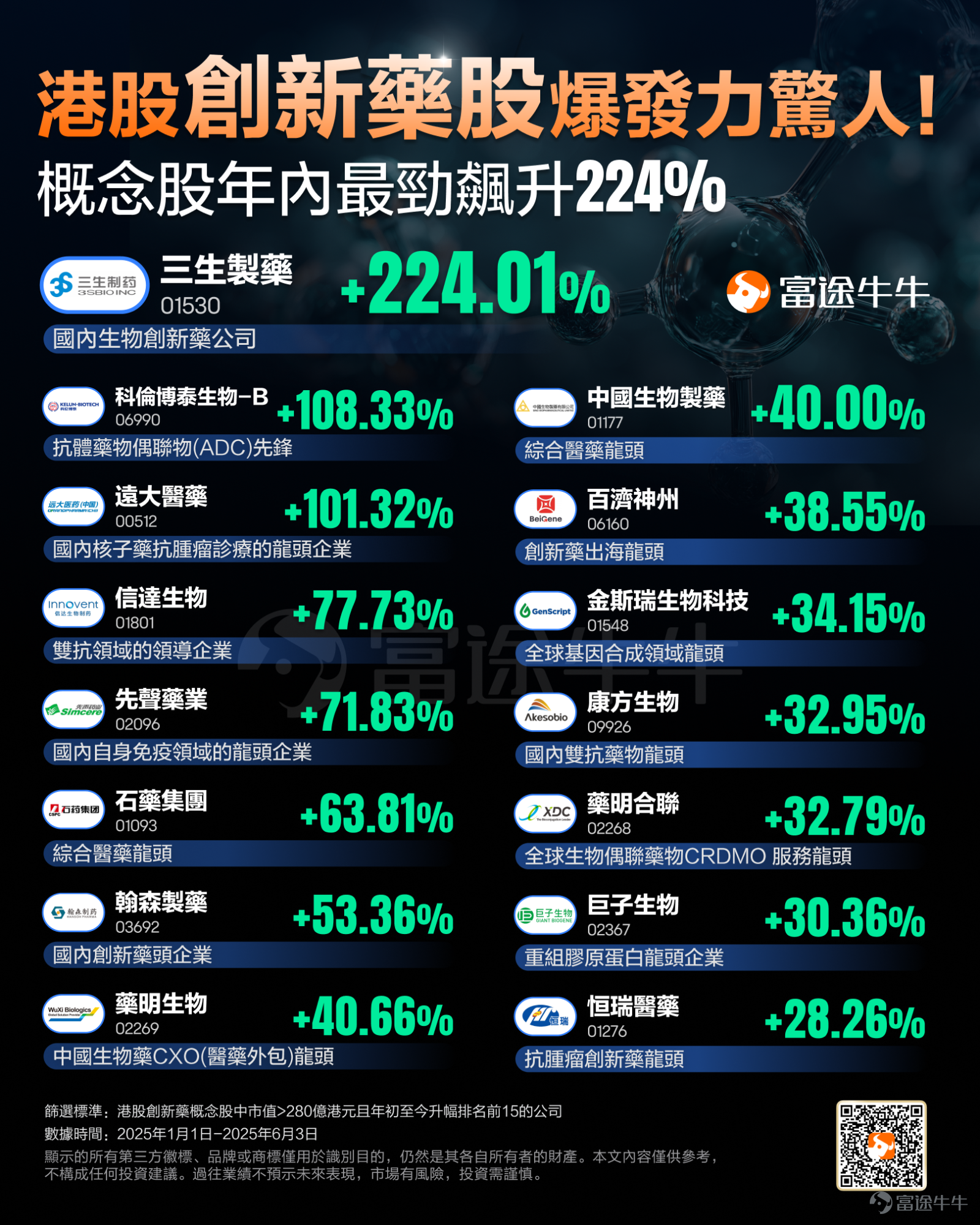

The Hong Kong stock market's innovative pharmaceutical stocks have shown astounding explosive power! Concept stocks have soared 224% this year. How should one position themselves now?
The "medication" market has reunited after a long absence.
Since the beginning of this year, China's innovative medical drug industry has been undergoing an unprecedented value reassessment, and it has recently shown an accelerating trend.
The market generally believes that The Hong Kong stock market serves as the "outbound bridgehead" for China's innovative pharmaceutical companies, and its investment value may welcome a historic opportunity window.
According to News from Futu, as of June 3, $3SBIO (01530.HK)$ the increase in the year has reached 224%, $SKB BIO (06990.HK)$ 、 $GRAND PHARMA (00512.HK)$ and the stock price has doubled.
According to The Paper, in the just-passed May, at least six domestic innovative pharmaceutical companies publicly announced BD Trade Orders, most of which were cross-border collaborations between Chinese and foreign pharmaceutical companies.Major BD has indeed become a key factor in catalyzing the market performance of innovative pharmaceuticals in the secondary market.
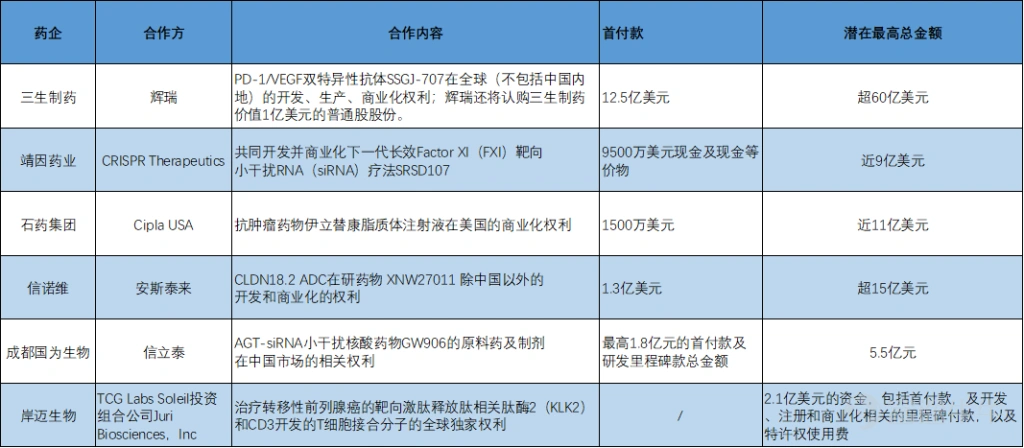
Source: The Paper
How should the investment value of innovative drugs in the Hong Kong stock market be viewed currently?
After a strong rebound, where will the innovative drug market head next? Multiple fund managers believe that there are opportunities for innovative drugs from multiple dimensions including valuation, fundamentals, and industry cycles, and the market is expected to have medium-term sustainability.
GF SEC states that at the current moment, it reaffirms the importance of the allocation value of innovative drugs in the Hong Kong stock market for the following reasons:
– In the stage of a declining growth rate, going overseas and establishing a global comparative advantage will likely correspond to excess returns in the stock market.
Currently, the focus of the capital markets is quietly shifting from traditional real estate and policy cycles to the long-term strategic significance of the China-US technology competition. Especially after the emotional uplift brought by the emergence of the DeepSeek large model at the beginning of the year, investors have begun to systematically reassess China's breakthrough potential in key technology areas.
In fact, overseas experiences also indicate that in the stage of declining growth rates, after traditional cycles tend to flatten, the sectors that can bring long-term excess returns to the stock market are often those that establish industrial advantages globally.
– The global competitive advantage of Chinese innovative drugs going abroad is becoming increasingly prominent.
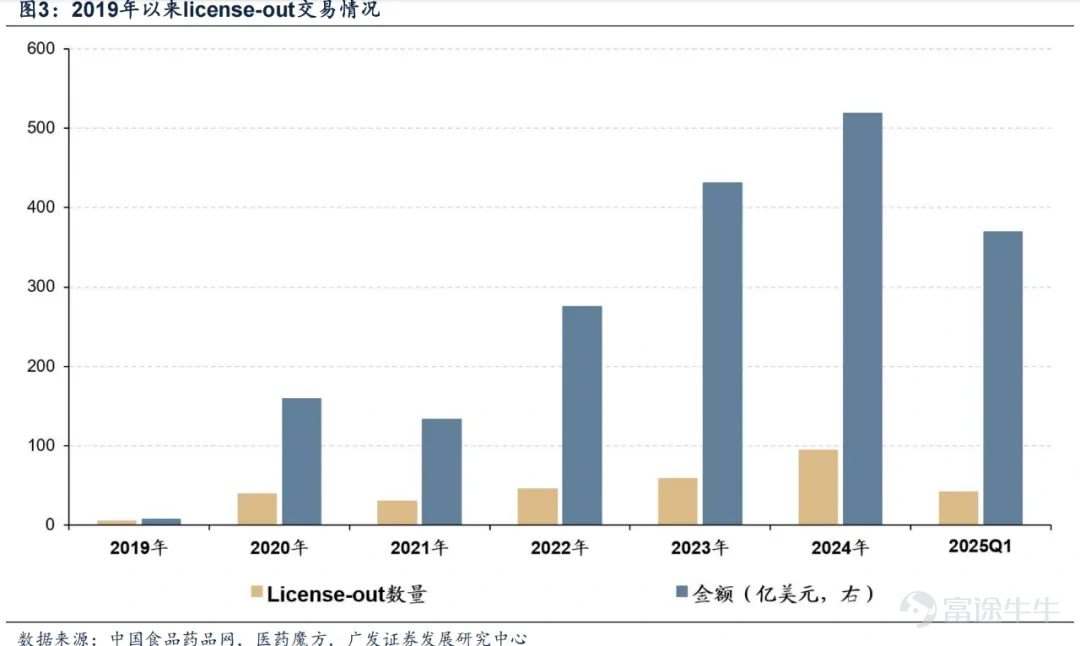
In recent years, Chinese pharmaceutical companies have achieved significant development in License-out Trade in overseas markets, showcasing the global competitiveness of Chinese innovative drug R&D.According to data from the Artery Think Tank, the License-out transaction value in the innovative drug sector was only about 11 billion USD in 2020, but from January to October 2024, 76 transactions have been completed, with a total amount exceeding 51.1 billion USD, showing significant growth in both transaction quantity and scale. This breakthrough is mainly reflected in three aspects: first, the upgrade of transaction structure, shifting from early small molecule drug licensing to the output of cutting-edge technology platforms such as ADC, bispecific antibodies, and siRNA; second, increased international recognition, with companies like Hansoh and CanSino frequently achieving substantial collaborations with multinationals like Merck & Co and Novartis; third, innovation in business models, with the rise of the NewCo model in 2024, establishing joint ventures to share risks and deeply bind interests.
The emergence of the NewCo model further helps original pharmaceutical companies address issues such as financing difficulties, monetization challenges, and high R&D risks.NewCo refers to the collaboration between domestic licensors (usually Biotech companies) and investors (such as overseas VC funds or multinational pharmaceutical companies) to create an independent new company, with common models being joint ventures (where the original pharmaceutical company contributes "technology/patents" as equity), spin-offs (where the pharmaceutical company separates certain technologies or pipelines), and the establishment of Special Purpose Vehicles (SPV).
Compared to traditional License-out, the NewCo model has advantages that include but are not limited to:First, it increases financing and monetization channels.(Independent financing is possible; while retaining traditional License-out revenues, it also increases opportunities for equity dividends and appreciation.)Second, reduce R&D/commercialization risks.(Outsource expensive clinical development, overseas registrations, and market promotion to NewCo or partners);Third, leverage external resources to accelerate globalization.(This can also help avoid some uncertainties in international relations).
– The policy and regulatory attitude is gradually shifting towards a more favorable situation for the sector.
Since the second half of 2023, a series of Bullish Signals have emerged at the policy level, marking an adjustment in regulatory thinking in the Industry.
First, the centralized procurement rules are continuously optimized:For example, the seventh batch of centralized procurement in 2022 first introduced the "backup supply company" mechanism, allowing unsuccessful bidding companies to fill the gap at the second-lowest price, reducing the risk of supply interruption. In terms of policy trends, it is expected to gradually promote the idea of "not solely focusing on low prices" in the future, avoiding irrational Quotes and taking into account factors such as the quality of drug production and the production and supply capabilities of companies.
Second, the normalization and correction of medical anti-corruption:Regulatory authorities emphasize "targeted anti-corruption", clarifying the legitimacy of compliant academic promotion, and hospital procurement is gradually returning to a normal pace.
Third, the support policies for innovative drugs are being strengthened:In 2024, innovative drugs will first appear in the government work report; the medical insurance catalog will lean towards innovative drugs, with 38 new "global new" innovative drugs added in 2024, setting a new historical high, and plans to launch Class B medical insurance catalog in 2025, further optimizing the payment system; local support policies are frequently released, with Shanghai issuing "Several Opinions on Supporting the Innovative Development of the Whole Chain of the CNI Biomedicine Index" in July 2024; in April 2025, Peking and Shenzhen respectively introduced 32 measures to support the entire chain.
– Empowered by innovative technology, greatly enhancing R&D efficiency.
In the past five years, whether in Biotech or traditional Pharma, there has been a significant increase in investment and construction of internal R&D systems; looking at the five major domestic chemical drug leaders, the R&D expense ratio has been on an upward trend since 2018.
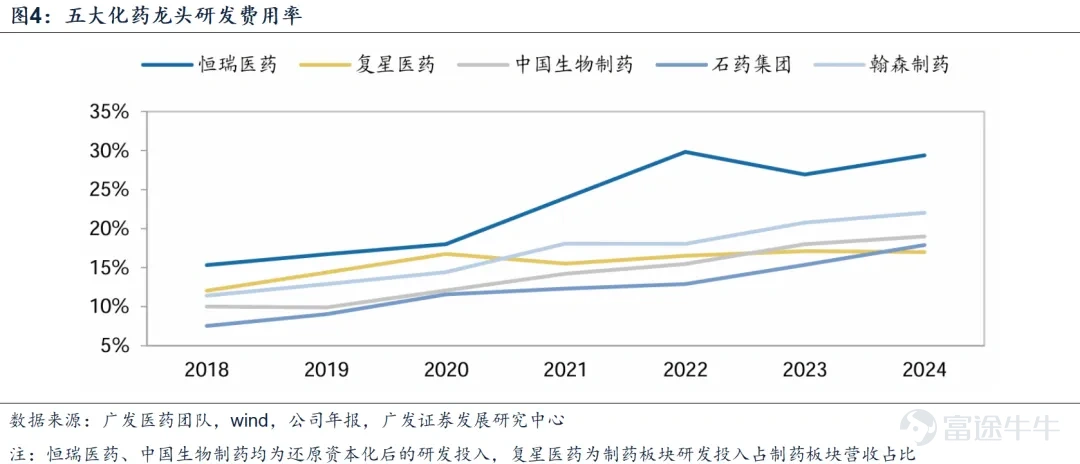
At the same time, innovative technologies are reshaping the landscape of the innovative drug industry at an unprecedented pace, jointly promoting the transition of drug research and development from traditional models to precision and intelligence.
How do institutions view the future of innovative drugs?
Regarding the future development of the industry and pharmaceutical investments, Sang Xiangyu from Huaan Funds is bullish on innovative drugs and AI medical technology. He believes:
First, innovative drugs are still in a cyclical acceleration phase.This year also has strong fundamental support for tangible results. Several new technologies have already begun to bloom.
At the same time, innovative drugs are transitioning from an expected BD wave to a profit wave.In the past, doubts about innovative drugs were due to high research barriers and companies not being profitable, making investment hesitant. However, as future companies experience high revenue growth that drives rapid profit increases, they enter the realm understandable by investors.
Zhang Chi, Chief Analyst of Strategy at Sinolink, emphasized the high elasticity of the Hong Kong stock market:The valuation expansion elasticity and space of Hong Kong stocks in the innovative drug sector may be stronger than that of A-shares.
Firstly, a higher research and development expense ratio and a larger share of overseas revenue indicate that the Hong Kong stock innovative drug industry has a higher "newness factor."At the same time, the overall Net income growth rate of the sector has consistently outperformed the A-shares since the first half of 2023. Considering the profit outlook, this comparative advantage is expected to continue.
Secondly,The Hong Kong stock innovative drug sector is more sensitive to US Treasury rates and benefits more from the uplift in valuation levels following overseas liquidity easing.
Finally, the Hong Kong stock innovative drug industry also has a better value-for-money advantage in terms of valuation, which, combined with better fundamental relative advantages, also means that the potential for valuation elasticity may be greater.
 Want to get more market analysis?Futubull AI is now online!Precise answers, comprehensive insights, seize key opportunities!
Risk Disclaimer: The above content only represents the author's view. It does not represent any position or investment advice of Futu. Futu makes no representation or warranty.Read more

Comment (1)
to post a comment
5
3