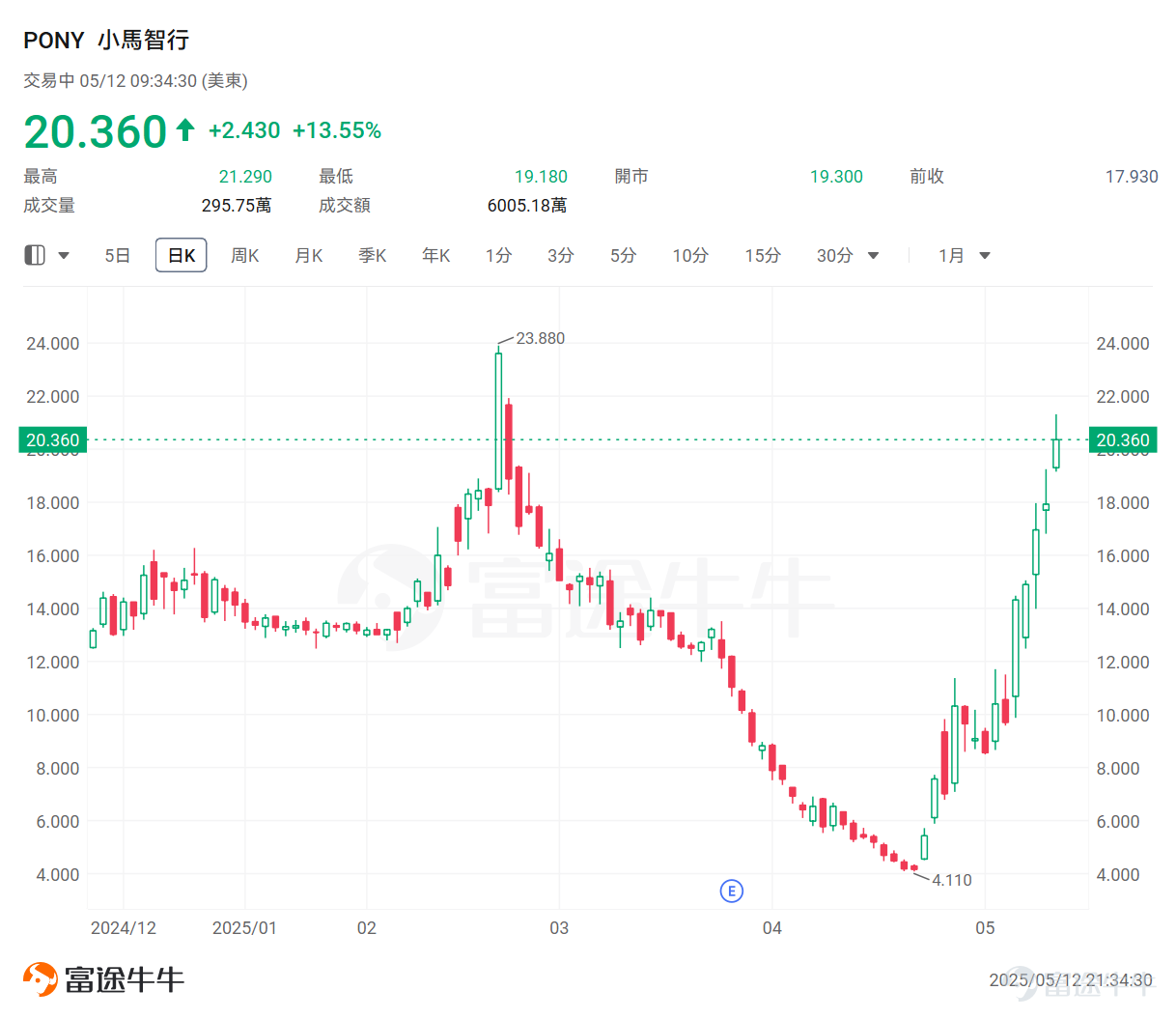

Pony.ai has almost quadrupled in the past two weeks! The self-driving industry has the potential to explode in 2025, which other companies will take off with this momentum?
Robotaxi is becoming the main battlefield in the global self-driving competition.
Recently, there have been frequent messages in the self-driving industry: the once Silicon Valley ride-hailing software, the pioneer of global online car-hailing. $Uber Technologies (UBER.US)$ Has reached a strategic cooperation with WeRide and Pony.ai.
$WeRide (WRD.US)$ Announced the expansion of strategic cooperation with Uber Technologies, planning to add Robotaxi services in 15 international cities in the next five years, including international markets in Europe, the Middle East and more.$Pony AI (PONY.US)$ Announced a strategic cooperation with Uber Technologies, planning to integrate Xiaoma Zhixing's vehicles into Uber's ride-hailing platform. The cooperation will launch later this year in the Middle East market, with plans to expand to other international markets in the future.
Looking at the stock price trend, Xiaoma Zhixing has risen over 390% in the last 14 trading days.

It is worth noting that in the upcoming period, the self-driving car industry will have many bullish catalysts, including:
– $Uber Technologies (UBER.US)$ and. $Lyft Inc (LYFT.US)$ This year, Self-Driving Cars will be launched in Texas and Atlanta;
– $Alphabet-C (GOOG.US)$ under Waymo and $Magna International (MGA.US)$ Plan to double the production of self-driving taxis at the Arizona factory by the end of 2026.
In fact, in the long term, the Self-Driving Cars market is expected to experience a groundbreaking explosion. Research from the McKinsey Center for Future Mobility predicts that by 2035, Self-Driving Cars will create revenues between 300 billion and 400 billion dollars.

Source: McKinsey Center for Future Mobility
Who will be the "winner" in the Robotaxi era?
According to Automotive Heart, overall, the Self-Driving Cars sector currently has four types of players, namely idealists, radicals, pragmatists, and opportunists.
Idealists, represented by Waymo, start from L4 Self-Driving Cars and aim to directly reap the fruits of high-level automated driving implementation; radicals, represented by Tesla and NIO, focus on advanced driving assistance, continuously upgrading features through OTA, and hope to achieve fully automated driving as soon as possible with data obtained from mass-produced fleets; pragmatists, represented by GM's Cruise and Great Wall's Haomo Zhixing, rely on large-scale automakers, placing greater emphasis on the safety of Self-Driving and assistance functions while moving forward at full speed; opportunists, represented by Huawei and DJI, are cross-industry players that leverage strong R&D capabilities to provide full-stack solutions for smart cars to automakers, aiming to create new profit points based on their main business.
Futu News has also organized some companies in the Self-Driving Cars sector of the Hong Kong and USA stock markets for investors' reference:

Specifically, these include:
Component Suppliers $Mobileye Global (MBLY.US)$ 、 $Innoviz Technologies (INVZ.US)$ 、 $NVIDIA (NVDA.US)$ 、 $Ouster (OUST.US)$ 、 $Luminar Technologies (LAZR.US)$ 、 $Aeva Technologies (AEVA.US)$ 、 $Tuya Inc (TUYA.US)$ 、 $Microvision (MVIS.US)$ 、 $Arbe Robotics (ARBE.US)$ 、 $Hesai (HSAI.US)$ 、 $HORIZONROBOT-W (09660.HK)$ 、 $BLACK SESAME (02533.HK)$ 、 $ROBOSENSE (02498.HK)$ ;
Map and Software Suppliers $Pony AI (PONY.US)$ 、 $Aurora Innovation (AUR.US)$ 、 $LeddarTech Holdings Inc (LDTCF.US)$ ;
Robotaxi Developers $Tesla (TSLA.US)$ 、 $WeRide (WRD.US)$ 、 $Baidu (BIDU.US)$ Under Apollo, $Amazon (AMZN.US)$ Under Zoox, $Alphabet-C (GOOG.US)$ Under Waymo;
Mobility service providers $Uber Technologies (UBER.US)$ 、 $Lyft Inc (LYFT.US)$ 、 $DiDi Global Inc (DIDIY.US)$ ;
Also includes auto manufacturers. $Tesla (TSLA.US)$ 、 $BYD COMPANY (01211.HK)$ 、 $XIAOMI-W (01810.HK)$ 、 $NIO Inc (NIO.US)$ 、 $Li Auto (LI.US)$ 、 $XPeng (XPEV.US)$ and so on.
Undoubtedly, Tesla, as a leading company, has the best technology and the most data accumulation.
According to media reports,Robotaxi is the top project personally designated by Musk.In an internal meeting in April, Musk decided to scrap the affordable electric vehicle project Model 2, betting Tesla's future on AI-driven projects such as self-driving taxis Robotaxi and humanoid robots.

However, apart from Tesla, there are many other companies worth noting.
Since 2025, Robotaxi players in the USA, including Waymo, Tesla, and domestic manufacturers such as Pony.ai and WeRide, have been continuously advancing their business progress and accelerating their layout in other global markets. On the policy front, the USA's self-driving regulations are gradually loosening, and more regions in the domestic market are issuing related management rules and making requirements for remote testing demonstrations. Specifically:
– Pony.ai: An L4 company focused on Robotaxi/truck business.
According to Everbright, Pony.ai was established in 2016, aiming to provide self-driving technology and solutions for the global market in the fields of transportation and logistics. The company launched the first Robotaxi service in the country in 2018 and initiated fully autonomous road operation and commercialization in 2021, being one of the first companies to obtain self-driving transportation service permits in Peking/Shanghai/Guangzhou/Shenzhen, and the only self-driving company to obtain all Robotaxi regulatory permits in these four major first-tier cities. In addition, the company is also laying out autonomous long-distance freight and intelligent driving services for passenger vehicles.
The company's core business mainly includes three major sectors: 1) Self-driving transportation services (Robotaxi services); 2) Self-driving freight services (Robotruck services); 3) Technology licensing and application services (Licensing and applications). Currently, all three major businesses of the company have achieved commercialization.
The firm believes that Pony.ai's Robotaxi business main advantages lie in:
1) Relying on the team's strong algorithm capabilities and leading technical strength: Compared with other companies in the Robotaxi industry, Pony.ai holds a leading position in accumulated mileage, average test speed, and takeover mileage; 2) Leading progress in regulatory approval: Pony.ai is one of the first companies in China to obtain permits for self-driving travel services in Peking, Shanghai, Guangzhou, and Shenzhen; 3) Has numerous ecological partners: Currently, Pony.ai has reached cooperation with upstream and downstream participants such as auto manufacturers, travel platforms, chip manufacturers, and sensor manufacturers, indicating the company is likely to continue solidifying its industry-leading position through its "circle of friends" advantage.
– Wenyan Zhixing: "The world's first Robotaxi stock."
Wenyan Zhixing was established in 2017 and is headquartered in Guangzhou.It is a cutting-edge technology company focused on L4 level autonomous driving technology.
The company's business mainly covers two major sectors:One is the operation of autonomous driving vehicles, covering various fields such as Robotaxi (self-driving taxis), Robobus (self-driving buses), self-driving logistics vehicles, sanitation vehicles, etc.It has already conducted testing and operations in 30 cities worldwide, accumulating a wealth of practical application data.Secondly, provide Smart Driving solutions,integrated hardware and software solutions from L2 to L4 level, and establish cooperation with well-known car companies such as Nissan, Yutong, and Bosch to promote the widespread application of autonomous driving technology in the auto industry.
It is worth noting that NVIDIA is one of the early investors in WeRide and is also a business partner of the company.
– Mobileye: Core Supplier of Autonomous Driving
Mobileye is a company headquartered in Israel, founded in 1999, which has long focused on the development of autonomous driving technology and Advanced Driver Assistance Systems (ADAS). The company is known for its self-developed EyeQ series chips and advanced computer vision algorithms, with its surround-view ADAS Smart Driving platform widely used in driving assistance systems of several global Auto Manufacturers.
In the field of autonomous driving, Mobileye is regarded as one of the leaders. Its technology has been adopted by over 20 global large Auto Manufacturers, supporting a variety of functions ranging from advanced driving assistance to fully autonomous driving. Mobileye's solutions not only cover the autonomous driving software system but also encompass full-stack development from hardware to software, including cameras, radar, Lidar, and Sensors, as well as algorithms for environmental perception and decision-making. Its products combine the self-developed EyeQ series chips and advanced computer vision algorithms to provide Auto Manufacturers with comprehensive support from perception to decision-making. This integrated hardware and software strategy positions Mobileye in a significant place in the field of autonomous driving technology.
– Travel service providers: Uber & Lyft
Wall Street financial giant Bank of America previously released Research Reports stating that with the rapid development of Self-Driving Cars technology driven by AI large models, the two major Online Car-hailing giants—Uber and Lyft—are likely to be long-term winners in the stock market benefiting from this major trend.
In fact, as Self-Driving Cars continue to commercialize, more and more technology companies are choosing to cooperate with travel platforms like $Uber Technologies (UBER.US)$ or $Lyft Inc (LYFT.US)$ such travel platforms.
On May 6, Self-Driving Cars companies WeRide and Pony.ai successively announced the expansion or establishment of cooperation with the mobility company Uber.
Among them, WeRide announced plans to add 15 international cities in the next five years, deploying Robotaxi (Self-Driving taxi) services through the Uber platform; Pony.ai announced a Global Strategy cooperation with Uber, with its Robotaxi services and fleet to be integrated into the Uber platform in the second half of this year, with cooperation starting in the Middle East market this year.
It is worth noting that earlier, on May 2, the Self-Driving Cars company Momenta also announced a strategic partnership with Uber to introduce self-driving vehicles to the Uber platform, with plans to launch commercial services in Europe starting in early 2026, forming a collaborative synergy among three Chinese companies "going overseas in succession."
According to foreign media reports, online car-hailing giant Lyft announced this year that it will join the increasingly competitive field of Self-Driving Taxis (robotaxi). The company stated that users will be able to experience self-driving car services in Atlanta as early as this summer, marking a significant step for Lyft in the future mobility sector.
Lyft's self-driving taxi service will be launched in cooperation with the autonomous technology company May Mobility. The first self-driving vehicles to be put into operation will be converted Toyota Sienna minivans equipped with May Mobility's advanced self-driving system.
A Lyft spokesperson added that after Atlanta, Dallas will be the next city for deployment. Lyft plans to collaborate with Mobileye and $Marubeni (8002.JP)$ other companies to strive to launch self-driving services in Dallas next year, and envisions a grand expansion blueprint with "thousands of self-driving cars and more cities" in the future.
 mooers, do you have confidence in the self-driving sector? Which company do you most favor? Feel free to leave a comment in the comment section~
Risk Disclaimer: The above content only represents the author's view. It does not represent any position or investment advice of Futu. Futu makes no representation or warranty.Read more


Comments (6)
to post a comment
62
44