Xiaomi's globalization has entered the "model going global" stage, and will open 0.01 million Xiaomi Home stores overseas within five years.
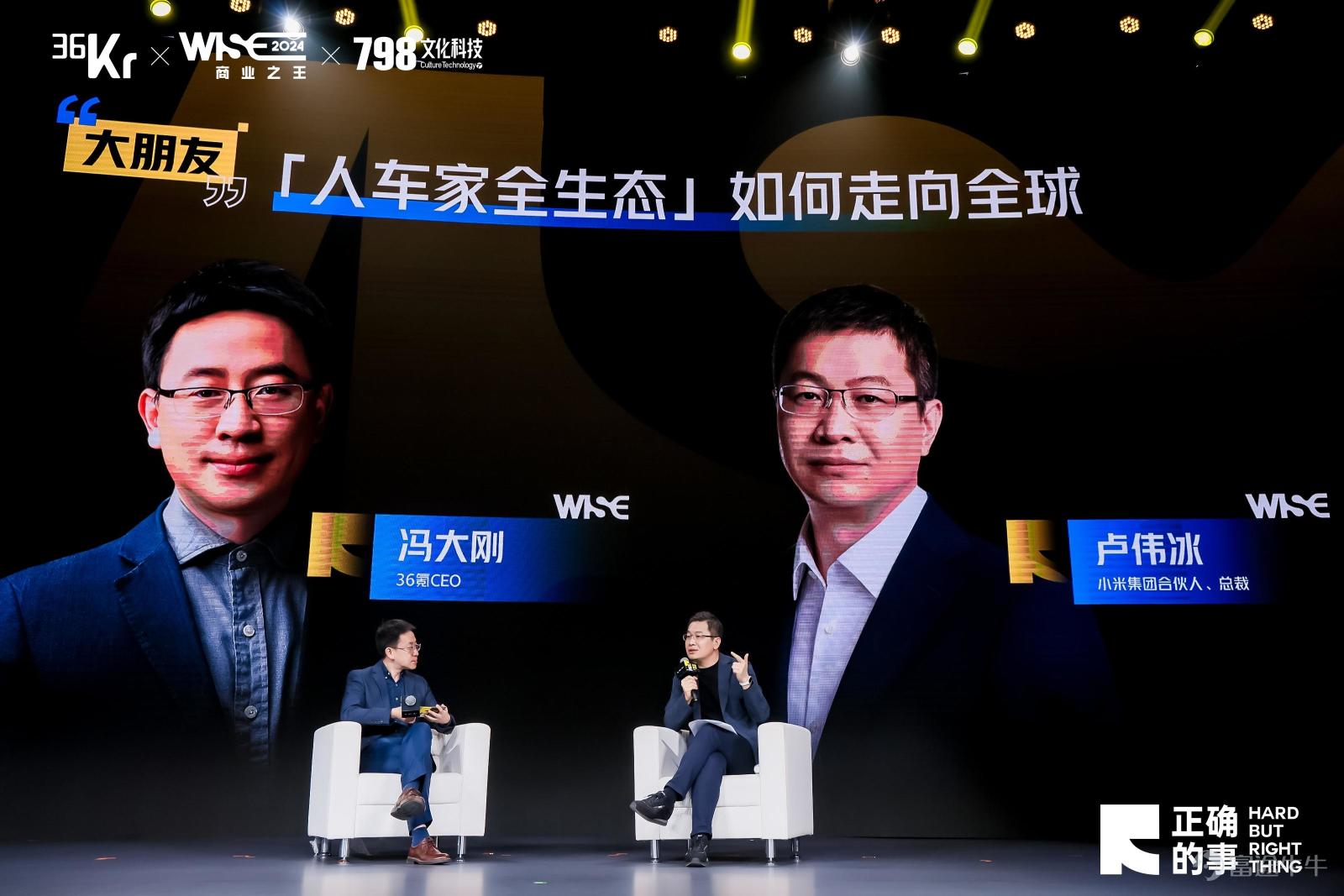
On November 28, Lu Weibing, a partner and president of Xiaomi Group, gave a presentation titled "How 'People-Car-Home Complete Ecosystem' Goes Global" at the "WSIE Business King" conference hosted by 36Kr. During a dialogue with 36Kr CEO Feng Dagang, Lu Weibing deeply analyzed the success principles behind the popularity of Xiaomi products like the Xiaomi SU7, Xiaomi 15, and smart home appliances from the perspective of Xiaomi's product and premium methodologies. He also extensively discussed Xiaomi's premiumization, investment in AI, and the heavyweight topics of "People-Car-Home Complete Ecosystem" going global.

Lu Weibing stated that Xiaomi's globalization has completed the product and brand overseas expansion and entered the second stage of 'model going global.' Xiaomi plans to open 100,000 Xiaomi Mi Homes overseas in 5 years, bringing the 'People-Car-Home Complete Ecosystem' and the Xiaomi new retail model to the international market.
Addressing the highly concerned issue of premiumization, Lu Weibing stated that Xiaomi has achieved "a huge success in phases" with premiumization, not just with the Xiaomi 15 series but almost all Xiaomi product categories transitioning to the premium segment. He particularly emphasized that the success of the Xiaomi SU7 is not accidental but an inevitable success of Xiaomi's product and premium methodologies, stating that 'every industry deserves to try the Xiaomi methodology.'

Lu Weibing believes that AI, a hot topic in the industry, will bring revolutionary changes to user experience and significantly improve business efficiency for enterprises. He also bluntly stated that the revolutionary disruption of AI on smartphone experience is just beginning, and it will take some time before reaching what Xiaomi aims for with AIOS.
Below is a record of the dialogue.
The host.Technological advancement is not achieved overnight; it requires patience, perseverance, and courage to experiment and innovate. When discussing innovation, we cannot ignore the strong Chinese brands that have shown remarkable competitiveness on a global scale. These brands not only stand out in the domestic market but also shine brightly on the international stage, embodying the magnificent transformation from 'Made in China' to 'Created in China.' Speaking of which, one name that cannot be omitted is Xiaomi.
Not only has it changed people's perception of smart phones, but it has also brought convenient smart living experiences to global users with its unique ecological concept. Next, we will enter the "Big Friends" segment, with the initiator of this conversation, Mr. Feng Dagang, CEO of 36kr holdings, and now let's welcome Mr. Lu Weibing, partner and president of Xiaomi Group, to share the main topic with us. Please!
Mr. Feng Dagang: First of all, congratulations to President Lu. Xiaomi released a very beautiful Q3 financial report these days. From the financial report, it can be seen that if Xiaomi had a period of confusion before, it has completely emerged from it now, with a very promising situation. Xiaomi's automotive sector has found its position, stable deliveries, and categories like large appliances and internet have become key parts. The three growth curves of Xiaomi are organically intertwined, and this achievement definitely cannot be separated from the change in management style. Today, I want to talk about our own observations. Xiaomi's management style over the past few years has gradually transitioned from "entrepreneurial" to "Fortune Global 500," and Lu is the most representative member because he has led many crucial departments, such as the China region, mobile phone department, ecological chain department, and the large appliances department, and now he has become the president of Xiaomi Group. Your understanding of Xiaomi's changes and how you envision Xiaomi's future is very crucial, thanks again President Lu.
Lu Weibing: Thank you very much for this opportunity to share Xiaomi's progress and thoughts with everyone.
Mr. Feng Dagang: Today's topic mainly covers three levels, from the company, to the industry, and then to the entire market. Firstly, Xiaomi's excellent performance in this financial report is not a coincidence, but a result of the multiplier effect based on the enhancement of Xiaomi's methodology and core capabilities. So, the first question I want to ask is, how to understand Xiaomi's methodology, and how was this methodology formed? A few years ago, we heard that Xiaomi's methodology was called focus, extreme, word of mouth, and speed. Is this methodology still the same as it used to be, is it a continuation, or a disruption?
Lu WeibingAfter every quarter's financial report, I have to do a roadshow. This year, I was often asked by investors in the roadshow: Xiaomi SU7 is so successful, can your second car be successful? Can the third car be successful? Is the success of Xiaomi SU7 accidental or inevitable? This is almost a question I have to repeat every quarter.
In this regard, what I discuss more with investors is Xiaomi's product methodology and Xiaomi's high-end methodology. We say,The success of Xiaomi SU7 is the culmination of Xiaomi's product methodology and Xiaomi's brand high-end methodology, the combination of these two methodologies has created the success of Xiaomi SU7 today.So what I talk to them most about in the roadshow is that this success is inevitable.This success is the result of our strategic planning after deciding to make cars at the end of March 2021, it is not accidental.。
They asked me, what is Xiaomi's methodology, what is Xiaomi's product methodology? I thought about how to explain it to investors, in fact, talkingXiaomi's product methodology, in one word, is 'explosive products,' it's about how you can create explosive products and then let those products change the whole market landscape.
Before the launch of Xiaomi SU7, Lei Jun invited many people - people in the industry, people who have been in the automotive industry for decades, to give us advice and guess how many units Xiaomi SU7 could sell. The highest guess at that time was that it would be very good to sell five thousand units in a month. Many people were saying, maybe one thousand, two thousand, three thousand units. Because they had a benchmark car model at that time which was Tesla Model 3, with about 45,000 units sold in a quarter. Selling one-third of Tesla would be very, very good. In fact, everyone can see the monthly deliveries of SU7 now, as we broke two thousand units in October.
Feng Dagang:Lei Jun, how much did you guess at that time? How much did you guess?
Lu WeibingLei Jun:
We set the annual target for the first year at 760,000 units in 9 months, with deliveries averaging less than 100,000 units in the early stages of each month, and over 100,000 units later on. But in reality, everyone can see that the monthly sales of this car have exceeded twenty thousand units, as currently the delivery cycle is still about 20 weeks, which means you need to wait for about 5 months if you open the Xiaomi Car APP today. We don't know today, what would the sales be if our delivery cycle was one or two months, we have not yet seen the upper limit of the sales.
In other words, when our delivery cycle was still over 20 weeks, our sales had already surpassed the Model 3. Previously, people said it was very difficult to achieve sales of over 200,000 units for a pure electric sedan, but they forgot that a truly explosive product can change the industry. This is the value of Xiaomi SU7 to the industry, not only has SU7 succeeded, but everyone can see that all the pure electric sedans are selling well, because a large number of Xiaomi orders overflowed to other friendly products. This is an explosive product that can change the industry landscape.You may ask a question, how did you create SU7? In summary, Lei Jun's words: invest ten times more and make a good car solidly. The R&D cost invested in SU7 is ten times that of a traditional car manufacturer for a single car. So when we just entered the automotive industry, many teams asked: how does Xiaomi do its "spectrum"? I said this is not how Xiaomi makes products. Xiaomi's approach is to make one product well, one product equivalent to their 10 or 20 products. Everyone says, "Having more children means more fighting", but we are not like that. We focus on raising one child well. This is the biggest difference between Xiaomi and other companies.
Feng Dagang: But is this a bit dangerous?
Lu Weibing: We thinkIt's more dangerous to have more than to have fewer, it's more dangerous to disperse forces than to concentrate forces. It seems to reduce risk, but actually increases risk.So if you look at Xiaomi today in any category of industry, such as the air conditioning sector, the number of Xiaomi SKUs is one-tenth of traditional air conditioning companies; in the smartphone industry, today Xiaomi phones are third globally, but our models are only half to one-third in number compared to the fifth and sixth place companies.
In any category, we must create explosive products, reduce product SKUs, and definitely make strong investments.What is the premise of making strong investments? It is necessary to have very strong user insights and technical insights. We need to combine user insights and technical insights to form a product. Why make multiple products? You simply don't know what users need, that's why you would produce more. Since the establishment of Xiaomi 14 years ago, we have followed this methodology, which seems to defy common sense, but we firmly believe in it.
Feng Dagang:Hmm, counterintuitive. In a sense, why did I say this was risky just now? Because it seems like a 'common sense': most people think that making 10 products, some successful, some not, is safe. Why does President Lu say that making one product is safer than making ten, and conversely, diversification and making many are unsafe? In fact, behind this is Xiaomi's confidence based on a deep understanding and insight into users and the market.
Lu Weibing: And there is another important reality, which is that a company's resources and people's energy are limited. If you make 10 cars, the time and effort you spend are completely different from making one car. Because every company's resources are limited, and everyone's time and energy are limited, this is the biggest difference in our mindset.
Feng Dagang: A few years ago, when Xiaomi started to make cars, there were also questions raised, such as needing to spend a lot of money on making cars and facing many competitors. Now Xiaomi's cash flow is relatively abundant, can we consider that Xiaomi's car manufacturing has reached a relatively safe state? What other challenges are there ahead?
Lu Weibing: In March 2021, when we announced the car manufacturing, the biggest issue raised by investors was how big the success of Xiaomi's cars would be. If Xiaomi's cars fail, will it drag down all your existing Xiaomi businesses? This was the biggest question we faced from investors from 2021 to 2023. Their concern is that Xiaomi, a company known for making phones, why would it succeed in entering the century-old automotive industry? After all, you have to face many even more powerful companies. So everyone is worried that Xiaomi's business may follow a 'double kill logic': if the car fails, it will drag down our existing business as well.
But actually, when we decided to make cars in 2021, we had a very clear idea. You can see that when we made cars, we made a very important decision, which is Xiaomi using 100% of its own money to make cars. We did not, like many companies, turn the car business into an independent company for financing, using external shareholders' money. In 2021, we also called it 'Mobile Phone × AIoT × Car'; we already believed that cars are a very important part of Xiaomi's future ecosystem layout. Since it is a very important part, it must be within Xiaomi's own system, without external funds leading to inconsistent interests, which would cause us significant losses, this is the first.
After this top-level design, we then made a second very important decision at the time, to invest $10 billion. This was mentioned by Lei Jun in March 2021, at that time ($10 billion) was about 70 billion RMB. In such a huge industry, if you do not firmly put 70 billion RMB on the table, it would be hard for us to enter the game. This was the second extremely important decision we made.
The third most important thing is to think clearly about what the essence of the smart electric car industry really is. We repeatedly ask this question. In this important transformative period of a hundred years, what exactly is this major transformation?
In the end, we understood that smart electric vehicles are a combination of consumer electronics and traditional industries, but they follow the rules of the consumer electronics industry. This statement is very important. What are the rules of the consumer electronics industry? It is about defining hardware with software and the future industrial landscape will continue to converge. We believe that the top five companies in the industry will converge to occupy 70% of the market share. That's why we aim to be among the top five global auto brands. If we are not in the global top five, we will be considered as "others" in the future. Therefore, we are determined to become one of the top five car manufacturers globally in 15-20 years. This is the basic logic behind our strategic planning. Once our (people, cars, and home ecosystem) strategy is established in 2023, our strategy can be fully implemented by 2024. Throughout this logical deduction process, everyone will discover that our existing business has become increasingly healthy over the past few years. When we announced our entry into the auto manufacturing industry in 2021, we had about 100 billion in cash reserves. Now we have 151.6 billion in cash reserves. During the past three years in the auto manufacturing industry, our cash reserves have increased by over 50 billion.
Feng Dagang: So, not only did auto manufacturing not burn money, it actually increased.
Lu Weibing: Currently, the automobile sector is still incurring losses, but our existing business is still very healthy. Therefore, after our Q2 automotive business financial report was disclosed this year, I told investors that Xiaomi's three growth curves have all taken shape: the first curve is the personal devices with phones as the core, the second curve comprises household devices with televisions, air conditioners, refrigerators, and washing machines as the core, and the third curve is for travel devices - cars.。This is the situation of Xiaomi's development today.
Feng Dagang: Mr. Lei has also mentioned three core management concepts before, simplifying management, flattening the structure, and finding like-minded people. Now, Mr. Lei has put more emphasis on the car, you have taken on more management responsibilities, what do you think is the "right thing"? We just talked a lot about logic, Mr. Lu has a whole set of ways of thinking behind him, I don't know if it is only suitable for Xiaomi, or if it is also suitable for others?
Lu Weibing: Today, the business I am in charge of at Xiaomi includes personal devices, home devices, internet-related business, global strategic areas, including managing the automobile sales and service business.
Many people ask me a question, with so many businesses under your management, how do you allocate your time? In management, I will divide the work into different layers. The furthest layer is called strategic control, we manage the business in a strategic way, only focusing on strategy and budget. The second layer, closer to the business, is called operational control, not only looking at its strategy and budget, but also delving into key operations, such as product roadmaps. Specific product lines need to attend the IPMT meeting, and key supplies need to be inspected. The third is the most core business, we call it critical detail control, such as the smartphone business, I need to oversee every product definition, polishing, determination, and external design setting.
I just divided them into these three categories, behind these three categories, we have done very important things. We have a lot of businesses, previously formed different management systems, styles, tools, so the most important thing in the past few years is, first, we need to form a unified Xiaomi strategy; second, based on this strategy, we need a unified management system, including processes, regulations, organizational development; third, we must build a common management backend capability. After completing these, we have built Xiaomi's "OS" of management, all businesses are like apps on this OS, can play to their characteristics, but must follow the rules of the unified OS. This allows Xiaomi to build a good management system, support the rapid development of multiple businesses, and not lose control.
Feng Dagang: I still feel that what you just said seems to be superficial, I feel that if another company does exactly the same thing, it may not necessarily be successful. Is there something fundamental that we don't know about?
Lu WeibingIn my opinion, The management system and tools we explored today have universality, not only suitable for Xiaomi but also for other enterprises.We are involved in automobiles, as well as smartphones, air conditioners, refrigerators, washing machines, televisions, and small appliances. Our explored management system not only has cross-category universality, but also cross-country universality, without significant specificity. The practice of management is universal.
Feng DagangJust now, I talked about the first most important core business - the smartphone business. Today, Xiaomi phones have achieved very good results, ranking third in global market shipments, very close to Apple. My first question about smartphones is, previously Lei Jun has mentioned several times that he wants to learn from Apple, benchmark the iPhone, and surpass the iPhone. Now that the iPhone's sales in China and globally are not as good, what new perspective can we use to view our old competitors or benchmarks?
Lu WeibingFirst of all, I believe that Apple is an extremely powerful and great company. Three data points stand out: the first year profit of 100 billion US dollars, the second year sales revenue of 400 billion US dollars, and the third with a market cap of over 0.03 million US dollars. I think this is extremely powerful. So I still believe that over the past decade, competing with Apple in the same industry has greatly benefited Xiaomi.
In the past, we focused more on learning from Apple. In 2021, we officially put forward the comprehensive symbol of Apple, what does that mean?What does it mean to symbolize? We compare from a technical perspective, not just on the surface, but from the fundamental technology perspective, from the aspects of chips, operating systems, ecosystem control, brand positioning, and even user segmentation. This comparison is comprehensive, end-to-end, and has brought Xiaomi very significant benefits.Starting from the Xiaomi 12 series, Xiaomi 12 is the first generation of products after fully symbolizing Apple. Up to Xiaomi 13, we have achieved great success; Xiaomi 14 has increased sales by about 70% based on Xiaomi 13. This year, the starting price of Xiaomi 15 has increased. The starting price of the first four generations of products was 3,999 yuan, while the starting price of Xiaomi 15 is 4,499 yuan, but we have seen good sales growth this year.
The growth behind this is the capability building of symbolizing Apple over the past few years, finally achieving such results. The capability building is ultimately reflected in the product's user experience. Xiaomi 15 is symbolized by the iPhone 16 Pro, and Xiaomi 15 Pro is symbolized by the iPhone 16 Pro Max. This year, our focus is on design transformation, where we have made changes to the texture and feel. This is a major 'handing in of assignments' in the past four generations of products compared to the iPhone.
Feng Dagang: Four generations of products are not easy, including the discussion just now on the price increase of Xiaomi 15. In fact, from many Xiaomi employees I have come into contact with, they should all have a dream: they especially want to pursue a high-end strategy, or in other words, pursuing high-end products is their dream. Today, with the launch of Xiaomi 15, can we talk about Xiaomi's pursuit of high-end smartphones?
Lu Weibing:We have indeed achieved significant success in this phase.When we were moving towards high-end businesses a few years ago, we encountered a lot of doubts, including internal doubts.
The first doubt was whether to achieve high-end with the Xiaomi brand or start a new brand? Some said there were not many successful precedents using the original brand. Many people asked why not change to a different brand, and many examples were cited.
Later, I said something internally, I said,There is no distinction in brand hierarchy. The most important thing is the level of the people behind the brand. The level of those who build the brand determines the brand itself.Brand's high-end and youthfulness is a permanent topic. Today, your brand may be high-end and youthful, but after ten years, it may face the same problem. Would you change the brand in ten years? Impossible. So, I believe that brand innovation and upgrading will be the norm in the future. Therefore, we firmly said we must go for high-end with the Xiaomi brand. Why? Because all our products share the Xiaomi brand, as long as we elevate this brand to high-end, Xiaomi will benefit.
Today, we find that not only Xiaomi phones have become high-end, but also air conditioners, our newly released air conditioner, achieved sales about 4 times our target; our dual-zone washing machine also surpassed our sales target by over 3 times, as well as many other products. Our recently launched Xiaomi smart watch saw a 20% price increase and doubled sales compared to the previous generation.You will notice that it seems all your Xiaomi products this year have become high-end. This is the result of the brand strategy under Xiaomi's benefit, so we must firmly continue with the high-end focus of the Xiaomi brand.。
Of course, the high-end also benefits from our technology investment in recent years. Today, many people may focus more on how much money is invested in smartphones, but may not know that Xiaomi just built a laboratory of over 0.01 million square meters in Wuhan last month. The day before yesterday, I also attended the groundbreaking ceremony of a major home appliance factory in Wuhan, with an investment of tens of billions. R&D investment is distributed across many categories. This year, Xiaomi's R&D investment is 24 billion, and we are budgeting for 30 billion in R&D investment next year. Xiaomi's R&D investment has grown at a compound annual rate of over 30% since 2017.If people see some of Xiaomi's successes today, the first thing behind it is solid investment in technology, and the second is moving the Xiaomi brand towards high-end.
Feng Dagang: Chairman Lu spoke very well. I really think that on this stage, if a CEO says that our sales increased by 10% last year, but relied on a 50% price reduction, I don't think this is necessarily what we want to see. This indicates that the entire market is shrinking. Today, Xiaomi is a very good example. Higher-end products are selling better, and R&D investment is increasing, creating a cycle that makes the entire business world better. So, China has good examples that can be learned from.
Lu Weibing: So internally, we talk about how all industries are worth trying out Xiaomi's approach.All industries are worth trying Xiaomi's approach internally.As we thought, large appliances such as refrigerators and washing machines have been completely solidified in the past decade. The technological progress and brand landscape of refrigerators and washing machines have been very solidified in the past decade. However, you will find that Xiaomi has innovated a lot with their own understanding.This time, our air conditioners and washing machines are both innovative product categories that have never existed in the industry before. We have innovated them.
Feng DagangRegarding a question related to AI, today Xiaomi has done a lot of work in AI, restructuring the operating system, starting to make AI phones, and even smart glasses. How do you view the role of AI for Xiaomi, regardless of household appliances, phones, cars, what kind of impact does it have?
Lu Weibing:From the perspective of Xiaomi, AI has at least two very clear aspects: the first is a revolutionary improvement in user experience, and the second is a significant improvement in the business efficiency of the enterprise.
Let me talk about industry efficiency first. Everyone is very concerned about Xiaomi's new retail. Xiaomi started with the digitalization of the entire chain, and today the value of data has been fully realized. Today, we use AI for all data mining to help our frontline teams better serve users, so we have features like Copilot. Secondly, we use AI technology to find new materials in the industry, such as Xiaomi SU7's titanium alloy. This alloy material has to be found in the appropriate one out of tens of millions of formulas. In addition, many materials in phones are also formulated using AI, and the use of AI will significantly increase our efficiency.
Feng Dagang: If Edison had AI back then, it would not have taken so many years to invent the light bulb, right?
Lu Weibing: Yes, this will greatly shorten. Second, in terms of user experience, there are two most important products in our company: Xiaomi's Surge OS and intelligent driving. Intelligent driving is the most mature and beneficial AI scenario we see today. We have invested heavily in intelligent driving, and the development speed is very fast. Although we entered late, we have been progressing very quickly recently, thanks to the support of AI large models.Xiaomi has invested heavily in AI, with about four to five thousand people currently dedicated to AI in various departments. But I believe that the revolutionary revolution of AI on smartphones in terms of the entire experience has just begun today. The AIOS we desire internally still needs some time.
Feng Dagang: After talking about AI, let's talk about going global. These two topics are the most concerned topics for Chinese companies. Xiaomi's international expansion is very well done, with overseas revenue accounting for about half of total revenue. This is a highly internationalized company. Xiaomi says it has completed the first step of globalization, so what is the second step?
Lu Weibing: Before Xiaomi had revenue in the automotive business, about half of the revenue came from overseas. With the car, our Q3 overseas revenue accounts for 45%. We divide going global into the first and second stages.The first phase is to take Xiaomi products and the Xiaomi brand overseas, and the second phase is to take the Xiaomi model overseas. Currently, most Chinese companies are in the phase of product overseas expansion. Xiaomi has already completed product and brand overseas expansion today.Brand overseas expansion means that all of Xiaomi's business today is based on its own brand, without any OEM business. And as everyone can see in the latest InterBrand Global Brand Top 100 ranking, Xiaomi is one of the two Chinese companies listed, and we have established a presence in high-end markets such as Europe, Japan, and South Korea.
The second phase is to take our model overseas, bringing the whole ecosystem of people, cars, and homes, as well as the Xiaomi new retail model, to international markets. Therefore, we plan to open 100,000 Xiaomi stores overseas in 5 years, which is a very important business model.
Feng DagangPreviously, there was talk of soft overseas expansion, hard overseas expansion, software overseas expansion, hardware overseas expansion. Do you see it as the entire ecosystem going overseas?
Lu WeibingYes, in the past, the focus was mainly on product overseas expansion. Only a few Chinese companies, in my opinion, have achieved brand overseas expansion. Even fewer Chinese companies have expanded their business models overseas, which is Xiaomi's unwavering goal.
Feng DagangFor other enterprises that want to go overseas, can you talk about some of your experiences and suggestions?
Lu Weibing: Every company needs to find its position in going overseas, based on your positioning, find the choice of strategy. Because Xiaomi's way of going overseas involves heavy investment, we establish local operation entities in each country to support our business model. We will sell products based on this business model, so we liken ourselves to an integrated "road construction + car manufacturing". For small and medium-sized enterprises, in the large business model, just define your position and make strategic choices based on it.
Feng DagangFeng Dagang: Xiaomi is definitely a company that everyone is very interested in. Today we talked a lot about smartphones, cars, small appliances, and also shared very sincerely. Thank you, Mr. Lu!
Lu Weibing: Thank you all for your support for Xiaomi!
Risk Disclaimer: The above content only represents the author's view. It does not represent any position or investment advice of Futu. Futu makes no representation or warranty.Read more


Comment (1)
to post a comment
23
24