
Q3 financial report exceeds expectations again! Can nvidia get on board now?

After nvidia's performance, how to capture short-term opportunities with ETFs?
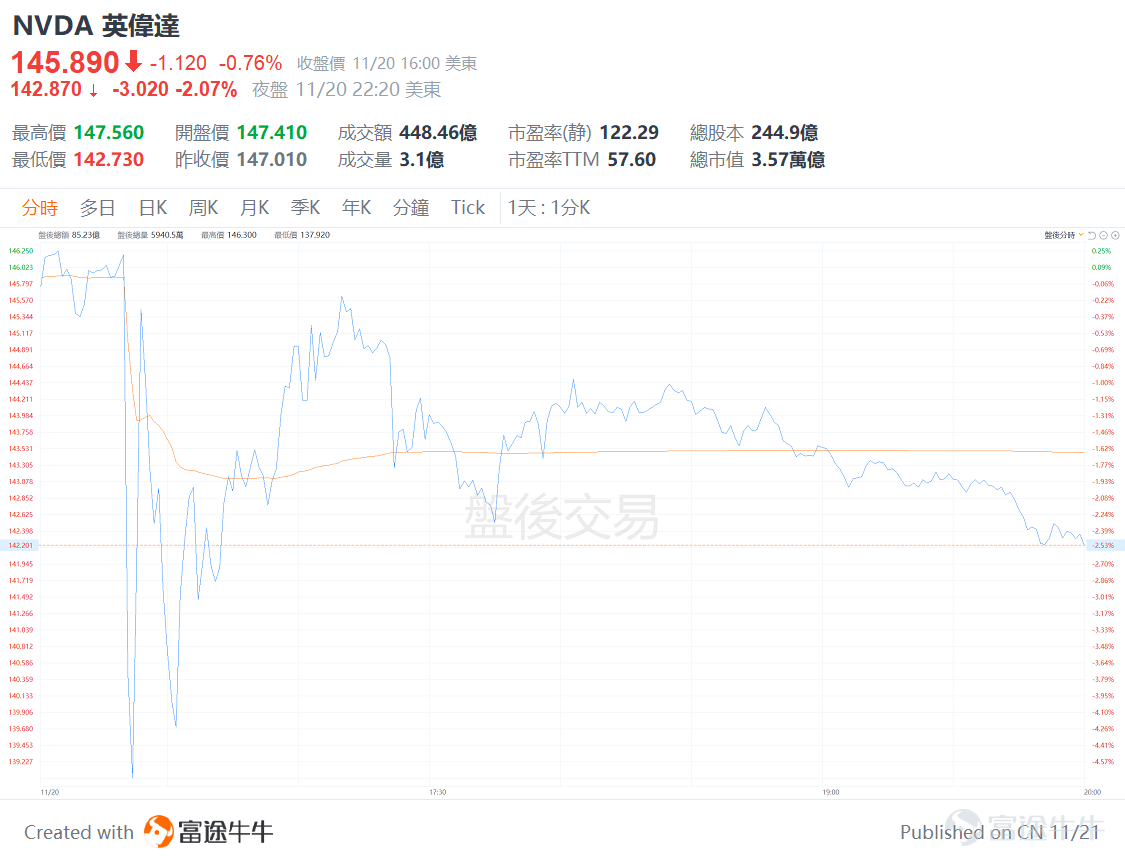
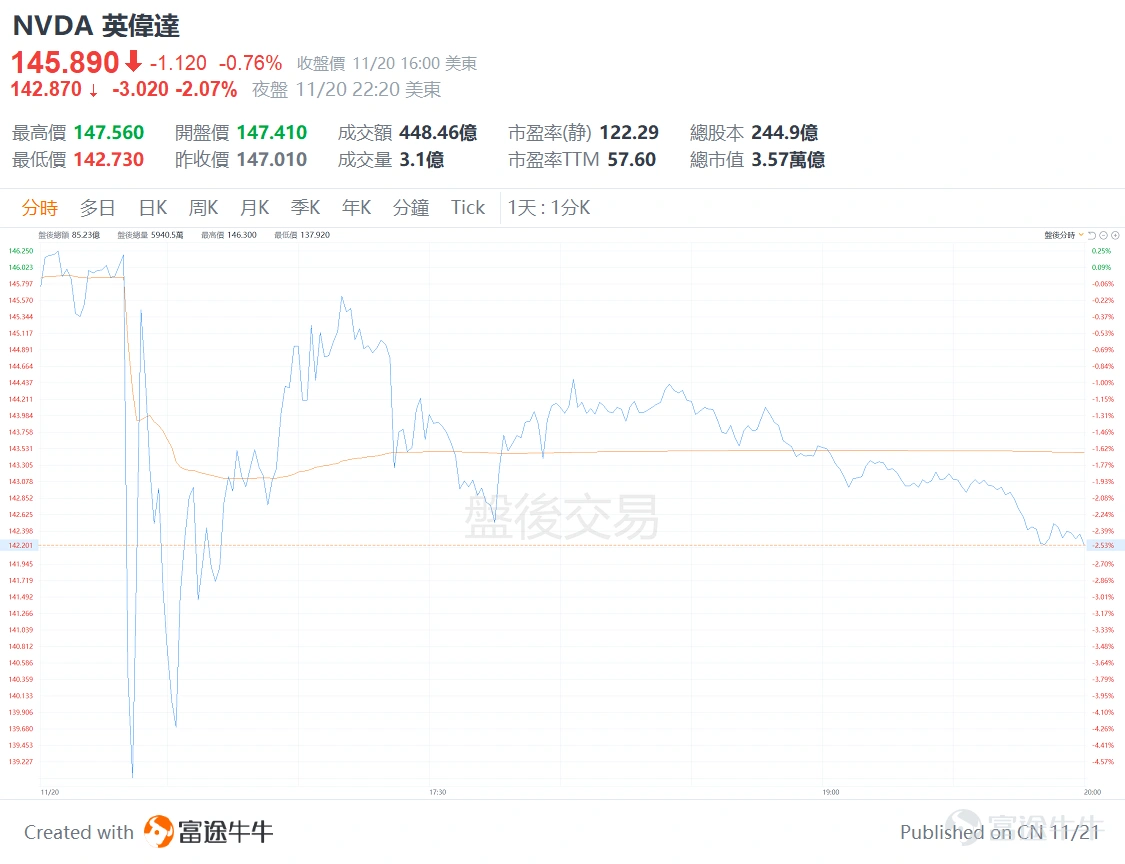
After nvidia's Q3 performance announcement, its stock price initially dropped more than 5% post-market, but later slightly rebounded and closed down 2% after hours.
Today, Mooer will summarize the key points of nvidia's performance for everyone and talk about what the market is really worried about.
For mooers with higher risk tolerance who want to capture short-term fluctuations in nvidia's stock price, Mooer also teaches everyone how to use ETFs to capture short-term opportunities.
How is Nvidia's performance?
First, Mooer will briefly organize the information on Nvidia's performance to help everyone understand what the market is worried about:
– Revenue growth has slowed downnvidia's FY25Q3 revenue year-on-year growth rate is +94%, quarter-on-quarter growth rate +17%. Although still above expectations, the year-on-year revenue growth in the previous few quarters was 265%, 262%, and 112% respectively, and the growth rate is not as exaggerated as before.
– The guidance did not exceed expectations.nvidia's Q4 revenue guidance is $37.5 billion, higher than the average expectation of $37.1 billion, but lower than the expectations of some analysts at $38.8-41 billion, possibly due to slower progress in the Blackwell chip. However, during the conference call, nvidia's CFO stated that they have successfully replaced a component of Blackwell, the company plans to start shipping in the fourth quarter, continue to increase production in the 2026 fiscal year, and expect Blackwell to remain in short supply in several quarters of the 2026 fiscal year.
Ahead of this performance, the market has been very concerned about the delivery of Blackwell. Although the management gave some positive signals during the conference call, the guidance was still a bit disappointing, causing some concerns in the market.
Therefore, mooerSubsequently, the focus should be on monitoring the delivery of Blackwell, which may directly impact the stock price of nvidia.。
How to capture short-term opportunities with etf?
When considering investing in Nvidia, besides buying stocks, you can also consider trading ETFs that track Nvidia stocks.
In recent years, the US stock market has seen many leveraged ETFs and inverse ETFs tracking individual stocks, which are suitable for those whoseek short-term gains and are suitable for investors with a high risk preference, let's explain it simply for everyone.
Leveraged or inverse single stock ETFs are tools suitable for short-term strategies, and are easy to implement, similar to stock trading. Compared to options, the advantage of these ETFs is that the operating logic is easier to understand, the potential risks are relatively controllable, but the downside is that the potential upside is not as high as options.
Here is a compilation of someLeveraged ETFs and inverse ETFs tracking Nvidia stocks: those bullish are $GraniteShares 2x Long NVDA Daily ETF (NVDL.US)$ , $Direxion Daily NVDA Bull 2X Shares (NVDU.US)$ , $T-Rex 2X Long Nvidia Daily Target ETF (NVDX.US)$ There are put options available. $GraniteShares 2x Short NVDA Daily ETF (NVD.US)$ , $T-Rex 2X Inverse NVDA Daily Target ETF (NVDQ.US)$ , $Tradr 1.5X Short NVDA Daily ETF (NVDS.US)$ 。
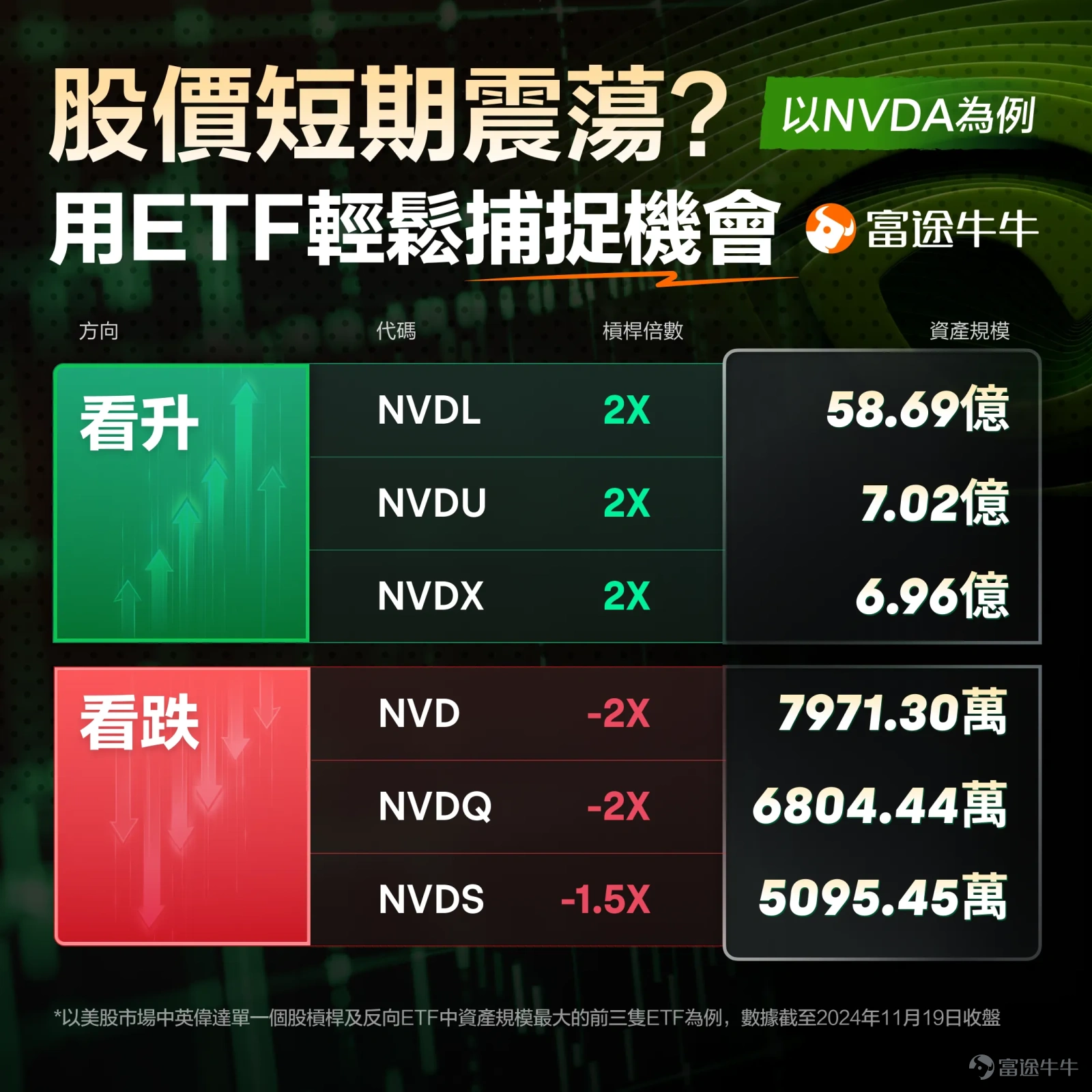
The principle is actually very simple, these ETFs all track the trend of Nvidia's stock price. If Nvidia's stock price rises by 2% on that day, NVDL (two times bullish) will increase by about 4%, while NVD (two times bearish) will decrease by about 4%, and vice versa. (There may be tracking errors, sometimes it may not be a whole multiple.)
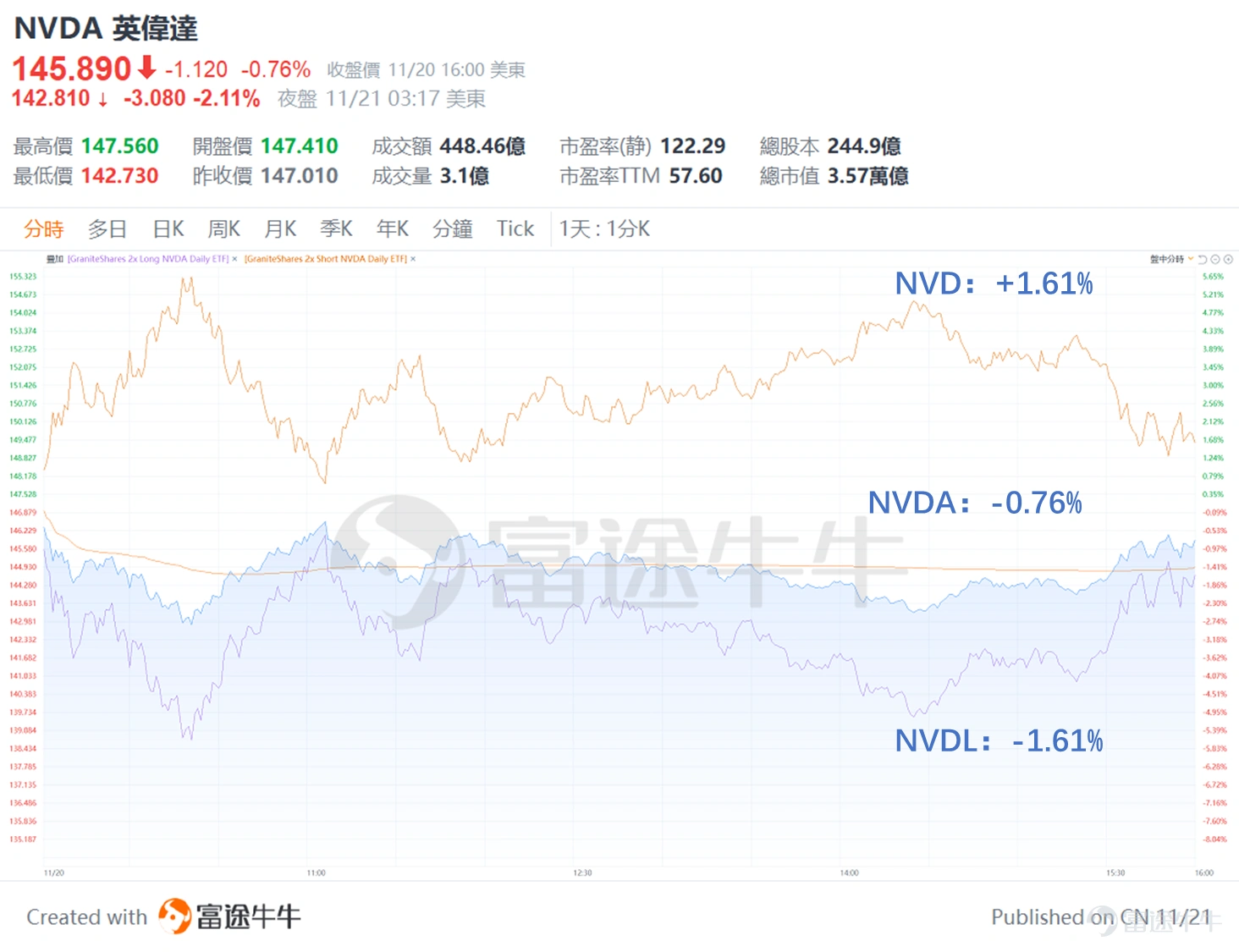
Here we will demonstrate the trend of Nvidia's stock price, NVDL, and NVD from yesterday using the overlay function of Futubull's market. Yesterday, Nvidia's stock price closed down 0.76%, NVDL followed with a 1.61% decrease, while the two times bearish NVD increased by 1.61%.
Based on the characteristics of individual stocks, mooers can use leveraged ETFs and inverse ETFs to amplify short-term gains and hedge risks:
1. Amplify gains based on your determination of the company's stock price.:Believe that nvidia's Blackwell chip will have increased volume in the future, driving nvidia's performance and stock price up, you can consider buying a 2x leveraged ETF tracking the stock; conversely, if you think there may still be delivery issues with Blackwell, which could impact nvidia's performance in the short term and cause the stock price to fall, you can consider buying an inverse 2x leveraged ETF.
2. Hold stocks to hedge short-term volatility risks.:Hold the actual stock and remain bullish in the long term, but expect a short-term price drop after earnings, you can also use an inverse 2x leveraged ETF to hedge risks.
If you want to learn more about playing with leveraged ETFs for various individual stocks, you can learn from this article:Clever use of single stocks leverage etf to capture short-term performance fluctuations.
In the end, Mooer still wants to.Regarding risks.Leveraged ETFs have greater volatility than stocks. In case of a wrong direction, there may be more losses. In addition, leveraged ETFs will have management fees and leveraged losses, which may cause tracking errors in ETFs. Therefore, mooers are best to evaluate their own risk tolerance, develop a suitable strategy, and avoid larger losses.
PS. Pay attention@牛牛課堂, orClick hereJoin the class to get more investment dry goods, greatly improve investment skills! If you want to exchange more, you can also join the mooer.Official investment exchange groupLearning, Chief Analyst real-time online guidance!
Risk Disclaimer: The above content only represents the author's view. It does not represent any position or investment advice of Futu. Futu makes no representation or warranty.Read more


Comments
to post a comment
10
15