
特朗普交易持續火熱!買什麼最好賺?

Futu Research | 2016 vs 2024: Outlook on the Impact of Trump on the US Stocks and US Bonds Market
On November 8, 2016, the unexpected election of Donald Trump brought severe shock to the global financial markets, becoming one of the most memorable political events in modern history. Now, as the 2024 election approaches, the market once again faces the test of the "Trump storm". This article will review the changes in the US stock and bond markets after the 2016 election, and discuss the new wave of market fluctuations that the 2024 election may bring. Four years have passed, will history repeat itself, or will there be a transformation in the market? Let's find out.
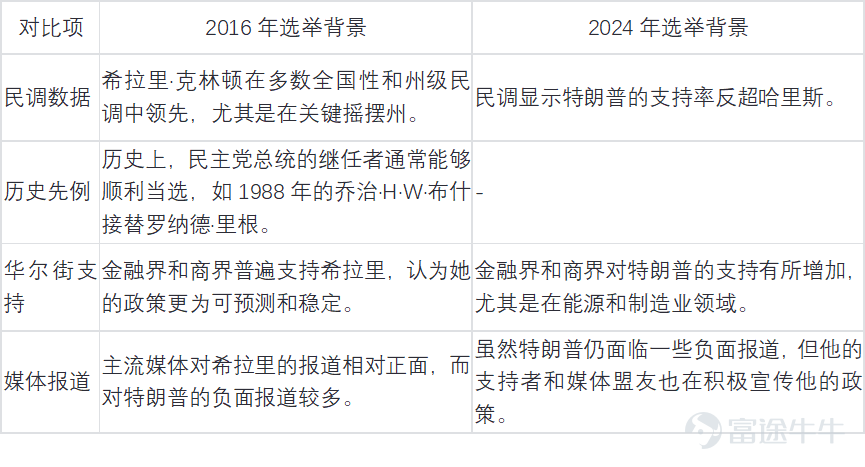
First, Election Background of 2016 vs. Election Background of 2024
The 2016 US presidential election was an adventurous affair full of uncertainty. At that time, the market generally expected Hillary Clinton to smoothly take office at the White House, but Donald Trump's unexpected victory was like a sudden "black swan" flying out, instantly stirring up the calm of the global capital markets. US stock futures immediately fell in response, with Dow futures plummeting more than 800 points at one point, reflecting investors' anxiety about the unknown policy direction.
However, the atmosphere of the 2024 election today is completely different. As President Trump runs for re-election, the market seems to have prepared in advance, with some expectations already reflected in current trading. This time, investors no longer fear the unknown, but are optimistic about the economic policies the Trump administration may continue, including tax cuts, deregulation, and promoting infrastructure development, among others.

Second, the trend of the US stock market after Trump's election in 2016

1. Short-term response
Election Night: After the news of Trump's victory, the US stock futures market once plummeted significantly, with Dow Jones Industrial Average futures dropping by more than 800 points at one point.
Next day opening: However, the next day after opening, US stocks quickly rebounded and closed higher. The Dow Jones Industrial Average, S&P 500 Index, and Nasdaq Composite Index all rose sharply.
2. Medium-term trend
a. 'Trump Rally': From November 9, 2016, to early 2017, US stocks continued to rise, known as the 'Trump Rally'. Market expected Trump's tax reduction policies, infrastructure investment plans, and regulatory easing measures to stimulate economic growth.
b. Industry Performance: The financial, energy, and industrial sectors performed exceptionally well as these industries benefited from the economic policies proposed by Trump.
Long-term Impact
a. Tax Reduction Policy: The tax legislation passed at the end of 2017 further boosted corporate profits, driving the continued rise of US stocks.
b. Trade War: The US-China trade war that began in 2018 had a certain impact on the market, but overall, US stocks still maintained strong resilience.
Third, the trend of the U.S. bond market after Trump was elected in 2016

1. Short-term reaction
a. Rising yields: After Trump's victory, the market expected inflation to rise, the Fed might accelerate rate hikes, leading to a rapid rise in U.S. bond yields. The yield on 10-year Treasury bonds rose from around 1.8% to over 2.4%.
b. Price decline: Due to the inverse relationship between bond prices and yields, U.S. bond prices experienced a short-term decline.
2. Medium-term trend
a. Continued rise: In the first half of 2017, U.S. bond yields continued to rise, reflecting market expectations of economic recovery and rising inflation.
b. Increased volatility: As the Fed gradually raised rates, volatility in the U.S. bond market increased, and the yield curve gradually steepened.
Long-term Impact
Monetary Policy: The fiscal stimulus policy of the Trump administration and the Fed's interest rate hiking cycle have jointly maintained the relatively high level of US bond yields for a long period of time.
International Trade: The impact of trade wars and global economic uncertainty on the US bond market cannot be ignored. However, overall, the position of US bonds as a safe-haven asset remains stable.
4. Conclusion
Comparison between 2016 and 2024:
- Market Expectations: Trump's victory in 2016 was seen as a "black swan" event, leading to a strong market reaction. In 2024, the market widely expects Trump to win the election, so the reaction may be more subdued. The market has partly priced in the possibility of Trump winning, so the election night volatility may not be as dramatic as in 2016.
- Policy Impact: Whether in 2016 or 2024, the market holds an optimistic view on Trump's tax reduction policy, infrastructure investment plans, and regulatory easing measures. These policies are expected to continue to drive up US stocks and bond yields. The financial, energy, and industrial sectors are expected to continue to perform well. The technology and medical care sectors may also benefit, but the increase may not be as strong as that of cyclicals.
- Economic Data: The US economy showed strong performance in 2017, with GDP growth rate and employment data exceeding expectations, boosting market confidence. If Trump's policies in 2024 can effectively stimulate the economy, similar strong economic data performance will enhance market confidence and continue to drive the stock market upward.
Market Sentiment: In the early stages of Trump's election in 2016, market risk appetite significantly increased, and investors were more willing to invest in stocks and other risky assets. In 2024, market sentiment may be similar, but investors' expectations of Trump's policies have become more mature and stable, so market volatility may be relatively small.
In summary, if Donald Trump is re-elected as President of the usa in 2024, the US stocks and bonds market are expected to undergo significant changes. US stocks may rebound quickly in the short term and continue to rise, benefiting from the positive expectations of the market for Trump's economic policies. US bond yields may rise due to increasing inflation expectations. These changes reflect the market's confidence in the Trump administration's policies, but also come with some volatility and uncertainty.
Risk Disclaimer: The above content only represents the author's view. It does not represent any position or investment advice of Futu. Futu makes no representation or warranty.Read more


Comments (2)
to post a comment
15
51