
特斯拉Q3盈利大超預期!新一輪漲勢來了?

Futu Research | Tesla 2024Q3 earnings report review: Gross margin exceeding expectations, is the automotive business bottoming out?
Key conclusions:
Looking at the outlook for the electric vehicle business, delivery volume has resumed growth this quarter, and the launch of new models next year indicates that the growth of Tesla's electric vehicles is already a highly certain outcome. However, the competitive landscape remains intense, and the stabilization of gross margin is still to be observed.
For Tesla's financial report, the most important aspect is not the financial performance numbers, especially because the electric vehicle delivery data is released before the financial report, but Musk's remarks at the performance conference after the report.
Although this quarter's revenue did not meet expectations, the stock price still rose significantly after the earnings call. Of course, the valuation based solely on the electric vehicle business indeed cannot support the current valuation (forecasted P/E ratio close to 70 times in 2025). This is because Musk has the ability to convince investors that Tesla's future valuation will come more from affordable car models, Robotaxi, Optimus, and other highly imaginative businesses. Looking back at Musk's historical statements and execution capability, we find that Musk has a strong execution capability, which is the core logic supporting Tesla's current valuation.
In the short term, we cannot accurately predict when these technologies will mature or become profitable. The current valuation is not low. If there is uncertainty in the future progress of implementation, the stock price may decline again. However, considering Musk's strong historical track record of execution, we believe Tesla can absorb the valuation over time. But how long this process will take can only be gradually verified over time. In this process, for investors, a better decision is to gradually build a position in batches, so that the capital utilization rate can be maximized. If one does not want to incur time costs, selling Put options is another better measure.
Detailed analysis
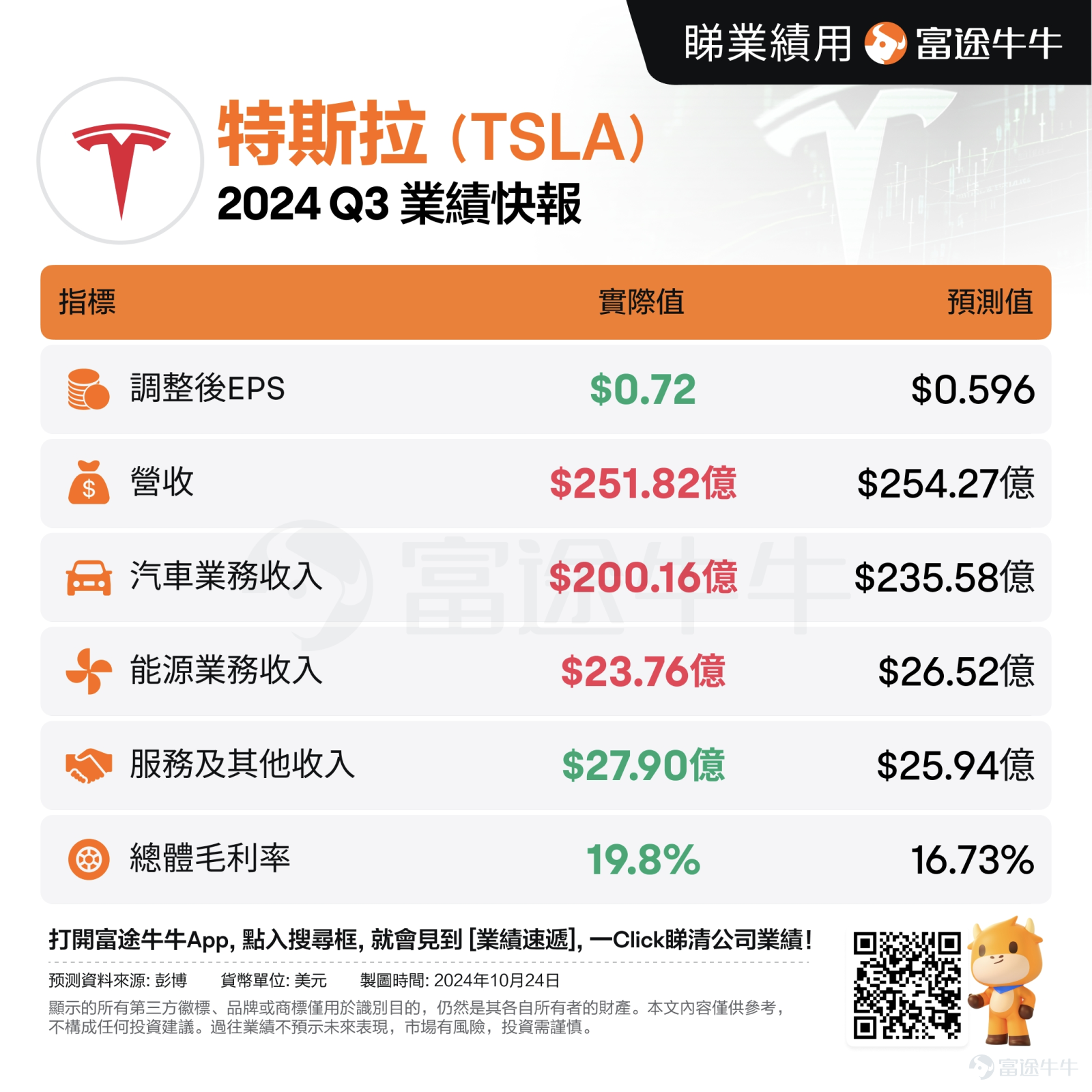
Tesla (TSLA.O) announced its 2024 third-quarter financial report after the US stock market on October 23, with an increase of about 12% in post-market trading. The performance data presents a mixed situation of joy and worry. Revenue fell short of expectations, while adjusted EPS and gross margin exceeded expectations, with a gross margin of 19.8%, higher than Bloomberg's consensus expectation of 16.73%.
Chart: Tesla 2024 Q3 Performance Brief

Data Source: Futubull, Futu Securities Compilation
The continued decline in per-vehicle revenue in the third quarter led to lower-than-expected car sales revenue.
In the third quarter of 2024, Tesla's revenue was $25.2 billion, an increase of nearly 7.8% year-on-year, lower than the sell-side consensus expectation of $25.5 billion on Bloomberg. The main reason is that the revenue from the car business is low, with car sales (excluding carbon credits) only $18.8 billion this quarter, below the market's expected $19.5 billion. The shortfall in car sales is still due to the month-on-month decline in car unit prices.
In the third quarter, the delivery volume was 462,890 vehicles, up 4.27% month-on-month and 6.4% year-on-year. Although the delivery volume in the third quarter still did not meet market expectations, the gap was very small. The third-quarter delivery volume ended the year-on-year sales decline in the first half of 2024, and recent economic conditions have shown some positive signs of change, which may indicate that demand may warm up in the coming quarters.
Chart: Changes in Tesla's car delivery volume

Data Source: Futubull, Futu Securities Compilation
As Tesla's third-quarter delivery volume has been revealed, the focus is on analyzing the per-vehicle revenue. In the third quarter of 2024, Tesla's per-vehicle revenue (excluding carbon credits and leases) continued to decline, dropping to 0.0407 million USD, a 2.5% decrease from the previous quarter. This downward trend can mainly be attributed to Tesla's loan incentive strategy: in the U.S. market, Tesla offered a financing rate discount of 1.99% throughout the entire quarter, while in the Chinese market, Model 3/Y continued with a 0-interest loan strategy for the entire third quarter.
On the pricing front, the negative impact is relatively small, with overall prices expected to remain stable or slightly decrease. In the U.S. third quarter, average selling prices fluctuated, with S/X models seeing a 1-2% price increase, Model 3 maintaining its price, and Model Y experiencing a price drop of around 1%. Prices in the Chinese market remained stable during the third quarter, while in Europe, prices actually rose, with the price of Model 3 increasing by around 1500 euros in early July.
Figure: Changes in Tesla's Single Vehicle Revenue

Source of information: Bloomberg, organized by Futu Securities
If investors remember, in the second quarter, automotive regulatory credit revenue exceeded expectations for overall automotive business revenue. While this quarter's regulatory credit revenue was 0.74 billion, down from the previous quarter, it still surpassed the market's expectation of 0.53 billion, once again supporting third-quarter performance.
As part of government incentives for environmental measures, electric car manufacturers are allowed to generate additional revenue by selling their excess emission credits to traditional auto manufacturers that do not meet emission standards. The sale of credits is highly opaque and difficult to predict; it is expected that with stricter compliance standards, the demand for regulatory credits will increase, thus enhancing Tesla's pricing power for selling regulatory credits. However, in the long run, as traditional auto manufacturers increasingly enter the electric vehicle market, the demand for such credits is expected to gradually decrease.
Raw material costs decrease, providing a positive surprise for auto gross margin.
Although the price per vehicle continued to decline this quarter, the car's gross margin achieved a growth that exceeded expectations, which is the most eye-catching aspect of this quarter's performance. The gross margin of car sales in the third quarter (excluding carbon credits and leasing) was 17.1%. Although the market had expected an increase in gross margin, the actual increase was indeed significant (Bloomberg's consensus expected 15.7%). So why did Tesla's car gross margin experience a growth beyond expectations?
Chart: Tesla's car sales gross margin (%) excluding carbon credits and leasing

Source of information: Bloomberg, organized by Futu Securities
1) Increase in Delivery Volume
Tesla's third-quarter delivery volume increased by 4.27% compared to the previous quarter. The Shanghai factory fully resumed its production capacity in the third quarter, with only 75% capacity utilization in the second quarter, effectively amortizing fixed costs and indirect expenses, providing upward momentum for the increase in gross margin. Although the insufficient capacity of the Austin and Berlin factories may offset some of the increase in gross margin.
2) Decrease in raw material costs and layoffs
Although raw material prices had already decreased in the second quarter, due to the lag in cost reflection, some of the automobile production costs in the second quarter may still be based on the higher raw material prices from the first quarter. In contrast, the third quarter includes more improvements in gross margin. At the same time, the layoffs in the second quarter reduced operating costs, helping to increase the gross margin in the third quarter.
3) Positive Impact of Full Self-Driving (FSD)
In the second quarter, FSD significantly improved Tesla's gross margin. In the third quarter, the introduction of the ASS (Actually Smart Summon) feature further increased FSD's revenue recognition, thereby increasing the gross margin. In addition, Tesla added FSD functionality to the Cybertruck on September 30, further enhancing the gross margin.
4) Cybertruck gross margin turned positive for the first time.
According to media reports, the sales volume of Cybertruck in the third quarter may see a significant increase compared to the previous quarter. The market originally expected Cybertruck to still be in a negative gross margin state, impacting the gross margin negatively. However, the actual announcement shows that Cybertruck's gross margin turned positive for the first time.
However, the gross margin is still unstable. Tesla introduced a new loan policy in the USA, starting from October 8, 2024, where US consumers purchasing the new Model 3 and Model Y can enjoy a 0% annual interest rate loan for up to 72 months. In the third quarter, the USA increased tariffs on imported Chinese electric vehicle batteries and battery components, which could affect the gross margin, especially in the fourth quarter.
Energy business gross margin hit a new high, showing strong growth.
In the energy storage business, revenue in the third quarter reached $2.4 billion, slightly lower than the market's expected $2.65 billion. Tesla deployed 9.4 GWh of energy storage products in the second quarter, while energy deployment in the third quarter reached 6.9 GWh, a 26.6% decrease from the previous quarter but a 73.3% year-on-year increase.
The energy storage business exhibits significant seasonal fluctuations, so a slowdown in one quarter is not a cause for concern. Tesla also anticipates that by the fourth quarter of 2024, energy storage deployment will continue to increase over the previous quarter, with annual shipments expected to double year-on-year, demonstrating strong growth momentum.
Chart: Tesla's energy storage deployment volume

Source of Information: Company Announcement, Compilation of Futu Securities
The gross margin of the energy storage business reached 30.5% in the third quarter, hitting a historical high, demonstrating the high profitability of this business sector. Thanks to economies of scale and improved cost control, Tesla's energy storage business has seen rapid gross margin growth over the past few quarters, making an important contribution to the overall profit margin of the company.
Chart: Revenue and Gross Margin Changes of Tesla's Energy Storage Business

Source of information: Bloomberg, organized by Futu Securities
In addition, the Shanghai energy storage factory is scheduled to start production in 2025, with an expected annual capacity of 0.01 million units at the Shanghai energy storage super factory, with an energy storage capacity of nearly 40GWh. The growth of the energy storage business helps reduce Tesla's dependence on the electric vehicle business, providing performance support for Tesla and improving the overall profit margin of the company.
The new car is expected to start production in the first half of 2025.
More important than performance are the highly anticipated new car models and Robotaxis. The "We Robot" event on October 10 disappointed investors due to lack of information, but after this earnings report, Musk provided a timeline for the new car and additional details on the FSD, increasing the visibility of Robotaxis.
The next generation of affordable car models will begin production in the first half of 2025, using existing production lines. With this new car driving growth, Musk expects vehicle growth to reach 20%-30% next year, providing a new growth engine for the auto business in terms of valuation.
Regarding Full Self-Driving (FSD), FSD13 will be released soon, with an expected 5-6 times increase in the mileage between takeovers compared to FSD12.5. By Q2 or Q3 of 2025, it is anticipated that the driving safety of FSD will exceed that of humans, with unsupervised FSD expected to be approved in California and Texas by 2025.
Robotaxi will be launched first in Texas in 2025, with the approval process in Texas progressing smoothly, so services should be available in Texas shortly. California is expected to launch before the end of 2025, with a coexistence of self-owned fleets and owners deploying online. The Robotaxi software will provide information such as the current route and estimated time of arrival, still in the early stages of network construction.
Image: Cumulative Mileage of Full Self-Driving (FSD)

Source of Information: Company Announcement, Compilation of Futu Securities
Risk Disclaimer: The above content only represents the author's view. It does not represent any position or investment advice of Futu. Futu makes no representation or warranty.Read more

Comments
to post a comment
18
22