
特斯拉Q3盈利大超預期!新一輪漲勢來了?

Futu Research | Tesla's 24Q3 financial report preview: Focus returns to the fundamentals of car manufacturing.
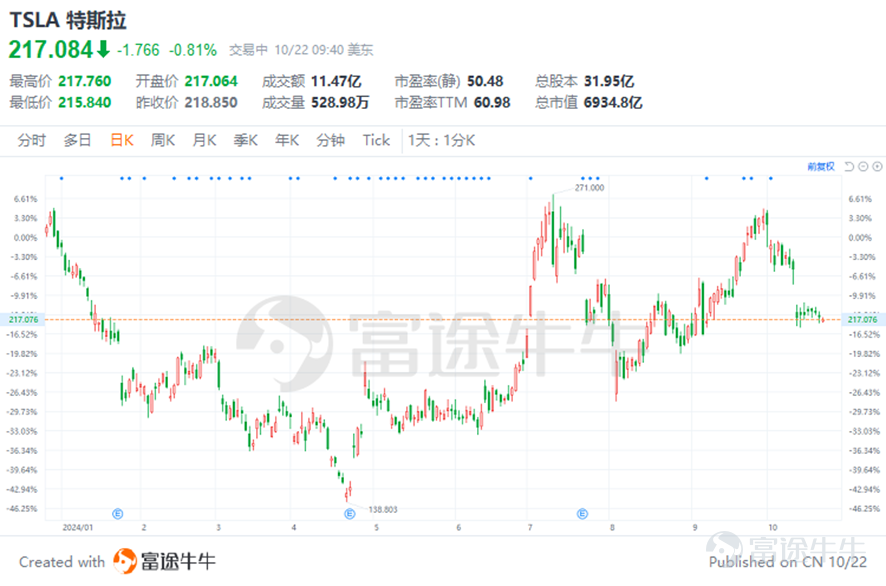
Tesla will release its 2024 third-quarter financial report as of September 30, 2024, after the market close on October 23, 2024, Eastern Time. Over the past few weeks, Tesla's stock price has experienced multiple fluctuations, especially after the sales data announced earlier this month fell below market expectations, and the 'We, Robot' event, these factors combined to lead to a decline in Tesla's stock price.

According to Bloomberg's unanimous expectations, Tesla is expected to report for the third quarter:
- Revenue of $25.534 billion, up 9.36% year-on-year, up 0.14% quarter-on-quarter.
Adjusted net income is $2.055 billion, a year-on-year decrease of 11.28%, and a quarter-on-quarter increase of 13.4%.
Overall, Tesla's performance has grown compared to the previous quarter, maintaining a certain momentum of growth despite facing market competition and technological challenges. However, the year-on-year decline in adjusted net income and earnings per share also reflects the pressure the company is facing during its expansion process.
The focus will at least return to the fundamentals of car manufacturing for now.
Tesla's business structure is mainly divided into three major business segments: automotive business, energy business, and services and other.
- The automotive department includes sales revenue of electric vehicles, leasing revenue, and sales revenue of automotive regulatory credits;
- The energy business covers a full range of solutions from solar energy generation, energy storage to electric vehicle charging. The department's revenue comes from the sales, leasing of related products, and services.
- The services and other departments include non-warranty after-sales services, paid charging services, used car sales, etc.

Currently, considering that Tesla's main source of revenue remains the automotive business sector, accounting for 88% of total revenue, the number of electric vehicles delivered in the third quarter appears particularly important.With the passing of Tesla's Robotaxi Day, we believe Tesla's focus will at least return to the fundamentals of car manufacturing.
In the third quarter, there was significant pressure on sales revenue from pure automotive operations.
1. In the third quarter, delivery volume achieved quarterly year-on-year growth for the first time.
Tesla's third-quarter production was 469,796 vehicles, up 21.53% quarter-on-quarter and 9.13% year-on-year; delivery volume was 462,890 vehicles, up 4.27% quarter-on-quarter and 6.4% year-on-year.
The third-quarter delivery volume still fell short of market expectations, although by a very small margin, causing Tesla's stock price to decline after the delivery data was released. The high-interest-rate environment weakened the purchasing power of consumers who relied on loans to buy cars. However, the delivery volume in the third quarter ended the year-on-year sales decline in the first half of 2024. Recently, there have been some positive signs in the economic environment, which may suggest a potential recovery in demand in the coming quarters.

In the second quarter of 2024, Tesla's delivery volume exceeded production volume, partially reversing the record of 47,000 vehicles in the first quarter where production exceeded delivery. However, the delivery volume in the third quarter was again lower than production by about 7,000 vehicles, resulting in a moderate increase in inventory, which will not significantly impede working capital. Overall, the current inventory level held by the company remains high.
2. On pricing: Due to varying pricing measures in different regions, many discount/reward measures are likely to lead to potential fluctuations compared to estimates. We expect the average selling price in the third quarter to remain flat year-on-year or slightly decline.
Because pricing measures vary in different regions, many discount/reward measures can easily lead to potential fluctuations compared to estimates. We expect the average selling price in the third quarter to remain flat year-on-year or slightly decrease.
In the third quarter, the average selling prices in the USA experienced fluctuations, with the pricing of S/X models increasing by 1-2%, Model 3 remaining unchanged, and Model Y decreasing by about 1%. During the third quarter, Tesla offered a 1.99% financing rate incentive for the entire quarter, and earlier this month, Tesla introduced a new loan policy: starting from October 8, 2024, US consumers buying the new Model 3 and Model Y can enjoy a 0% annual interest rate loan for up to 72 months.
Prices in the Chinese market remained stable in the third quarter, with the last price adjustment occurring in mid-April. Throughout the third quarter, the zero-interest loan strategy continued for Model 3/Y. These incentives significantly boosted Tesla's sales in the Chinese market, with Tesla announcing a 37% month-on-month increase in deliveries in September 2024.
Prices in Europe are expected to slightly increase, with the price of Model 3 going up by about 1500 euros in early July, before the EU imposed tariffs on electric cars manufactured in China. Despite the delayed tariffs, the upward pricing trend is expected to persist.
Based on the assumption that the average selling prices may remain stable or slightly decrease year-on-year, we do not expect car sales revenue to significantly exceed expectations.
Expected regulatory credits to support third-quarter automotive business revenue once again.
In the second-quarter financial report, the significant increase in revenue from regulatory credit sales boosted overall automotive business revenue beyond expectations. In fact, last quarter's pure automotive sales revenue was lower than market expectations.
We expect credit revenue to support third-quarter performance once again, as part of government incentives for environmental measures, allowing electric car manufacturers to earn additional income by selling their excess emission credits to traditional car manufacturers that do not meet standards. Credit sales are very opaque and difficult to predict. With tightening compliance standards, demand for regulatory credits is expected to increase, thereby strengthening Tesla's pricing power in credit sales registration. However, in the long run, as traditional car manufacturers increasingly enter the electric vehicle market, the demand for such credits is expected to gradually decline.
Expected slight increase in automotive gross margin on a month-on-month basis.
The various factors affecting the gross margin of autos are quite complex. Overall, it is expected that the gross margin will improve sequentially in the third quarter, but decrease year-on-year. The specific influencing factors are as follows:
Positive:
1) Increase in Delivery Volume
In the third quarter, Tesla's delivery volume reached approximately 463,000 vehicles, a 4.27% increase from the previous quarter. The Shanghai factory fully restored its production capacity in the third quarter, while in the second quarter, it only had a 75% capacity utilization rate. This effectively amortized fixed costs and indirect expenses, providing an upward momentum for the improvement of the gross margin. However, the underutilization of capacity in the Austin and Berlin factories may offset some of the gross margin growth.
Additionally, the layoffs in the second quarter reduced operating costs, helping to increase the gross margin in the third quarter.
2) Decrease in Raw Material Costs
Although raw material prices had already decreased in the second quarter, due to the lag in cost reflection, some car production costs in the second quarter may still be based on higher raw material prices from the first quarter. Consequently, the gross margin in the third quarter is expected to improve.
3) Positive Impact of Full Self-Driving (FSD)
FSD significantly improved Tesla's gross margin in the second quarter. We expect that the introduction of the Actually Smart Summon (ASS) feature in the third quarter will further increase FSD revenue recognition, thereby improving the gross margin.
In addition, Tesla added FSD functionality to the Cybertruck on September 30, as the FSD feature is included in previously sold packages, some related revenue is expected to be recognized in the third quarter, further enhancing the gross margin.
Cons:
1) Pricing and incentive measures
In the third quarter, Tesla's product pricing may remain stable or only slightly decrease. However, as the company introduces more loan incentive measures, this may exert some downward pressure on the gross margin.
2) Changes in product mix
According to media reports, Cybertruck's sales may increase significantly month-on-month, however, it appears that the Cybertruck may still be in a negative gross margin status, so this change may have an adverse effect on the gross margin.
3) Impact of tariffs
Tesla is affected by tariffs on raw materials and finished goods. In the third quarter, the United States increased tariffs on imported Chinese electric car batteries and battery components, which may have an impact on the gross margin. This tariff increase will have some impact in the third quarter, with the impact possibly becoming more pronounced in the fourth quarter.
The energy business continues to grow year on year.
In the energy storage business, Tesla deployed 9.4 GWh of energy storage products in the second quarter, more than double the 4.1GWh in the first quarter, setting a record high for single-quarter deployment. Tesla's third-quarter energy storage deployment reached 6.9GWh, showing a strong growth momentum despite a 26.6% decrease from the previous quarter, with a year-on-year increase of 73.3%. According to Bloomberg's expectations, Tesla's energy business revenue for the third quarter is expected to grow by 41% year on year to $2.652 billion, and we expect the energy business to potentially exceed expectations.
Chart: Quarterly Energy Storage Deployment (GWh)

Source of information: company announcement.
The gross margin of the energy storage business reached 25% in the second quarter, significantly higher than the 15% of the automotive business, demonstrating the high profitability of this business sector. This growth will help boost Tesla's overall gross margin.
Conclusion
Overall, it is expected that the performance of pure car sales revenue in the third quarter may be less than expected, while regulatory credits for cars and the energy business will once again support this quarter's performance. Gross margin is expected to improve compared to the previous quarter but continue to be under pressure year on year.
From the past financial reports and the stock price reaction, although some quarters' revenue or earnings per share did not meet expectations, the stock price still rose significantly after the earnings conference call. This is because Musk has the ability to convince investors that future valuations of Tesla will come more from low-cost models, Robotaxi, or imaginative businesses like Optimus.
However, the 'We Robot' event on October 10th indicated that the pattern may have changed, tangible products and concrete profits have become more important to investors than future concepts and promises. Investors are starting to focus on specific implementation details and landing plans. In the short term, we cannot accurately predict when these technologies will mature and when they will become profitable. If Musk can reveal more details and exceed expectations about the plans for low-cost models and robotaxi in this earnings conference call, it may restore investors' confidence. Simply forecasting this quarter's performance may lack surprises.
Risk Disclaimer: The above content only represents the author's view. It does not represent any position or investment advice of Futu. Futu makes no representation or warranty.Read more

Comments
to post a comment
10
9