Q3 performance explodes! How high can Netflix still "fly"?

Futu Research | Netflix 24Q3 financial report review: impressive performance! Operating profit margin significantly expanded.
After the market close on Thursday in the east coast, Netflix released its third-quarter report, with overall performance exceeding expectations and raised future performance guidance, causing the stock price to rise over 5% after hours. In the third quarter, the company's revenue increased by 15% year-on-year to $9.825 billion, operating income increased by 51.8% year-on-year to $2.909 billion, operating margin was 29.6%, diluted earnings per share (EPS) were $5.40, a 44.8% increase YoY.
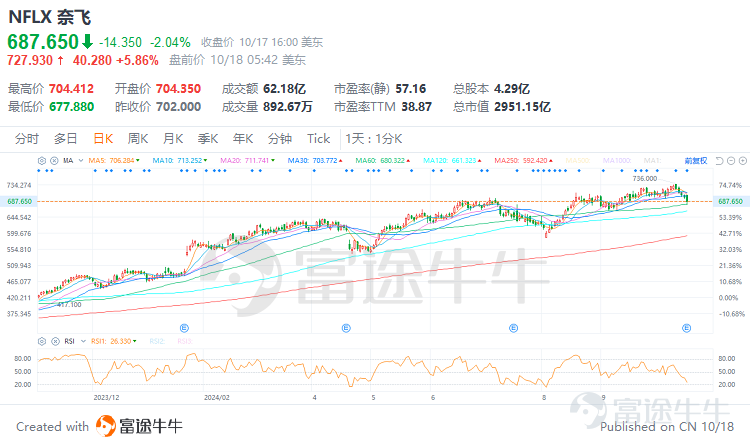
Netflix dispelled market concerns with its impressive performance report, causing the stock price to rise over 5% after hours. Next, we will analyze Netflix's financial report in detail to see how much further the company's stock price can grow in the future.

1. User growth exceeded expectations, ensuring accelerated growth in user numbers with the release of high-quality content.
In 24Q3, the company's revenue increased by 15% year-on-year to $9.825 billion, surpassing company guidance and Bloomberg consensus expectations, mainly due to the growth in subscribers. The company added a net of 5.07 million paid subscription users in the third quarter, exceeding Bloomberg's consensus forecast of 4.47 million, reaching a total of 0.283 billion paid memberships, with a YoY increase of 14.39%.
Figure: Net increase in subscribers from 19Q1 to 24Q3 (unit: thousand people)

Source of information: company announcement.
Low-price advertising membership plans and paid sharing policies are important drivers of the company's growth in new users.
In the third quarter, low-price advertising packages still attract new users, with a 35% increase in the base of advertising members compared to the previous quarter, showing good growth momentum. The company promotes the growth of advertising tier users through adjustments in member pricing plans, bundled sales, and live events. The paid sharing policy continues to play a stable role in converting users and increasing ARM, but its effectiveness has started to weaken over time.
By region, benefiting from the success of localized content, the Asia-Pacific region has become the largest source of new users, while the number of subscribers in the Latin America region has declined due to price increases and weak content. Specific data is as follows:-
- In the third quarter, the Asia-Pacific region (APAC) saw a net increase of 2.28 million subscribers, primarily due to strong local content offerings in Japan, South Korea, Thailand, and India.
- In the third quarter, Europe, Middle East, and Africa region (EMEA) saw a net increase of 2.17 million subscribers.
The net increase in subscription users in the USA and Canada (UCAN) was 0.69 million, slightly below expectations.
In the third quarter, there was a net decrease of 0.07 million subscription users in Latin America, mainly due to price increases and a decrease in high-quality content causing short-term negative impacts. However, with the introduction of localized high-quality content in Latin America in the fourth quarter, the number of Latin American members is expected to recover growth in the early fourth quarter.
Strong content lineup in the fourth quarter and 2025 is expected to drive accelerated user growth.In the third quarter, the company introduced a series of high-quality content to ensure healthy growth of core users, such as The Perfect Couple, The Perfect Coupe, Nobody Wants This, Tokyo Swindlers, Emily in Paris, Cobra Kai, Beverly Hills Cop: Axel F. In the fourth quarter, the company is set to launch an even stronger content lineup, expected to drive accelerated user growth, such as Squid Game S2, the Jake Paul/Mike Tyson fight, and two NFL games to be aired on Christmas. Additionally, 2025 will see the return of popular shows like Wednesday and Stranger Things.
Overall, Netflix's user growth continues to benefit from the introduction of low-priced ad-supported membership plans and the advancement of paid sharing policies. In the long term, high-quality content remains the key factor in ensuring core user growth. Considering the very strong content lineup in the fourth quarter and early 2025, it is conducive to driving growth in subscription users and company performance.
On the other hand, ARM growth continues to be under pressure and awaits a surge in advertising revenue.
Due to the negative impact of the low-priced ad-supported membership growth, ARM growth in the third quarter remained essentially flat year-on-year.The growth of low-price advertising memberships in the company has a dilutive effect on ARM, especially when advertising monetization has not yet ramped up. By region, only the North American region (UCAN) achieved a 5% year-on-year ARM growth, while the rest of the regions did not achieve growth, indicating that the purchasing power of users in North America is significantly higher than in other regions.
Chart: Revenue and ARM performance by region

Source of information: company announcement.
The company's current focus is to expand the scale of advertising memberships as much as possible to drive advertising revenue growth.Following the cancellation of basic packages in the UK and Canadian markets, in the third quarter, the company began gradually phasing out basic packages in the USA and France. This will compel users of the $11.99 basic package to migrate to the $6.99 advertising tier monthly, or upgrade to the $15.49 standard package monthly, with the advertising tier as the default option. Additionally, the company announced the cancellation of basic packages in Brazil in the fourth quarter.
To drive stable ARM growth and offset the negative impact of low-price advertising packages, the company is gradually increasing the pricing of membership packages.In terms of pricing, in early October, the company raised package fees in some countries in EMEA and Japan, while announcing price increases in Spain and Italy starting from October 18.
Overall, the company expects that most of the growth next year will still be driven by an increase in memberships, with ARM's contribution relatively limited. In the long run, ARM growth will need to wait for the ramp-up of advertising revenue. It is expected that advertising revenue will gradually increase by 2025, but it will still not be a major growth driver.
Third, the company's operating margin has expanded significantly.
In the third quarter, the company's operating margin expanded significantly, benefiting from revenue growth and cost optimization.In the third quarter, operating profit increased by 51.8% year-on-year to $2.909 billion, with an operating margin of 29.6%, a year-on-year increase of 7.2 percentage points, significantly exceeding expectations. Net income in the third quarter was $2.364 billion, a year-on-year increase of 41%; diluted earnings per share (EPS) were $5.40, a year-on-year increase of 44.8%.
Chart: Operating margin and net margin (%) of the company from 17Q1 to 24Q3.

Source of information: company announcement.
In terms of cost of goods sold, the company's content production costs benefited from the optimization of the overall competitive landscape of the film and television industry. In the third quarter, the company's cost of goods sold only increased by 3.84%, with the gross margin increasing to 47.89%. With the gradual increase in streaming market share, most traditional media companies are willing to obtain copyright fees through open copyrights. Netflix can gain a large amount of high-quality content sources from this, thereby alleviating the pressure of content production. At the same time, since 2023, the content arms race in the streaming industry has slowed down, and it is expected that content production costs can remain stable in the short term.
In terms of operating costs, in the third quarter, the expense ratio of operating costs stabilized and decreased to 18.27%. The company's marketing expense ratio, research and development expense ratio, and management expense ratio have all maintained a stable downward trend in recent years, mainly due to the continuous optimization of the company's operating costs.
Due to the impact of the better-than-expected operating profit growth, the company has raised its full-year free cash flow guidance.The company's free cash flow in the third quarter was $2.2 billion, an increase of $0.3 billion compared to the same period last year. The company expects free cash flow of $6-6.5 billion in 2024. In the third quarter, the company spent $1.7 billion to repurchase 2.6 million shares of stocks, with $3.1 billion remaining in the repurchase authorization.
Chart: Free cash flow of the company from 19Q1 to 24Q3 (in million USD).

Source of information: company announcement.
Therefore, thanks to the company's revenue growth and cost optimization, the company's operating margin will continue to expand, driving accelerated growth in EPS. In the long term, with the gradual increase in the proportion of advertising revenue, there is further room for improvement in the company's profit margin, which will drive the growth of the company's free cash flow.
IV. Trading Strategy
In this financial reporting quarter, Netflix's performance continues to be driven by the growth in users. Additionally, benefiting from revenue growth and cost optimization, the company's operating margin has significantly expanded to 29.6%, driving accelerated growth in EPS.Looking ahead, the content lineup for the fourth quarter and the beginning of 2025 is very strong, helping to ensure the continuous growth of the company's user base and to drive performance growth. The continuous expansion of the company's operating margin will drive the accelerated growth of EPS and free cash flow.
Performance guidance is more optimistic than expected. The company expects fourth quarter revenue to increase by 14.7% year-on-year to $10.128 billion, with an operating margin increase of 4.7 percentage points to 21.6% year-on-year, diluted EPS growth of 105% to $4.23; expects full-year revenue to grow by 15% in 2024, with an operating margin increase to 27%; expects 11%-13% revenue growth in 2025, with an operating margin increase to 28%.According to calculations, the company's operating profit is expected to increase by 50.58%, 17.19%, and 19.93% year-on-year in 2024, 2025, and 2026.
Currently, the company's shareholder returns are relatively low, spending about $1.7 billion on buybacks in a single quarter, with an annual buyback of around $6.8 billion, accounting for 2.3% of the total market value ($295.1 billion).However, considering the continuous expansion of the company's profit margin, future shareholder returns are expected to benefit from the increase in free cash flow. It is expected that free cash flow will exceed $10 billion by 2026.。
As of October 18th, before the U.S. market opened, the company's stock price was around $727. Based on our profit (EPS) forecast, the forward PE ratios for 2024, 2025, and 2026 are expected to be 37x, 31x, and 26x respectively.The valuation is relatively reasonable.。
Overall, driven by the dual growth in revenue and expanding operating margin, the company's profits in 2025 and 2026 are still expected to maintain a high growth rate of nearly 20%. It is anticipated that in the future, with the increase in free cash flow, the company is expected to enhance shareholder returns.
Risk Disclaimer: The above content only represents the author's view. It does not represent any position or investment advice of Futu. Futu makes no representation or warranty.Read more

Comments
to post a comment
9
24