What do we need to learn before investing in funds?

Futu Research | Nuggets the Canadian REITs market and selects high-quality products
introduction
In the global asset allocation landscape, real estate investment trusts (REITs) are increasingly becoming an important part of diversified investment portfolios as a bridge between capital markets and physical real estate. After the pandemic ended, as the global economy recovered, the REITs market showed a unique appeal and became the focus of attention of investors seeking stable cash flow and capital appreciation opportunities.
Among many capital markets, the Canadian REITs market is particularly mature and dynamic, providing domestic and foreign investors with rich and diverse investment opportunities and stable return potential. Its REITs products cover a variety of fields, from commercial offices and retail properties to industrial logistics, residential apartments, healthcare, etc., to meet the needs of investors with different risk preferences. Next, let's introduce you to the relevant products and investment strategies.
1. What are REITs? What are the advantages of REITs?
Real Estate Investment Trusts (English name Real Estate Investment Trusts, REITs for short)It is a type established in accordance with legal procedures to collect investors' funds by issuing shares or fund units, and a professional organization carries out the operation and management of real estate, andA trust fund that allocates more than 90% of net after-tax income to investors. Essentially speaking, REITs are an institutionalized arrangement for real estate investment.
Depending on the source of revenue, REITs can be divided into three types:
Equity REITs:Equity REITs are property rights that invest in and directly own real estate. Their income mainly comes from rent generated from the real estate they hold. This is the main type of REITs, accounting for more than 90%;
Mortgage REITs:Secured REITs do not directly own real estate property rights, but instead invest capital in real estate loans or loan support certificates (MBS), and their income mainly comes from loan interest;
Hybrid REITs:Invest not only in real estate property rights, but also in real estate loans.
Currently, common REITs mainly invest in commercial real estate, infrastructure, etc. For example, hotels, shopping malls, office buildings, and hospitals are all commercial real estate.
The disadvantages of traditional real estate are large investment amounts, lack of liquidity, difficulty in monetizing, and high transaction taxes. whereasREITs eliminate their shortcomings while retaining traditional real estate investments:
1. Regular mandatory high dividends: Currently, all countries require REITs to distribute at least 90% of net income to investors every year, so investors can receive continuous cash flow every year, and generally pay dividends quarterly or semi-annually.
2. Low investment threshold: REITs index funds allow investors to participate in real estate rent dividends in small amounts.
3. Lower transaction costs: Buying index REITs is just like buying fund stocks. There are no high taxes, only subscription fees and operating costs
4. Specialized management: The REITs management team are all professionals in the real estate field and are more sensitive to the development trend of the industry.
2. How to select high-quality REITs, and what indicators do you need to pay attention to?
Step 1: Know which industries you're buying REITs in
The underlying assets of different REITs investments are quite different, so before buying REITs, investors should have a general understanding of the REITs' investment strategy, including the type of property it focuses on (such as retail, office, residential, industrial, healthcare, or data centers), location, and investment goals to match their investment preferences.
Step 2: Assess earnings and dividend potential
Investors often choose REITs products because they prefer higher dividend rates and stable dividend returns (over 90% of income after tax). Therefore, when selecting REITs, it is necessary to compare the dividend rates between products to see if they have a stable dividend situation, so as to select products with higher dividend returns.
Step 3: Optimizing Cost-Effectiveness
The agency hires a professional management team to manage its own company's REITs products, uses good performance to attract investors to buy, and inevitably needs to charge management fees as compensation. REITs' management fees and operating costs directly affect investors' net returns, and lower rates help increase investors' net returns.
3. Why choose Canadian REITs, and what are some good products?
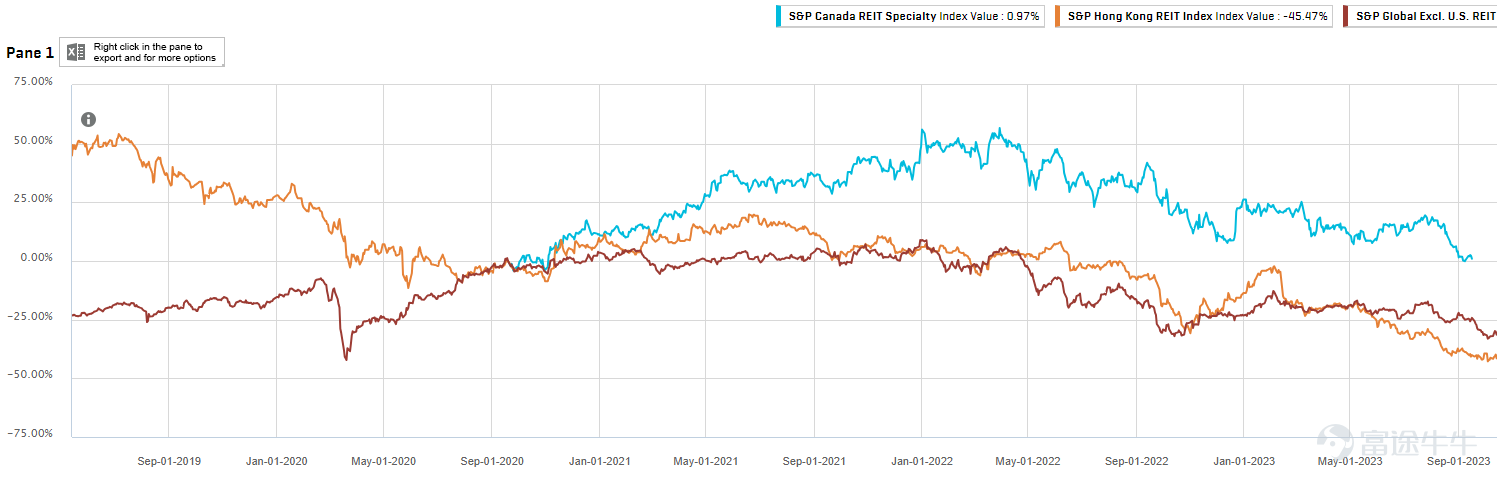
Since 2009, Canadian REITs have beaten the local stock market index for 15 consecutive years, making this year's performance highly anticipated by the market. After the end of the epidemic, the real estate industry in the Canadian local market is developing well.By 2023, the average annual return on REITS products in this market has reached around 5.12%.
Currently, the yield of the REITs index in the Canadian market is much higher than that of the Hong Kong stock market and the US stock market, so we recommend investors seize REITs investment opportunities in the Canadian market and discover high-quality assets.
Figure: Comparison of REIT yield in mainstream markets

Source: Capital IQ
So what are the high quality REITs products currently on the Canadian market?
Diversified REITs
$Canadian Net REIT (NET.UN.CA)$: Canadian Net Real Estate Investment Trust
NET Trust Fund acquires and owns a number of high-quality commercial properties in the three networks (telecommunication networks, radio and television networks, and the Internet) and unmanaged commercial real estate. The investment product targets are very diverse, including commercial real estate in the retail, energy, catering and other industries.
As of 5/13, NET had a total market capitalization of $104 million and a dividend ratio of 6.9%, which is far higher than the risk-free interest rate level in the US. In addition, NET has accumulated 98 dividends since its listing, paying dividends twice a month, with a total dividend amount of $0.56 per share, which can provide investors with stable compound interest income.
Advantages: Diversification of investment product targets allows investors to diversify investment risks in specific industries.
Disadvantages: The listing period is not long, the fund size is small, and the popularity is relatively low.

Healthcare REITs
$Vital Infrastructure Property Trust (VITL.UN.CA)$: Northwest Medical Properties Real Estate Investment TrustNWH's investment industry is medical real estate, particularly for tenants in the healthcare sector, providing investors with high-quality medical real estate portfolios. The fund management team mainly invests in Oceania, Europe and America.
As of 5/13, NWH had a total market capitalization of $1,243 billion and a dividend ratio of 12.78%, which is more than double the risk-free interest rate. Furthermore, NWH has accumulated 169 dividends since its listing, and earnings are very stable. However, NWH's monthly dividend is less competitive than other products, and is only 0.03 Canadian dollars per share.
Advantages: The dividend ratio is very high and can generate considerable income.
Disadvantages: The medical industry is under high competitive pressure, and revenue is highly dependent on a single type of tenant; product prices have been declining since 2023.

$Chartwell Retirement Residences (CSH.UN.CA)$: Chartwell Retirement Home Trust
CSH's main investment areas are Canadian nursing homes and long-term care homes. It earns income from the nursing business of providing retirees through the rental and sale of health and retirement-type homes.
As of 5/13, CSH's total market capitalization was $3,055 billion, and the dividend ratio was 4.85%, which is slightly below the risk-free rate. Since its listing, CSH has accumulated dividends 245 times. Dividends are distributed in the middle of each month, with a dividend amount of 0.05 Canadian dollars per share.
Advantages: The fund is large and has increased by more than 25% since '23, and the development prospects are impressive.
Disadvantages: The dividend rate is not as good as the risk-free interest rate, and the competitiveness is low.

Retail REITs
$Plaza Retail REIT (PLZ.UN.CA)$: Plaza Retail Real Estate Investment Trust
The PLZ Trust Fund focuses on retail real estate, and its portfolio mainly includes retail real estate such as open-air centers, independent fast food restaurants, freestanding or anchored grocery stores, and pharmacies.
As of 5/13, the total market value of PLZ was 388 million Canadian dollars, and the dividend ratio was 7.95%, which is far higher than the risk-free interest rate level in the US. In addition, NET has a high dividend payout frequency. Since its listing, it has accumulated 174 dividends. On average, dividends are paid once a month, with a dividend payout amount of about 0.02 Canadian dollars per share.
Advantages: The dividend ratio is high, which can attract investors.
Disadvantage: The retail industry is under pressure from e-commerce competition, and the rent and occupancy rate of physical stores may be affected.

$Slate Grocery REIT (SGR.UN.CA)$: Slate Grocery Real Estate Investment Trust
SGR's investment industry is mainly retail properties, mainly supermarkets. The company's assets include Bloomingdale Plaza, Errol Plaza, Merez Town Center, Oak Hill Village, and Salerno Village Square.
As of 5/13, SGR had a total market capitalization of $642 million and a dividend ratio of 10.77%. The dividend return was more than double the risk-free interest rate in the US. In addition, SGR has a high dividend payout frequency. Since its listing, it has accumulated 119 dividends, and regular dividends are paid in the middle of every month. The dividend amount per share is about 0.07 Canadian dollars, which is higher than PLZ's dividend amount.
Advantages: Supermarkets are usually points of sale for essential consumer goods, and have certain economic cycle defense characteristics.
Disadvantage: Real estate revenue depends on a single type of tenant, and the industry is risky.

$First Capital REIT (FCR.UN.CA)$: First Venture Real Estate Investment Trust
The PCR Fund invests in retail and mixed-use (residential, office, recreational facilities, etc.) real estate companies. Its management team is a developer, owner, and operator of mixed-use urban real estate in central Canadian cities.
As of 5/13, the total market value of PCR was $3,335 billion, and the dividend ratio was 5.67%, higher than the US risk-free interest rate. In addition, PCR has a high dividend payout frequency. Since listing, it has accumulated 153 dividends, and regular dividends are paid once a month. The dividend amount per share is about 0.07 Canadian dollars, which is the same as SGR.
Advantages: Invest in mixed-use properties where the product has additional growth and stability.
Disadvantage: In the current market environment, retail properties can face challenges.

Housing REITs
$Flagship Communities REIT (MHC.U.CA)$: Flagship Community Real Estate Investment Trust
Investments mainly in affordable residential real estate, including communities and manufactured homes. The trust's management team owns, manages, and operates multi-family homes located in the US, all of which are the properties of economic housing communities.
As of 5/13, MHC had a total market capitalization of $375 million and a dividend ratio of 3.82%, which is slightly below the risk-free rate. In addition, MHC has accumulated 43 dividends since its listing, once in the middle of every month, and the dividend amount per share is 0.049 US dollars, or 0.067 Canadian dollars, which is higher than that of the same type of REITs.
Advantages: Invest in economy type housing, which offers less expensive accommodation options, and may be more popular during times of economic slowdown.
Disadvantage: Investments are in the specific type of affordable housing, and the product's long-term growth potential may be limited.

$Minto Apartment REIT (MI.UN.CA)$: Minto Residences Real Estate Investment Trust
MI invests mainly in condominium-type residential real estate. The company owns, develops and operates a portfolio of income-generating multi-residential rental properties in Canada. Its investment portfolio includes 32 multi-residential rental properties, as well as four mixed-use residential apartments and commercial buildings.
As of 5/13, MI's total market value was 613 million Canadian dollars, and the dividend ratio was 3.23%. Not the high dividends of other REITs, but the company's dividend income is more stable than other REITs, and there is little historical fluctuation. In addition, MI has accumulated 70 dividends since its listing in 2018. Dividends are paid in the middle of every month, and the dividend amount per share is 0.042 Canadian dollars, which is slightly lower than MHC.
Advantages: The investment assets are stable residential properties such as apartments, which can provide reliable rental income.
Disadvantage: The Canadian real estate market fluctuated to a certain extent after the pandemic, which may affect property values and rents.

Industrial and office REITs
$True North Commercial REIT (TNT.UN.CA)$:True North Commercial Real Estate Investment Trust
TNT mainly invests in commercial real estate related to the office industry, including office properties in various regions such as Alberta, British Columbia, New Brunswick, Nova Scotia, and Ontario.
As of 5/13, TNT's total market capitalization was $140 million, and the dividend ratio was 10.52%, which is far above the risk-free rate. In addition, TNT has accumulated 130 dividends since its launch. The dividend date is mid-month, and the dividend amount each time is $0.142. It is one of the highest dividend REITs products in Canada.
Advantage: The dividend rate is over 10%, which is very attractive for income investors.
Disadvantage: Product prices suddenly dropped sharply in the first half of 2023 and are still low; in addition, remote work trends may have a negative impact on office space demand.

$Nexus Industrial REIT (NXR.UN.CA)$:Nexus Industrial Real Estate Investment Trust
NXR is a REIT headquartered in Canada. The fund management team enhances the value of unitholders through the acquisition and management of industrial, office and retail properties. The product investment direction is mainly industrial real estate, such as warehouses and logistics centers.
As of 5/13, NXR had a total market capitalization of $512 million and a dividend ratio of 8.61%, which is far above the risk-free rate. Furthermore, since its listing, NXR has accumulated 126 dividends. Starting in the second half of '21, it will pay dividends twice a month. The total monthly dividend is $0.16, which is more attractive than TNT's dividend return.
Advantages: The current development trend of the international e-commerce industry is good, driving demand for industrial properties.
Disadvantage: The industrial real estate market is highly competitive and may cause rent growth to slow down.

4. REITs-related ETFs - the choice of risk-averse investors
If you are a risk-averse investor who believes that REITS products are biased towards investing in a specific real asset industry, will face specific industry risks, and are afraid to take risks, then we recommend it to youA more stable and secure investment product — ETF can be selected. Its strengths are:
1. Diversification of investment risks:The fund manager will first establish an investment portfolio containing various REITs, such as office buildings, shopping malls, apartment buildings, etc., which is equivalent to buying multiple types of REITs such as “ABC” for investors. This can effectively diversify the risks posed to investors by investing in a single REIT and reduce losses caused by problems in a specific region or industry.
2. Easy for novice users to operate: You only need to buy relevant ETFs on the exchange, and you can enjoy the investment benefits brought by multiple types of REITs. This method obviously saves more time and does not require too high investment technology requirements.
3. Respond flexibly to market changes:Investors can quickly adjust the holding ratio of different REITs in their investment strategies according to market conditions, making it easier to implement tactical or strategic investment decisions.
Below, we recommend a few REIT-related ETFs in the Canadian market. You can choose according to your own investment preferences:
$BLACKROCK ASSET MANAGEMENT CA LTD ISHARES S&P/TSX CAPPED REIT INDEX ETF (XRE.CA)$: iShares S&P/TX capped REIT ETF
Track 19 REITs in the Canadian market, and the weight limit for a single investment is 25%. The fund invests in industries concentrated on retail (36.6%) and residential (23.2%) REITs, and does not own real estate service companies.
As of 5/13, XRE's assets were 1.12 billion Canadian dollars, with a dividend ratio of 5.02%, which is far higher than most index funds, and is comparable to some high-dividend stocks, and it pays monthly interest. However, the ETF's management rate is 0.61%, and the transaction cost is high, which is equivalent to paying a management fee of 61 Canadian dollars for every 10,000 Canadian dollars invested.
Advantage: While diversifying risk, XRE offers a dividend rate of up to 5.02%, which is very attractive to investors looking for high returns.
Disadvantage: Higher management fees, significantly increasing costs and reducing the final return on investment during long-term investments

$BMO ASSET MANAGEMENT INC EQUAL WEIGHT REITS INDEX ETF (ZRE.CA)$: BMO Equal Weighted REITs Index ETF
The Solactive Equal Weight Canada REIT Index is tracked. The index uses an equal weight method to allocate constituent stocks, which means that every Canadian REIT in the index is given the same weight during calculation, regardless of its market capitalization size, which helps reduce dependence on large REITs and increase portfolio diversity.
As of 5/13, ZRE's assets were $531 million and the dividend ratio was 5.35%, which is slightly higher than XRE. At the same time, the management rate for this Canadian REIT ETF is 0.63%, which is higher than XRE, which is equivalent to paying a management fee of 63 Canadian dollars for every 10,000 Canadian dollars invested.
Advantages: The dividend rate is very high, which is very attractive to investors looking for high returns.
Disadvantage: It also has a high management expense ratio. Long-term investment will increase costs and reduce return on investment.

summed
Taken together, various REITs and REITs-related ETF products not only provide investors with multiple investment options in the real estate industry, but also take into account profitability and safety, making them an ideal tool for building a stable investment portfolio. Investors should carefully consider the characteristics of each product according to their own risk tolerance, investment goals and market expectations, and adopt corresponding investment strategies to obtain an ideal return on investment.
At the same time, we also remind investors to comprehensively consider the advantages and disadvantages of each product when selecting products and reasonably avoid investment risks, so as not to cause unnecessary losses to themselves.
Risk Disclaimer: The above content only represents the author's view. It does not represent any position or investment advice of Futu. Futu makes no representation or warranty.Read more

Comments
to post a comment
13
13