
Futu Research | Will Meta be able to move forward against headwinds?
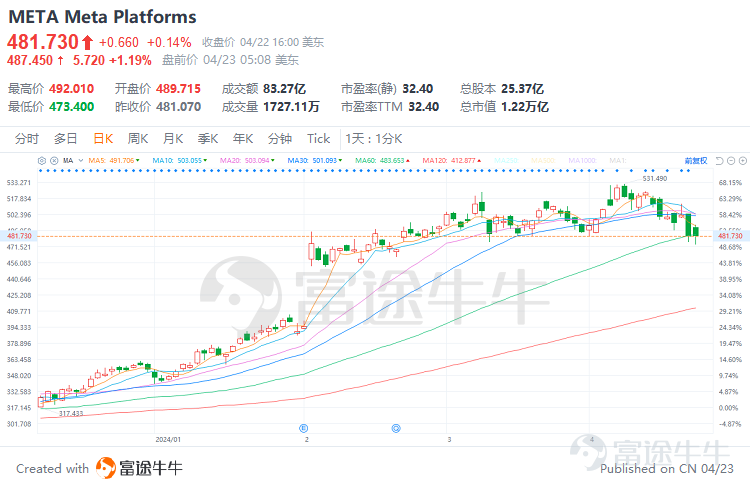
$Meta Platforms (META.US)$About to release first-quarter financial report after the market closes on April 24th, Eastern Time, with extremely high market attention. Bloomberg's consensus expectation currently shows that the company is expected to grow revenues by 26.46% to $36.223 billion in 24Q1, with EPS up by 96.56% to $4.32 compared to the same period last year.
Following the release of Meta's 23Q4 financial report, the stock price surged by 20.32% on the same day, not only due to good performance but also because the company announced a $50 billion share repurchase and began dividend payouts during the earnings call, raising shareholder return to a level of 5% at that time. However, this time's performance release is not expected to bring much change in shareholder returns, as Meta has lost the "repurchase magic". Can Meta still surprise investors?
It is worth noting that prior to Meta, tech stocks like Netflix and Taiwan Semiconductor had already released their earnings, with impressive performances. However, due to extremely high valuation pressures and market expectations, their stock prices still faced setbacks. So, how will Meta's stock price perform after this earnings release?

First, the strong US economy provides support, and Meta will benefit from the growth of digital advertising.
As a social media company, Meta essentially earns advertising revenue through a suite of social software applications. We can see from the company's revenue composition that 98.59% of the revenue in 2023 comes from social application software, with the vast majority of it being advertising revenue, while the remaining less than 2% of the revenue comes from the currently loss-making metaverse business (Reality Labs). Therefore, Meta can be said to be an advertising company, and in our analysis, we can also use the logic of advertising revenue to analyze.
Figure: Composition of main business

Data source: Futubull
Advertising revenue has a very strong correlation with the macro economy.We can understand it this way: the reason why the advertising industry's revenue increases is because advertisers (companies that need to advertise) believe that consumers still have a very strong purchasing demand and consumer ability. At the same time, advertisers have sufficient budgets and are optimistic about future economic expectations, so they are willing to invest heavily in advertising to attract consumers. Whether consumers have sufficient purchasing power and whether corporate budgets are sufficient are indicators of macroeconomic activity.
Therefore, we can first analyze the performance of Meta's advertising revenue from the macroeconomic situation in Q1 of the United States.
The US economy remained robust in the first quarter of 2024. Looking at the retail sales rate, US retail sales increased by 0.7% month-on-month in March, with e-commerce showing the largest increase. After adjusting the February data, retail sales also increased by 0.9% month-on-month. This shows that US consumer spending is still resilient. Looking at employment data, US non-farm employment increased by 0.303 million people in March, and the unemployment rate further dropped to 3.8%, indicating that the employment environment in the United States is very optimistic. An optimistic employment environment is also an important factor supporting consumer spending.
With the support of a strong US economy, advertising unit prices are expected to continue to rise. It is expected that the advertising revenue in Q1 2024 will still perform very well, especially the significant increase in e-commerce sales mentioned in Meta's previous performance, indicating that the company will continue to benefit.
Figure: Year-on-year growth rate of advertising unit price (%)

Data source: Bloomberg
Second, Meta's competitive advantage is obvious, and advertising revenue growth still significantly outperforms its peers.
In this quarter, Meta's advertising revenue growth rate still significantly outperforms its peers, mainly for the following reasons:
(1) Strong social ecosystem advantage
Meta's Facebook, Instagram, WhatsApp and other globally renowned social software have a nearly monopolistic position in the social ecosystem. With such a large user base, according to the data from Q4 2023, the active users of the app continue to increase steadily, demonstrating a strong social ecosystem barrier.
Having a huge user traffic, Meta naturally becomes the first choice for many advertisers.
Figure: DAU of the main site Facebook continues to grow (in millions; %)

Source of information: Company's official website
(2) AI applications have improved ad placement ROI.
Meta fully utilizes AI tools and has launched many automated empowering ad products. The scalable Gen AI ad tool greatly improves the ROI of ad placement.
In addition, Meta also has a powerful open-source AI model called 'Llama,' which was upgraded to 'Llama 3' last week and updated the Meta AI chat assistant. Although 'Llama' has not yet reached the profit stage, it demonstrates the company's strength in AI, and the road to AI-empowered digital advertising has been successfully validated.
III. It is expected that the EPS for Q1 2024 will increase significantly, but the growth rate compared to Q4 2023 shows a clear slowdown.
As an internet company operating with light assets, Meta's net income growth will significantly outperform revenue growth during the company's upward cycle.
With continued optimization and control of costs, it is expected that the company's expense ratio for the first quarter will remain stable. The revenue expense ratio, administrative and management expense ratio are expected to further decrease compared to the previous year. While research and development expenses have increased due to increased investment in AI, it is expected that the research and development expense ratio will remain at a normal level of around 43%.
In addition, the company's net income for Q1 2023 declined by 23.52% compared to the previous year. With this low base effect, the year-on-year growth rate of net income will be amplified. It is expected that the year-on-year growth rate of EPS for Q1 2024 will be close to 100%, but lower than the growth rate of 202.84% in Q4 2023, showing some slowdown.
Chart: Company operating margin and net margin.

Source of information: Company's official website
The company is expected to have outstanding performance in the first quarter, but faces the risk of slowing growth in the second half of the year.
The company previously expected revenue for 24Q1 to be in the range of $34.5-37 billion, with Bloomberg consensus currently at $36.223 billion, at the upper end of the guidance.
The current US economy remains very strong, with rapid growth in e-commerce retail sales, which is expected to further drive digital advertising growth. At the same time, Meta has a huge social ecosystem advantage and strong AI capabilities that continue to optimize the product power of advertising tools, and Meta's advertising revenue is expected to outperform its peers, with 24Q1 revenue close to $37 billion, slightly exceeding market expectations.
At the same time, with ongoing cost optimization and the low base effect of 23Q1, it is expected that 24Q1 EPS growth rate will be close to 100% year-on-year, but compared to the growth rate of 23Q4 and 23Q3, there is a significant decline.
The outstanding performance of 24Q1 is almost certain, the question is the risk of Meta's performance slowing down in the second half of the year.
Meta's explosive growth in EPS started in the second half of 23, so under the high base effect, the growth rate of Meta's performance in the second half of 24 may show a significant slowdown, returning to a relatively stable growth level. It is important to focus on the performance guidance announced by the management during the earnings conference call.
Meta's current valuation is not low, with a PE (TTM) of 32.4x, such a valuation requires a very high performance growth rate to support it.Therefore, if management mentions a slowdown in the growth rate of the company's performance in the earnings call, it may have an impact on the stock price, similar to the situation where Netflix's stock price fell after the earnings announcement last week.
In terms of shareholder returns, Meta announced a $50 billion buyback in the previous quarter, with free cash flow of $43.847 billion in the 23 fiscal year. Assuming stable growth in free cash flow in 2024, the company is expected to buy back around $30-40 billion, resulting in an annualized return on investment of approximately 2.5% to 3.3%.Currently, the risk-free interest rate in the United States is around 4.6%. Therefore, the 2.5%-3.3% return on investment for shareholders is not attractive enough and is not sufficient to build a safety margin for the company.
After companies like Netflix and Taiwan Semiconductor released their financial reports last week, their stock prices performed poorly. Therefore, in such a weak market environment, Meta needs strong performance to drive the stock price up. Buying calls at this point carries high risks, so it is recommended that investors adopt a relatively conservative strategy. If investors already hold Meta's stock, they can use a covered call investment strategy when volatility and option premiums are high to protect returns and reduce losses.
Risk Disclaimer: The above content only represents the author's view. It does not represent any position or investment advice of Futu. Futu makes no representation or warranty.Read more

Comments (14)
to post a comment
18
21