
小米Q4手機業務回暖!到了上車時機?

Futu Research | Xiaomi Group Financial Report Review: Auto Business Determines Upward Valuation Space
$XIAOMI-W (01810.HK)$The financial results for the year ended 23Q4 and the full year were recently released. Overall results for the fourth quarter of 2023 exceeded market expectations. Q4 revenue reached 73.2 billion yuan (RMB, same below), achieving a 10.9% year-on-year increase; net profit for the period was 4.7 billion yuan, an increase of 50.3% year-on-year. Revenue and net profit were higher than Bloomberg's agreed expectations of 72.5 billion yuan and 3.77 billion yuan, respectively.
I. Business Overview
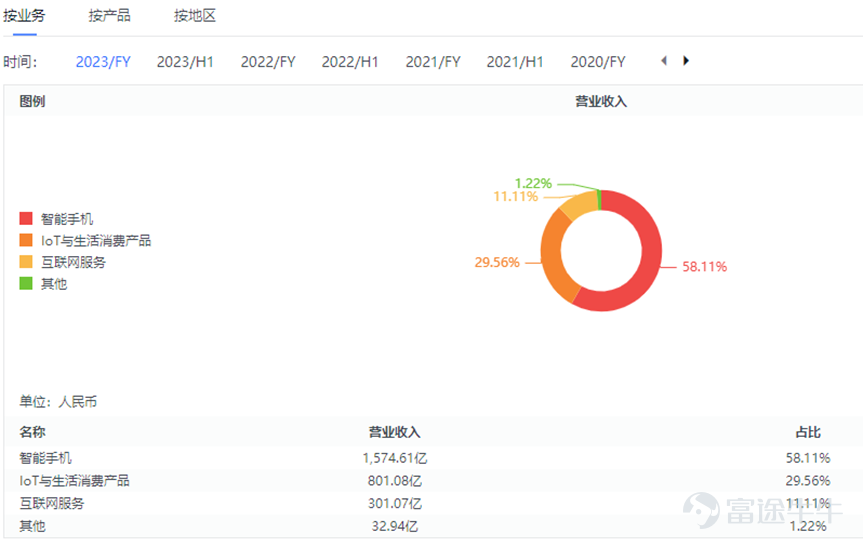
Xiaomi's business structure includes smartphones, IOT and consumer products, and Internet services. With the mobile phone business as the core, it accounts for about 60% of revenue. On this basis, the Internet of Things (IoT) business has been expanded, and diversified product lines covering TVs, wearables, smart homes, etc. have been built to form a complementary linkage effect with the mobile phone business.
The Internet Service Division's revenue comes from Internet value-added services such as advertising services and online games and fintech businesses. It accounts for only 11% of revenue, but with its high gross profit characteristics (gross profit margin of 75% in 23 years), it has contributed a profit scale comparable to that of the mobile phone business.
Figure: Xiaomi's business revenue share

Material Source: Futubull
2. Mobile phone business: New devices bring about a month-on-month increase in ASP, and costs are expected to rise in 24 years
The Q4 smartphone business achieved revenue of 44.2 billion yuan, an increase of 20.6% year-on-year, mainly due to increased shipments. Xiaomi's smartphone business benefited from the recovery of the global market. According to Canalys data, global smartphone shipments increased 7.5% year on year in the fourth quarter, ending seven consecutive quarters of year-on-year decline. Xiaomi shipped a total of 40.5 million smartphones during the quarter, an increase of 23.9% over the previous year, far exceeding the overall growth rate of the industry.
Specifically, the year-on-year increase in Q4 phone shipments was mainly due to its new flagship product, the Xiaomi 14 series, which was released in October '23. However, there was a month-on-month decline, mainly due to increased promotion efforts during Diwali in the third quarter, and mobile phone shipments in India declined in Q4.
Figure: Shipment volume (million units)

Source: Bloomberg, compiled by Futu Securities
In terms of price, Q4 ASP was 1091.7 yuan, down 2.6% year on year and up 9.5% month on month. The year-on-year decline in ASP was mainly due to an increase in the share of shipments in emerging markets with low ASP such as Latin America and Africa, while the Chinese region benefited from the launch of the new Xiaomi 14, and ASP increased 19% year over year. The starting price of the Xiaomi 14 is 3,999 yuan, entering the 4,000-6000 high-end mobile phone price range. The 23Q4 Xiaomi phone has a market share of 28% in this price segment, ranking first.
Figure: Average unit price (yuan, RMB)

Source: Bloomberg, compiled by Futu Securities
For 2024, the global smartphone market is expected to show a weak but steady recovery. In the domestic smartphone market, the two giants, Apple and Huawei, will continue to promote product innovation and competitive upgrading in 2024. Apple is expected to launch the iPhone 16 series phones, and Huawei will also release a new generation of Mate series phones. The two major brands are potentially limiting Xiaomi's impact on the domestic high-end market share.
At the same time, costs will be in an upward phase this year, which is expected to have a negative impact on gross margins. The gross profit margin of the mobile phone business in '23 was 14.6%, a significant increase from 9% in the previous year. One was due to the optimization and adjustment of the product portfolio structure, and the other factor was the reduction in costs. The most important of these was the significant reduction in memory costs. However, memory and screen costs have rebounded this year. Overall, as raw material costs rise, gross margin may gradually drop to normal levels starting in 2Q.
3. The IoT business continues to be sluggish, and the Internet business benefits from advertising growth
In the fourth quarter of 2023, Xiaomi's IoT business achieved revenue of 20.3 billion yuan, down 5.1% year on year and 1.6% month on month. The IoT business's gross profit margin for the quarter was 13.9%, down 0.4 pct year over year. The decline was mainly affected by the decline in revenue from smart TVs and notebooks. Affected by insufficient demand, the fourth quarter was a low season for the home appliance market, and seasonal demand for products such as TVs, air conditioners, refrigerators, and washing machines usually weakened. This led to a month-on-month decline in sales during the quarter. The IoT business continues to be sluggish.
In the fourth quarter of 2023, Xiaomi's Internet service business achieved revenue of 7.9 billion yuan, up 9.9% year on year and 1.6% month on month. Internet businesses include advertising services, game revenue, and other value-added businesses. Advertising services account for the largest share of the Internet business, and the growth is mainly due to the increase in advertising business.
Figure: IoT and Internet business revenue (million yuan, RMB)

Source: Bloomberg, compiled by Futu Securities
4. Automobile business brings cost pressure
The first Xiaomi SU7 is expected to be officially launched on March 28. It is positioned as a C-class high-performance eco-technology sedan. Based on size and configuration, it is estimated that the market is mainly aimed at 25-300,000 yuan cars. Lei Jun, founder of Xiaomi Auto, said on Weibo posted on March 15 that the Xiaomi SU7 will “be delivered as soon as it is released, and the quantity is increased when delivered.” Looking at it now, the overall parameter configuration of Xiaomi cars is at the forefront of the industry. As far as the product itself is concerned, the shape, configuration, and promotion of the Xiaomi SU7 already has certain advantages. It is expected that the first batch of sales data will not be too bad, but subsequent sales are uncertain.
The 200,000-300,000 smart electric vehicle market is the most competitive segment in the entire market. Xiaomi's competitors mainly include domestic new energy vehicle brands JiKrypton, Xiaopeng, Huawei Smart World S7, and Tesla. Major new energy vehicles to be launched also include the Genjie M8, the Zhijie S9, the Porsche Pure Electric Macan, and the Mercedes-Benz Pure Electric G-Class. The final pricing and market position of the Xiaomi SU7 will be extremely challenging in order to balance brand positioning and sales volume in this context.
Figure: Comparison between Su7 and major competitors

Source: Official websites of various car companies, compiled by Futu Securities
The cost pressure brought about by the automobile business has been reflected. Q4 R&D expenses were 5.46 billion yuan, an increase of 16.2% over the previous year. R&D expenses and management expenses continued to rise, mainly due to increased R&D expenses related to innovative businesses such as smart cars. Among them, innovation expenses such as smart cars reached 2.4 billion yuan this quarter. Currently, Xiaomi's cash reserves are 136.3 billion yuan. There is little problem supporting the automobile business in the short term, but as the automobile business enters the market, the company's overall profit level may be affected in the next few quarters due to the expansion of the automobile business and the increase in combined R&D and administrative expenses.
Overall, the excess of Xiaomi's earnings report mainly reflects the growth and increase in gross profit in the mobile phone business in a single quarter, while the performance of other businesses is relatively lackluster. The current growth and visibility of the traditional business is insufficient. The mobile phone business is expected to recover moderately in '24, and there is little room for a rebound. Combined with the impact of domestic Apple and Huawei, it is constraining further seizing the share of the high-end market.
From the profit side, the cost and raw material advantage of the mobile phone business has weakened in the past two quarters. It is expected that gross margin will drop to a normal level, and the expansion of losses in the automobile business will have an impact on overall profits in the next few quarters. The automobile business will be the focus of market attention. As the SU7 is about to be launched, the sales volume of Xiaomi's automobile business will directly affect the valuation of the company's automobile business. The shape, configuration, and promotion side of the Xiaomi SU7 already has certain advantages. It is expected that the first batch of sales data will not be too bad, but at the same time, the competitive landscape of the automobile business is unclear, and investors need to keep a close eye on it.
Risk Disclaimer: The above content only represents the author's view. It does not represent any position or investment advice of Futu. Futu makes no representation or warranty.Read more


Comment (1)
to post a comment
16
12