恆科指進入技術性牛市!你嘅策略係?

Futu Research | Hong Kong Stock Connect's dividend tax is expected to be reduced, which is beneficial to the valuation of Hong Kong stocks in the long term
Recently, Lei Tianliang, deputy to the National People's Congress and chairman of the Hong Kong Securities Regulatory Commission, proposed during the two sessions to continue to expand and optimize the existing connectivity mechanism, consolidate Hong Kong's role as a bridge between mainland and overseas capital markets, and further consolidate and enhance Hong Kong's important position as the preferred overseas listing destination for mainland enterprises.
One of the proposals includes the imposition of high dividend dividend income taxes on individual investors under the Hong Kong Stock Connect, which affects the attractiveness of the Hong Kong stock market to individual investors in mainland China.It is recommended that the State Administration of Taxation and the securities regulatory authorities of the two places actively study and optimize the relevant tax system to lower the dividend tax level of individual investors on the Hong Kong Stock Connect to the same level as the A-share market.
This article will discuss in detail the current dividend tax systems for Hong Kong Stock Connect and A shares, and how this proposal will affect the Hong Kong stock market if implemented.
Different tax rates affect the actual return on higher dividends
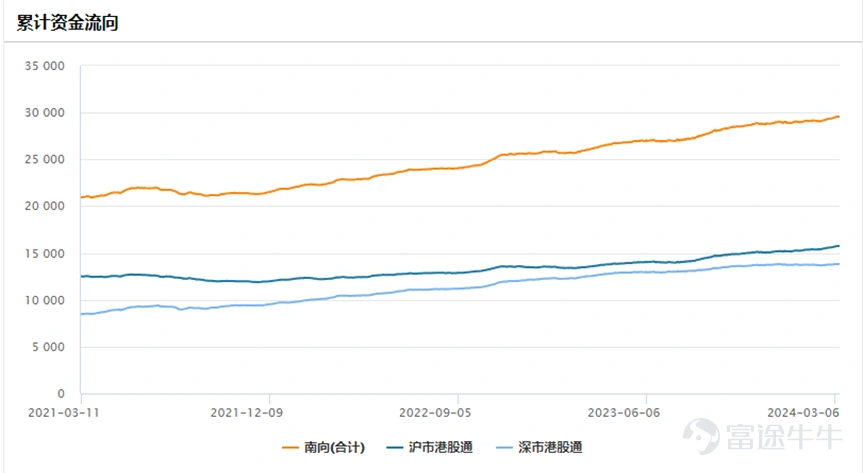
The purchasing power of Hong Kong Stock Connect funds slowed slightly after 2021, but it is still an important component of the Hong Kong stock market. By the end of 2023, Hong Kong Stock Connect's annual capital turnover exceeded HK$7 trillion, accounting for more than 28% of market turnover. The total market value of Hong Kong Stock Connect companies is HK$45 trillion, and the market value of Hong Kong Stock Connect accounts for 86% of the total market value of Hong Kong Stock Connect.
Figure: Hong Kong Stock Connect capital flow
Source: Wind
However, it is difficult for mainland investors to spread their preferences for undervalued and high-dividend stocks to the Hong Kong stock market. There is a clear dividend rate and valuation difference between Hong Kong stocks and the A-share high-dividend sectorTake China Shenhua, which is listed in both places, as an example. China Shenhua's dividend rate TTM for A-shares is 6.6%, while China Shenhua's dividend rate TTM for Hong Kong stocks is 9.7%, and the A/H premium rate is 43%. Also for the high dividend indices of the two regions, the dividend rate of the China Securities Dividend Index for A-shares is 5.4%, and the dividend ratio of the Hang Seng High Dividend Ratio Index is 7.6%.
In addition to the liquidity premium, another important factor is that the Hong Kong Stock Connect dividend tax burden is too high. At the practical level, mainland individual investors are required to pay a dividend tax burden far exceeding that of the mainland, which greatly reduces the actual return on holding high-dividend stocks.
How is the Hong Kong Stock Connect tax payment system?
According to the main sources of revenue, companies in the Hong Kong market can be divided into Chinese stocks (revenue mainly from mainland China), Hong Kong local stocks (revenue mainly from Hong Kong), and foreign shares (revenue mainly from overseas); according to the place of registration and nature of the enterprise, Chinese stocks can also be further divided into H shares (enterprises registered in mainland China), red chip stocks (state-owned enterprises registered overseas), and Chinese private shares (private enterprises registered overseas).
According to the provisions of the “Notice Concerning Tax Policies Related to the Shanghai-Hong Kong Stock Market Trading Interconnection Mechanism Pilot” and the “Notice Concerning Tax Policies Related to the Shenzhen-Hong Kong Stock Exchange Interconnection Mechanism Pilot”,For different types of businesses, there are different requirements in the dividend tax system:

For mainland individual investors, for dividends obtained through Hong Kong Stock Connect investing in H shares listed on the Hong Kong Stock Exchange, H share companies should apply to China Securities Registration and Settlement Co., Ltd. (hereinafter referred to as China Settlement), and China Settlement will provide the H share company with a list of mainland individual investors. The H share company shall comply with20% tax rate withholding personal income tax; Dividend dividends obtained by investing in non-H shares listed on the Hong Kong Stock Exchange shall be settled by China in accordance with20% tax rate withholding personal income tax。
In other words, regardless of the stock, a uniform 20% interest tax will be levied on Hong Kong Stock Connect account investors.
The above tax policy is a tax calculation method for investors at the Hong Kong Stock Connect level. Since H share companies operate in China, and Hong Kong Stock Connect users are mainland residents, the dividends have not left the country, so they only need to pay the regular 20% dividend tax according to regulations. For non-H shares,It will also involve levying a 10% corporate income tax on overseas investors of Chinese companies.The specific tax rate difference is whether 10% corporate income tax has already been applied to the dividends announced by the enterprise.
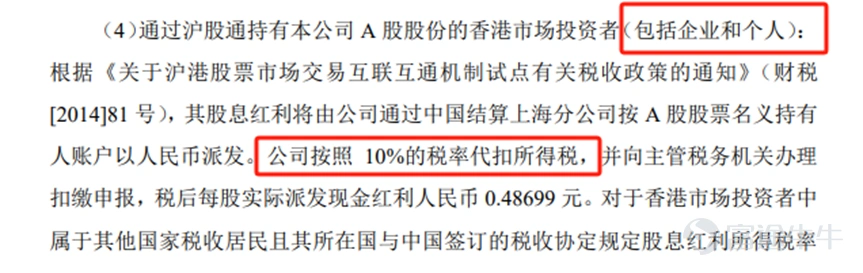
For situations where dividend income tax has not been withheld, red-chip companies must first withhold 10% corporate income tax according to the standards of corporate investors, and then the remaining dividends are withheld and paid 20% personal income tax on dividends by China Securities Deng CompanyThe actual tax rate after adding up the two is 28%. The reason for this is that Hong Kong Stock Connect investors are all registered in the shareholder register of red chip companies through the Hong Kong Central Clearing Company (agent). Currently, in practice, red chip companies cannot distinguish individual investors from corporate investors on a technical level, so all investors from the Hong Kong Central Clearing Company are withholding 10% corporate income tax.
Figure: CNOOC's 2023 dividend announcement on the collection of Shanghai Stock Connect income tax
Source: Company Announcements
Well, for individual investors, that is, the dividends received have been repeatedly taxed twice, once corporate income tax, once personal income tax.This involves double taxation.According to Finance and Taxation [2014] Document No. 81, individual investors who have already paid withholding tax abroad can apply for tax credits at the competent domestic tax authorities with a valid tax deduction certificate.However, due to the complicated application costs, it is difficult for Hong Kong Stock Connect investors to enjoy tax credits on a practical level.
In contrast, Fiscal Tax [2015] Document No. 101 stipulates preferential differentiated dividend dividend income tax policies for individual investors of A-shares (holdings can be halved for more than 1 month, exempt from holding shares for more than 1 year), resulting in the actual tax burden of Hong Kong Stock Connect dividends far greater than A shares.Taking China's Shenhua as an example, the actual return that Hong Kong Stock Connect investors can get after deducting dividends will drop to 6.9%, which is a significant reduction compared to the 6.6% gap for A-shares.
The actual dividend tax burden borne by Hong Kong Stock Connect investors is much higher than investors in Hong Kong's local and A-share markets. Not only does this fail to bring reasonable returns to investors, but it is also not conducive to high-quality companies that distribute high dividends in a stable manner to obtain reasonable valuations.
If the proposal is implemented, what impact will it have?
Can the current tax burden of individual investors on Hong Kong Stock Connect be reduced, and what are the main obstacles involved?
The current Shanghai-Hong Kong Stock Connect mechanism involves two agents, China Settlement and Hong Kong Central Clearing. Compared with mainland corporate investors,For mainland corporate investors who invest in Hong Kong listed stocks through Hong Kong Stock Connect, dividend dividend income obtained by holding H shares continuously for 12 months is exempt from corporate income tax according to law. Well, the main reason why mainland corporate investors and mainland individual investors have tax rates is that corporate accounts are relatively easy to track when they hold positions. Tax relief for individual investors is also likely if institutional and technical barriers are removed, and given the small amount the Chinese government collects from dividend taxes each year.
If Hong Kong Stock Connect's tax rate is leveled to the same as A shares, that is,”If the holding period is at least one month and less than one year, 10% bonus tax is charged; personal income tax is exempt from holding for longer than one year”. This will mean that for investors in Hong Kong Stock Connect, the overall tax burden will be reduced by 10%;The reduction in tax burdens will make the dividend rates of Hong Kong Stock Connect companies significantly attractive, and high-dividend sectors within Hong Kong Stock Connect will be the first to benefit. As mentioned above, the market value of Hong Kong Stock Connect already accounts for 86% of the total market value of Hong Kong Stock Connect, and the increase in the valuation of Hong Kong Stock Connect is expected to drive up the valuation of the overall Hong Kong stock market in the future.
Risk Disclaimer: The above content only represents the author's view. It does not represent any position or investment advice of Futu. Futu makes no representation or warranty.Read more


Comments (8)
to post a comment
48
43