
How to understand the “semi-managed” boom in cross-border e-commerce?
After full hosting swept through cross-border e-commerce, “semi-hosting” is now popular.
The core of full hosting is “the seller only supplies, and the platform covers everything else”. Because it greatly reduces the entry threshold for sellers and reduces the cost of all aspects, this model has been highly sought after in recent years. Since this year, AliExpress and Temu have each launched a “semi-managed” model, which has once again aroused buzz in the industry.
Since August of last year, AliExpress has been testing the “semi-managed” model. After the official launch, it also promoted incentives. Temu's semi-hosting model is intensive investment. According to “Deep Sound,” Temu's investment agents have recently been in a state of “not being able to fully respond to information.”
Cross-border sellers are very pragmatic. Many people complain about the platform's price pressure, but it is difficult to resist the temptation of “breaking orders” and “clearing inventory.” Compared to the full hosting model for shipping to domestic warehouses, Temu's semi-hosting is suitable for sellers with overseas inventory. A group of incremental sellers who want to borrow Temu to “clear overseas inventory” are entering the market. Even if there is no stock in overseas warehouses, some sellers are looking for cooperative resources to try to seize the opportunity.
The industry's previous boom in full hosting, as well as the current enthusiasm for “semi-hosting,” is actually a reflection of the logic of “the platform takes the lead role and encompasses more links”.Understanding all of this is also understanding the new rules of the game in the cross-border e-commerce industry.
Fully managed and semi-managed are all verifying the value of division of labor and restructuring
Cross-border e-commerce is not a good business; the industry links are very long. From production and supply, product selection and pricing, domestic warehouse-international logistics-overseas warehouse logistics, to delivery of goods to overseas consumers, as well as marketing promotion, customer service communication, and after-sales service, there are various forms of division of labor.
In every segment in every segment, there are people exploring opportunities to make money.Opportunities will also continue to emerge due to division of labor and restructuring over long links.
The full hosting model is the result of division of labor and restructuring, while semi-hosting is a deepening of the restructuring logic. As for how to restructure, different platforms will make judgments based on their own needs.
For example, Temu's “semi-trusteeship” only adjusts the warehousing and logistics process; the “pricing power” that the industry is concerned about still belongs to Temu.Temu's purpose is to attract sellers with overseas warehouses to enter the market and improve the platform's logistics timeliness and variety richness.
The e-commerce industry focuses on “how fast is good to save”. Temu's full hosting reduces costs in the cross-border e-commerce chain, and at the same time uses a “price comparison” mechanism to select products with better prices. This satisfies “province” and (relatively) “good.” However, from domestic warehouses to overseas, logistics can take about a week as fast as possible. At the same time, this model is more suitable for small products with high added value, and is not suitable for large products such as furniture and home furnishings.
If large goods are shipped by air, the cost cannot be recovered; by sea, the speed is not fast enough. The better approach is to ship directly from the contiguous US. Currently, Temu's semi-hosting business is already investing in the household category, focusing on major categories such as large and small appliances, kitchen, restaurant, and bathroom supplies.
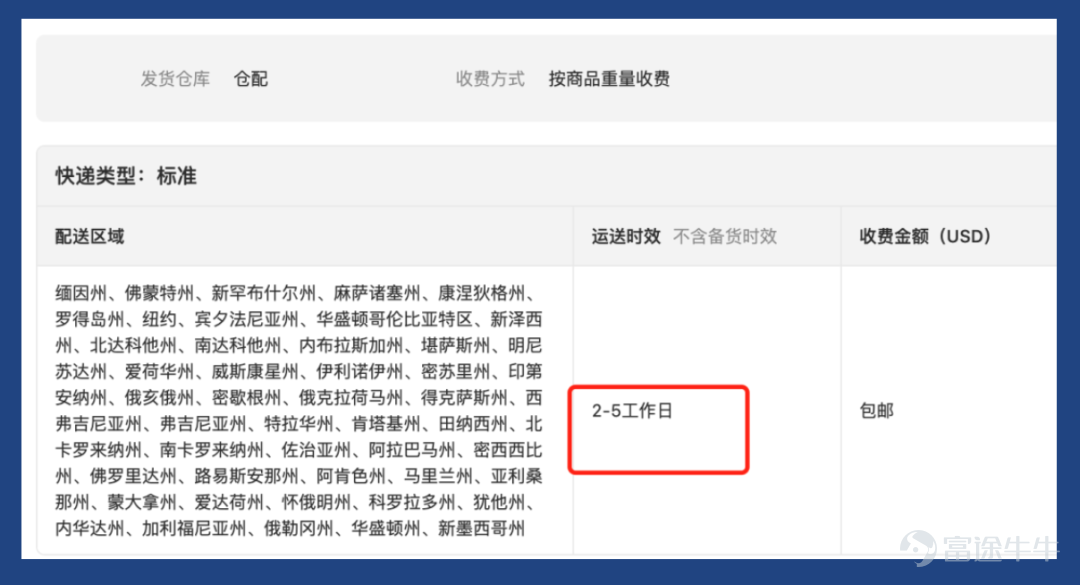
Timeliness is a key requirement for sellers in the Temu semi-hosting model. In the Temu backend, sellers need to set up delivery timelines and free shipping zones for semi-hosted stores. The platform only provides “delivery within 1 business day” and “delivery within 2 business days” options. For the delivery regions within the scope, the delivery time provided by the platform is “2 to 5 working days”.

Also called “semi-hosting,” AliExpress and Temu are two completely different practices.
AliExpress's “semi-hosting” targets self-operating sellers under the POP model. The platform mainly covers warehousing and logistics, and the pricing power is still in the hands of sellers. AliExpress's intention is to use the platform's logistics resources (such as the Cainiao supply chain) to help self-operated sellers simplify logistics links and improve the overall service quality of the platform.
Sellers who have product and operational advantages but lack logistics advantages are attracted by AliExpress. This type of seller is not like a factory seller; they can connect to full hosting as a “supplier” without much burden. However, refusing full hosting will also miss out on the convenience brought by the “platform package” model.
AliExpress's logistics resources can supplement this type of seller's key ability — the merchant prepares goods to the Cainiao warehouse, and the subsequent execution is handled centrally by the platform. While efficiency becomes higher, the seller's original advantage can also be maintained.
Although the approach is different, the starting point of Temu and AliExpress is to make adjustments based on their own needs.Temu is a dark horse in the cross-border e-commerce industry. The full hosting model is suitable for starting and setting a benchmark, breaking up overseas warehousing and logistics links, which is beneficial for Temu to further expand its categories. AliExpress itself has a self-operated seller base, and has taken care of warehousing and logistics to meet its growing needs.
New logic and new questions
So, there's no need to worry about how to define the concept of “semi-hosting.”What is important to note is that the popularity of hosting logic has verified the value of reorganizing the division of labor in a new environment. Different platforms can find new optimization space in the industry's long links according to their own circumstances.
Platforms have different practices in this regard.
Amazon does not endorse the fully managed model. According to Amazon's claim, sellers should not retreat to the “supplier” position, but rather improve their various operating capabilities and upgrade from “manufacturer” to “brand.”
However, Amazon has taken advantage of the “managed” model that helps attract sellers. In the face of aggressive Chinese competitors, Amazon uses the “Ten Rules for the Industrial Belt to Set Sails” to lower the threshold for seller transformation, release supply chain solutions based on its advantages in warehousing and logistics, lower related rates and allowances for specific categories of low-priced products, etc.
These actions are not only to strengthen the appeal of the platform to sellers in the Chinese industry, but also to enhance the price competitiveness of platform products in the low price wave.
Shein started with her own business and promoted the platform business last year. According to “Deep Sound”, the core investment target of Shein's platform business at this stage is industry belt sellers, and full hosting, which has a lower entry threshold for sellers, is still the platform's main promotion model.
Similar models meant Shein had to face up to competition from Temu. Compared to Temu, which burns money to grow, Shein has its own brand and apparel supply chain advantages, but in addition to strong categories, Shein has to invest more in investment promotion and low prices.
TikTok Shop is also promoting full hosting. Compared to other platforms, TikTok Shop is characterized by occupying a “high level of traffic”, stronger content attributes, and emphasizes the link between content and transactions. Therefore, TikTok Shop's full hosting doesn't “cover everything” like Temu, but instead focuses on simplifying the operating pressure of sellers, so that they can focus more on preparing goods and operating content.
Different platforms have their own characteristics, but one thing is certain:The rules of the game for cross-border e-commerce are changing. “The platform covers more links” has become a new trend, while the “Four Little Dragons that go overseas”(i.e. Temu, AliExpress, Shein, TikTok Shop)It is an active practitioner of the trend.

The formation of the “platform encompasses more links” trend is due to multiple reasons.
Traditional foreign trade sellers and industrial sellers need new channels, and inventory pressure needs to be relieved; Apple and Google's privacy policies make it more difficult for sellers to buy; there is also uncertainty about shipping logistics.The complex industry environment, the urgency of expanding the market, and the challenges of cross-border e-commerce transformation are intertwined, making the “platform covering more links and expanding sales channels for sellers” extremely marketable.
The popularity of full hosting validates the establishment of the trend. However, full hosting is not the end. The “platform package” logic can have more room for refined operations, and the division of labor and restructuring can be done in more detail. “Semi-hosting” is a product of refined logic.
Sellers on Temu, AliExpress, Shein, TikTok Shop, and platforms are working together to shape a new cross-border e-commerce ecosystem. Ecological changes have new dividends, but they also bring new questions — how can sellers and platforms continue to play games? How will the various participants in the cross-border ecosystem disappear from one another? When full hosting becomes homogenous, how can each platform find differentiated increments? These are all issues as important as “growth.”

© ️ Deep Echoes Original · Author | Xiao Zhuo
Risk Disclaimer: The above content only represents the author's view. It does not represent any position or investment advice of Futu. Futu makes no representation or warranty.Read more
Comments
to post a comment
2