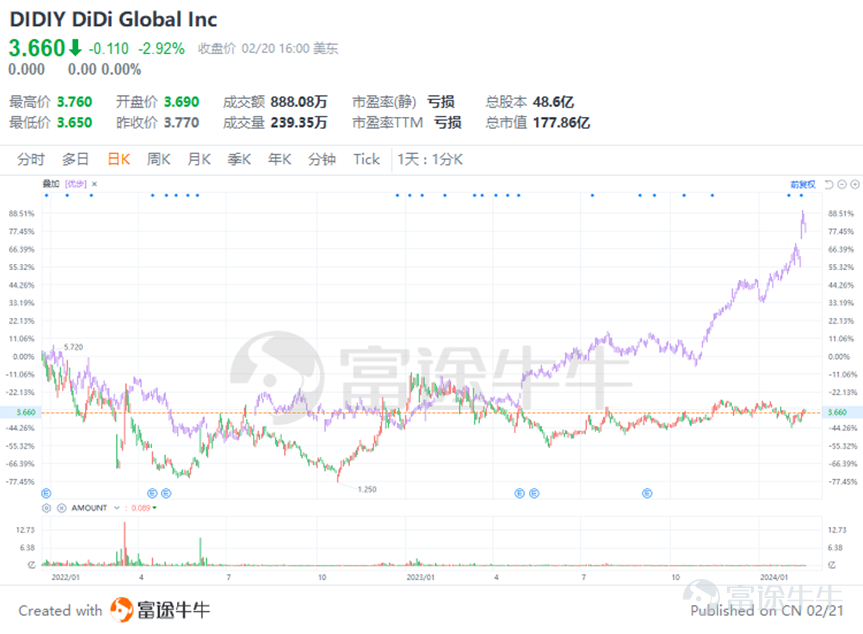

Futu Research | With a market cap only one-tenth that of Uber, what is the current investment value of Didi?
Driven by Uber's strong fourth-quarter results and a share-repurchase program totaling more than $7 billion, the company's stock has hit a new all-time high, pushing its market capitalization to $162.8 billion—roughly ten times that of Didi, the other leading player in the ride-hailing industry. Given such a wide valuation gap between the two major ride-hailing giants in China and the U.S., is Didi perhaps undervalued?

I. Didi and Uber: Similarities and Differences
Although Didi and Uber appear to have many business similarities, their revenue structures differ significantly.
Didi's core business is primarily divided into three segments: China Mobility, International Mobility, and Other Businesses.
1) China's mobility services: encompass ride-hailing, taxis, and designated driver services;
2) International Travel: Primarily for ride-hailing and food-delivery services
3) Other Businesses: This category encompasses a wide range of activities, including bike and e-scooter sharing, certain energy and vehicle services (such as fueling, charging, maintenance, and repair), intra-city freight, autonomous driving, and financial services.
Didi's revenue is almost entirely derived from its ride-hailing business, making it highly dependent on the domestic mobility market.As of Q3 2023, China Mobility accounted for over 90% of revenue and more than 80% of GTV, making it the company's sole profitable segment; both the international business and other segments remain loss-making.
Figure: Didi's Main Business Composition in Q3 2023 (in RMB million)

Source: Company announcements, compiled by Futu Securities
By contrast, Uber’s business structure is more diversified, with its food-delivery segment now fully mature.The business is primarily segmented into three major areas: ride-hailing, food delivery (Uber Eats), and freight. Ride-hailing and food delivery are the core businesses, accounting for 53% and 32% of revenue, respectively, as of the end of 2023. From a gross booking perspective, after five years of development, the transaction value of the food-delivery segment has now matched that of ride-hailing. In terms of profitability, the ride-hailing segment currently remains the primary contributor; however, the profit contribution from food delivery is growing rapidly.
Figure: Composition of Uber's Core Business in 2023

Source: Moomoo, compiled by Futu Securities
Uber entered overseas markets earlier, while Didi, mired in intense domestic competition, lagged behind by eight years in its global expansion.Uber was founded in 2010 and launched operations in the United States, then began expanding into the European market in 2011, essentially completing its global footprint within four to five years. By contrast, Didi, plagued by a cutthroat price war in China’s domestic ride-hailing market at its inception, did not begin to expand overseas until 2019.
In comparison, Uber’s profit structure is relatively diversified and more balanced, whereas Didi remains heavily reliant on the Chinese mobility market in both geographic coverage and business mix.
II. How Big Is the Gap Between Didi and Uber?
1. Post-pandemic, the gap between Didi and Uber's ride-hailing businesses has widened.
From the most direct comparison of transaction volume data,As of the first nine months of 2023, Didi's gross transaction value (GTV) totaled RMB 248.2 billion, while Uber's comparable gross booking value was USD 100.2 billion for the year, or USD 137.8 billion on a full-year basis—meaning Didi's overall transaction volume was equivalent to 34% of Uber's.
Figure: Total Gross Merchandise Volume of the Uber Platform

Source: Company announcements, compiled by Futu Securities
If only the travel business is considered,Comparing Didi's China ride-hailing segment with Uber's ride-hailing segment (note that Didi's overseas operations also include food delivery, so this comparison is not directly applicable), Didi's China ride-hailing GTV for the first three quarters of 2023 was RMB 199 billion, equivalent to 50%–60% of Uber's figure. Given that both companies' GTVs were distorted during the pandemic, prior to the 2019 outbreak, Didi's China ride-hailing GTV typically represented 60%–70% of Uber's level.In other words, although the pandemic has impacted both companies, if we set aside the incremental contribution from food delivery and focus solely on their ride-hailing businesses, Didi's post-pandemic recovery has lagged behind Uber's, widening the gap in overall ride-hailing volume between the two.
Figure: Comparison of Transaction Volume between China's Ride-Hailing Sector and Uber's Ride-Hailing Business (in USD billions)

Source: Company announcements, compiled by Futu Securities
2. The two have diverged in profit margins.
From the perspective of monetization rate, given the substantial differences in their revenue recognition principles, directly comparing revenue to GTV is inappropriate and would lead to an overestimation of Didi's revenue.
1) Uber: In revenue recognition, the platform is classified as an intermediary that facilitates transactions, and only the service fees collected by the platform from transaction proceeds are recognized as revenue—i.e., revenue is recognized on a net basis. Drivers' earnings and driver incentives are treated as deductions from revenue.
2) Didi: Didi employs two accounting systems for revenue recognition. For the ride-hailing segment of its domestic revenue, it uses the gross basis, as Didi considers itself the principal in the transaction-matching process.All transaction amounts are recognized as revenue, while ride-hailing drivers' earnings and incentives are included in cost of goods sold (COGS).; With regard to domestic taxi, ride-sharing, and designated driver services, as well as overseas operations,Didi maintains that it only performs an intermediary function and recognizes revenue on a net basis.
Therefore, from the perspective of the underlying business model, the metric that most closely aligns with Uber's revenue on a comparable basis in Didi's financial reports is "Platform Sales," defined as the platform's GTV net of all commissions, incentives, and taxes paid to drivers and partners—making it a measure that more accurately reflects the definition of revenue.
Figure: Comparison of Didi China's Mobility Revenue and Platform Gross Merchandise Volume (in RMB million)

Source: Company announcements, compiled by Futu Securities
Didi's monetization rate lags significantly behind Uber's.Given that Didi's international operations are still in the early stages of development, a comparison with the mature Didi China and Uber reveals that Uber's revenue-to-gross booking ratio reached 28% in 2023, whereas Didi's platform sales-to-GTV ratio for the first three quarters of 2021–2023 was 16.7%, 18.7%, and 17.3%, respectively—indicating no significant improvement in monetization over the past three years. From a profitability perspective, Didi China's adjusted EBITA-to-GTV ratio has remained around 2% since 2023, while Uber has already achieved approximately 7%.
In the third quarter, Didi's adjusted EBITA as a percentage of GTV declined from 2.1% to 2% on a quarter-over-quarter basis. In 2023, due to the increase in the number of driver supply,Although Didi has reduced drivers' earnings and incentives, its profit margin has nonetheless declined. This is largely attributable to the intensifying competitive landscape in 2023, coupled with a challenging macroeconomic environment that has prompted increased subsidies for users.
3. Didi's market share is declining, while Uber's is rising.
Since its removal from app stores in July 2021, Didi's user base had declined. Following the app's relaunch in January 2023 and the implementation of aggressive user subsidies, the number of active users rebounded. Prior to its removal in the first quarter of 2021, Didi boasted 377 million annual active users in the Chinese market; after its relaunch in the first quarter of 2023, this figure recovered to 411 million, representing a year-on-year increase of 9%.
However, in terms of market share, competitors—particularly various aggregation platforms—quickly seized ground during the period when Didi's services were suspended. According to Analysys data, in March 2023 Didi Chuxing's monthly active users accounted for 74% of the combined monthly active user base of key ride-hailing operators, a decline of roughly 20 percentage points from its peak market share of about 90% in 2021. In Q3 2023, Didi's domestic GTV grew by approximately 6.5% quarter-on-quarter, while overall ride-hailing order volume increased by about 9.4% quarter-on-quarter. Assuming Didi's average order value is broadly in line with the industry average, Didi's growth has not outpaced the sector as a whole.
Meanwhile, Uber's market share in the U.S. has been on the rise. As Uber has intensified its expansion efforts, total ride volumes for 2023 increased by 22% year over year, compared with 18% for Lyft. By Q3 2023, Uber's share of the U.S. market had reached 75%, a 5-percentage-point increase from the end of 2019. In terms of average revenue per ride, Uber has consistently maintained a leading edge.
Figure: Comparison of Average Order Value between Uber and Lyft

Source: Bloomberg SecondMeasure, compiled by Futu Securities
III. Is Didi's valuation cheap enough?
Based on the foregoing analysis, we can conclude that, despite the numerous similarities in their business operations, from a fundamental perspective, Didi faces the following valuation headwinds relative to Uber:
1) High regional dependence: 90% of business revenue is generated in China, and overseas operations started later; increased investment may lead to a temporary widening of losses.
2) The business structure is single-minded, with all profits centered on mobility.
3) Competition remains intense and is intensifying further, making it difficult to increase domestic travel market share and monetization rates.
4) Other businesses, such as bike-sharing, exhibit only moderate growth, and losses remain substantial.
So, is Didi's current valuation sufficiently cheap? We will discuss this by breaking it down into three business segments:
1) China's ride-hailing business
Domestic mobility business GTV = number of transaction orders × average order value per customer.
The growth in order volume stems from the overall industry expansion or an increase in market share. Judging from the current landscape, the domestic ride-hailing industry has returned to normal growth, but competition has intensified. In the face of continuous increased investment by competitors such as Amap, Meituan Taxi, and Cao Cao Mobility—especially given that aggregation platforms provide substantial traffic and attract users through heavy subsidies—We believe Didi's market share is unlikely to rise easily; order volume will instead grow more in tandem with the overall industry expansion, driven by increased frequency of consumer trips.
As for average transaction value, the macro environment remains uncertain, consumer sentiment is cautious, and competitive pressure from low-price offerings by rivals further complicates the situation.It will be difficult to increase average order value in the short term, and pricing is likely to align with industry norms. If Didi chooses to capture market share through subsidies and commission discounts, it will have to sacrifice its profit margins.
In the first three quarters of 2023, Didi China's mobility GTV grew 37% year on year; given the low base in the fourth quarter of last year, growth is expected to accelerate in the fourth quarter before returning to a more normalized pace in 2024. For 2023–2025, China's mobility GTV is forecast to expand by 40%, 15%, and 10% year on year, reaching RMB 261.3 billion, RMB 300.5 billion, and RMB 330.5 billion, respectively. In the first three quarters of 2023, Didi's domestic operations maintained low profitability, with adjusted EBITA margin around 2% of GTV. Increased driver supply and reduced revenue share have been supportive of margins; however, consumer subsidies are unlikely to decline amid intense market competition, partially offsetting these benefits and resulting in only a modest improvement in overall margin. Accordingly, adjusted EBITA margins are projected at 2%, 2.2%, and 2.3% for 2023–2025, translating into adjusted EBITA of RMB 522.6 million, RMB 661.1 million, and RMB 760.2 million, respectively.
2) International Travel Services
Didi's international business is centered on Latin America. Of the 14 countries where Didi operates internationally, 10 are in Latin America, with Brazil and Mexico serving as two key markets. Over the past few years, Didi's international operations have expanded rapidly, with revenue growing year over year by 55%, 62%, and 40% in the first three quarters of 2021, 2022, and 2023, respectively. Meanwhile, the company's losses have continued to narrow, with adjusted EBITA for the first three quarters of 2023 coming in at RMB 122 million, compared with RMB 318.5 million in the same period last year.
However, Didi also faces direct competition from Uber in international markets, where Uber enjoys a first-mover advantage in Latin America.Currently, the two companies dominate the Latin American market in a duopolistic structure, resulting in intense competition. Given its later entry into the market, Didi's primary strategy remains low driver commissions and passenger subsidies; according to Measure AI, in its two key markets—Brazil and Mexico—Didi's average total fare per ride is lower than Uber's.
Looking at Q3 2023, the acceleration in the growth of the company's overseas business was primarily driven by increased investment—such as subsidies and customer acquisition initiatives—though this also led to a widening of losses. The EBITA loss for the overseas segment expanded again on a quarter-over-quarter basis, from RMB 240 million to RMB 800 million, with the loss as a percentage of GTV rising to 4% compared with the previous quarter.
We believe Didi has room to expand in overseas markets; however, as its scale grows and competition intensifies, the growth rate of GTV is expected to decelerate.We expect that, as the company gradually scales back operations in loss-making segments and continues to optimize cost expenditures, the loss trend will continue to narrow. However, we cannot rule out the possibility of recurring losses due to temporary increases in investment. We forecast GTV growth of 40%, 25%, and 20% for FY23/24/25, respectively, corresponding to adjusted EBITA of RMB -2,092 million, -1,307 million, and -1,046 million.
3) Other business
Other businesses primarily include bike-sharing, intelligent driving, and energy platforms. In the first three quarters of 2023, adjusted EBITA for other businesses was RMB 3.6 billion in losses, compared with RMB 5.2 billion in the same period last year; this segment accounted for 50.47% of total revenue, representing a significant improvement from the 81.07% loss margin recorded in 2022.This business segment exhibits limited growth potential, with the primary focus being on continuously reducing losses.
In November 2023, XPeng Motors acquired Didi's smart car development business through a share issuance, with a total consideration of HKD 55.835 billion. Following the closing, Didi acquired a 3.25% stake in XPeng. In the first three quarters of 2023, R&D expenses declined by 11% year on year, primarily due to the divestiture of the intelligent driving business; it is expected that R&D spending will continue to decrease in the future. However, given the high wear and tear and short service life of shared bicycles, depreciation expenses are still expected to remain relatively high, thereby suppressing profit margins.
Revenue is forecast to grow by 7% year-on-year in 2023, 3% in 2024, and 3% in 2025, with adjusted EBITA of RMB -478.4 million, -344.9 million, and -152.2 million, respectively.
Figure: Didi's Depreciation Expenses (RMB in millions)

Source: Company announcements, compiled by Futu Securities
On the shareholder return front, Didi announced in the third quarter a share repurchase authorization of up to USD 1 billion over the next two years, corresponding to an annualized shareholder return rate of approximately 2.8%. From an investor-return perspective, this commitment is relatively modest.
In summary, Didi continues to face both internal and external challenges: domestic ride-hailing growth remains relatively weak, with no clear inflection point in profit-margin improvement; overseas ride-hailing is growing at a robust pace, but efforts to reduce losses have been inconsistent. Until the earnings report provides clearer signals of loss reduction, the market is likely to continue basing its outlook on the current situation.Adjusted EBITA is forecast at negative RMB 1.6 billion, RMB 1.9 billion, and RMB 5.0 billion for fiscal years 2023, 2024, and 2025, respectively. As of February 20, 2024, Didi's market capitalization was RMB 127.8 billion, implying valuation multiples of 69x and 25x based on the adjusted EBITA for 2024 and 2025, respectively. Given the illiquidity of the pink-sheet market, it is difficult to conclude that the stock is significantly undervalued.
Risk Disclaimer: The above content only represents the author's view. It does not represent any position or investment advice of Futu. Futu makes no representation or warranty.Read more


Comments (12)
to post a comment
24
43