
蘋果業績來襲+新品發售,是佈局好時機嗎?

Futu Research | iPhone struggles alone, Greater China's decline raises concerns
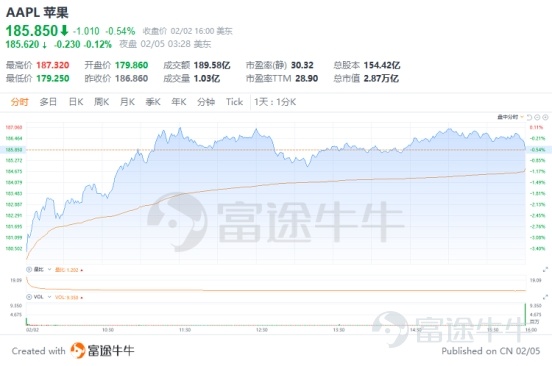
Apple (AAPL.O) reported its FY24Q1 financial report after the US market closed on February 1st, with revenue stopping the decline and increasing by 2% year-on-year to $119.58 billion, exceeding Bloomberg's consensus expectations, while adjusted EPS increased by 16% year-on-year to $2.18. However, looking at the segmented business, apart from iPhone revenue exceeding expectations, the performance of services, Mac, iPad, wearables, and other businesses fell short of expectations, leading to a decline in Apple's stock price.

One, what do we need to focus on in Apple's financial report?
Apple stands out in the global technology industry with its unique and strong business model.
The iPhone business is the company's most core and flagship cash cow business. Apple's cornerstone is its high-end, well-designed consumer electronics products, especially the iPhone smart phone, which not only accumulates a large number of Apple users for the company due to its huge sales volume, but also becomes the main source of revenue and profit for the company due to its high profit margin.
Mac, iPad, wearable, and other hardware businesses are hardware ecosystem expansions around the iPhone business, meeting users' different needs for mobility and productivity in different work and life scenarios. It is a supplement to the core iPhone product, enhances the overall user experience, further solidifies consumer brand loyalty.
Subscription services are the current company's sustainable growth engine. Thanks to the large user base brought by hardware products, Apple has gradually shifted its business model towards value-added services, such as the App Store, Apple Music, iCloud, Apple TV+ and other subscription services. These service subscriptions provide Apple with stable income streams, help increase customer lifetime value, reduce the risk of relying on a single hardware product, and improve the company's overall profit level.
Therefore, Apple has built a closed-loop iOS ecosystem, ensuring seamless integration from hardware to operating systems, and then to applications and services. This high level of integration enables Apple to provide unparalleled user experience, encourages users to make cross-product purchases and use within its ecosystem, thereby increasing customer stickiness and creating a self-reinforcing brand barrier.
So when we look at Apple's financial report, the first thing we need to focus on is:
(1) Can Apple's hardware products maintain a leading advantage and continue to attract users to purchase, especially the performance of the flagship iPhone products.
(2) Secondly, whether the growth momentum of its subscription services business can continue, this is related to the company's future sustainable development capabilities and profit level improvement.
Both are indispensable, and have important impacts on the company's performance and valuation.
Chart: Composition of the company's main business

Data Source: Futubull
Second, Apple's iPhone revenue performance in this quarter is strong, becoming an important support for the company's performance
In FY24Q1, Apple's iPhone business gave the market a surprise, and the company still maintains a leading position in the smart phone market. In FY24Q1, the company's total revenue achieved year-on-year growth, ending the continuous decline of the past 4 quarters, mainly benefiting from the iPhone business revenue reaching 69.7 billion USD, a 6% year-on-year increase.
Chart: FY19Q2-FY24Q1 company's iPhone business revenue and growth rate (million USD, %)

With the consumer electronics industry in such a slump, why can iPhones still sell well? We will analyze from two aspects: shipment volume and ASP (average selling price) .
In terms of shipment volume,According to IDC data, in Q4 2023, iPhone's shipment volume increased by 11.6% year-on-year, market share rose to 24.7%, and Apple became the world's largest smartphone manufacturer after surpassing Samsung for the first time in 13 years. There are several reasons for the rapid growth in sales volume:
(1) After the launch of the iPhone 15 series, continuous price reductions and promotions stimulate the sales of iPhones in the fourth quarter of 2023.
(2) The active promotion of trade-in offers and interest-free financial installment plans enhance consumers' purchasing power and frequency of upgrading.
(3) Apple's share of high-end devices is increasing, with strong competitiveness in the high-end market and no global competitors.
Chart: Global smart phone shipment volume in Q4 2023 (million units)

Source of information: IDC
Regarding ASP,According to our calculations, due to the impact of price reductions, the ASP of the iPhone fell by 5% year-on-year to $866.
Against the backdrop of relatively sluggish market demand, Apple is now increasing iPhone sales by lowering prices and improving cost performance, sacrificing some profit. However, this approach may also lead to unstable pricing for the iPhone. Price reductions and promotions are good short-term measures, but not a long-term strategy.
2. Looking ahead, Apple's iPhone business still faces uncertainties.
(1) In terms of competitive landscape, in the China market, domestic brands like Huawei are beginning to rise again, posing a significant challenge to Apple's sustained growth in competition with local Chinese smartphone brands. From the latest financial data, the Greater China market, which accounts for around 20% of revenue, saw a year-on-year decline of 12.9% to $20.82 billion, becoming the only region in the world to decline.
However, the Indian market still holds promise as an important source of additional revenue for Apple.Based on the data for 23Q2, Counterpoint Research data shows that India surpassed France and Germany for the first time in 23Q2, becoming the fifth largest market for Apple iPhones, contributing nearly 4% of total iPhone sales, a year-on-year increase of 50%. With the continuous expansion of India's middle class population, it is expected to become Apple's most important incremental market.
Chart: Regional revenue growth rates for the company from FY19Q2 to FY24Q1

Source: Company's official website, Futu Securities compilation
(2) On the supply chain front, data shows that iPhone orders started to slow down from December, and Hon Hai's first-quarter revenue is expected to decrease by 26-33% compared to the fourth quarter of last year, which is worrying for the 2024 iPhone shipments.
(3) Currently, there is a lack of innovation in smartphones, leading to an extended replacement cycle for consumers. The high-end replacement demand for iPhones in other major markets such as North America and Europe has actually stabilized. At the same time, the attractiveness of the iPhone may be weakened in the face of AI and folding phones.
Therefore, in 2024, Apple's iPhone business still faces significant pressure and needs to seek new market growth points and leverage the advantages of the ecosystem to revitalize the iPhone business.
III. Other hardware products like Mac did not perform as expected, and Vision Pro is still unable to lead the way.
The growth space for the Mac business is limited.
The Mac business stopped the decline for four consecutive quarters, with a year-on-year growth of 0.6% to $7.78 billion, mainly due to the following reasons:
(1) The Mac business revenue in FY23Q1 declined by 28.72% compared to the low base in the same period last year.
(2) In terms of new products, the company released the iMac and Macbook Pro equipped with the M3 series chips last autumn, targeting the high-end professional consumers for upgrades. The pricing of the products is high, limiting the overall increase in Mac shipments, but positively impacting the increase in sales unit price.
Overall, during the remote working period of the pandemic, most of the Mac purchase demand was advanced. Therefore, the future growth space for Mac is limited:
(1) While the global PC market decline is narrowing, Mac performance is weak. According to the latest IDC data, the total global PC shipments in 2023Q4 were 68.2 million units, a decrease of 2.7% year-on-year, significantly narrowing from the previous quarter. Among them, Mac shipments reached 7.2 million units, down 18.4% year-on-year.
(2) The future trend in the PC industry should head towards AI PCs, but currently, not much effort and effect by Mac are seen in this area.
iPad and wearable business continue to decline, raising concerns about product competitiveness.
In FY24Q1, the company's iPad revenue was $7.02 billion, a 25% year-on-year decrease. The main reason is that the positioning of the iPad products is relatively unclear, and there have been no new product releases recently, leading to intense competition in the tablet market.
Wearable devices, home, and accessory revenue was $11.95 billion, down 11% year-on-year. Due to intense market competition and low product barriers, Apple's wearable product market share has been eroded.
In addition, Apple Watch's blood oxygen feature is facing a patent dispute with medical device manufacturer Masimo. Apple has repeatedly stopped selling the smartwatches Apple Watch Series 9 and Apple Watch Ultra 2 that use blood oxygen sensors. Although the company removed this feature to avoid sales bans, it still weakens the product's attractiveness.
Can Vision Pro carry the banner of hope? Premature to say.
Although Vision Pro had a hot start, its positioning is unclear, reviews are mixed, and it has not become a mature blockbuster product. Vision Pro almost immediately sold out upon pre-order, selling approximately 0.2 million units, reflecting its popularity driven mainly by hardcore fans. However, its positioning does not align with mass consumer goods, indicating a risk of weakened demand later on.
Vision Pro still faces the dual constraints of high price (starting at $3,500) and low shipment volume, which have negligible contributions to the company's overall revenue and profit. Continued attention is needed to the upgrading and iteration of Vision Pro.
Overall, there is little visible growth momentum for Mac, iPad, Wearables, and Vision Pro. Continued focus on new product releases is necessary.
Chart: Revenue growth rates for each business segment of the company from FY19Q2 to FY24Q1 (%)

Source of information: Company official website
The service business maintained double-digit growth, but still faces regulatory and competitive pressures in the future.
Apple's subscription service business mainly includes the App Store, traffic channel fees from Google, other advertising businesses, Apple Music, iCloud storage services, Apple TV+ video streaming services, etc.
Therefore, the growth of the company's service business is closely related to the growth of hardware base, the US macroeconomy, and the quality of service content.
In FY24Q1, the company's service business revenue was $23.12 billion, with YoY growth of +11.3%, maintaining double-digit growth, mainly benefiting from the growth in advertising revenue, App Store commission revenue, and other subscription revenue.
1. The service business revenue still has certain growth space, mainly due to the following reasons:
(1) The user base continues to expand. As of the end of 2023, the installed base of active devices exceeded 2.2 billion units, a 10% year-on-year increase, laying a solid foundation for the future expansion of the Apple ecosystem.
(2) There is still room for improvement in the penetration rate of subscription services. As of the end of 2023, the company had over 1 billion paying subscription users, accounting for approximately 45% of the user base, with still significant room for growth.
The strong performance of the macroeconomy in the usa, declining inflation, steady growth in disposable income of residents, supporting the development of AppStore commissions, advertising business, and other subscription services in the service business.
At the same time, the risks of the service business are gradually becoming apparent, with the most important being regulatory risks and competitive risks.
Currently, both AppStore and Google Pay traffic channels are facing antitrust regulation and investigation. In order to avoid regulation, apple may sacrifice some interests, such as allowing some reduction in AppStore commission rates, allowing external app payments, and so on.
The company's many subscription services, including Apple Music, Apple TV, are facing fierce competition in the market, with their market positions not fully solidified, therefore requiring more investment to face intense competition.
Therefore, it is expected that the company's service business, supported by a vast user base and robust usa economy, is expected to maintain double-digit growth, but still faces regulatory and competitive risks.
Chart: FY19Q2-FY24Q1 company service business revenue and growth rate (million dollars, %)

Source: Company website
What is the current investment value of Apple?
1. In terms of EPS
The uncertainty of future revenue growth for the company is high. On one hand, this is due to intense competition faced by the iPhone business in greater China, as well as innovation bottlenecks faced by the iPhone, resulting in high uncertainty in iPhone business revenue. At the same time, there is currently no clear growth driver for other hardware products such as Mac and Vision Pro. In addition, services are expected to maintain double-digit growth, but also face regulatory and competitive risks. Therefore, it is expected that Apple's revenue in the next 3 years will grow at a low single-digit rate, especially in the 2024 fiscal year.
Apple strictly controls expenses, with a year-on-year decrease of 3.15% in operating costs in FY24Q1, and a growth of only 1.16% in operating expenses. Under strict cost control, the company's gross margin and net margin have reached historical highs. The company's ability to control costs is excellent, and it is expected that profit margins will continue to be maintained at a high level.
EPS is expected to grow at a high single-digit rate (7%-9%) in the fiscal years 2024, 2025, and 2026.
2. In terms of cash flow
By the end of 2023, the company's cash and equivalents amounted to $173 billion, slightly increasing, indicating a still very healthy cash position. At the same time, the company's total liabilities were $279.414 billion, with current liabilities at $133.973 billion.
Free cash flow is strong. In FY24Q1, the company's operating cash flow was $39.9 billion, a 17% year-on-year increase, with free cash flow at around $37.5 billion, a 24% year-on-year increase. Apple generates approximately $100 billion in free cash flow each year, supporting generous shareholder returns.
3. In terms of shareholder returns
Apple has always been quite proactive in returning value to shareholders. In 2023, Apple returned a total of $98.9 billion to shareholders through buybacks, dividends, and dividend equivalents, with a shareholder return rate of 3.4%. However, with the rise in stock price, Apple's current shareholder return rate is already lower than the risk-free rate (around 4%).
If Apple's stock price further declines and the shareholder return yield exceeds the risk-free rate, then the company's stock price can have significant support.
Chart: Company's net cash position for capital returns (in billion US dollars)

Source: Company's official website
Overall, Apple still has stable, abundant cash flow and active shareholder returns, attracting investors' attention. However, the company's future performance still has uncertainty. To determine the company's investment value, we can make several assumptions:
(1) If the company's current PE ratio remains unchanged, and with EPS growth plus shareholder return rate, there could be an investment return rate of approximately 10.4%-12.4% per year.
(2) If the performance is poor, with a significant decline in iPhone's appeal, the company's stock price could have a downside potential of 17.65%, possibly dropping to $153.05.
(3) If new products like the iPhone perform well, driving continuous sales growth for the company, the stock price still has room for upward movement. Considering the company's PE ratio (TTM) at 29x, the upside potential is limited, with a target price of $198.6 by 2024.
Risk Disclaimer: The above content only represents the author's view. It does not represent any position or investment advice of Futu. Futu makes no representation or warranty.Read more


Comments (4)
to post a comment
42
21