
科技巨頭業績大考!Meta績後飆升

Futu Research | Strong Microsoft financial report faces pressure from high market valuation.
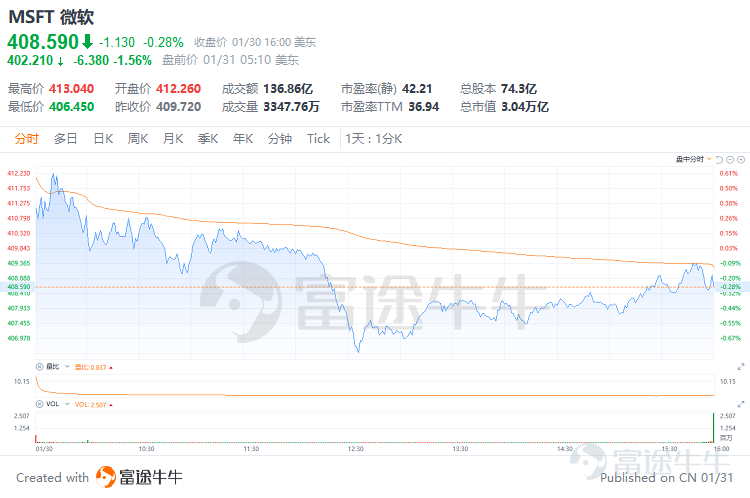
Microsoft announced its second quarter financial report for the 2024 fiscal year after the US Eastern Time on January 30. The performance exceeded expectations across the board, but the stock fell more than 2% after hours.

1. What is Microsoft's business model?
As an old-tech giant, Microsoft initially seized the PC wave through Windows and Office, becoming a software leader. Now, it has also seized the innovation wave of cloud computing and AI, once again leading the way at the forefront of the era. As of the Friday closing on January 12, Microsoft's market cap reached $2,887.2 billion, surpassing Apple's $2,874.7 billion, reclaiming the top spot in global market valuation.
So what is Microsoft's business model and why can it reclaim the top spot after many years?
Microsoft is a software company that initially made profits by selling essential office software and Windows systems required for computers.
However, as the PC era faded, Microsoft expanded into a more flexible cloud computing business. Leveraging its economies of scale, it shifted from the traditional business model of selling consumer electronics products and software services to a long-term subscription model.
Overall, Microsoft's products and services are transitioning towards a paid model in cloud computing and moving from one-time sales to subscription services. This shift ensures profitability and longer-term steady growth of cash flow.
Specifically from a business perspective, Microsoft's revenue is mainly composed of three business segments, including Asia Vets, Productivity and Business Processes, and More Personal Computing, accounting for 41.48%, 32.69%, and 25.83% of the revenue share, respectively. Among them, Asia Vets has become the main driving force for the company's growth.
So how is Microsoft's latest financial performance? After experiencing a sharp increase, does it still have investment value?
Figure: 2023 Fiscal Year Revenue Situation

Data source: Futubull
Second, the core Asia Vets business remains the main driver of this quarter's performance growth.
FY24Q2 Microsoft's revenue increased by 17.6% year-on-year to $62 billion, exceeding the company's guidance and market expectations. Among them, Asia Vets business is growing the fastest and is the main driver of the company's performance growth.
Figure: Microsoft Revenue Performance (in million US dollars)

Source of information: Bloomberg, organized by Futu Securities
Intelligent cloud business includes businesses such as Azure, server, and GitHub, which continue to maintain high-speed growth driven by AI demand.In FY24Q2, the company's intelligent cloud business revenue was $25.88 billion, a 20.4% year-on-year growth. Among them, Microsoft Azure and other cloud service revenue grew by 30%, but grew by 28% when calculated at fixed exchange rates. Compared to Google Cloud's 25% growth rate, Microsoft Cloud has a clear advantage. With AI driving, Azure cloud's AI service penetration rate has significantly increased, contributing 6% growth (compared to 1% in the previous quarter).
So why does Microsoft Cloud have such good growth relatively? This requires studying from a business perspective:
(1)As a traditional enterprise software and service provider, Microsoft has a strong foundation in the enterprise market. Many customers are already using products such as Windows Server, Office 365, Dynamics 365, and Microsoft Azure can seamlessly integrate with customers' existing IT environments.
(2)The acceleration of enterprise digital transformation has led to a continuous increase in demand for cloud computing. Azure can provide comprehensive and advanced IaaS (infrastructure as a service), PaaS (platform as a service), and SaaS (software as a service).
(3)Azure's development system is improving, emphasizing hybrid cloud and multi-cloud support, allowing enterprises to achieve flexible deployment and management in private cloud, public cloud, and on-premises environments, which is very attractive to customers.
Therefore, Microsoft's cloud has a unique competitive barrier in cloud service competition.
However, in the field of cloud computing, there are countless competitors. For example, in certain vertical markets, AWS has accumulated significant advantages due to its early entry into the market.
Overall, the demand for AI remains strong, with downstream customers still having a large amount of data inference, model training, and other needs. With the continuous increase in the penetration rate of AI services, Microsoft's cloud business is still expected to maintain sustainable high-speed growth. It is expected that the economy of scale will help increase the profit margin of Microsoft's cloud business.
Figure: Azure and other cloud service revenue (million USD)

Source of information: Bloomberg, organized by Futu Securities
III. Productivity and business process business fully transition to cloud-based SaaS products
Microsoft's productivity and business process business include traditional office software products, as well as subscription-based Office 365 products, Microsoft 365, Dynamics 365, LinkedIn, and other SaaS products.In FY24Q2, Microsoft's Productivity and Business Processes revenue was $19.2 billion, a 13% year-on-year increase to $19.25 billion, exceeding the expected $19 billion.
Benefiting from continuous migration of Office customers to cloud products, Microsoft's subscription users for productivity software and systems continue to grow, while ARPU value continues to rise under software and system upgrades driven by AI.Office commercial products and cloud services revenue increased by 15%, with Office 365 commercial seat growth of 9% and increased revenue contribution per user, driven by small and medium enterprises and frontline workers. Meanwhile, Office consumer products and cloud services revenue grew by 5%, with Microsoft 365 Consumer user growth of 16% to 78.4 million. In addition, revenue from Dynamic products and cloud services primarily used for office systems increased by 21%; LinkedIn revenue grew by 9%.
Benefiting from a software-light, scalable business model advantage, the Operating Margin for Productivity and Business Processes exceeded 53% and is expected to maintain this profit level in the future.
As a result, Microsoft's Productivity and Business Processes business relies on the strong market position and stickiness of office software, ERP, and other office systems, gradually expanding to cloud product services to ensure long-term sustainable growth of the business. Meanwhile, with the gradual increase in Copilot penetration in the future, it is expected to become a new growth driver.
Microsoft's More Personal Computing business is mainly based on traditional PC business, benefiting from the acquisition of Activision Blizzard this time.
Microsoft's More Personal Computing business includes Windows operating system, Surface hardware, Xbox consoles, and the newly acquired gaming company Activision Blizzard, primarily focused on traditional PC business.
The acquisition of Activision Blizzard is expected to contribute to a 15% growth this fiscal quarter.In FY24Q2, Microsoft's revenue from more personal computing business increased by about 19% to $16.89 billion, slightly exceeding expectations, mainly benefiting from the completion of the acquisition of Activision Blizzard, which brought a 15% growth. At the same time, after completing the acquisition of Activision Blizzard, the substantial growth in gaming and other businesses led to a 61% year-on-year growth in Xbox content and service revenue.
In addition, benefiting from the recovery of the PC market.Windows OEM revenue increased by 11% year-on-year, exceeding expectations, while device revenue narrowed its decline to 9%.
The operating profit margin of the more personal computing business is 25%, showing a significant decline from the previous quarter. The main reason is the significant increase in operating expenses due to the acquisition. It is expected that after the gradual absorption of the expenses caused by the acquisition, the operating profit margin of this business can improve.
Therefore, this round of growth in the more personal computing business is mainly benefited from the acquisition of Activision Blizzard. The impact of the acquisition is expected to continue for 3 quarters. In addition, this business still needs to pay attention to the recovery of the PC industry. It is expected that the recovery of the PC industry in 2024 will help Microsoft's more personal computing business maintain relatively stable growth.
The fifth secret to the company's high returns is the increase in operating leverage.
The company's profit margin continues to improve, mainly due to capital expenditures being lower than expected and the amplification of operating leverage.In FY24Q2, the company's gross margin was 68%, an increase of 1 percentage point year-on-year. The operating profit margin was 44%, a 5 percentage point year-on-year increase. Non-GAAP diluted EPS increased by 26% to $2.93, exceeding market expectations.
Due to microsoft's excellent business model, most costs are fixed. With the continuous increase in company revenue, profit growth becomes more noticeable. Company costs and expenses mainly come from two aspects:
(1) Capital Expenditure.Capital expenditure was lower than expected, with capital expenditures including financing leases in FY24Q2 totaling $11.5 billion, lower than expected due to delays in contract deliveries. Cash outflows for the purchase of property, plants, and equipment amounted to $9.7 billion.
(2) Operating Expenses.Benefiting from the continuous amplification of operating leverage, microsoft's sales expense ratio, management expense ratio, and R&D expense ratio all achieved a year-on-year decrease.
Chart: Microsoft's gross margin, operating profit margin, net profit margin situation

Source of information: Bloomberg, organized by Futu Securities
With the steady improvement in the company's profitability, free cash flow has achieved high-speed growth, but the buyback intensity has decreased.FY24Q2 company's free cash flow was $9.1 billion, up 86% year-on-year, with ample cash flow. With abundant cash flow support, the company returned $8.4 billion to shareholders through dividends and repurchases this quarter, but lower than previous quarters may be related to the current high company valuation and reduced buyback intensity.
So, what is the current investment value of Microsoft?
Microsoft's performance in this financial quarter remains very impressive, exceeding expectations in both revenue and EPS. At the same time, intelligent cloud, productivity and business processes, and more personal computing businesses all outperformed expectations, with Azure continuing to maintain high growth.
It is expected that in the second half of the 2024 fiscal year, generative AI will remain the main driving force for the company's performance growth. Microsoft's Azure cloud and Copilot are expected to be significant drivers of the company's performance growth, with the main reasons including:
(1)Microsoft has the most comprehensive AI ecosystem, covering products and services from B2B to B2C, IaaS to SaaS, and at the same time, utilizing Copilot to perfectly link the Office and other product ecosystems, creating an irreplaceable competitive advantage in AI products.
(2)It is expected that IT spending in various industries in 2024 is expected to improve compared to 2023, and the monetization of AI is expected to drive Microsoft's performance growth in 2024.
(3)Microsoft customers still have strong demand for Azure AI services, and the proportion of AI contribution is expected to continue to increase; meanwhile, Copilot will be fully open to end consumers from the end of 2023, with an expected gradual increase in adoption rate, which will have a more positive impact on company revenue.
Performance guidanceIn terms of performance guidance, for FY24Q3, productivity and business process business are expected to generate revenue of $19.3 billion to $19.6 billion, a year-on-year growth of 10% to 12%; intelligent cloud business revenue is expected to reach $26 billion to $26.3 billion, an increase of 18% to 19%, with Azure growth expected to remain stable; more personal computing business revenue is expected to grow by 11% to 14% to $14.7-15.1 billion.
In terms of performance, the company is expected to maintain high double-digit revenue and EPS growth in the fiscal years 2024 and 2025. With operational leverage, the company's operating profit margin is expected to continue to expand.
In terms of valuation, due to the previous large increase and high market expectations, Microsoft's current valuation is high, with a PE (TTM) of 39.59x, which is at a historically high level.
Regarding shareholder return, the company's free cash flow is expected to maintain stable growth, providing support for shareholder returns. However, due to the high current market cap, shareholder returns are somewhat diluted, at only 1.2%-1.3%.In the full fiscal year of 2023, the company spent $38.8 billion on buybacks and dividend payments, in the first half of fiscal year 2024, buybacks and dividend payments cost $17.5 billion. It is expected that the total annual buybacks and dividend payments will cost $35 billion. Currently, the company's market cap is $3.04 trillion, resulting in a shareholder return rate of approximately 1.2%-1.3%.
With this analysis, the investment value of Microsoft can be determined easily.
In summary, Microsoft's performance is still expected to maintain steady high-speed growth, but the current valuation is relatively high. The corresponding net income for 2024 and 2025 is 35.64x and 30.41x, respectively. At the same time, the shareholder return rate is only 1.2%-1.3%, slightly lower than the risk-free interest rate (4%). If the performance growth slows down, the stock price may face a correction.
Risk Disclaimer: The above content only represents the author's view. It does not represent any position or investment advice of Futu. Futu makes no representation or warranty.Read more


Comment (1)
to post a comment
21
27