
At the time of a major decline, what will smart investors do next?
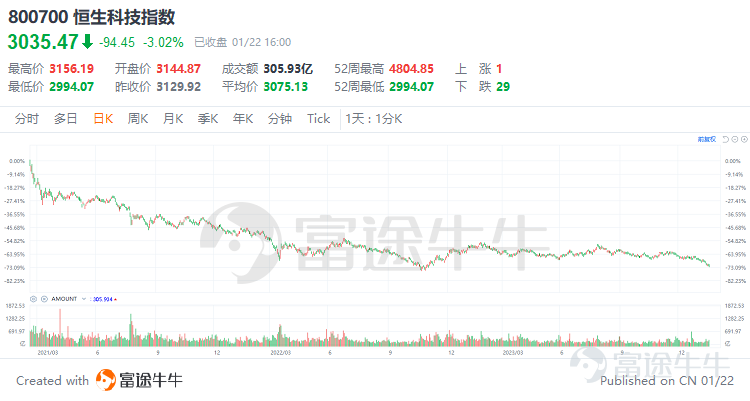
Recently, the Hong Kong stock market has plunged again, with the sharp drop in large network technology stocks leading to a spread to the entire market, causing a widespread slump in global sectors, and the market sentiment is extremely negative. At the close, the Hang Seng Index fell by 2.27% to 14961 points, breaking below the key level of 15000 points intraday. The H-share index fell below 9,000 points, and the Hang Seng Tech Index fell by 3.02% to 3035 points, hitting a new historical low intraday.

The market is ruthless and cold. Investors silently cultivate their own fields in this cold world. So how will smart investors thrive in the cold capital markets?
1. How do the masters deal with a major decline?
The best learning targets are the long-standing masters who have survived in the market, as they have stronger resilience relative to the market.

股神巴菲特
According to the stock god Warren Buffett, the best way for investors to deal with violent market fluctuations is to stay calm and adhere to long-term investment principles.
At 90 years old, Buffett has weathered many storms. In an interview in 2016, he warned investors: 'When the stock market falls, do not focus too much on market performance. If an investor is worried when the market is down and thinks of selling stocks when the market rebounds, then this type of investor will not ultimately achieve the desired returns.'
The old saying repeatedly played by Master Buffett: Once you have identified, you should hold onto it.
Ironically, his teacher Graham's fund incurred losses as high as 78% in the 1929-1932 liquidity crisis, which almost left him penniless. After experiencing these storms, Graham later made a comeback and wrote the investment classics "Security Analysis" and "The Intelligent Investor."
Master Graham, through his own bitter experience, summed up an eternal fundamental principle of value investing: Margin of Safety.

Ray Dalio
In addition to the value investing camp, the investment master in asset allocation, Ray Dalio, founder of Bridgewater Associates with assets under management as high as $150 billion, tells us: "Investors do not need to panic when facing a stock market decline, they should stay calm. Investors tend to make selling decisions easily when the market falls, but succumbing to fear is not a wise strategy because it will not lead to success. On the contrary, when the market is declining, investors need to do the opposite, that is, when you no longer feel fear, you may need to sell; when you feel fear, you may need to buy."
Master Dalio tells us from a more macro perspective: When there is market panic, we must stay calm.
2. Where do we go from here?
While the masters may have unlimited "ammunition (funds)" to continuously increase positions, where should we go from here?

The market often tells us: wise people always focus on stable fundamentals when going through various ups and downs; while frivolous people follow their feelings, make emotional reactions, rush to popular things, and immediately give up when things are not popular.
So, when examining the fundamentals have not deteriorated:
First, do not sell stocks at dirt cheap prices out of panic. If you despairingly sell stocks during a stock market crash, your selling price will often be very low. The market crash in October 1987 was terrifying, but there was no need to dump stocks on that day or the next. In November of that year, the stock market began to steadily rise. By June 1988, the market had rebounded by over 400 points, meaning an increase of more than 23%.
Second, have the courage to hold onto stocks of good companies that you already own.
Third, dare to buy good company stocks at low prices. A crash is the best opportunity to make big money: great wealth is often made in such market crashes. A market crash is a good opportunity to make big money.

In the current market's extreme panic situation, we can seize the unchanging elements. Although we do not know where humanity is headed, we believe that humans will always move forward. Even if the path is winding, looking back at recent historical development, overall technological revolutions will continuously bring various advantages, leading to improved economic efficiency, growth, and belief in equity investments for human progress.
In the novel "The Three-Body Problem," during the oscillation of the three planets, as long as it is not extremely close to the long-term catastrophic Long Duration Destruction of the "Three Suns in a Line," the Continuation Era will still bring progress of civilization. However, as an investor, "good industry models, good management teams" have pricing power, long-term investment value, but once leverage is added, even good assets can collapse in the short term due to market crashes and wipe out their positions, leading to self-destruction.
If you have to perish, perish slowly while bottom fishing for "good companies at good prices," but never leverage up.
Risk Disclaimer: The above content only represents the author's view. It does not represent any position or investment advice of Futu. Futu makes no representation or warranty.Read more


Comments (5)
to post a comment
9
17