
Futu Research | After 30 years of turbulence, where will Hong Kong stocks go today?
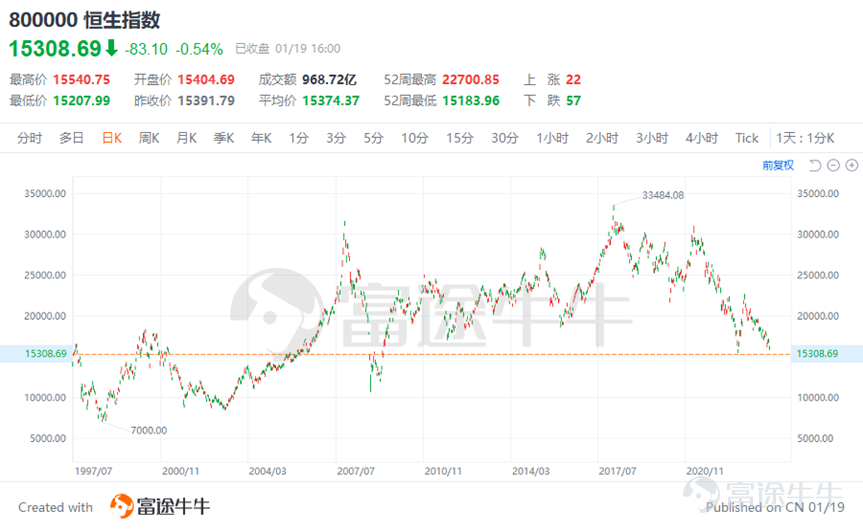
At the beginning of 2024, the Hong Kong stock market did not experience the long-awaited turnaround. Since the beginning of the year, the three major Hong Kong stock indexes have declined across the board and have fallen to the level of 1997.
Looking back at the history of nearly 30 years, it is easy to see that the Hong Kong stock market shows typical cyclical characteristics. It has experienced two changes and three cycles in just 30 years. If we deconstruct the history of the development of the Hong Kong stock market over a ten-year span, we will find that the Hong Kong stock market seems to follow the rule of “a thousand sails by the side of a ship, a thousand trees ahead of us.” Taking history as a guide, what stage are Hong Kong stocks currently at, reaching the batting zone?

Data source: Futubull
I. The turbulent period under multiple crises (1997-2007)
After the Hong Kong stock financial defense war and the Asian financial crisis, the Hong Kong economy resumed its recovery path in 1999. The Hang Seng Index rebounded sharply by 170% from the bottom until the Nasdaq Internet bubble burst in 2000.
1. Hong Kong's Financial Defense War (1997-1998)
Hong Kong stocks have suffered a severe setback in the last three years, which is reminiscent of Hong Kong stocks during the Asian financial crisis. Faced with large-scale short selling by international speculative funds at the time, the Hong Kong government played multiple combo punches to eventually repel bears and successfully preserve the Hong Kong financial market.
In 1997, after Hong Kong's return, shorting forces were acting recklessly. In 1998, when the harvest of Southeast Asia was basically completed, bears focused their attention on Hong Kong.
The logic of bears making airport stocks is closely related to the Hong Kong dollar issuance model. The Hong Kong dollar is tied to the US dollar and has a linked exchange rate system. As long as the amount of US dollars in Hong Kong is controlled, the value of the Hong Kong dollar can directly influence the value of the Hong Kong dollar. If you want to short the Hong Kong stock market, you can reduce the amount of Hong Kong dollars in circulation, create a shortage of Hong Kong dollar liquidity, and raise interest rates on the Hong Kong dollar, which can trigger a decline in Hong Kong stocks.
Zhu Rongji, then Premier of the State Council, publicly stated: “As long as the administrative government of the Hong Kong Special Administrative Region submits a request to the central government of China, the central government will spare no cost to maintain Hong Kong's prosperity and stability.” With Beijing's support, the Hong Kong government protects the exchange rate first and then the stock market. They bought a large amount of Hong Kong dollars, raised the exchange rate, and then personally bought the Hang Seng Index to stabilize market sentiment. In the end, international capital such as Soros returned.

Data source: Futubull
2. The rise in the TechNet stock bubble (1998-2000)
After the Asian financial crisis, Hong Kong's economy resumed its recovery path in 1999, and the Hang Seng Index rebounded sharply by 170% from the bottom until the Nasdaq Internet bubble burst in 2000.
During this period, the myth of TechNet Stock King was also created. Telecom PCK, whose stock code is “00008,” was once favored and held by countless people. It is a star listed company that is not inferior to Tencent in 2018 in fame and size.
On May 4, 1999, the stock price of PCC Digital Power (the predecessor of Electric Power) was listed on the back of the back office and resumed trading. The stock price rose from a high of HK$0.136 before the suspension of trading to HK$3.225 and closed at HK$1.83, an increase of 1250%.
A total of 47 companies were listed on the Hong Kong GEM market in 2000, and the total market value of GEM also rose from a few billion Hong Kong dollars at the beginning to nearly 100 billion Hong Kong dollars.

Data source: Futubull
3. The TechNet stock bubble burst, and Hong Kong stocks plummeted (2000-2003)
Until the beginning of 2000, when the US stock Nasdaq peaked and fell back, Hong Kong stocks also began to fall back and experienced a new round of drastic adjustments. The collapse of the US internet bubble in 2001 was compounded by the impact of the “9/11” incident. The global economy fell into recession, and Hong Kong's economy was also dragged down.
On March 10, 2000, it broke up from the NASDAQ. The index fell all the way from a high of 5048.6 points, falling below 3,500 points in more than a month, a drop of nearly 1/3. By the second half of 2001, it had fallen to only 1,100 points, and the market value evaporated 80%. The Hang Seng Index, on the other hand, began to be adjusted in September 2000. It has plummeted from 18,000 points to 14,000 points in more than a month. The stock prices of leading companies such as Dengying mentioned earlier have dropped 80%, and some small and medium securities have even reached 90%.
Dengying, which was proud of in the last round of sharp gains, became a negative asset blue-chip stock. At one point, it almost became a sub-stock (stocks with a stock price of less than 1 Hong Kong dollar), but in the end, it only saved its face through the 5-in-1 share.
After the collapse of the Internet bubble in 2000, the decline in US stocks continued until the end of 2002, but due to the outbreak of SARS (SARS) in 2003, the decline in Hong Kong stocks ended even later, until the end of the first quarter of 2003. It was only in the second quarter that a steady upward trend began, and then a new round of bull markets began.

Data source: Futubull
Over the past decade, Hong Kong stocks, as an offshore market, have been affected by fluctuations in global financial markets, especially under the spotlight of the US dollar exchange rate. However, with the strong support of the Chinese economy, the leading power of Hong Kong stocks is undergoing changes.
II. A New Era of Interconnection (2007-2019)
Major milestone: On August 20, 2007, the State Administration of Foreign Exchange announced the “Hong Kong Stock Express” program, which allows domestic shareholders to invest in Hong Kong stocks, helping the Hong Kong stock market reach a record high. The dominant power of Hong Kong stocks is changing.
On June 20, 2007, the Securities Regulatory Commission issued the “Trial Measures on the Administration of Overseas Securities Investment by Qualified Domestic Institutional Investors”, and the QDII system began to be implemented. On August 20, the State Administration of Foreign Exchange announced the “Hong Kong Stock Express” plan, which allows domestic shareholders to invest in Hong Kong stocks. As a result, Hong Kong stocks performed well back then; however, this plan did not come to fruition back then. The subprime mortgage crisis made the supervisory authorities aware of the risk of capital outflow, and the “Hong Kong Stock Express” was postponed indefinitely.
1. Hong Kong stocks cannot escape bad luck under the subprime mortgage crisis (2007-2009)
The Hong Kong stock market set a new record in 2007. The trend of the Hong Kong stock market changed rapidly. The Hang Seng Index fluctuated greatly, and many market indicators repeatedly reached new highs. The market value, trading volume, and single-day rise and fall rate of the Hong Kong stock market have all reached new all-time highs.
According to statistics from the Hong Kong Stock Exchange, as of December 14, 2007, many market indicators in the Hong Kong stock market set new historical records. Among them, many of the data were set on October 30: on that day, the total market value of the Hong Kong stock market reached HK$23.19 trillion, the Hang Seng Index climbed 31638 points, up 58% from last year's high of 2001 points, and the Hang Seng China Enterprises Index reached 20,400 points. Furthermore, as of December 14, the total turnover of the Hong Kong stock market in 2007 had reached HK$2,096 billion, far higher than the full year of 2006; the average daily turnover of the stock market reached HK$88.4 billion, which was HK$54.5 billion higher than in 2006; the transaction amount for H shares was HK$7523.9 billion, an increase of HK$798.73 billion over the full year of 2006, and the number of newly listed derivative warrants reached 5973, a record high.
However, after all, the carnival was unable to escape the subprime mortgage crisis that swept the world. In August 2007, global liquidity problems began, and the global market was severely affected. The Hong Kong stock market was no exception. The Hang Seng Index fell from 31,958 points in November 2007 to 10,676 points in October 2008. The bear market lasted 11 months, falling a total of 2,1282 points.

Data source: Futubull
As a result of this sharp decline, the much-anticipated direct connection to Hong Kong stocks was once again extended indefinitely.On May 27, 2008, the “Hong Kong Commercial Daily” published an article entitled “The Hong Kong Stock Express is not yet appropriate”, saying that to implement the Hong Kong Stock Express, mainland investors seem to need more education so that the Hong Kong stock market does not turn into a gambling casino. Meanwhile, the Hong Kong and mainland markets also require stricter supervision to prevent the mainland and foreign investors from making waves. If both of these are achieved, the Hong Kong Stock Express will reach its goal and bring the mainland and Hong Kong to a win-win situation. However, the time is not yet right now; the Hong Kong-stock Express is still in the research stage, and the official launch is far away.
2. The European debt crisis dragged down the weakening of Hong Kong stocks (2010-2013)
After the subprime mortgage crisis, the European debt crisis completely broke out. Greece's sovereign debt broke out at the end of 2009, driving the entire EU into a debt quagmire; in 2011, the European debt crisis completely broke out, and the EU fell into its biggest crisis since its establishment 11 years ago.
The European debt crisis also dragged down the global equity market and changed the layout of the investment market in the second half of the year. At one point, the Hang Seng Index fell below the 20,000 mark, with the biggest drop in the range of 34%. However, after the crisis gradually subsided, Hong Kong stocks entered a volatile upward trajectory.

Data source: Futubull
3. Connectivity opens a major era of Hong Kong stocks (2013-2019)
Entering 2013, the “Hong Kong Stock Express”, which had been suspended for a long time, once again broke into investors' eyes. At the 2013 Central Bank of China working meeting held from January 10 to 11, 2013, the central bank clearly proposed for the first time that it should actively prepare for the Qualified Domestic Individual Investor (QDII2) pilot.
In 2014, the investment market, which had been waiting for seven years, finally welcomed the official announcement of the “Hong Kong Stock Express” program. On April 10, 2014, the China Securities Regulatory Commission allowed the Shanghai and Hong Kong stock exchanges to achieve two-way investment. The next day, the Hang Seng Index rose above 1.51%; the Shanghai Composite Index rose 1.38% on the same day, and the “Hong Kong Stock Express” was officially launched on November 17.
As a result, the southward movement of mainland capital became a huge driver of the rise in Hong Kong stocks.In 2015, a one-and-a-half month increase of 21% was used, with an average daily turnover of HK$153.2 billion, the highest daily turnover of HK$291.5 billion, and the lowest daily turnover of HK$73.2 billion; until A-shares dragged down the decline in Hong Kong stocks.
On the 2nd anniversary of the Shanghai-Hong Kong Stock Connect, the Shenzhen-Hong Kong Stock Connect was officially launched. On December 5, 2016, the Shenzhen-Hong Kong Stock Connect was officially launched, thus opening a new chapter in the full connectivity of the Shenzhen-Hong Kong capital market.The Shanghai-Hong Kong Stock Connect and the Shenzhen-Hong Kong Stock Connect have become important bridges and windows for the institutional opening of China's capital market, introducing fresh water into the healthy development of Hong Kong's capital market and starting a strong market.
Since the second half of 2019, southbound capital has rapidly seized the pricing power of Hong Kong stocks, and domestic capital has become the backbone of the Hong Kong stock market. From the perspective of trader structure, Southbound Capital has unquestionably ranked among the mainstream participants in Hong Kong stocks, going hand in hand with international capital and local capital in Hong Kong.
The figure below shows the total shareholding ratio of Hong Kong Stock Connect shares to the total number of shares in Hong Kong stocks

Data source: WIND
The evolution of market capitalization structure and pricing power over the past decade has essentially marked a profound transformation in the Hong Kong stock ecosystem, and this transformation is still ongoing.
3. Underestimated Hong Kong stocks
Currently, the valuations of major indices in the Hong Kong stock market are generally below the historical pivot level, and are also lower in major global markets.
On the basis of the current decline in Hong Kong stocks and shrinking liquidity, the market will use “equity thinking,” that is, buying companies will prefer to buy stocks that can provide higher equity returns if they are unable to sell quickly to obtain benefits from the price difference. Therefore, in the past, when Hong Kong stock technology stocks lacked shareholder returns, they would only have game value. In such a market where liquidity was scarce, valuations were greatly reduced.
Horizontal comparison:
Compared with major global indices, the Hong Kong stock market's valuation level position. Compared to the representative indices of the US and Japanese securities markets, the Hang Seng Index is the penultimate in the world in terms of price-earnings ratio and net price-earnings ratio; judging from risk compensation with risk-free interest rates (10-year US Treasury yield), the Hang Seng Index far surpasses other markets.

Data source: Futubull
Vertical comparison: Hong Kong stocks are at an all-time low
Price-earnings ratio:According to Wind data, the Hang Seng Index's current price-earnings ratio (PE) is 7.45 times lower than the 10-year average of 10.54. However, be wary of the Hong Kong stock undervaluation trap. The undervaluation of the Hang Seng Index may not really be undervalued. For example, the risk of financial stocks and real estate stocks that account for half of the Hang Seng Index's growth and corporate quality is also a factor to consider.
Figure: The PE trend of the Hang Seng Index in the past 10 years

Data source: Wind
Net market ratio:According to Wind data, the current net market ratio (PB) of the Hang Seng Index (PB) is 0.79 times lower than the average PB value of 1.12 in the past ten years. Currently, the market account ratio of the Hang Seng Index is below 1X. Many low points in history, such as the 1998 financial crisis, the 2008 financial crisis, and the 2011 European debt crisis, have never seen a lower level than at this time.
Figure: Hang Seng Index PB trend in the past 10 years

Data source: Wind
Excess earnings perspective: the overall valuation of Hong Kong stocks is still not in a safe position
The yield on ten-year US bonds valued with assets is known as the “anchor of global asset pricing”. It is the main reference target for risk-free interest rates in global financial markets, and is also an important indicator for investors.
Currently, the dividend yield on Hong Kong stocks is higher than the return on 10-year US Treasury yields, but compared to historical data for the past ten years, the risk premium is still at a historically low level. As the market anticipates a slowdown in economic growth, capital's tolerance for investment risks will decline, and there will be a trend towards “steady happiness.” From this perspective, the overall valuation of Hong Kong stocks is still not in a safe position.
Chart: Hang Seng Index risk premium trend in the past 10 years

Data source: Wind
Therefore, in a market where sentiment is weak and capital is flowing out, “reducing losses” has become a top priority, and undervalued assets will leave safe space for investors. However, undervaluation is not a sufficient reason to buy stocks. For many companies, the stock price may already reflect the company's future profit prospects, and the current reflection of undervaluation may be the result of full pricing; if the fundamentals of many high-dividend stocks deteriorate, such companies should also stay away.
In the current market environment, maybe Graham's adherence to the triple concept is a powerful tool to help investors get through the bear market. (1) There is a properly determined dividend return; (2) there is a stable and sufficient income record; (3) there is satisfactory tangible asset support.
Hong Kong stocks have changed in the past 30 years, and every wave has outlined the imprint of the times. I hope that in the future, Hong Kong stocks will continue to move forward steadfastly, and continue to tell their own stories.
Risk Disclaimer: The above content only represents the author's view. It does not represent any position or investment advice of Futu. Futu makes no representation or warranty.Read more


Comments (16)
to post a comment
68
81