高股息股開年一枝獨秀!有哪些隱藏王者?

Futu Research | What dividend ratio can be considered a high dividend when heated by a high dividend group?
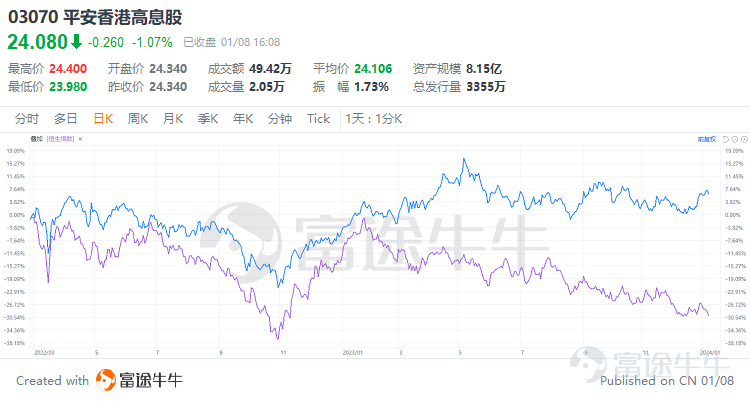
In 2024, the beginning was hell-level of difficulty, and the market continued to decline. However, the “Ping An Hong Kong High Dividend” index with a blue line performed far better than the “Hang Seng Index” with a purple line. The market is also hotly debating the investment value of high dividends, but are high dividends necessarily good? Whether there is a value trap here is the point that should be paid more attention to.
Figure: Trend of Ping An Hong Kong high-yield stocks

The content is for display, educational demonstration or reference purposes only. It is not and should not be regarded as a summary or recommendation, nor should it be interpreted as professional opinion or investment advice
First, in this process, we need to assume that we are the owner (business owner) of the company, that is, what Buffett often said is “buying a stock is buying a company”. Thinking about the owner of the business would be closer to the essence of investment. At this point, we remember a formula, which we will use often later:
Return on investment = growth in corporate profits* changes in valuation levels+shareholder returns
1. Stock dividends are similar to raw eggs
Let's assume that a listed company currently has a profit of 100 million yuan/year, 10 times PE, and a market capitalization of 100 million yuan* 10 times PE = 1 billion yuan of market value.
All profits are paid out in dividends, that is, 100% of the profit is distributed to shareholders. After purchasing the company's shares with 1 billion yuan, 100 million yuan of profit will be distributed to shareholders every year, so what shareholders can get is “100 million yuan/purchase cost of 1 billion yuan = 10% dividend rate.”
When dividends are paid, there will be a process of excluding dividends. That is, the profit of 100 million yuan eventually becomes cash received by the shareholders themselves. This 100 million yuan needs to be removed from the net assets of the listed company, while the market value of the listed company changed from 1 billion yuan to 900 million yuan. In addition to this, tax deductions are also required. From the shareholders' point of view, does it seem like a loss?
At first glance, it looks like a loss, because what we got at this point was: 900 million yuan market value after excl. plus dividend of less than 100 million yuan after tax <1 billion yuan of initial market value.
However, when the company's profit remains the same, the overall valuation changes from 10 times PE to 9 times (900 million yuan market capitalization/100 million yuan profit = 9 times PE). If the profit remains the same, and 100% of the profit is distributed the following year, then the dividend becomes: 100 million yuan dividend/900 million yuan market value = 11.11% dividend rate.
If other market participants think that the 11.11% dividend rate is very high, they buy one after another, and the dividend rate converges to 10%, then the valuation level will be 10 times PE again. At this point, the market value is 1 billion yuan. That is, after a year, what the initial investors have is a dividend of 100 million yuan plus a market value of 1 billion yuan after tax deduction.
The data we can observe in this way is that investors initially own a company with a market value of 1 billion yuan and a portion of dividends. Is this process similar to eggs?
After laying eggs (dividends), the hens lose weight (excluding dividends), but after a period of life (operating to make a profit), they conceive a new egg (with the ability to pay dividends), then regenerate eggs and eggs, and cycle back and forth.
At this point, however, a few new questions arise:
(1) Does this hen have any health problems? (Whether and how did the fundamentals of management change)
(2) Can we continue to lay eggs in the future? (Whether it has the ability and willingness to continue to pay dividends)
(3) Whether the number of animals on the market that can replace hens to lay eggs has increased (whether the risk-free interest rate has changed)
The above three points: changes in the fundamentals of listed companies, dividend payment capacity (ability to repurchase), and risk-free interest rates are all factors that can continue to influence the pricing of listed companies other than dividends.
2. How much dividend ratio is relatively high
First, in addition to looking at dividends, another layer of functions similar to dividends is “repurchase cancellation”. The point that repurchases and cancellations are better than dividends is “exempt from paying dividends”. For investors, when a repurchase initiated by a listed company is equivalent to a direct reduction in total share capital, it directly boosts earnings per share on the premise that profits remain the same, so in addition to being able to calculate the dividend rate, it is also possible to calculate the ratio of repurchase and cancellation.
We can observe and use Futu's stock selector to select:
(1) There are 544 listed companies with a dividend ratio of TTM greater than 5% in 2023;
(2) There are 462 listed companies with a dividend ratio of TTM greater than 6% in 2023;
(3) There are 373 listed companies with a dividend ratio of TTM greater than 7% in 2023;
(4) There are 292 listed companies with a dividend ratio of TTM greater than 8% in 2023;
(5) There are 223 listed companies with a dividend ratio of TTM greater than 9% in 2023;
(6) There are 178 listed companies with a dividend ratio of TTM greater than 10% in 2023;
If we adjust the indicators again, for 250 consecutive trading days, with a turnover of more than 500,000, there are as many companies as follows: 163, 136, 107, 73, 45, and 31 with dividend rates of 5-10%;
We can observe that when the dividend ratio is above 7%, companies with a certain level of liquidity are absolutely scarce in the Hong Kong market.
However, as we mentioned above, in addition to being able to lay eggs, this “hen” can also gain weight (optimize operations and increase profits). Let's go back to the above formula:
Return on investment (return on investing in a chicken) = increase in corporate profit (chicken weight gain) * change in valuation level (change in external currency environment) +shareholder return (return on egg production)
For investing in a listed company, being able to invest in a listed company with a dividend rate of 7% or more is a very scarce asset (including buybacks and cancellations). If a company can not only maintain a 7% dividend, but also has a continuous boost in performance, it will be a better quality asset. We use this formula:
When comprehensive shareholder return = profit growth (without diluting share capital) +shareholder return of at least 7%, this investment will be a scarce asset, prone to rise and fall.
In addition, companies that simply invest in high dividends (high repurchases and cancellations) are also at risk, that is, do their “interest-bearing assets” have health problems? In other words, there are risks such as a decline in the profitability of the enterprise. If the hen in their hands “dies due to illness,” it will be empty-handed. Therefore, although the current market is hotly discussing high-dividend investments, investors should pay more attention to whether the fundamentals of the enterprise can continue to be boosted, the worst, and no decline.
Risk Disclaimer: The above content only represents the author's view. It does not represent any position or investment advice of Futu. Futu makes no representation or warranty.Read more


Comments (8)
to post a comment
44
54