
If the younger generation doesn't trade stocks, they don't have enough chives? —Remembering the awakening and transformation of a generation
Text | financial statements
Original production by Yan Cai
Three trading days after New Year's Day in 2024, there were three major attacks. Since the beginning of the year, the pride of having swapped for fine wine evaporated in a blink of an eye. Seeing that the A-share and Hong Kong stock indices had reached new lows, the sprint in the first few days filled everyone with unspeakable hazy expectations for 2024, but for the first three days of the year, a pot of cold water filled the body and body.

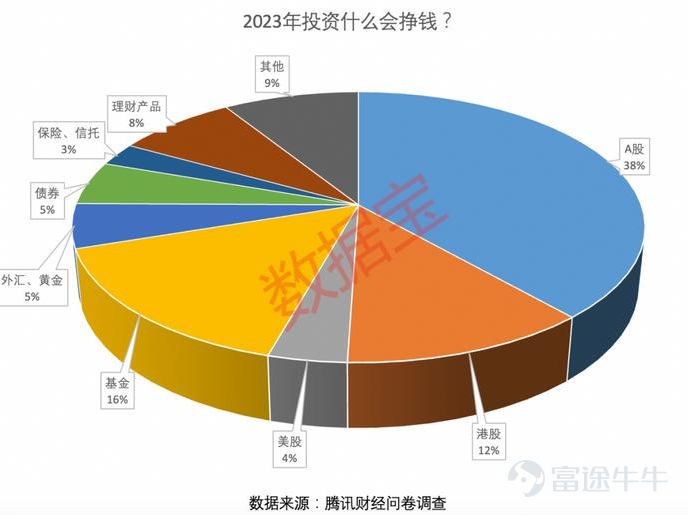
Looking back at the beginning of 2023, this also seems to be the case. A questionnaire survey on what would make money by investing in 2023 showed that nearly half thought investing in A shares plus Hong Kong stocks would make money, more than 4% in the US. What are the results? A merciless punch in the face. No one believes in grand narratives anymore, and no one wants to recharge A-shares for their faith? Is all of this due to lack of chives?
After New Year's Day, the A-share and Hong Kong stock markets ushered in a continuous decline at the beginning of the year, and investors' expectations for 2024 were instantly thrown in cold water. When we examine this phenomenon, we find that deep social and economic factors are hidden behind it, particularly with regard to the attitudes and behaviors of the younger generation of investors.
Recently, I saw a statistic. If you look at the age distribution of A-share shareholders, the age distribution of A-share shareholders is mainly between the ages of 30-60, accounting for over 70%; those under 30 only account for 7.75%. Fresh chives only account for 7.75%!!! The question was so clear. In order to have fresh water from a source, there are no new chives, where did the living water come from? Water from the Yellow River comes from the sky, but chives cannot fall from the sky.
So the core question is, why are young people no longer willing to trade stocks and no longer believe in investing to become rich?
In the grand narrative of the modern Chinese economy, the stock market has always been a role that cannot be ignored. It is not only a playground for capital, but also a stage where the dreams and reality of hundreds of millions of people intertwine. In recent years, especially with regard to the participation of the younger generation of shareholders, we have discovered a profound transformation — perhaps this is not just a change in an economic phenomenon, but a concentrated expression of the mentality and background of the times.
1. Stock Market: A Generation's Dream of Wealth
Looking back, the stock market was a “gold mine” in the minds of countless people. From the 1990s to the beginning of the 21st century, with the rapid rise of the Chinese economy, the stock market became a channel for many people to quickly accumulate wealth. Most shareholders at that time had dreams of becoming rich overnight, and every fluctuation in the market touched the hearts of countless people. Every sharp rise is accompanied by people's endless fantasies about a better life; every sharp drop also seems to indicate the collapse of dreams.
However, as time passed, the enthusiasm of the market gradually cooled down. As we look at today through data, a remarkable phenomenon has emerged: the younger generation, particularly shareholders under 30, account for a surprisingly low share of the overall market, at only 7.75%. What are the reflections behind this transformation?
II. Why do young people stay away from the stock market
Young people are no longer willing to trade stocks, and they no longer regard investing in the stock market as the main way to become rich like their ancestors. There are many reasons behind this phenomenon, involving various aspects of social economy, psychology, culture, etc., and this phenomenon is reflected not only in China, but in many countries around the world.
1. Economic structure and distribution of wealth:
Wealth accumulation and distribution:Over the past few decades, the rapid development of the global economy has enabled some people (especially middle-aged and elderly people) to accumulate considerable wealth. This generation has benefited from the dividends of a period of rapid economic growth, such as the booming real estate market. In contrast, when a new generation of young people enters the market, they face high housing prices, high living costs, and a fierce competitive environment.
Revenue growth and opportunities:As economic growth slows, the new generation faces the problem of stagnant wage growth. At the same time, opportunities for entrepreneurship have declined due to market saturation, making it difficult for young people to accumulate wealth through traditional means.
2. Changes in social culture and mentality:
The rise of the reclining culture: Faced with high costs and limited opportunities, some young people chose the so-called “lying down” culture, where they no longer pursue material success excessively, but rather seek psychological balance and satisfaction.
A shift in values: The values of modern young people are different from those of the previous generation. They may place more emphasis on quality of life and work-life balance rather than simply accumulating wealth.
3. Impact on stock market investment:
Investment capacity limitations: Due to limited income and high life stress, young people have relatively few funds at their disposal, which directly limits their ability to participate in stock market investments.
Decline in willingness to invest: In the face of a complex and risky stock market, combined with a lack of sufficient economic and investment knowledge, young people may be wary of investing in the stock market.
The economic and social environment faced by this generation of young people is markedly different from that of the previous generation. Not only do they have to deal with more intense competition and higher living costs, but they also need to find new opportunities in a relatively mature and slowly growing economic environment.
These factors work together on their attitudes and behavior towards investing, especially in the stock market, so that fewer and fewer young people are willing or able to participate in the stock market. In this context, understanding the challenges and needs of the younger generation is of great significance in formulating corresponding economic policies and market strategies.
Therefore, the core of today's young people not trading stocks is the stress of life and the awakening of consciousness.
1. Economic pressure and income distribution:
High cost life stress: As the cost of living rises (especially housing prices and education costs), the economic pressure faced by young people has increased dramatically. This makes them more inclined to spend their limited funds on everyday spending and emergency savings rather than investing in riskier stock markets.
Revenue growth is slow: Compared to the past, the income growth rate of young people is currently slowing down, making them more cautious when considering investments and prefer prudent financial management methods.
2. Changes in risk appetite and perception:
Decreased risk appetite: Compared to the previous generation, modern young people have shown a lower risk tolerance when it comes to financial investments. They pay more attention to the safety of their funds and are concerned about fluctuations and uncertainties in the stock market.
Financial knowledge and cognition: When receiving education, today's young people may have insufficient understanding of financial knowledge and have certain cognitive impairment about the complexity and risks of the stock market.
3. Social environment and cultural change:
Socio-environmental impacts: In recent years, stock market volatility and market manipulation incidents have frequently appeared in media reports. These negative news may have affected young people's confidence in investing in the stock market.
Evolution of values: Modern young people pay more attention to quality of life and personal development rather than simply material accumulation. They may be more inclined to invest their time and energy into personal interests and career development rather than trading stocks.
4. Technological development and the information age:
How to obtain information: Under the influence of the internet and social media, young people have more diverse ways to obtain information. Their quick access to all kinds of information about investing in the stock market, including cases of risk and failure, may have heightened their concerns about the stock market.
Attracting new investment methods: With the development of technology, emerging investment methods such as digital currency and P2P have attracted the attention of many young people. These emerging fields may be viewed as more promising and attractive investment choices.
As we can see, young people are no longer as enthusiastic about investing in the stock market as before; this is a result of a combination of factors. Among these are economic reasons, as well as psychological and cultural effects.
3. The Awakening of the Younger Generation: The Collision of Dreams and Reality
1. Economic stress and life reality:Many young people face heavy financial pressure at the beginning of their entry into society. High housing prices and rising cost of living have a direct impact on their life choices. In this context, the high-risk nature of stock market investment is particularly prominent. For most young people just starting out, they prefer to choose a stable lifestyle rather than invest limited capital into the volatile stock market.
2. Changes in values:Compared to the previous generation, the values of today's young people have changed markedly. They no longer regard wealth accumulation as their sole goal in life; they pay more attention to the quality of life and spiritual pursuit. In their view, investing in the stock market means not only financial risk, but also an investment of time and energy. This conflicts with their philosophy of pursuing an efficient and balanced life.
3. Distrust of the stock market:Fluctuations in the stock market over the past few years, especially some irregular market behavior, have intensified young people's distrust of the stock market. They have witnessed too many investor losses due to market manipulation and information asymmetry.

Public funds, a series of huge losses, and the performance of Gu Lan, Liu Geyi, and Cai Songsong, etc. have made young people no longer believe the so-called lies that professionals can make money.
These events have undoubtedly sown the seeds of doubt in the minds of young people: is such a market really worth my money and hope?
4. Lack of new chives and market adjustment: decluttering and long-term value investment
As the proportion of retail investors declines, the market is experiencing a trend of de-retailing. This may indicate the maturation of the Chinese stock market — the gradual formation of a more regulated market that is more focused on long-term value. The future stock market may no longer be a dream place to become rich overnight, but rather an investment environment that is more rational and pays more attention to corporate fundamentals.
1. Sources of market vitality:Fresh blood is essential to the vitality of the stock market. However, as younger investors dwindled, the market lost important growth momentum. This not only affects the liquidity of the market, but may also lead to a decline in the market's ability to innovate.
2. Signs of market maturity:The maturity of the stock market should not depend on the constant addition of new “leeks”. Instead, a mature market should be based on value investing and rational investment. This market environment is likely to attract more young investors who focus on long-term investments.
3. The role of policies and institutions:In order to attract young people to the stock market, reforms are needed at the policy and institutional levels. For example, increasing market transparency, strengthening investor education, and improving the regulatory system may all increase young people's confidence in the stock market.
5. Conclusion: A Generation's Choice and the Voice of the Times
Each generation has its own characteristics and choices. The choice of today's young people to stay away from the stock market is probably the result of careful consideration of their lives and investments. This is not only an individual choice, but also a collective act in the context of the times. We can't predict how the market will develop in the future.
What is certain, however, is that this kind of change, caused by the awakening and transformation of a generation, will undoubtedly have a profound impact on China's capital market and the economy as a whole.
1. Changes in stock market dynamism:
Changes in the investor structure: As young people become less interested in investing in the stock market, the investor structure of the stock market is likely to change. This may lead to a decline in market dynamism, as younger investors tend to be more willing to participate in high-risk, high-return investments.
The impact of market liquidity: The decline in young people may affect the liquidity of the market, particularly in small and medium-sized enterprise stocks. These are generally areas that younger investors are more interested in.
2. Social innovation and economic growth:
Decrease in venture capital: The decline in venture capital among young people may lead to a reduction in innovation capital, which is particularly important for promoting technological innovation and enterprise entrepreneurship.
Economic growth momentum weakens: The stock market is an important indicator and driver of economic growth. Reduced investment by young people may weaken the stock market's contribution to economic growth.
3. The formation of a low-desire society:
Changes in consumption patterns: The younger generation's tendency to have low desire may lead to changes in consumption patterns, from past competition and consumerism to more pragmatic and quality-oriented consumption.
A shift in social values: This generation is likely to place more emphasis on quality of life and personal growth rather than the accumulation of material wealth. This shift in values is likely to have an impact on the overall direction of society's development.
4. Challenges to policy development:
Economic policy adjustments: Governments may need to take into account these changes in the younger generation when formulating economic policies, such as providing more support for innovation and entrepreneurship, or adjusting social welfare policies to reflect changes in the demographic structure.
Capital market reform: In order to attract more young investors, it may be necessary to further reform and improve the capital market, improve transparency and fairness, and lower the investment threshold.
The actions and choices of the younger generation are a product of changing times and reflect broader social and economic trends. Their changes will have a profound impact on China's capital market, economic growth, social structure, and policy formulation. Understanding and adapting to these changes is essential to ensure sustainable and healthy social and economic development in China.
Financial records on 2024-01/04
Risk Disclaimer: The above content only represents the author's view. It does not represent any position or investment advice of Futu. Futu makes no representation or warranty.Read more


Comments
to post a comment
3
1