

紅海危機引連鎖反應:巨頭停產、航運漲價潮

Futu Research | The situation in the Red Sea is changing again. What is the impact?
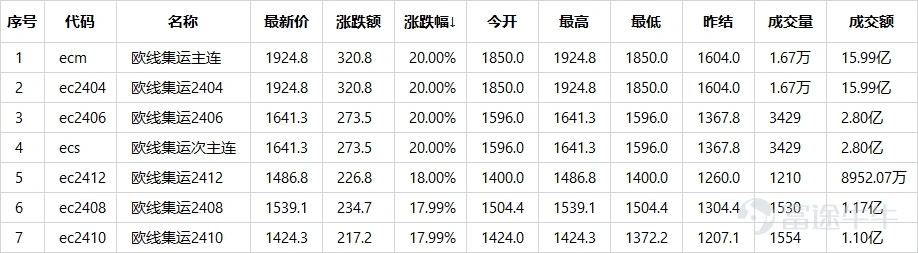
Since December, Yemen's Houthis have attacked cargo ships passing through the waters near the Red Sea route, and several container shipping companies have announced the suspension of routes in the Red Sea region. After the cargo ship was attacked again, Maersk once again announced the suspension of all Red Sea transportation for 48 hours on December 31. The situation in the Red Sea has changed again. Affected by this, the opening of all contracts on the shipping index (European line) on January 2 hit a rise or fall.
Figure: European freight forwarding related indices
Let's take a look at how the Red Sea situation is expected to evolve in the future, and how will it affect the market?
Figure: Shipping concept sector trends

1. Sorting out the timeline of the Red Sea incident: The situation in the Red Sea changed when it was attacked again under escort
In order to make it easier for everyone to understand, we have sorted out the Red Sea events according to the timeline:
On December 15, 2023, the Houthis in Yemen fired a missile at a container ship bound for Israel. On the same day, shipping company Hapag-Lloyd and Denmark's Maersk Shipping Group announced the suspension of container ship transportation via the Red Sea route.
On December 18, 2023, US Secretary of Defense Austin announced joint patrols in the southern Red Sea and the Gulf of Aden to protect transiting merchant ships.
On December 20, 2023, as of 20, many major shipping companies, including Maersk, Hapag-Lloyd, Mediterranean, Dafei, and Evergreen Shipping, announced the suspension of the Red Sea-Suez Canal route and detour to the Cape of Good Hope, and at least 13 shipping companies have announced detour plans.
On December 24, 2023, Maersk announced that it would resume navigation through the Red Sea under an escort operation led by the United States.
On December 31, 2023, the Maersk container ship was once again attacked by the Houthis. Maersk announced that it will suspend all Red Sea transportation for 48 hours.
On January 1, 2024, the Iranian destroyer “Elbrus” entered the Red Sea through the Strait of Mande.
Furthermore, according to information released by the Houthis, the official armed forces of the Houthis have reached 870,000, of which 770,000 are in the army. In addition, it has nearly 2,800 main battle tanks of various types, 1,844 doors, and 4,856 armored vehicles. The overall strength of this armed force is not weak.
After sorting it out, we can see that the Red Sea incident is a spillover of the conflict between Palestine and Israel. The situation in the Middle East is complicated and difficult to predict, and the Red Sea incident is probably far from over.
2. The importance of the Red Sea route: one of the busiest routes in the world
As a transportation hub connecting Europe, Asia and Africa, Suez-Red Sea-Mander Strait is one of the busiest shipping routes in the world. As we can see from the map, the Mander Strait controlled by the Houthis armed group in Yemen is located at the southern end of the Red Sea. It is the only way for ships to and from the Red Sea route, and its strategic position is very important.
Figure: Route changes affected by the conflict between Palestine and Israel

The Red Sea route is one of the world's important trade routes and has a great impact on shipping and oil transportation. According to Clarksons (Clarksons) data, in 2023, the cargo volume of ships passing through the Suez Canal accounted for 37% of global shipping volume, 22% of LPG carrier traffic, 14% of refined oil tanker traffic, and 11% of crude oil tanker traffic, while accounting for less than 4% of global dry bulk cargo volume.
3. The impact of the suspension of the Red Sea route: The short-term impact on European shipping prices is significant, and the impact on oil prices is relatively small
In terms of shipping
After suspending the Red Sea route, shipping companies can only choose to take a detour to Cape of Good Hope, which will significantly increase the transit distance and number of days of travel on the relevant routes, and delay delivery. According to US S&P Global estimates, the voyage of a freighter sailing from Rotterdam in the Netherlands to Singapore via the Cape of Good Hope will increase by 40% compared to the original voyage of the Suez Canal.
As a result, container shipping giants avoid Red Sea routes, leading to lower transportation efficiency and higher transportation costs, which will directly lead to an increase in container shipping prices. Since the Red Sea route has the greatest impact on the Asia-Europe route and the Asian-Mediterranean route, from a geographical perspective, it has the greatest impact on the increase in capacity prices in the European market. As of January 1, SCSI (Shanghai Container Export Freight Index) increased by 24% compared to December 1, with the Shanghai to Europe/Mediterranean route rising sharply by 217%/177%.
In terms of oil prices
If tankers take a detour to the Cape of Good Hope, the price of oil transportation will also be affected by the increase in transportation distance. As of January 1, the crude oil BDTI/refined oil BCTI freight index increased by 2% and 15%, respectively, compared to December 1.
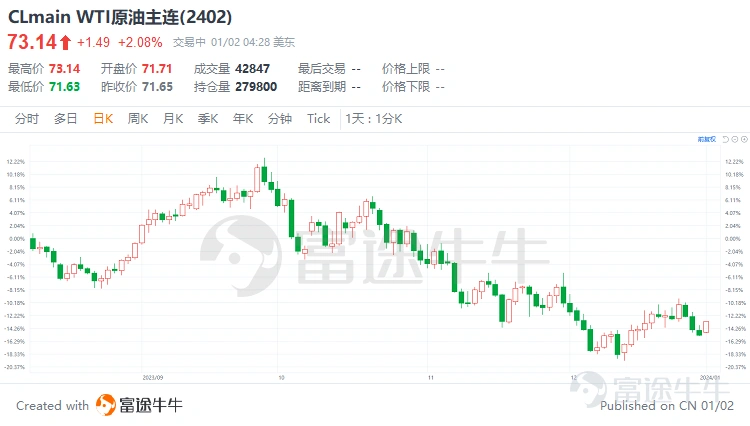
Changes in the Red Sea situation caused crude oil prices to fluctuate in the short term. As can be seen from changes in WTI crude oil futures prices, crude oil prices have gradually risen since the Red Sea incident escalated in mid-December. After Maersk announced the resumption of Red Sea shipping, crude oil prices declined markedly, and after Maersk announced another suspension of Red Sea routes, crude oil prices rose slightly again.
However, in the long run, the impact of the Red Sea shutdown on oil prices is relatively limited. On the one hand, the Suez Canal does not account for a very high proportion of oil transportation. At the same time, oil transportation prices account for a lower cost of crude oil. Under normal circumstances, freight rates only account for 1.5%-4.5% of crude oil import prices. Furthermore, oil prices are mainly affected by changes in the supply and demand pattern; production and demand are the key variables.
Figure: WTI crude oil main chain trend
4. The Red Sea situation may be difficult to calm down in the short term. How will investors respond?
The current situation in the Middle East is still very complicated, and we still need to pay close attention to the direction of the Red Sea route incident.Currently, the US military, escorting the Maersk container ship, has clashed head-on with the Houthis and caused casualties. It is expected that Britain and the US will jointly issue a joint statement to issue an ultimatum to the Houthis in Yemen. Meanwhile, the Iranian military, which has always supported the Houthis in Yemen, dispatched the Iranian destroyer “Elbrus” into the Red Sea through the Strait of Mande on January 1, local time.
Therefore, the situation in the Red Sea may be difficult to calm down in the short term, and we need to be wary of the escalation of the situation caused by armed conflict.
Assuming that the situation in the Red Sea escalates again and the Red Sea route is suspended for a long time, it is recommended to focus on shipping companies in the short term. In the long run, if there is no extreme shutdown, considering that the shipping market faces a large number of new ship deliveries in 24-25, the overall global shipping capacity will be oversupplied next year, and freight rates will still face significant suppression. In terms of oil prices, the escalation of the situation will bring about a short-term rise in oil prices, but the overall impact is limited, so the shipping sector is likely biased towards one-time stimulus.
Assuming that the situation in the Red Sea gradually calms down and the Red Sea route can resume in the short term, shipping prices and oil prices will drop significantly.
Risk Disclaimer: The above content only represents the author's view. It does not represent any position or investment advice of Futu. Futu makes no representation or warranty.Read more


Comments (2)
to post a comment
35
41