
小米汽車技術發佈會召開,定價仍有懸念?

Futu Research | It fell after the press conference. What happened to Xiaomi cars?
December 28, 2023, 14:00$ Xiaomi Group -W (01810.HK) $The first NEV technology conference was held. At this press conference, the Xiaomi SU7, the first model of Xiaomi, was unveiled. SU is an abbreviation for Speed Ultra and is positioned as a C-class high-performance supercar.
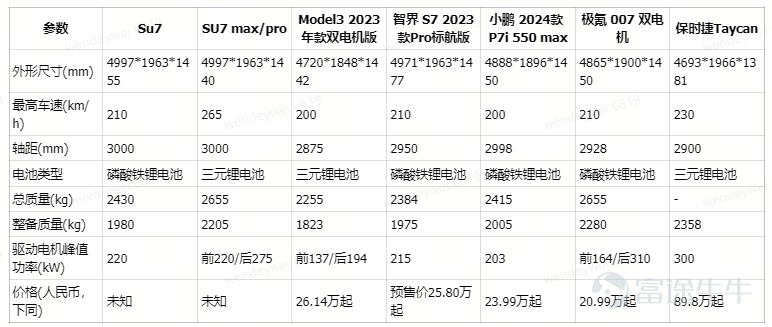
According to Xiaomi's declaration from the Ministry of Industry and Information Technology, the production qualification for the SU7 is BAIC Off-Road Vehicle Company. The wheelbase is 3,000 mm, and the length, width, and height are 4997/1963/1455 mm respectively. Two versions are available. The main differences are battery pack capacity and range. Among them, the single-motor rear-drive version is equipped with a 73.6 kWh Freddy lithium iron phosphate battery with a battery life of 628 km (20 inch wheels) or 668 km (19 inch wheels); the dual-motor four-wheel drive version is equipped with a 101 kWh Ningde era ternary lithium battery with a battery life of 800 km (19 inch wheels) or 750 km (20 inch wheels).
Table: Comparison of parameters between Xiaomi cars and competing models

Source: Public Information Collection, Futu Securities
The Xiaomi car presents a sports coupe style. Overall, the Su7 has many similarities with the Porsche Taycan in terms of appearance, and the style is younger and more high-end. Judging from the appearance, the body lines are smooth, and the front hatch is relatively smooth, which helps to optimize the wind resistance coefficient and is easily accepted by young consumers. However, the design elements are very similar to Porsche, and there are imitation disputes in terms of design.
Picture: Comparison of the appearance of a Xiaomi car and a Porsche

Source: Company's official website, public data compilation, Futu Securities
The core competitive elements of electric vehicles are two aspects: the first is three-electric technology, which mainly focuses on electric drives, batteries, and electronic control, and the other is intelligent technology focusing on intelligent driving and smart cockpits. We will mainly conduct a comparative analysis of Xiaomi cars from the above aspects.
1. The speed of mass-produced motors is at the forefront, but lower than that of Huawei
Xiaomi has now developed three different models of motors, officially known as “supermotors,” namely HyperEngine V6, HyperEngine V6s, and HyperEngine V8s. Of these three motors, HyperEngine V6 and HyperEngine V6S have been mass-produced, and are installed in Xiaomi SU7 and SU7 Max models, respectively. As for the HyperEngine V8s, although mass production has already been achieved, it is expected that we will not see it on the model until 2025.
In the field of electric drive technology, the speed of a motor is regarded as an important indicator of performance. Higher speed usually means more powerful vehicle performance. Xiaomi's motors have adopted the model of self-research and joint development. The main partners include UAES United Electronics and Huichuan Technology. According to official data, the speed of HyperEngine V6 and V6S both reached 21,000 rev/min. Specifically, the maximum power of the HyperEngine V6 supermotor is 220 kW, the peak torque is 400 N·m, and the 400V voltage architecture is used; while the maximum power of the HyperEngine V6S supermotor is raised to 275 kW, the peak torque is 500 N·m, and the 800V voltage architecture is used. In comparison, the HyperEngine V8S motor, which has not yet been mass-produced, has a higher rotation speed, reaching 27,200 rev/min.
As of now, the maximum motor speed that Xiaomi plans to mass-produce in 2024 is 21,000 rev/min. Although this exceeds the motor speed of the Tesla Model S Plaid, it is still lower than the Huawei Smart S7. The motor speed of the latter can reach 22,000 rev/min. Furthermore, Huawei said that the Zhijie S7 did not fully unlock the full potential of its electric drive system; in fact, the system was limited to 3,000 rev/min. And although Xiaomi's HyperEngine V8s has an attractive speed of 27,200 rev/min, we won't be able to see its performance until 2025.
Figure: Comparison of rotation speed between Xiaomi cars and competitors (rev/min)

Source: Public Information Collection, Futu Securities
2. True 800V battery, but requires overcharge support
Xiaomi has developed in-depth cooperation with Ningde Era in the field of battery technology, and the two sides have jointly built a special CTB integrated battery pack factory. Through this cooperation model, the rated voltage of the 800V high-voltage battery pack independently developed by Xiaomi Motor has reached 871V, which exceeds the rated voltage of most 800V battery systems in the industry. Currently, many car companies have launched 800V high-voltage batteries one after another, including Krypton 007, Xiaopeng G6, and Zhiji LS6, all using 800V high-voltage batteries one after another. However, in fact, the current rated voltage of 800V batteries in the industry is generally around 600V.
The battery technology of Xiaomi cars can theoretically achieve a fast charging capacity of 510 kilometers within 15 minutes, but the achievement of this performance depends on the support of corresponding overcharged charging piles. When car companies release 800V high-voltage batteries, they also usually build their own overcharging piles to fulfill their 800V fast charging promises.
CTB integrated battery technology is a common technology trend in the industry. That is, make the battery pack part of the car body, and then use it to replace the bottom plate of the entire car body. This technology can not only improve the structural strength of the vehicle, but also maintain a higher battery life rate in a low temperature environment, and achieve advantages such as faster heating efficiency and faster charging speed of the air conditioner. The CLTC battery life of the first mass-produced car launched by Xiaomi in 2024 can reach 800 kilometers, which is 870 kilometers lower than that of the Extreme Krypton 007, and has the highest battery life performance.
Figure: Comparison of mileage between Xiaomi cars and competitor CLTC (km)

Source: Public Information Collection, Futu Securities
3. Intelligent driving started late and needed to catch up with rivals
The first is smart driving ability. In terms of sensor hardware, Xiaomi's sensing capability consists of 1 lidar, 11 high-definition cameras, 3 millimeter-wave radars, and 12 ultrasonic radars for a total of 27 sensing hardware. The smart driving chip comes from two DRIVE Orin X provided by Nvidia, with a total calculation power of 508 TOPS, which is comparable to the computing power of Xiaopeng and Tense's smart driving solutions.
Xiaomi has carried out full-stack independent research and development on smart driving algorithms, and has adopted the industry's mainstream BEV+ Transformer+ occupancy network structure to integrate large-scale road data models. Xiaomi plans to achieve the popularization of City-Level Navigation Assisted Driving (NOA) in 100 cities by the end of 2024. This progress lags slightly behind Huawei's goal of covering all cities (some roads) this year and Xiaopeng Motor's plan to cover 200 cities by the end of 2024.
In the smart cockpit field, the hardware highlight of the Xiaomi SU7 model is its five-screen interactive system. The system consists of a 16.1-inch central control screen, a 56-inch HUD, a flip-up instrument screen, and two rear pad expansion screens. It is equipped with a Qualcomm Snapdragon 8295 car-grade cockpit chip. This chip has been used in models such as the Jiyue 01, Krypton 007, and Geely Galaxy E8.
In terms of software, the Xiaomi SU7 emphasizes the integration of rider connectivity and the IoT ecosystem. These functions have also been implemented in models from brands such as Huawei, similar to other competitors in the industry. Compared with Huawei, Xiaomi still has a certain gap in R&D investment in intelligent driving. The highlight is that its support for cross-brand tablet compatibility, including Apple's wireless CarPlay, shows its flexibility and openness in intelligent technology.
Table: Comparison of Xiaomi and Huawei's automotive business

Source: Public Information Collection, Futu Securities
At present, the overall parameter configuration of Xiaomi cars is at the forefront of the industry, but it lacks unique technological innovation. Price will be a key determinant of sales volume. If the final price of the SU7 is less than 200,000 yuan: in the price range below 200,000 yuan, refer to the BYD Qin PLUS (pure electric), the configuration currently announced by Xiaomi will have a certain advantage. If the price of the SU7 is between 200,000 and 300,000 yuan, the 200,000-300,000 smart electric vehicle market is the most competitive segment in the entire market. Xiaomi's competitors mainly include domestic NEV brands JiKrypton, Xiaopeng, Huawei Smart S7, and Tesla. The final pricing and market position of the Xiaomi SU7 will be extremely challenging in order to balance brand positioning and sales volume in this context.
Research Report Disclaimer
| General statement |
This report has been prepared by Futu Securities International (Hong Kong) Limited (“Futu Securities”). By receiving and/or viewing this report (including any relevant annexes), the holder of this report represents and warrants that it is entitled to obtain this report under the conditions described below and agrees to be bound by the restrictions contained herein. Any failure to comply with these restrictions may constitute a violation of applicable law.
This report and the information contained in it may not be (i) copied, copied or stored, or (ii) distributed directly or indirectly or transferred to any other person for any purpose without the prior written consent of Futu Securities. Futu Securities is not responsible for any direct or indirect losses resulting from the use of the materials contained in this report.
The information in this report comes from what Futu Securities believed was an accurate and reliable source at the time the report was issued. However, this report is not intended to include all the information required by investors, and may be affected by factors such as delivery delays, obstructions, or interceptions. Futu Securities does not express or implied guarantee or represent the sufficiency, accuracy, completeness, reliability or fairness of any such information or opinion. Accordingly, neither Futu Securities nor its related companies (collectively, “Futu Group”) shall be liable for any loss of any kind (including but not limited to any direct, indirect, or consequential loss) due to the actions of any third party in reliance on the contents of this report.
The opinions, recommendations, suggestions and opinions in this report do not necessarily reflect the position of Futu Securities or its related companies, and may be changed at any time without notice, and Futu Securities is not responsible for providing updates to any relevant information or opinions.
This report is for general data purposes only. It is intended for general reading by Futu Securities customers, and does not take into account the specific investment goals, financial situation or any special needs of any particular recipient. No information or opinion contained in this report shall constitute or be construed as a proposal, suggestion or solicitation of the purchase or sale of any securities, related investments or other financial securities by any member of Futu Group. The products mentioned in this report may not be suitable for all investors, and those reading this report should fully consider relevant factors and seek professional advice when making any investment decisions.
This report is provided to a recipient based on the recipient's perceived ability to independently assess investment risk and exercise independent judgment on investment decisions. Independent investment judgment means that investment decisions are made independently by investors themselves based on potential investment goals, needs, opportunities, risks, market factors, and other investment considerations.
This report is provided by Futu Securities in Hong Kong, which is regulated by the Hong Kong Securities and Futures Commission. Hong Kong investors should contact Futu Securities directly if they have any questions about the Futu Securities Research Report. The central number of the Hong Kong Securities Regulatory Commission license held by the author of this report has been disclosed next to the author's name on the front page of the report.
Nothing in this report shall be construed as an offer or invitation to buy or sell securities. Any decision to purchase the securities mentioned in this research report should take into account available publicly available information, including any prospectus, etc. relating to such securities.
| ANALYST GUARANTEE |
The analyst primarily responsible for writing this report confirmed that (i) the opinions expressed in this report accurately reflect his/her personal views on the listed corporations reviewed in this study; and (ii) he/she has received past, present, or future, directly or indirectly, no part of the remuneration he/she has received is related to any particular recommendation or opinion he/she expressed in this report.
The analyst confirmed that neither the analyst himself nor his contacts traded the listed corporations and related securities described in the report within 30 days prior to the publication of the study report and within 3 business days after the publication of the research report.
| Interest Disclosure Statement |
The author of the report is a licensed person from the Hong Kong Securities Regulatory Commission. The analysts themselves or their associates are not senior executives of the listed companies reviewed in this study, nor do they hold any financial interests in them.
According to this report, Futu Securities does not hold any financial interest of 1% or more of the listed company's market value, and has had no investment banking relationship with the company in the past 12 months. None of our employees are employees of the listed company.
| availability |
For some jurisdictions or countries, the distribution, publication, or use of this report may conflict with local laws, regulations, or other registration or licensing regulations. This report is not intended to be distributed to or used by any person or entity in such jurisdictions or countries.
The information contained herein is based on sources that Futu Securities believes are accurate. Futu Securities (or its subsidiaries or employees) may hold positions and trade in related investment products. Futu Group and/or related parties are not liable for any losses that investors may incur as a result of using this report or reliance on the information contained in it.
For more information on the risks of the different products, visit http://www.futuhk.com
Risk Disclaimer: The above content only represents the author's view. It does not represent any position or investment advice of Futu. Futu makes no representation or warranty.Read more


Comments (5)
to post a comment
15
13