
The 100x miracle of the Indian Index: Good investor protection is the foundation for long-term bullish growth
Text | financial statements
Original production of Yonzai
Don't let the stock market become an extrajudicial place for the majority shareholders to falsify and make money: since 1990, the Indian stock market itself is 100 times bigger!!
The Indian index can rise more than 100 times. Economic growth is the fundamental driving force, yet the rational design of the investor protection system is the foundation for the long-term bullish trend of the Indian index. Good investor protection is the foundation. This is also a place where the country needs to be continuously learned and strengthened, rather than turning the stock market into a place of money for major shareholders.
At home, the punishment for a listed company to commit fraud is actually so light that investors sometimes call it “three glasses of alcohol.” If they falsify hundreds of millions of dollars and a fine of 600,000, who says it's not a joke? In this way, no one would take the risk; in any case, they would be fined 600,000.
Let's first take a look at India's regulations and penalties: Take financial fraud by listed companies as an example. In India, financial fraud by listed companies is strictly punished by law. According to the Companies Act 2013 (CA 2013):
Scope of punishment: Any official or other person involved in financial fraud will face jail time and financial penalties.
Quantification of penalties and fines: minimum 6 months to maximum 10 years in prison, and at least 3 years for fraud involving the public. The amount of the fine is 100% to 300% of the amount involved.
Irreconcilable Offenses: Corporate fraud is considered a criminal liability and an irreconcilable offense.
Money Laundering Prevention Act (PMLA, 2002): Corporate fraud is also included as one of the 29 scheduled crimes under the Money Laundering Prevention and Control Act, and those involved will face both criminal and financial penalties under the PMLA and the Companies Act 2013.
Compared to that, aren't your feelings very deep? At the cost of breaking the law domestically, it is strange that the majority shareholders don't take risks.
Although China's securities regulators have stepped up their crackdown on financial fraud by listed companies, the penalties for fraud are still relatively light compared to international standards. For example, the China Securities Regulatory Commission has recently investigated and administratively punished many cases of financial fraud, but the amounts involved are usually large. The fraud is complex and covert, but the amount of fines is limited.
Therefore, the country needs to further strengthen its supervision and audit standards for listed companies and increase the penalties for illegal acts to ensure market health and investor protection. This not only helps improve the transparency and fairness of domestic capital markets, but also enhances international investors' confidence in the Chinese market.
Today, talk about wealth in combination with the investor protection system behind the 100x miracle of the Indian stock market to unravel the roots of the Indian stock market's long-term bullish trend.

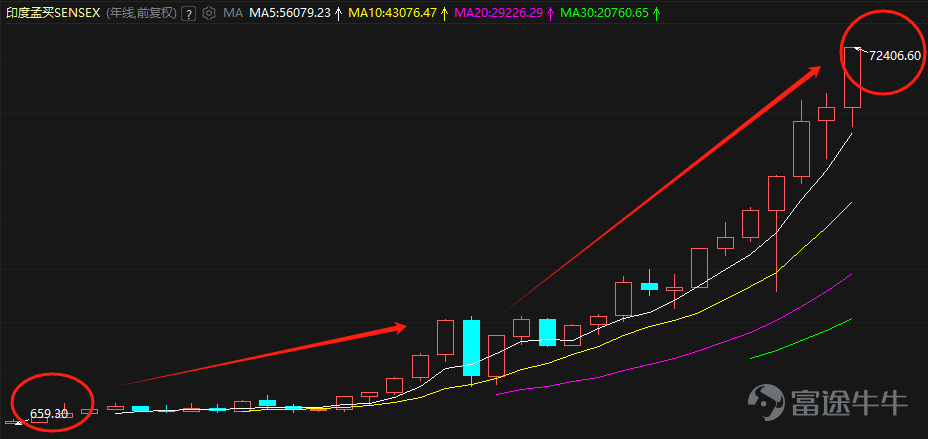
India's Bombay SENSEX Index has increased more than 100 times in the 34 years since 1990, and is properly 100 times as high as a share!1990 is also a deep memory for domestic investors. The Shanghai and Shenzhen Stock Exchange was also almost established one after another around 1990. After so many years, the Shanghai Stock Exchange also increased 30 times, but it is still far from being 100 times that of India.

If compound interest is used as a reference system, to achieve 100 times the return in 34 years, an average annual return of 15% is required, and the Indian stock market actually achieved this. This is a very scary return. Especially in such a long-term dimension, there is a saying in investment: there are many people who triple in a year, but there is very little that doubles in three years.
The long-term growth of India's Mumbai SENSEX Index reflects several success factors for the Indian economy:
Economic liberalization and reform: Since 1991, India has implemented a series of economic reforms, reducing government control over economic activity and attracting foreign direct investment.
Demographic dividend: India has one of the youngest populations in the world, which provides huge human resources for economic growth.
The rise of technology and services: India has achieved great success in the information technology and services industry and has become a global outsourcing center.
corporate governance: India's corporate governance structure is gradually improving, especially for listed companies, and regulators are continuously strengthening regulations to enhance transparency.
Investor protection: The establishment of the Securities and Exchange Commission of India (SEBI) and its subsequent strengthening have strengthened market regulation and investor protection.
Delisting system: India's delisting system aims to maintain the health and fairness of the market and protect investors from companies unfit to go public by setting strict standards.
These factors work together to keep the Indian stock market dynamic for a long time and provide a good return on investment.Economic growth is the fundamental driving force, but Yan Cai believes that the rational design of an investor protection system is the foundation for India's long-term bullish index. Here, we will introduce in depth the design of India's corporate governance supervision, investor protection and delisting system.
India's corporate governance reform has several key time points and related regulations:
1992: The Indian Securities and Exchange Commission (SEBI) was established to set the legal framework for corporate governance and investor protection.
Early 2000s: Amendments to the Companies Act (Companies Act) introduced requirements for independent directors and audit committees of companies.
2009: The Company Law was further revised to introduce more rules on corporate governance, such as provisions on related-party transactions.
2013: India has passed a new corporate law which strengthens the liability of directors and executives of companies and increases the requirements for corporate social responsibility.
2015: SEBI introduced corporate governance principles and recommended practices called “Listing Agreements and Disclosure Requirements (LODR)”.
The purpose of these reforms is to improve the transparency of listed companies, strengthen the responsibility of the board of directors, protect investors' interests, and ultimately enhance the confidence of the entire market.

The design of India's investor protection and delisting system has the following characteristics:
Investor protection:
Regulatory framework: The Securities and Exchange Commission of India (SEBI) is responsible for regulating the market to ensure transparency and fairness.
Disclosure of information: The company must comply with strict financial reporting and disclosure standards.
Investor education: SEBI promotes various investor education programs to improve investors' understanding of financial products.
Dispute resolution: Fast and effective dispute resolution mechanisms, such as securities arbitration and mediation.
Delisting system:
Delisting rules: If a company does not meet the required financial standards or violates regulations, it can be forcibly delisted.
Protective measures: In the delisting process, there are a series of measures to protect minority shareholders, such as fair pricing mechanisms.
Transparent process: The delisting process requires openness and transparency to ensure that all shareholders have a fair understanding of the situation.
These measures have strengthened the structure of the market, increased its attractiveness, protected investors' rights and interests, and ensured the quality and stability of the market.Compared with a glass of alcohol, which is fined 600,000 for domestic fraud, listed companies in India are extremely expensive to commit fraud and face more stringent regulations.
Key features of India's investor protection and corporate fraud penalty mechanisms include:
1. Company Law Reform in 2013: In response to the “Indian Enron” incident (such as the 2009 Satyam scandal), the 2013 Companies Act introduced major reforms to investor protection measures. These reforms include prohibiting insider trading, prohibiting forward-looking trading in securities, introducing class action lawsuits, registered valuers, definitions of fraud, providing exit opportunities for disagreeing shareholders, and increasing penalties for irregularities and non-compliance.
2. Directors' duties and transparency: The Company Act stipulates the duties of directors and requires them to exercise management duties with good faith, due care, skill, and independent judgment. Directors who violate their duties face fines. Furthermore, the law has strengthened disclosure requirements for board reports and increased management transparency.
3. Increase penalties: The Company Act increases the scope of penalties for offending directors and key management personnel, including criminal liability. This is to ensure the overall responsibility of the Board of Directors.
4. Class actions: The Company Law introduced a class-action lawsuit mechanism, granting investors and minority shareholders new rights to deal with the company's misconduct. This provides investors with a means to collectively seek compensation.
5. Fraud and Investigations: Company law defines “fraud” for the first time and gives it a broad scope. Fraud is considered an irreconcilable and identifiable crime, punishable by 6 months to 10 years in prison and a fine. Additionally, auditors must report fraud to the central government within 60 days when they discover it.
These measures are aimed at strengthening supervision of company management, improving transparency, and increasing penalties for illegal acts, thereby protecting investors' interests and maintaining market health.What people are most concerned about, such as financial fraud by listed companies in India, are there any penalties, are the penalties large, and will they be delisted?
Take financial fraud by listed companies as an example. In India, financial fraud by listed companies is strictly punished by law. According to the Companies Act 2013 (CA 2013):
Scope of punishment: Any official or other person involved in financial fraud will face jail time and financial penalties.
Quantification of penalties and fines:A minimum of 6 months to a maximum of 10 years of imprisonment, and a minimum of 3 years for fraud involving the public. The amount of the fine is 100% to 300% of the amount involved in the case.
irreconcilable offenses:Corporate fraud is considered a criminal liability and an irreconcilable offense.
Money Laundering Prevention Act (PMLA, 2002): Corporate fraud is also included as one of the 29 scheduled crimes under the Money Laundering Prevention and Control Act, and those involved will face both criminal and financial penalties under the PMLA and the Companies Act 2013.

These strict penalties are aimed at preventing financial fraud by listed companies and ensuring investor protection and market fairness. Simply put, they are not only fines, but also very serious criminal penalties.
Let's look at a specific case:
The 2009 Satyam scandal was India's biggest corporate fraud case until 2010. The founder and board members of the Indian outsourcing company Satyam Computer Services falsified accounts, inflated stock prices, and stole large amounts of money from the company. Most of these funds are invested in real estate. The scam was discovered when Hyderabad's real estate market crashed in 2008.
Satyam Chairman Byrraju Ramalinga Raju resigned on January 7, 2009, admitting that he manipulated the company's accounts, involving an amount of 70 billion rupees. India's Central Bureau of Investigation (CBI) took over the case and filed three partial charges in 2009. On April 10, 2015, Raju and 10 other members were convicted.
Audit firm PricewaterhouseCoopers (PricewaterhouseCoopers), as Satyam's independent auditor, was fined $6 million by the US Securities and Exchange Commission (SEC) in the Satyam fraud case for not complying with the Code of Conduct and Audit Standards. In 2018, the Securities and Exchange Commission of India (SEBI) banned PricewaterhouseCoopers from auditing any listed company in India for two years and ordered the company and two partners to return more than 13 million rupees of illegal proceeds.
Penalty measures:
1. On January 7, 2009, Satyam Chairman Byrraju Ramalinga Raju resigned, admitting that he had manipulated the 70 billion rupee account many times, causing shock and anger in the global business community.
2. The Central Bureau of Investigation (CBI) of India took over the case in February 2009 and then filed three partial indictments within a year, covering all aspects of misconduct. In the end, all uncovered charges were combined into a single indictment.
3. On April 10, 2015, Byrraju Ramalinga Raju and 10 other members were found guilty.
4. The Indian branch of accounting firm PricewaterhouseCoopers was fined $6 million by the US Securities and Exchange Commission (SEC) for not complying with auditing standards and ethics.
5. In 2018, the Securities and Exchange Commission of India (SEBI) banned Price Waterhouse from auditing listed companies in India for 2 years and ordered the return of more than 13 million rupees of improper profits.
6. Mahindra Group purchased 31% of Satyam's shares through a public auction on April 13, 2009, and then rebranded its services as “Mahindra Satyam”. Later, Tech Mahindra announced a merger with Mahindra Satyam, which was legally completed on June 25, 2013.
The incident had a profound impact on India's investor protection and delisting system, prompting the Indian government and regulators to strengthen regulations on listed companies and reform relevant regulations to prevent similar fraud from happening again.
Take the issue of corporate fraud as an example. Let's take a look at how Indian law defines it, which includes the definition, penalties, causes, and relevant legal provisions for corporate fraud.
Highlights:
1. Corporate fraud is on the rise in India, involving all types of people associated with companies, and requires higher standards of corporate governance and legal provisions to prevent and respond.
2. Corporate fraud, which includes manipulating financial statements, known as “window decoration” to show false financial circumstances to parties, is now considered a criminal liability.
3. Section 447 of the Companies Act 2013 added the roles and responsibilities of independent directors and statutory auditors to prevent and respond to corporate fraud.
4. Corporate fraud involves not only financial gains and losses, but also non-financial damage to victims.
5. Corporate fraud is considered a criminal liability, and those involved face jail time and financial penalties.

6. Corporate fraud is usually carried out by white-collar criminals due to external factors and the nature of personnel. A company is a virtual legal entity composed of shareholders, the public, investors, customers, employees, government, etc., and is therefore vulnerable to fraud. Reasons for corporate fraud include economic access to global resources, attracting and retaining the world's best talent, collaborating with suppliers, and demonstrating ethical behavior.
7. The Company Law clearly defined corporate fraud for the first time in 2013, including a series of acts such as misstatement of important facts, intentional deception, and victim reliance on misstatement and damage. The definition and penalties of corporate fraud are included in section 447 of the Companies Act 2013, and those involved face jail time and financial penalties. Imprisonment and financial penalties for corporate fraud vary depending on the circumstances involving the public and not involving the public. Corporate fraud is considered an irreconcilable crime that seriously affects fraudsters.
8. The Serious Corporate Fraud Investigation Agency (SFIO) was established to investigate corporate fraud in a scientific and systematic manner, including experts from different fields and experiences. External investigation agencies must not interfere with SFIO's investigations and must hand over all documents and records to SFIO.
9. Statutory auditors must report corporate fraud to the Indian Government, and if they participate in fraud, they will bear individual and joint legal responsibility. The company needed to recover the amount of more than 11% of profits paid as a result of accounting fraud, as well as assets that obtained improper benefits through corporate fraud.
10. Corporate fraud is considered a criminal liability and requires jail time and financial penalties. Section 447 of the Companies Act 2013 provides strict provisions to prevent and respond to corporate fraud.
Another example is for insider trading. In India, penalties for violating insider trading regulations include:
fines: For example, SEBI fined IndiaBulls Venture and its former non-executive director, her husband, and company secretary Rs 105 million for violating insider trading regulations.
Market entry prohibited: For example, SEBI prohibited Future Group founder Kishore Biyani, his brother Anil Biyani, and Future Corporate Resources Ltd (FCRL) from entering the securities market within one year, and prohibited them from directly or indirectly trading shares in Future Retail Ltd (FRL) within two years, each with a fine of 100 million rupees.
Company and individual responsibilities: For example, SEBI fined APTech Ltd 100 million rupees for violating insider trading regulations in 2016.
These cases show that India's punishment for insider trading involves both financial fines and other measures such as market bans to ensure the fairness and transparency of the market.
In summary, I think the Indian index can increase more than 100 times. Good investor protection is the foundation. This is also a place where the country needs to continue to learn and strengthen, rather than turning the stock market into a place where the majority shareholders make money.

Good investor protection mechanisms are critical to the long-term health and growth of the stock market. India has significantly improved its investor protection policies and regulations over the past few decades, particularly by adopting strict measures to address issues such as insider trading and corporate fraud. These reforms have increased market confidence and transparency, and provided investors with a safer investment environment. These factors, along with the rapid growth of the Indian economy and other positive macroeconomic factors, may be one of the important reasons why India's stock index has been able to grow more than 100 times.
A healthy, transparent, and well-regulated stock market not only protects investors, but also promotes broader economic growth and stability. For China, raising corporate governance standards, strengthening law enforcement, increasing penalties for fraud and illegal acts, and ensuring fair and transparent markets are the keys to boosting investor confidence and attracting long-term investment. By learning from and drawing on the successful experiences of other countries, such as India, in investor protection, China can further enhance its capital market appeal and global competitiveness.
Money on December 28, 2023
Risk Disclaimer: The above content only represents the author's view. It does not represent any position or investment advice of Futu. Futu makes no representation or warranty.Read more


Comment (1)
to post a comment
8
11